
Inside the Anti-ICE Protests at Delaney Hall
As federal agents increase the use of force at the facility, demonstrators are adopting new tactics.
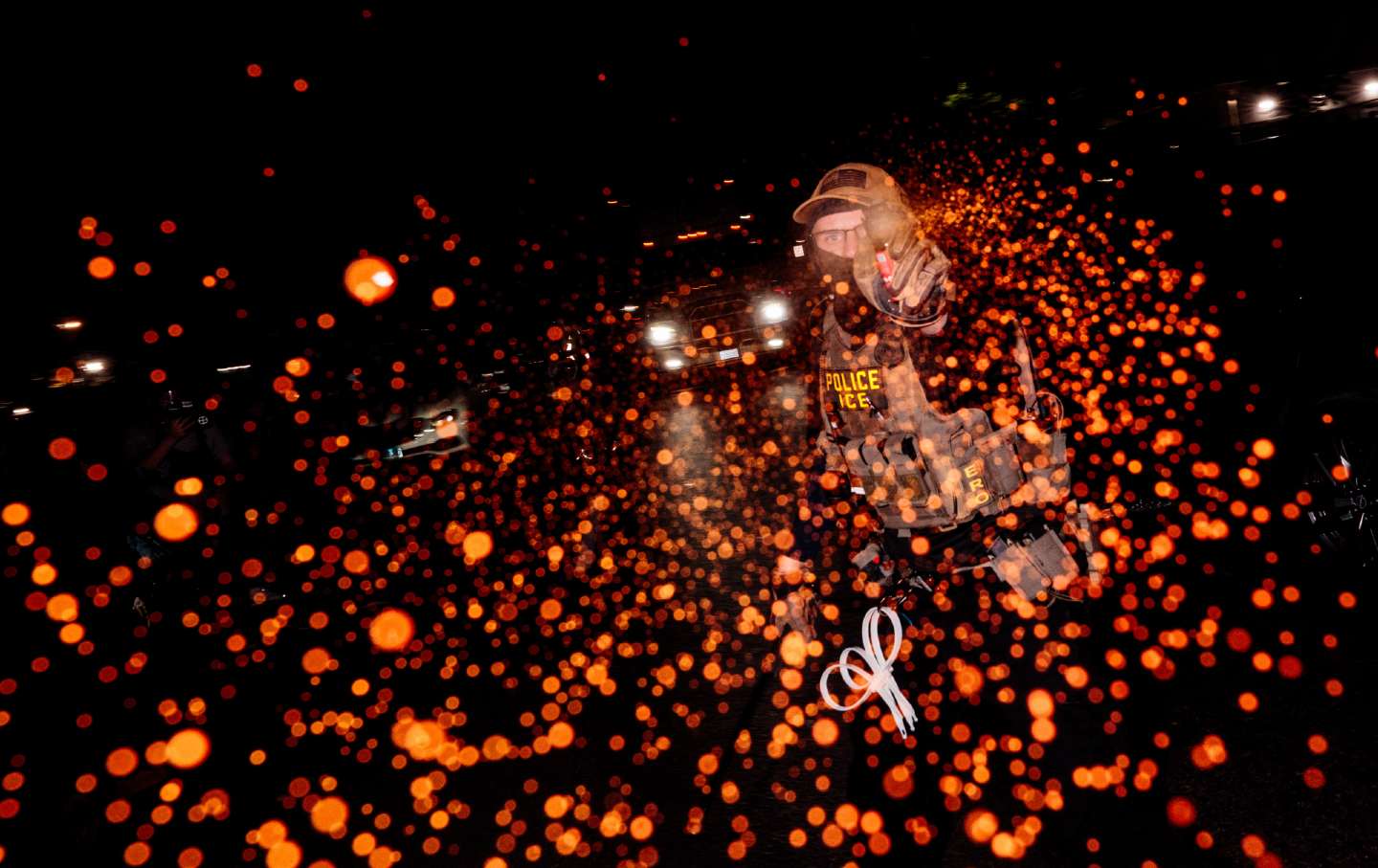
An ICE agent sprays chemical irritants at protesters and media over the Memorial Day weekend.
(Adam Gray / Getty Images)
Since Memorial Day weekend, detainees at Delaney Hall in Newark, New Jersey, have been on a hunger and labor strike to protest conditions at the facility—including substandard medical care, poor food, uncompensated labor, and the detainment of the elderly, minors, and pregnant women. Outside, protesters have gathered every day in solidarity. Some chant and hold signs; others work to block ICE vehicles from entering and exiting the detention center.
Delaney Hall presents logistical challenges for demonstrators that weren’t in play at other ICE detention facilities that sparked mass protests. The Broadview facility in Chicago is in an industrial warehouse area, and the Whipple Building in Minnesota sits on a sprawling campus of federal buildings and parking lots. By contrast, Delaney Hall is on a four-lane thoroughfare. Trucks and buses drive by perilously close to protesters at all hours of the day and night.
As a result, this past week’s protests at Delaney Hall forced protesters to alter their tactics. As I covered the actions at Broadview, I dodged rubber bullets and faced down armed officers; at protests in Portlands, it was pepper balls. As I shadowed immigration raids in other cities, ICE and Border Patrol agents routinely used tear gas. At Delaney Hall, agents were armed with Tasers and the most potent pepper spray available.
I arrived at Delaney Hall on Tuesday, May 26. The protesters had set up barricades at one entrance to the facility, where employees of GEO group—the private contractor running the detention center—would come and go. At the other side, the driveway that the ICE vehicles mostly used, protesters linked arms and stood in the way. In response, the agents would rush into the crowd, brandishing Tasers, batons, and pepper spray.
Sometimes they’d come into the crowd to chase a specific person, but that didn’t mean they ignored everyone else. In one run-in, as I was filming agents chasing a protester and wrestling him to the ground, I got a full dose of pepper spray. Shortly after, agents chased a protester across the street and down to the train tracks that run parallel to the road. They tased him, pepper-sprayed him, and detained him. From that point forward, it seemed like at least one agent was always holding a Taser, ready to go.
When protesters attempted to block the ICE cars, they always cleared space for medical emergency vehicles. This soon became something of a ritual, since emergency vehicles were in steady demand. It was not long until every time one arrived ICE cars were close behind them, zooming through the path that protesters made for the ambulances.
Even with its superior firepower, the ICE contingent at Delaney Hall was clearly understaffed. Eventually, agents parked a row of DHS vehicles parallel to the line they held in in front of the detention facility entrance.
The next night, a set of talkative but violent agents were at the end of the line, where members of the press had gathered. A few protesters had decided to block the road and keep the trucks from their routes, but they were a small minority. Soon, an argument ensued. As the protesters fought one another, the agents looked on and joked among themselves that the fracas wasn’t their problem.
“That wasn’t your stance in Minneapolis,” I said. Outside of the Whipple Building, agents had regularly broken up fights between left-wing activists and right-wing ICE supporters. “What changed?”
Instead of answering, they asked me what Minneapolis had been like (short answer: cold). They went on to explain that they also had been stationed there. I told them I had been covering ICE and the Border Patrol since August, and this was the most violent I had yet seen them be. “What about Minnesota?” they asked.
Pepper balls and tear gas were not a big deal, I told them—but the pepper spray was horrible. And it seemed likely to me that someone was going to get run over by an 18-wheeler.
An officer replied that tear-gassing was bad optics. “It hurts us, too,” another said of the pepper spray. It was true; sometimes they would stand in their line sniffling, with tears in their eyes. But they were the ones spraying it—and electing to not wear safety gear.
Earlier, I had tried my luck asking an agent why they were so understaffed. He only gave me a canned nonanswer. Since these guys were much more talkative, I decided to try again.
“You think we’re short-staffed because you’re seeing shift change,” one agent said—the same nonresponsive answer the other officer gave me earlier in the day.
I pointed out they were stretched so thin they were using a line of parked cars as a fortress. “We do the best we can with what we have,” he said.
I pushed on, asking why deployment orders hadn’t gone out after the crackdown on Memorial Day had made national news.
“More are coming,” he said. “They’ll be here soon.”
Our conversation ended when the protesters finally moved out of the way of traffic. At that point, trucks were waiting to drive by as far as the eye could see in either direction. ICE vehicles were also nested in the traffic line, anticipating another push forward by agents into the crowd of demonstrators.
From a trucker’s perspective, it’s not rational to think that the police would advance on protesters and push them dangerously close to you. But that’s exactly what happened over and over again—along with clouds of pepper spray that temporarily blinded people. And later that night, a protester was jammed into the wheel well of a truck, which slowly rolled over their foot. (Somehow, the protester was fine.)
The ICE agents I talked to hadn’t been lying about reinforcements being on the way. The next morning, more agents were guarding the facility. For hours, we continued in the same tense standoff: protesters and agents standing face to face, everyone waiting for a reason to move, or not to. At night, an EMS vehicle once again led a string of ICE cars into the facility. The now massive line of agents pushed forward with Tasers and batons out, causing even more chaos than before. During the ensuing melee, another dozen or so agents popped out of a van and ran toward the commotion.
Once the cars were in the driveway, the agents backed up to their line, staying side by side. One waved a Taser around, occasionally pulling the trigger with the safety still on, causing a high-pitched whirring. Others twirled their pepper spray around. “Quit your job and kill yourself,” the protesters chanted. “Who are you going to tase next?” one asked. The agent didn’t answer; the Tasers did all the talking for them.
By Friday, a slew of local and state police had been sent under the vague and impractical mission to restore some semblance of order. They created a designated free-speech zone for the protesters, but by the time I arrived, they’d already given up on forcing people into it. Once again, protesters stood in a line and stared at the ICE agents, but now local police were clumped together in the crowd. It was unclear what the police planned to do, though at one point, a New Jersey State Patrol officer asked several members of the media if we had security. When we said no, he told us to “move over to where our media staging area is in between Delaney Hall and Essex County Jail.” (We declined.)
Eventually, state police announced that everyone needed to leave by 10 pm. The protesters largely ignored this directive as well. As the confrontation stretched into the night, it became clear that the state police were not restrained by the optics-minded rules of engagement that my ICE informants had cited. Police fired tear gas into the crowd; lines of riot cops and officers mounted on horses sought to disperse the protesters. The demonstrators, meanwhile, quickly dismantled the free-speech zone’s barriers, shoving them under cars and clearing them from the entry path so that people wouldn’t be trapped or trampled. The police continued to advance, deploying tear gas ahead of their approach.
The ICE agents stood in the entrance to the detention center, gleefully watching the chaos in front of them, and occasionally firing off a pepper ball. Eventually, state police officers moved the entire crowd to one side of the driveway. After deploying some more tear gas and a few flash-bang grenades, they retreated, leaving the protesters and ICE alone once again.
Popular
“swipe left below to view more authors”Swipe →In other cities, the arrival of local police had meant that the feds were no longer in charge of guarding their own facility. The Delaney Hall action marked the first time the police had cleared people out for ICE’s shift change, and then simply left.
New Jersey Attorney General Jennifer Davenport released a statement that night alleging that protesters had thrown tear-gas canisters at police—a plainly ludicrous claim, since no protester would have been able to procure tear gas ahead of the action. Not mentioned in the statement was the obvious fact that the state police’s reaction had been an escalation compared to ICE’s understaffed show of force.
The next night saw a repeat of the show New Jersey state troopers had staged the night before. Riot cops again marched forward, deploying flash-bang grenades and an excessive amount of tear gas. The night was louder, which together with the heavy cloud of tear gas, made the horses act unpredictably. One photojournalist working for the Associated Press was injured in the crowd, and had to be carried off by volunteer medics. In the chaos, she was separated from her bag with $10,000 worth of gear in it. (An Essex County police officer has now been charged with stealing her equipment.) Police shot tear gas indiscriminately, even gassing officers who were working at the nearby jail. Unlike the prior night, they did not retreat.
By Sunday, a 9 pm curfew was in place, and members of the press were evidently not exempt from it. A group of roughly four dozen completely peaceful protesters defied the curfew, which led to a heavy contingent of state police lining up before them. The two groups stood face to face, blocking the entire street, even as cars tried to drive by.
The protesters, along with a couple dozen members of the press and three passersby were pushed into a tight kettle. The police started to apprehend people from the group, starting with one of the passersby. (The Department of Homeland Security later lifted a video of his arrest from video journalist Ford Fischer on X, captioning it “don’t be this guy”). With each arrest, the circle grew smaller, cramming journalists and protesters closer together, trying to avoid the many horse droppings now in the street. Finally, one officer announced that members of the press would be allowed to leave if we presented credentials. This proved not to be the case; several members of the media were denied exit, including a conservative commentator who ended up with a black eye. Even though it’s not clear whether members of the kettled crowd were actually in the curfew zone, protesters and journalists were held in jail for 24 hours, and are now facing charges.
Trump administration immigration czar Tom Homan has announced that he plans to send an unprecedented number of ICE agents into neighboring New York City—a mobilization that would likely include a fresh surge of agents in New Jersey. In March, ICE agents at the Houston airport told me they anticipated a deployment to New York sometime this year. While the New Jersey police presence seems to have receded at Delaney Hall, the core ICE detachment here could be getting more reinforcements before long.
More from The Nation
The Accidental Activists of Data Center Alley The Accidental Activists of Data Center Alley
These would-be rebels in Northern Virginia joined the fight against data centers mostly to stop the encroachment on their homes and exclusive private communities.
An Effective Movement for Palestine Needs Allies Like Zohran Mamdani An Effective Movement for Palestine Needs Allies Like Zohran Mamdani
In order to build a broad-based coalition, we need to work together—not practice purity politics.
The First Amendment Applies to Concert Stages Too The First Amendment Applies to Concert Stages Too
Protests like that of Macklemore on Palestine should never be silenced by billionaire owners.
France’s Students Won’t Back Down France’s Students Won’t Back Down
Without full-time teachers, temperature-regulated classrooms, or school nurses, French students are turning their grievances into a national movement.
Inside Cornell’s Week of Protest Inside Cornell’s Week of Protest
“We won’t be silenced anymore. Our university needs to start protecting us, like they should’ve with Jane Doe and all other survivors on campus.”
Netanyahu Came to New York. New Yorkers Were Ready for Him. Netanyahu Came to New York. New Yorkers Were Ready for Him.
Scenes from the defiant protest against the genocidal leader’s UN speech.

