
Leqaa Kordia’s Long Road Home
The Palestinian activist was locked up in an ICE prison for a year. Now she is rebuilding her life, piece by piece and meal by meal.
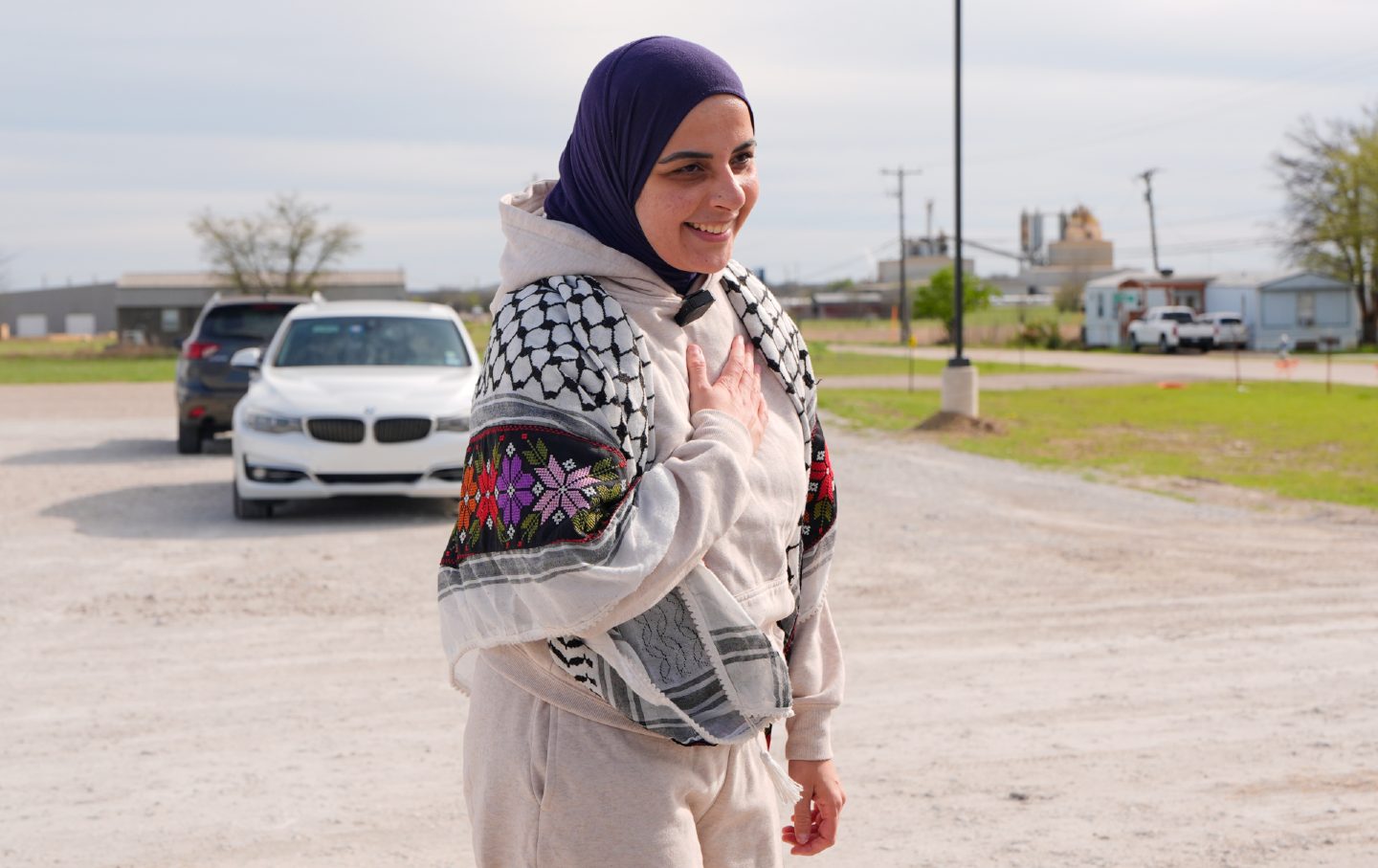
Leqaa Kordia greets her supporters after being released from the Prairieland Detention Center in Alvarado, Texas, on Monday, March 16, 2026.
(Tony Gutierrez / AP)Leqaa Kordia likes to feed people.
I learned this when I met her at Nouri Cafe on Main Street (also called Palestine Way) in Paterson, New Jersey. She walked confidently into the restaurant, greeting the staff warmly with quick hugs and light punches to the arm. As we sat at a table by a big window, she asked if I had eaten yet.
During our conversation, an employee brought over a big plate of baked pasta, bubbling with cheese on top—their staff family meal. She immediately asked for a second plate and poured (far more than half) of the heaping portion onto it for me.
The food kept coming: falafel and cheese borek and baba ganoush. As Kordia poured me a bowl of molokhia, a savory jute leaf and chicken stew, she told me how people in her native Palestine eat it with crushed green chilis and lemon juice, while Syrians tend to have it with vinegar, onions, and fried pita. She made sure I tried it both ways—I preferred the added kick from the lemony chilis. I left Nouri loaded with our leftovers and clear instructions: Freeze the molokhia—it freezes well; have the dips and falafel for dinner.
Leqaa Kordia likes to feed people. But she hasn’t been eating much herself lately.
In March 2025, Kordia was arrested during a routine immigration appointment in New Jersey and shipped 1,500 miles away to Prairieland Detention Center outside Dallas. She was one of several people detained by ICE under the Trump administration after protesting Israel’s genocide in Gaza. Kordia spent a full year in ICE jail—“I don’t like the word detention. It’s jail,” she says—despite facing no criminal charges. Her case shows how the administration has used the machinery of immigration enforcement to punish pro-Palestinian speech, and her experience inside reveals just how inhumane that punishment is. Now, Kordia lives in limbo: free from jail but unsure if she’ll be allowed to stay.
Kordia first came to the United States from the West Bank 10 years ago to reunite with her mother, an American citizen living in Paterson, home to one of the largest Palestinian diaspora communities in the country. This trip was Kordia’s first time leaving Palestine, her first time on a plane. She was leaving everything she knew behind: her friends and family, the place she called home, the Ka’ak Al Quds (Jerusalem bagel) from her favorite bakery, the taste of Palestinian water she still craves. But she was joining her mother.
“It’s the mother’s hug,” she says. “You can have all the problems in the world, but as soon as you get between your mother’s arms, it all goes away. That was the thing I was most longing for.” She remembers her first bite of mansaf—tender lamb slow-cooked in fermented yogurt and served over rice, cooked by her mom and her mom’s best friend—after her long, tiring travels.
Kordia built a life in Paterson. She learned English, made friends, and savored the stuffing and yams of her first Thanksgiving. “I like going to the salon. I love road trips. I love going to some museums, not all museums,” she says. She prefers going to the movies alone. “I don’t like anybody to talk to me while I’m watching…I was a very simple girl. I’m still a very simple girl. Or woman, I should say.”
Then the genocide began. The unfolding horror in her homeland, the intensification of the ongoing Nakba, became a constant presence in Kordia’s life. She has had over 200 extended family members killed by Israeli strikes. “It is impossible to not think about it,” she says. “You have a house, you have a roof on top of your head, you have food, you’re working, you’re studying, you’re traveling, while your family, your own people are starving, being ethnically cleansed, dehumanized and killed. They’re living in tents and walking miles to get a small gallon of water.”
Kordia found that she couldn’t eat much. When she tried, she would remember her family members who were being forced to starve by the Israeli government. “The feeling of guilt, the feeling of being helpless, are really two of the worst feelings ever.” She would go to protests, including one at Columbia University, where she was briefly arrested on charges of failure to disperse. All charges were later dropped. “I’m not an organizer. I’m not an activist. I’m simply a human being. Forget that I’m Palestinian. I’m a human being who protested against an ongoing genocide,” she says.
Kordia had been on a student visa while she studied English in Paterson, and petitioned for permanent residency through her mother. In 2021, the petition was approved. Based on incorrect legal advice at the time, she understood this to mean that she had legal status while she awaited her green card, so she let her student visa lapse.
On a cool morning, March 13, 2025, Kordia had an immigration appointment in Newark. She had been told there was some sort of issue with her application, “which was weird to me, because if there is an issue with the application they send you a mail or something.” But she wasn’t worried. “I hadn’t done anything wrong… I was like, ‘OK, everything is changing.’” She wore sneakers and sweatpants, ready for a long day of bureaucratic meetings.
Kordia drove to the immigration building with her stepdad and sister, and met her lawyer there. As she entered, her lawyer was stopped at the door and Kordia was arrested. She was led through long hallways with doors on either side, up and down staircases, “like a maze.” They took her possessions, “they stole my shoelaces, by the way. I’m still mad at this.” Then she was left in an “extremely cold” cell with just a small stool in it. She sat there for hours. This was during Ramadan, so Kordia was fasting. “I was hungry, thirsty, terrified, worried, confused—all these feelings at the same moment,” she says.
She was given papers to sign with no explanation. They asked if she wanted an immigration judge or not. “I tried to read, to understand, but all this immigration law is very complicated,” she says. She figured, “OK, I’ll take an immigration judge. Thankfully. Apparently, if you signed that you don’t want an immigration judge, that means you’re signing your deportation.”
The ICE agents seemed “very, very confused” about her case. They asked her why she was there. “I don’t know, you got me here… isn’t this the right thing to do?” Her family and lawyer were told she would be going to an ICE facility in upstate New York. Instead, she was taken in an unmarked car to Newark Airport. She was escorted onto a United Airlines flight to Dallas. When the New Jersey ICE agents passed her off to the Texas ones, she remembers them saying, “This is her file. Good luck understanding it.” She was then driven to Prairieland Detention Center, one of the most notorious ICE prisons in America.
Kordia’s arrest came amid the Trump administration’s broader targeting of students and campus protesters who had spoken out against Israel’s war in Gaza. On March 8, 2025, Columbia graduate student and green-card-holder Mahmoud Khalil was arrested in the lobby of his apartment building. He spent 104 days at the LaSalle Detention Center in Louisiana. On March 25, Rümeysa Öztürk, a Tufts doctoral student, was grabbed off a street in Somerville, Massachusetts, by plainclothes ICE agents while on her way to break fast; she had cowritten an op-ed in her student paper calling for divestment. She spent six weeks in ICE jails. On April 14, Mohsen Mahdawi was arrested when he appeared for a citizenship interview in Vermont. He was held for 16 days. Kordia would be jailed for 368.
“I thought I was educated about the ICE jails,” Kordia tells me. She had read testimonies and investigations about the facilities. “Nothing comes close to what the place actually is, how horrible the place actually is.”
Kordia arrived at Prairieland around midnight, and waited in intake for about five hours. When she finally got to the dorm, she was shocked by how crowded it was. Prairieland was at nearly double its capacity for much of her stay. There was no bunk for her, or even a “boat,” a plastic tub used as a bed in overcrowded jails, so she took her “paper-thin” mattress and slept on the floor that first night. She would then sleep on one of those plastic boats for her first three months.
It took several days before Kordia was put on the proper Ramadan schedule for her meals. When she wasn’t fasting, she says, the food was barely edible—rotten, disgusting, and lacking nutrition. She remembers opening the tray of her first breakfast and seeing slimy grey mush staring back at her. “I swear I almost vomited. It looked horrible. It was horrible.” This flavorless oatmeal was topped with a soggy slice of bread. On the side was about a tablespoon of powdered eggs. Lunches and dinners consisted of “really disgusting bad soy meat” patties. There might be canned green beans and carrots. They often had beans, “lots and lots of beans. Like half of the tray will be just black beans or red beans.” Sometimes they had a piece of hotdog meat with shredded cabbage. Once a week they were given a small piece of real chicken. Almost every meal included a large piece of “cake,” a thick, dry bread Kordia believes helped the jails meet their caloric requirements cheaply. Water could be discolored or have “things swimming in it.” If women had the funds to buy water bottles from the commissary, they were limited to five bottles a week.
Kordia couldn’t eat much. Now many others, still inside ICE facilities, are choosing hunger. This spring, detainees at Prairieland and at least five other facilities across the country have launched hunger strikes to protest the conditions Kordia describes. At Delaney Hall in Newark—just miles from where Kordia was first arrested—nearly 300 detainees signed letters describing decaying food containing worms among other “torturous” and “inhumane” conditions. Their accounts match widespread and documented complaints, including from the Department of Homeland Security’s own inspectors, who have found moldy bread, spoiled meat, and food handling “so substandard” that kitchen managers were replaced mid-inspection. These for-profit ICE jails reportedly spend less than a dollar per meal. While the profits of LaSalle Corrections, which operates Prairieland, are private and difficult to track, GEO Group, which operates Delaney Hall reported a record $254 million in profit in 2025, up 700 percent from the year prior. As these companies rake in record profits, the conditions they create have led to severe health issues and more than 50 deaths in ICE detention since Trump took office.
Kordia saw, and later learned, how the stress of detention and lack of nutritious meals left many around her sick. “A lot of the pregnant ladies used to have this unimaginable pain in their stomach…their limbs would go numb,” Kordia says. The “special nutrition” the pregnant prisoners were given was shredded lettuce. When Kordia received apples during Ramadan, she gave them to a different woman each day—she likes to feed. Kordia heard the story of a pregnant prisoner who miscarried in the bathroom and was promptly deported the next day. “If a baby was born with any problem, ICE is the one responsible for this. The government is the one responsible for this.”
Kordia faced health issues of her own. One night she developed a terrible fever. “I literally thought that I was gonna die that night,” she says. Despite her complaints, she was not treated, not even given ibuprofen. Instead, it was her fellow imprisoned women who cared for her, using their own commissary funds to buy her hot soup or make cold water pads for her forehead. After a few days with this fever, Kordia had the first seizure of her life. She was sitting in the dorm reading. The next thing she remembers is waking up on the floor of the bathroom with a nurse telling her not to move. It was terrifying. She was taken to the hospital and spent three days with her hands and legs chained to the bed. “I said, ‘Please, it’s hurting me. It’s heavy,’” Kordia says. It was a thick chain attached to a handcuff holding her down. “I told [the ICE guard], ‘Please, can you please just remove the chain from my hand, if you want to keep my leg, fine, but my hand?’ She said, ‘No.’ I said, ‘Why?’ She said, ‘Because I said so.’”
Kordia had a second seizure in April, after her release. She has now been officially diagnosed with epilepsy. After rarely needing the doctor in her first three decades, she now has to go regularly for scans and tests. She loved road trips. She can no longer drive, swim, or hike alone.
When we spoke in late May, Kordia was hoping to make it seven months without another incident, at which point her doctors told her she might be able to reduce her medication. On Saturday June 13, she had another seizure, her third. The clock resets for Kordia now, who wrote in a social-media statement: “The harm ICE inflicted on me didn’t end when I walked out of detention. It’s continued to have a lasting impact on my health and my life.”
Despite all she faces, Kordia is wary of sounding like she’s complaining. “Thinking of the thousands of Palestinian prisoners who are still tortured, abused, raped, starved, humiliated every single day, it makes me feel shy, ashamed to complain.”
Leqaa Kordia spent this horrific year in ICE jail without being charged with a crime. The DHS characterized the Columbia protests she attended as “pro-Hamas” and claimed that the money she was sending to family overseas was supporting terrorism. They never produced any evidence to support these claims and wholly abandoned them in court, according to her legal team. On two different occasions, an immigration judge ordered her released on bail. Both times, the government invoked the rare automatic stay to keep her detained.
Four months into Kordia’s imprisonment, on the Fourth of July, fireworks burst outside the fences of Prairieland. Demonstrators had gathered outside the detention center, hoping those inside would hear them. Nine of those protesters have since been convicted on terrorism charges—for acts ranging from moving a box of zines to shooting a police officer—and sentenced to terms from 30 years to 100. Kordia was imprisoned for speaking out against a genocide. Those who protested the system that detained her now face their own imprisonment—sweeping, cyclical suppression of dissent.
On March 16, after the third time an immigration judge ordered her release, Kordia heard a guard tell her to pack her things. “They called my name, ‘Kordia. Pack your stuff.’ This is a very scary word. Pack your stuff. It means either you’re going to be deported or you’re going to be transferred. Very, very rarely [does it mean] you’re going to be released.” Two ICE agents guided her back to intake and gave her a bag with her property. She asked where her shoelaces were. They didn’t have them.
Kordia was released. She saw the wide Texas sky. In the jails, they had limited outdoor space, behind big fences with barbed wire. “I always used to say that I see the sky cut up [in jail]. It’s a cut up sky; it’s a not full sky.” Now she saw the full sky. Looking up at it, she took her first steps out of Prairieland. Then she tripped and twisted her ankle—she wasn’t looking down at the stairs.
Still, hobbling, Kordia was thrilled to be out. She broke her first iftar with members of the Dallas Muslim community at a Yemeni restaurant, eating lamb mandi, shank falling off the bone. “It was weird to eat a piece of lamb. I was looking at the lamb, it was real lamb, I couldn’t believe it was real meat… and I drank mint tea. I almost cried.”
She is always thinking of the women still inside, who became a support system. The women who took care of her, whom she made sure to feed what she could. “We would laugh together, we would cry together. When someone had court, we would pray for each other,” she says. In these ICE jails, Kordia didn’t see threats to the US. She saw “mothers, daughters, grandmothers, doctors, students, housekeepers, nurses, teachers, farmers, people who work in supermarkets, at restaurants. All they did was dream. Dream of a better future for them and their family. This is the American dream, right?”
A few days later, Kordia was back in Paterson in time for Eid celebrations with her community. “The first time I hugged my mother, it was really—there’s no words to describe this.”
I attended a press conference at City Hall held upon Kordia’s return to Paterson. The walls were hung with banners of Martin Luther King and Malcolm X; the chambers buzzed with the energy of a homecoming. Family friends greeted one another with salam alaikum and Eid Mubarak. There was a joyousness to the event, a smiling resilience that shone through the horrific reason for this reunion. The mayor spoke, as did advocates and Kordia’s legal team. “Her obscurity was not accidental,” they said. Mahmoud Khalil, bound to Kordia through a suffering they uniquely share, took the podium: “I never felt I was fully free knowing you were still in there.” Then Kordia rose to speak to a standing ovation. Tears were wiped away, but the joy held. She stood at the podium in a brown pantsuit. She read from her phone. She made nervous jokes. She was a 33-year-old woman looking out at her community, not the symbol she has been forced to become.
Since getting out, Kordia has been building back her appetite. During these celebrations, restaurants around the neighborhood would invite her for meals. She ate kabobs and lamb over rice. She had lots of zaatar pies: “Anywhere I went, I ordered zaatar pie.” I ask Kordia about the joy with which she holds herself, the verve I witnessed among her community. “Well, joy is a form of resistance,” she says. “Palestinians, we find happiness in everything; we make jokes of everything. I remember my father used to make jokes every time the Israeli soldiers would raid our house. They would be inside our house, and my father [would be] telling jokes. So that’s in our blood. We find the happiness.”
Popular
“swipe left below to view more authors”Swipe →Still, Kordia is entering a new phase of her life filled with lots of uncertainty. She can’t work or travel. The US government’s deportation case against her remains ongoing. She fears deportation could amount to a death sentence. Not only because of the ongoing genocide but also because Israel has expanded the death penalty for Palestinians convicted of offenses it classifies as terrorism. According to Israeli human rights group B’Tselem, “these military courts have an approximately 96% conviction rate, based largely on ‘confessions’ extracted under duress and torture during interrogations.”
“I wasn’t released to my regular life. I was released to a totally new life,” she says. Now her days are spent on media interviews, legal meetings, and doctor visits. She considers herself “just a simple woman” who didn’t choose any of this. “But I’m thankful. Thankful that I have the platform to advocate for my rights and my freedom and the freedom of my people. To tell my story and the ICE prisoners’ stories. I’m thankful. But it is not easy.”
Leqaa Kordia likes to feed people. She once dreamt of opening a restaurant, “a unique restaurant where, when you enter, it feels like you’re entering an old Palestinian home. It’s not just providing food but providing books, culture, all of that,” she says. “So that was one of my dreams, but, yeah…”
I ask Kordia if she still has this dream, if she still can dream. “I’m still dreaming. No one can stop me from dreaming,” she says. “But I can’t make decisions; I can’t take steps. Because I don’t know if I’m going to be here or I’m going to be deported. And if I’m deported, I don’t know if I’m going to be alive or killed. You can’t make decisions with certainty during this time with so much uncertainty,” she adds. “But one day, one day.”
More from The Nation
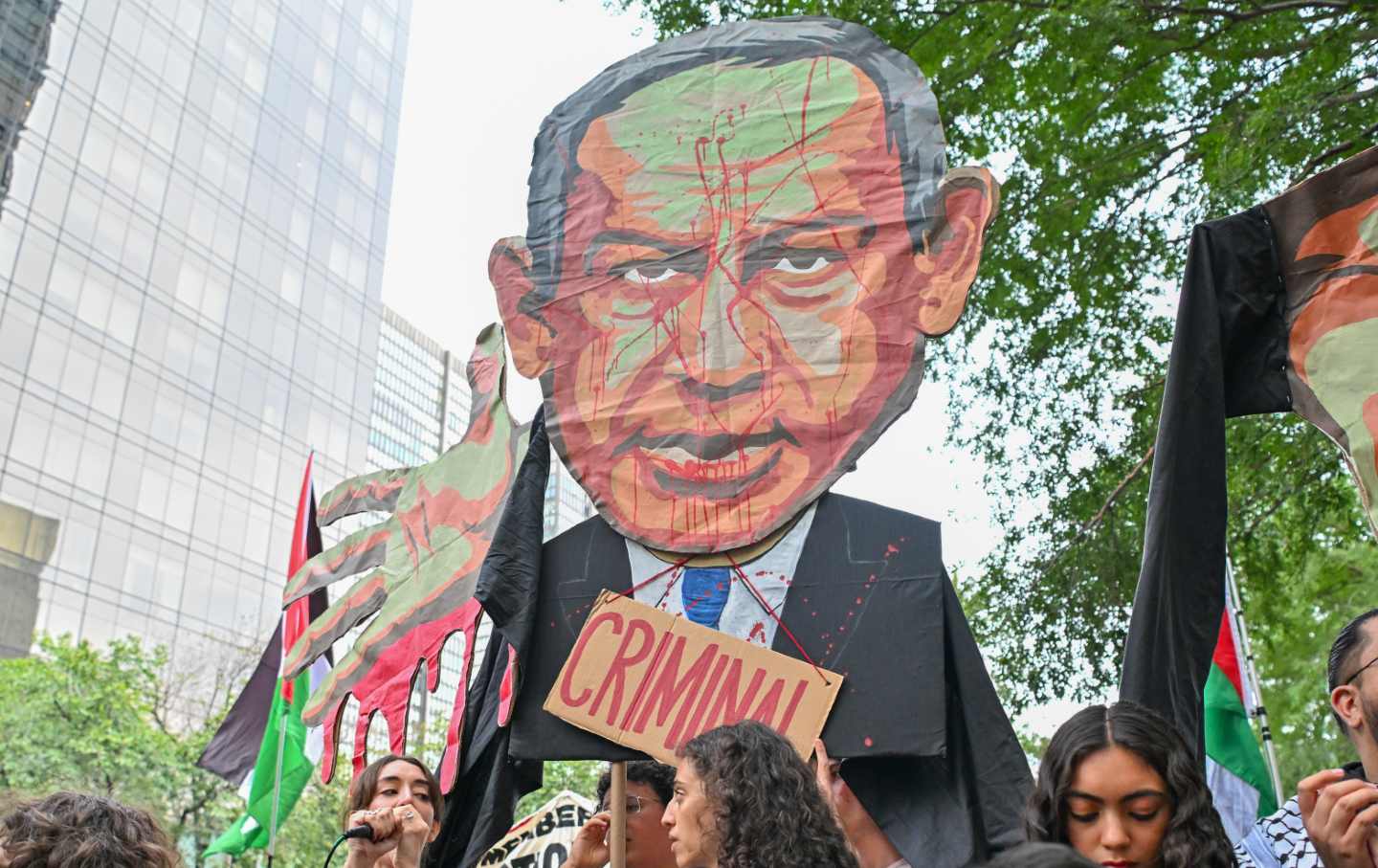
Netanyahu Came to New York. New Yorkers Were Ready for Him. Netanyahu Came to New York. New Yorkers Were Ready for Him.
Scenes from the defiant protest against the genocidal leader’s UN speech.
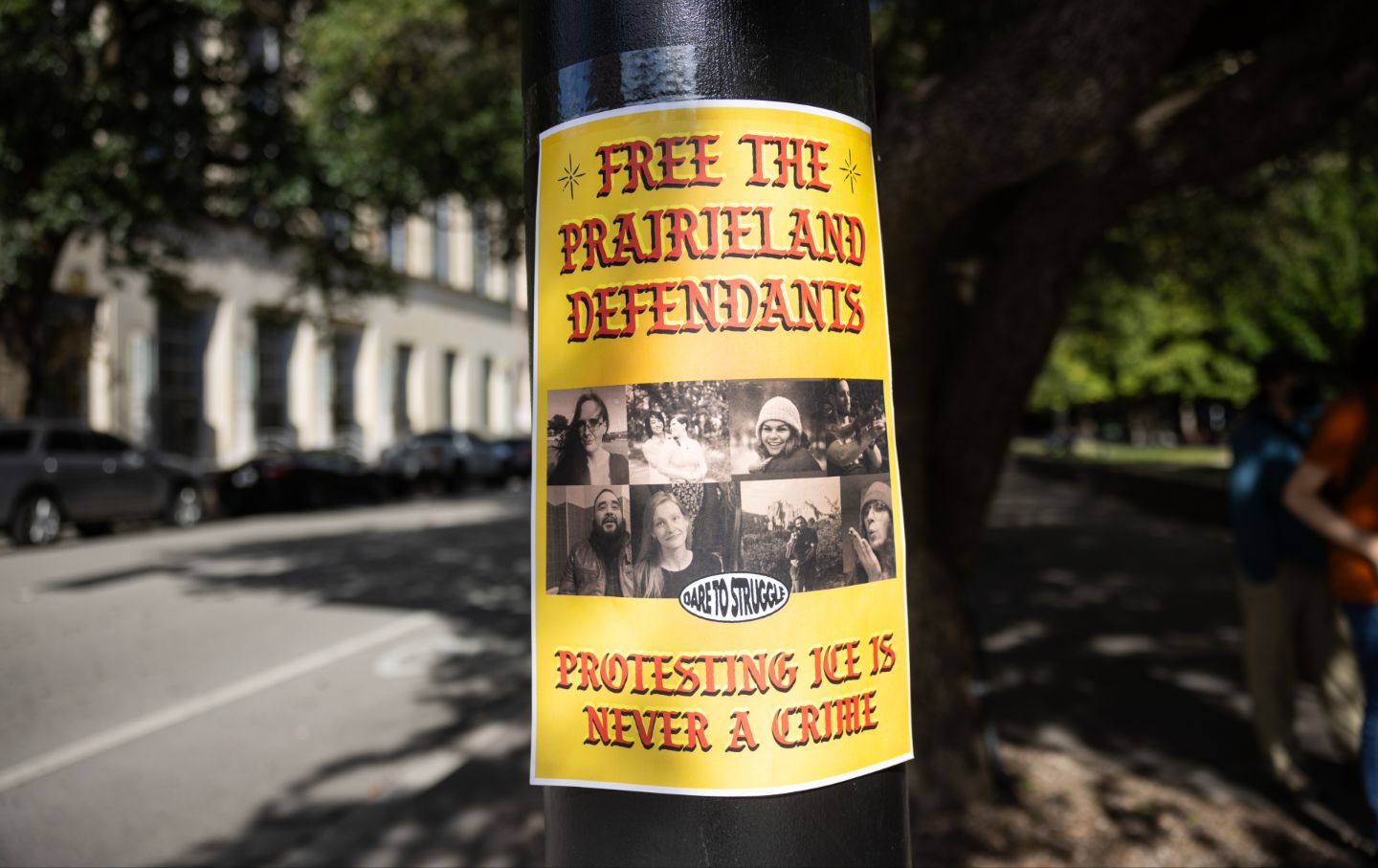
A Message From Prairieland Prisoner Autumn Hill: “Don’t Be Afraid” A Message From Prairieland Prisoner Autumn Hill: “Don’t Be Afraid”
I talked to the political prisoner about the politics of love, her case, surviving as a trans woman in a men’s prison, and how she makes it through the day.
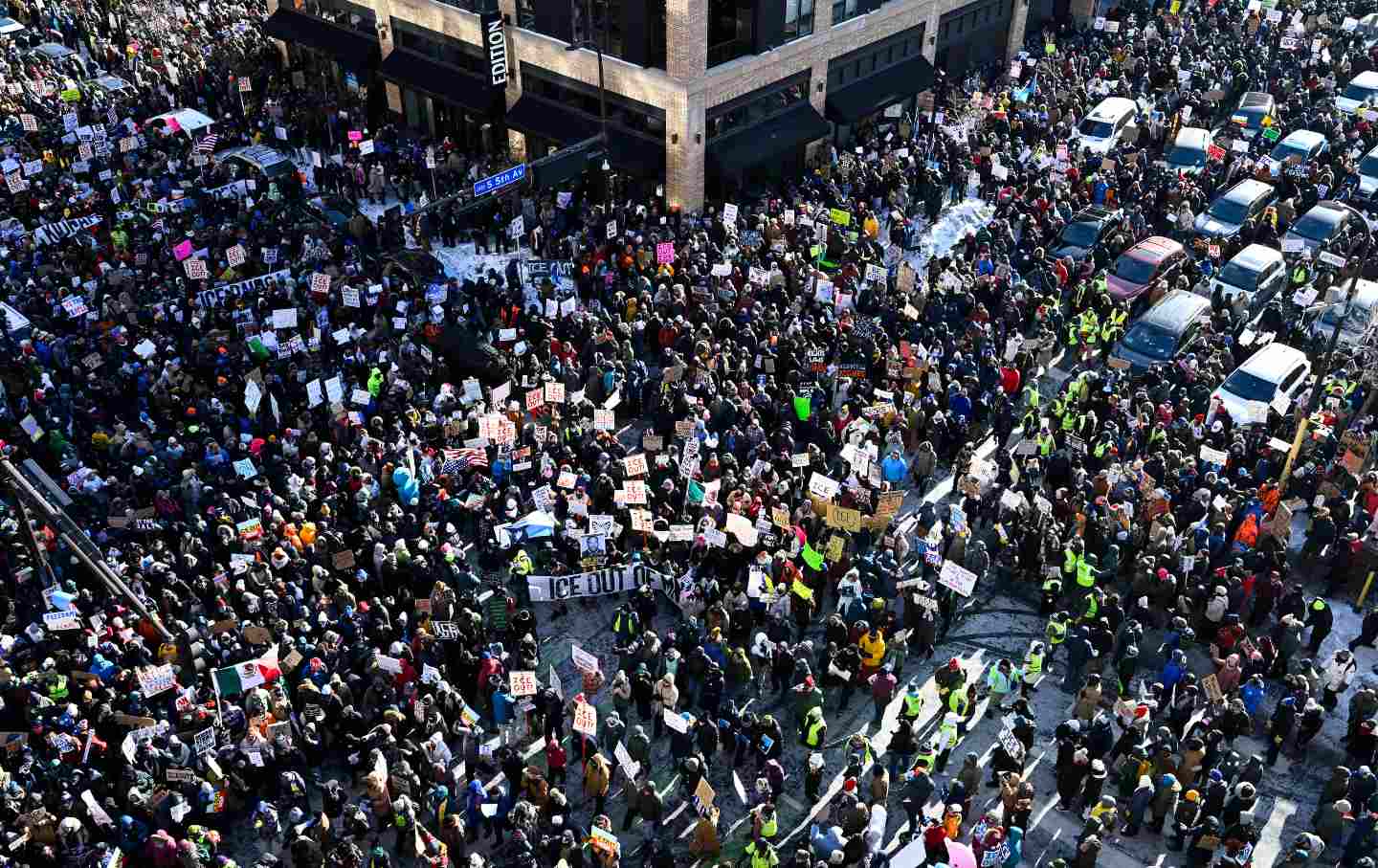
The Impossible Will Take a Little While: The Power of Persistence The Impossible Will Take a Little While: The Power of Persistence
In troubled times, history offers a lesson: Seemingly impossible change can begin with ordinary people who refuse to give up.
Gloria Steinem’s Many-Splendored Feminist Life Gloria Steinem’s Many-Splendored Feminist Life
The feminist icon lived the struggle for gender equality and always found time to lend support and solidarity to other women leaders, even in her final days.

No, Woke 1 Was Not Crazy No, Woke 1 Was Not Crazy
AOC and others are laughing off 2020 as a wild, isolated moment. None of that is true.
How Occupy Wall Street Still Explains Politics Today How Occupy Wall Street Still Explains Politics Today
It sowed the seeds for a new era of social movements—but its politics of powerlessness should act as a cautionary tale.

