Why Abolition Is Essential to Reproductive Justice
A landmark gathering brought together activists on the inside and outside of a women’s prison fighting for reproductive justice for everyone.
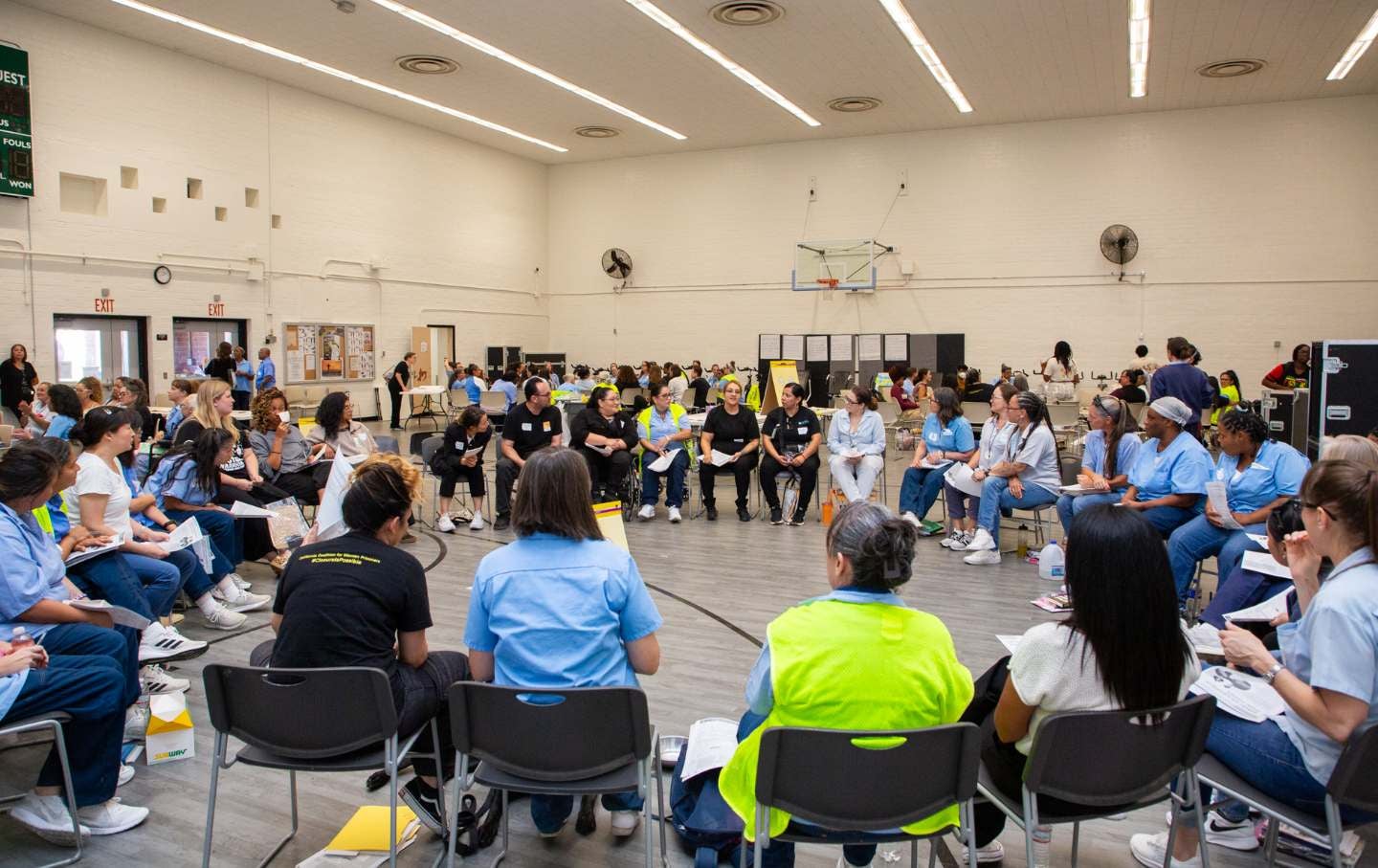
On the first day of the reproductive justice-focused convening RJ Across Walls, participants gathered inside the California Institution for Women.
(Courtney Hanson)In early October, I had the opportunity to attend the first-ever convening on reproductive justice and abolition held, in part, inside a women’s prison. The event, called RJ Across Walls, gathered participants at the California Institution for Women in Corona on the first day—enabling 100 people who are currently serving sentences at CIW to attend—and outside at Riverside City College on the second day. It was a remarkable experience to facilitate a conversation about abortion with my coauthor Renee Bracey Sherman on the first day. But what I took away from the convening went well beyond gaining a deeper understanding of the reproductive injustices inside the carceral system; the event underscored why abolition is essential to our fight for bodily autonomy.
The California Coalition for Women Prisoners, in close partnership with a subcommittee composed of people “inside” at CIW, organized the two-day gathering. The coalition formed 31 years ago in the wake of a class-action lawsuit, Shumate v. Wilson, which documented the medical injustices inside CIW and the Central California Women’s Facility. As the number of women in California’s prisons surged in the 1990s, organizers inside and outside of prisons understood pressure would need to be applied across prison walls in order to improve the conditions. Shumate was the catalyst for organizers to form CCWP, and in the years since that case was decided in the plaintiffs’ favor, its advocates have continued to fight for justice for those being harmed behind bars while seeking to end the systems that make this abuse and medical neglect possible.
What I remember most about stepping out of our rental car and onto the grounds of the California Institution for Women was the smell. My nose was completely blocked from a cold, but I felt the foul odor, which Renee confirmed, without being able to inhale it. CIW is located almost 50 miles east of Los Angeles on former farmland. Arid fields surround the facility, backdropped by scenic mountain views. Soon after our arrival, we joined about 50 other attendees to have a police dog check all of the food and meeting supplies we were bringing into the prison. Then CCWP organizers gathered our group, before we entered the front security building in small groups. No electronic devices were allowed, though CIW did permit Courtney Hanson to bring in her camera and document the day (the photos she took were reviewed by the facility before her departure).
The inside portion of the convening was held in a huge hall that the inside sub committee had turned into a meeting room, with armed officers stationed outside the building. It was easy to forget they were there as you entered the hall, which was divided into four sections, each with foldout chairs forming a circle around a white board listing the upcoming workshop.
CCWP organizers and the inside folks they have worked with over the past three decades have long understood that abolition is essential in order for people trapped in the prison industrial complex to experience or exercise reproductive freedom, but this convening allowed them to bring these conversations to the forefront. “Welcome to the solution,” CCWP organizer and MC for the day Elizabeth “Leesa” Normura said as she addressed the 100 inside attendees who sat among the 50 outside attendees, referring to the convening’s mandate:
- To imagine new visions for care and community beyond California’s carceral institutions.
- To collectively strategize how to best support incarcerated people facing reproductive justice issues in California prisons, and mobilize efforts to dismantle carceral institutions.
- To share collective wisdom, expertise, and ideas across prison walls, with an aim of developing reproductive policy and practice interventions grounded in reproductive justice and abolition.
The day consisted of three blocks of workshops, 12 in total, covering a range of topics, from parenting while incarcerated to pregnancy and postpartum separation, to sexual violence and forced sterilization. One workshop on toxic prisons and environmental racism would directly address the very apparent air quality concerns surrounding the prison, emanating from the former dairies, as well as issues of extreme temperatures and unequal access to bottled water. And Renee and I guided a discussion on abortion stigma and how it operates in tandem with the carceral system to criminalize people for their pregnancy outcomes and control reproductive decisions.
Women are the fastest-growing prison population, and thanks to the Supreme Court’s ruling in Dobbs v. Jackson Women’s Health Organization, the number of people facing pregnancy-related prosecutions is only growing. But the prison system was not designed to meet their medical needs, nor set up to ensure women—the majority of whom have survived sexual abuse—would be safe in the custody of prison staff. The same can be said for incarcerated trans people.
Paige Linville, one of the subcommittee organizers, explained in her remarks that upon setting foot in prison, “we immediately learn that our bodies no longer really belong to us. From the first strip search when every inch of our body is examined by a stranger, we are constantly reminded that other people are in complete control of us.”
And it’s not just the loss of bodily autonomy. The reproductive justice framework also demands the right to have children, or not have children, and the right to parent the children you have in safe and sustainable communities. But prisons, by design, make exercising those rights impossible, as Kwaneta Harris, a mother and former nurse who is incarcerated at a Texas state prison, explained in her pre-recorded keynote address. I met several women who had spent the majority of their reproductive years behind bars, and did not have children but not by choice. Reproductive justice and abolition are intertwined because, “you cannot dismantle reproductive oppression while leaving cages standing, because the cages ARE reproductive oppression, wearing a badge,” said Harris. “You can’t have bodily autonomy on the outside while there are women in here who can’t choose when they use the bathroom, see daylight, eat, and whether they get to hold their newborn for more than a few minutes before the shackles come back on.”
“Think about it this way,” Harris added. “If your movement fights for the right to parent, but doesn’t fight the system that snatches parents away and cages them for surviving abuse, poverty, or a broken safety net—that ain’t full justice. That’s justice with an asterisk. And if your movement fights to close prisons but doesn’t center the specific ways that gender, race, pregnancy, and violence against women funnel us into those prisons in the first place—that ain’t full abolition either. That’s abolition with a blind spot.”
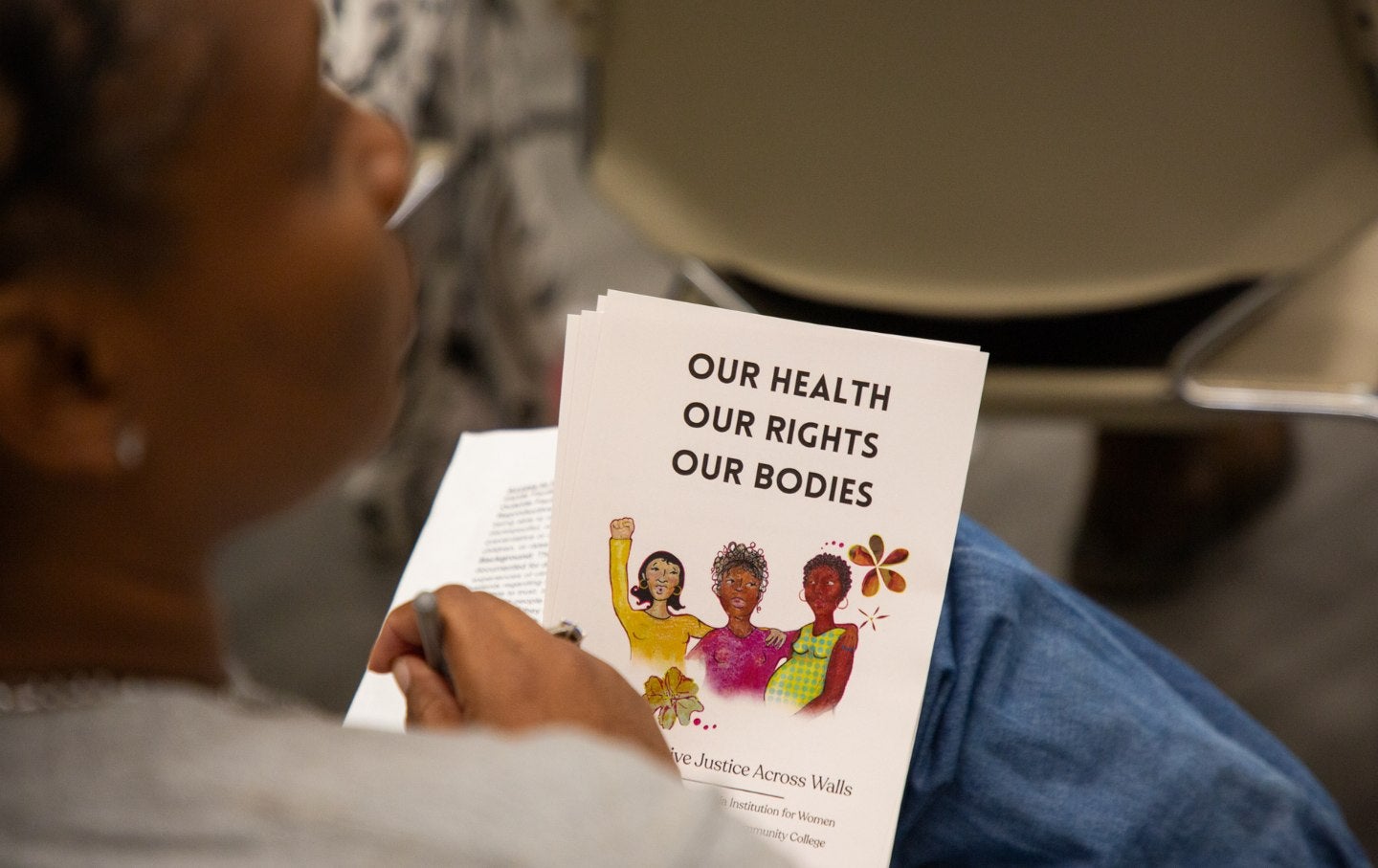
The organizers of the convening spent six months thinking deeply about how to shape this convening around a vision for full justice, without asterisks or blind spots. In the spring, CCWP had published a booklet—in collaboration with the advocacy nonprofit Unapologetically HERS, researchers at the University of California San Francisco, and incarcerated researchers at the Central California Women’s Facility—titled Know Your Reproductive Rights in Prison. This convening marked the next stage of CCWP’s RJ work, creating “an opportunity to harness wisdom inside, to really be thinking critically about not only how do we protect folks who are there now, but how do we work with them to envision a world without prisons,” said sociologist Jennifer James, a CCWP organizer who runs the PhD Sociology Program at UCSF and contributed to the booklet. “So many of the reproductive harms, the reproductive oppression, that comes through prison, is not stuff that can be reformed away.” Reforms that have increased access to period products, breastfeeding, or have eliminating shackling during childbirth are important, James noted, but “the critical harms of people not being able to create their families the way they want to, not being able to raise the families they have, concerns about their overall reproductive health, sexual abuse and assault and violations of body autonomy, are features of prisons themselves.”
In other words, reforms can hide structural problems that aren’t going away.
The organizers wanted to highlight those tensions and invite attendees to imagine ways to shrink the carceral system, not expand it. What attendees came up with on day one—expanded upon on day two with outside attendees, including folks who weren’t able to attend the inside portion—is a list of priorities across each topic. For example, menopause continues to be an issue area where there’s “real excitement and energy to help us think critically about the impact of aging…on women’s chances of getting out,” James explained. Women who are behind bars while experiencing perimenopause and menopause, without the resources or support to treat their symptoms, may experience changes in their mood or how they engage in their community, which “might be a hindrance [when it comes to] getting board approval,” said James. “So how can we really advocate around considerations and menopause and helping people come home when they’re eligible?”
Popular
“swipe left below to view more authors”Swipe →There’s also been a lot of progress around expanding access to doulas in prisons. On day two, I sat in on the breakout session focused on supporting pregnant and birthing people, and doula programs are central to this work. (The topics for the breakout sessions were based on the most paramount issues that developed during day one’s conversations.) Pregnant people represent 4 percent of people in jails and prisons. Very little information is known about their experience behind bars, though medical anthropologist Carolyn Sufrin has worked incredibly hard to change that. Doulas can empower incarcerated pregnant people, who may not be familiar with their rights or have all the information they need about pregnancy behind bars or the forced separation from their newborns shortly after giving birth, when they are returned to prison. And while California has gone further than most states in improving maternal healthcare in prisons and jails, not everyone is able to access the care or treatment they need. But ending the incarceration of pregnant people would be the only way to ensure they are removed from this system that by design treats them unfairly and subjects them to medical neglect and, often, to forced C-sections. However, there are some efforts advocates can take to improve the conditions of incarcerated pregnant people, like increasing doula training and ensuring state institutions are following the rules outlined in policies like California’s Reproductive Dignity for Incarcerated People Act, which offers protections for pregnant people behind bars, when the law is actually followed.
CCWP is currently gathering the priorities outlined over the two days and strategizing around ways to build on the momentum, including potentially organizing a followup session with inside attendees this winter. Already, inside attendees have shared with the organizers that the convening gave them a voice, making them feel heard. Others declared that “abolition is possible and necessary” and demanded we “FIGHT” because “we got each other, forever.”
In many ways, the convening pulled together different threads of discussions happening across the state. An event at CIW earlier in the year, hosted by the Oakland-based nonprofit Impact Justice, addressed gaps in menopause care and information within the prison. Not long after, the US Department of Justice concluded its investigation into sexual violence at California’s two women’s prisons and found the facilities had an “unbroken pattern” of staff sexual assault over the past 20 years. And, the women at CIW are still reckoning with California’s history of involuntarily sterilizing tens of thousands of people, from 1909 to 1979, in its institutions because they were “unfit to produce.” According to the 2020 Belly of the Beast documentary, nearly 1,400 sterilizations occurred between 1997 and 2013. A Reveal News investigation found “the state paid doctors $147,460 to perform the procedure” during that period. Some who participated in the RJ Across Walls gathering are survivors, while others there reported that these coerced sterilizations—an internationally recognized form of genocide—have not stopped despite the state passing a ban in 2014.
The convening reaffirmed for me why abolition is essential to reproductive freedom. It also confirmed why it’s crucial for those of us on the outside to be sure to elevate the voices of those on the inside when we make any demands for reproductive justice from our elected officials. If our demands do not reach everyone, they are not going far enough.
More from The Nation
Finding Freedom When Your Body Becomes State Property Finding Freedom When Your Body Becomes State Property
When you’re incarcerated, your name is replaced by a number, your self-worth stolen by a strip search. But serving time does not grant the state permission to deny your humanity.

There’s Nothing “Crazy” About Wanting to Abolish Prisons There’s Nothing “Crazy” About Wanting to Abolish Prisons
A recent “New York Times” article argued that “wokeness,” including calls for prison abolition, is a political liability. That’s simply not the case.

“Grand Theft Auto” Is the “Mona Lisa” of Video Games “Grand Theft Auto” Is the “Mona Lisa” of Video Games
It is technically perfect in its rendition of imperfection, evocative in a way that can’t be explained and must be experienced. And it can be experienced on many different levels....

At Cornell, Students Are Still Seeking Answers At Cornell, Students Are Still Seeking Answers
Amid faculty votes of no confidence and perceived administrative mishandling of sexual assault allegations, Cornell students are still searching for accountability.
What It Looks Like to Parent Without Gender What It Looks Like to Parent Without Gender
My queer partner and I are raising our new baby in unconventional ways. It’s going to frustrate people on the right and the left.
Will Nithya Raman Take on the Olympics Machine? Will Nithya Raman Take on the Olympics Machine?
As Los Angeles’s mayor-elect, Raman is in the perfect position to raise major questions about the Olympics. Before the election, she seemed ready to do so. Now it’s not so clear.