
The Terrifying Future of States Criminalizing Pregnant People Is Already Here
The idea of charging people who have abortions with murder is gaining traction on the right. But a new report finds that people are already being prosecuted for their pregnancy outcomes.
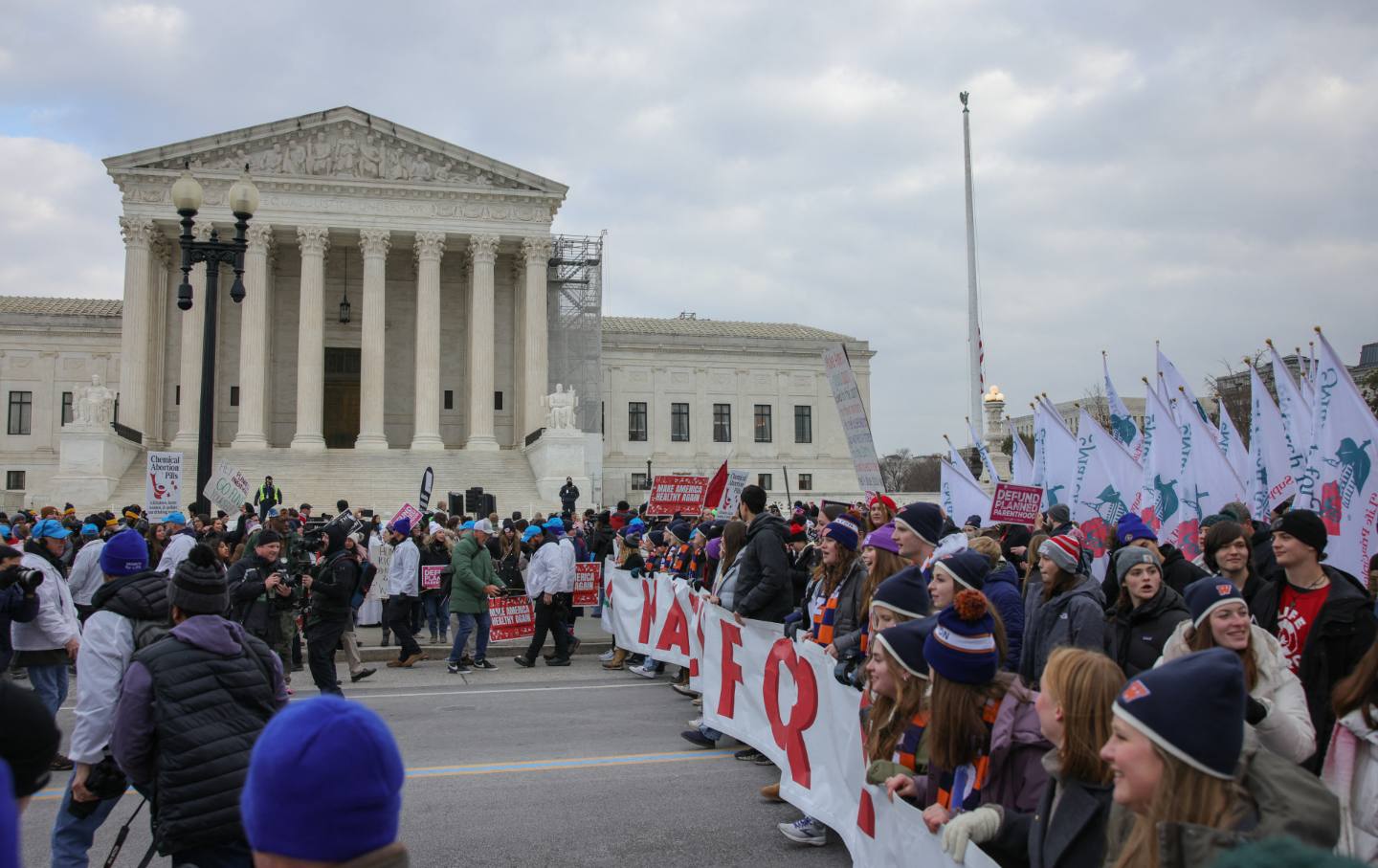
Anti-abortion rights demonstrators march to the Supreme Court for the 52nd annual March For Life in Washington, D.C. on January 24, 2025.
(Bryan Dozier / Middle East Images / Middle East Images via AFP)
Since the Supreme Court overturned Roe v. Wade in 2022, the idea of charging people who have abortions with murder has gained terrifying new traction. During her brief stint as White House press secretary, Katie Zacharia became just the latest prominent conservative to draw attention for her ties to a radical wing of the anti-abortion movement that wants to charge people who have abortions with murder. This year alone, state lawmakers floated 14 bills to charge people who have abortions with homicide. (The idea is still so unpopular across the political spectrum that none of those bills passed.) Yet this whole debate is, in a sense, a red herring, because hundreds of people a year are already being prosecuted for their pregnancy outcomes. The vast majority of those cases involved a live birth where the mother was suspected of using drugs, but in a rising minority of cases since Dobbs, people are also being criminalized for pregnancy loss.
I spoke with Dana Sussman, senior vice president at Pregnancy Justice, about a new report the organization published today finding that in the first three years after the Supreme Court overturned Roe v. Wade, prosecutors have initiated at least 902 cases across the country charging individuals with crimes related to pregnancy, pregnancy loss, or birth.
I’ve edited our conversation for brevity and clarity. —Amy Littlefield
Q: What’s new in this report, which looks at pregnancy criminalization in the first three years after Dobbs?
A: When Roe was overturned, we suspected that pregnancy loss would become an increasingly criminally suspect event, and we unfortunately are starting to see that play out in the data. This report finds a significant acceleration in pregnancy loss prosecutions. We now have documented 70 pregnancy loss prosecutions in the first three years post-Dobbs.
Q: I was struck by the breakdown of allegations prosecutors made in the cases you found. There were 871 allegations of substance use during pregnancy, 77 allegations of a lack of prenatal care, and just 13 related to obtaining, attempting or researching an abortion. What does this tell us about who is being criminalized for pregnancy post-Dobbs?
A: This is the continuation of a trend that we’ve been seeing for decades. The way that pregnancy is policed and prosecuted in the United States is through the lens of substance use. The foundation for prosecuting pregnancy is based in the war on drugs from the 1980s, and the way in which Black women, in particular, were targeted for charges of child abuse when they were deemed substance users, primarily with crack cocaine and this obsession over a “crack baby epidemic” that has been thoroughly debunked. Three state supreme court decisions used pregnancy and substance use as the way to redefine who a person is [thereby extending child abuse protections to fetuses] under their state laws: Alabama, South Carolina, and Oklahoma, which consistently rank among the top three states that criminalize pregnancy.
Q: What did you find about the race and socioeconomic background of the folks who were criminalized for their pregnancy outcomes in this report?
In the 80s, 90, and early 2000s, we were seeing disproportionately Black women being charged with crimes in connection with pregnancy, and that has shifted since the mid-2000s until the present. The majority are white women at this point, but poverty is a very big indicator, as it is across the criminal justice system. So we’re looking at poor white women as the majority in the data set at this point. There are a few different theories from scholars about why this is. [Legal scholar] Michele Goodwin has said that Black women were the canary in the coal mine; cruelty by the state is tried out on Black women, and then it spreads more broadly. There’s also a lot of scholarship showing that when a victim is white, the perpetrator of the crime is treated more harshly, and so we are talking about the assumption that these are white babies, and so they are held in higher esteem, frankly, than non-white babies, and so their mothers are treated more harshly, potentially. There’s also shifting patterns in policing around nonviolent drug crimes; we see less of it in city centers and more of it in rural areas, and also the patterns of drug use, as well.
Q: So it’s mostly low-income white women in a small number of states. I’m looking at the map: 381 of the cases in South Carolina, 222 in Oklahoma, 204 in Alabama, and then there’s states like my home state of Massachusetts where there’s zero.
Each one of those three states has proclaimed by state supreme court decision that fetuses are children under the child abuse laws. In South Carolina, it was in the late ’90s, in Alabama, it was 2013, and in Oklahoma, it was 2020. So that kind of unleashed permission for prosecutors across the state to apply laws in this way. In other states, we see prosecutors doing this, but those cases have not yet gone to the state supreme court. In Mississippi, for example, the state has no fetal personhood law or judicial decision, and yet we see 27 cases in that state of prosecutors just choosing to reinterpret laws that were never intended to be applied in this way.
Q: So what impact did Dobbs actually have on these types of prosecutions, and is Dobbs really the culprit here, or are there other, more long-standing forces at play?
Popular
“swipe left below to view more authors”Swipe →Two things are true here. One is that the foundation for these prosecutions was laid way before Dobbs, and it’s a continuation of a decades-long trend. Fetal personhood is at the root of these cases, and fetal personhood has existed in state law or in state judicial decisions since the 1990s. That is, ultimately, the anti-abortion movement’s goal. It wasn’t the overturning of Roe. It wasn’t sending issues back to the states. It is the federalization of fetal and embryonic personhood, because that would ban abortion without question, without exception, and it would allow for increased criminalization of people who are not performing pregnancy in the way that the powers that be might want them to. At the same time, we suspect that we are seeing more pregnancy loss cases in our data year upon year post-Dobbs, and I don’t think that should be a surprise, either. If we ban abortion and we make pregnancy loss suspicious because in some places provision of abortion has been made illegal, then we are creating an environment in which we are inviting law enforcement in to investigate how some of these pregnancies ended. That criminal response varies depending on one’s identity, one’s behavior, and one’s access to health care.
Q: After the Supreme Court decision in Dobbs in 2022, there were predictions that we would see a mass number of criminal cases related to abortion, because all of a sudden providing abortion was a crime in about a dozen states. How does the reality compare to those expectations?
We are seeing what we expected: that this was going to fall most harshly on people who use substances during pregnancy and were going to be charged with child abuse or neglect, and that pregnancy loss would be an increasingly suspect event. I remember getting lots of questions about period tracking apps and wiping that from your phone, and I was like, if they want to criminalize pregnancy, they have other ways to do it, and they’ve been doing it. This is not going to be some new dragnet, it’s going to be the same old ways that they’ve been doing it for a very long time, and that has played out.And the circumstances are often through health care, that is, the people who are reporting to law enforcement or child welfare [are often health-care providers]. That was the case before Dobbs, and it remains the case now.
Q: Katie Zacharia recently made headlines for the fact that she was on the board of White Rose Resistance, which is part of an extreme wing of the anti-abortion movement that has called for “equal protection” laws that would treat embryos as people and abortions as murder. I’m wondering if you could reflect on the fears generated by these efforts versus what the data already show about criminalization?
There are 17 states that redefine who a person is to include an embryo or a fetus right now. So this movement to provide “equal protection” to embryos and fetuses already exists in a slightly different form under many state laws.
Q: What would you tell someone who lives in a state where abortion is banned, and is ordering abortion pills to self-manage an abortion?
These are an incredibly small number of cases [criminalizing self-managed abortion in a ban state] when it comes to how many abortions have happened post-Dobbs. You can still access abortion safely and confidentially, and if you are experiencing medical concerns around abortion care, you can call the Miscarriage and Abortion Hotline. You can get care that you need and you do not need to say anything about abortion. People should keep their community of people who know as small and as trusted as possible, because the most common scenario [triggering criminal prosecution] is getting reported by other people.
More from The Nation
The Supreme Court Is Coming for Affirmative Action—Again The Supreme Court Is Coming for Affirmative Action—Again
The high court has just accepted a case that takes aim at efforts to increase diversity at high-performing public schools.
My Family’s Dark, Hidden History With Institutionalization My Family’s Dark, Hidden History With Institutionalization
My great-great-grandfather was the namesake of an infamous institution for the disabled. From long-neglected records of the property, the lives of forgotten people were uncovered....
Smoke and Mirrors: The Right's Latest Attacks Against Trans People Smoke and Mirrors: The Right's Latest Attacks Against Trans People
The MAGA movement is redoubling its attacks on trans healthcare in an attempt to win votes this November.

Is Blockbuster Video the Answer to Our Digital Privacy Woes? Is Blockbuster Video the Answer to Our Digital Privacy Woes?
The Supreme Court is weighing whether a 1988 video-store law can be used to protect our digital privacy.
How Congress Is Cashing In on the AI Boom How Congress Is Cashing In on the AI Boom
Roughly one in five members of Congress has household investments in the industry.

Obviously, the Knicks Should Not Visit the White House. Why Is This Even a Discussion? Obviously, the Knicks Should Not Visit the White House. Why Is This Even a Discussion?
The Knicks shouldn’t let their legacy include genuflecting to Donald Trump, one of the most hated figures in the very city printed on their jersey. New Yorkers deserve better.

