
Scotland’s Wealthiest University Is in Crisis
The University of Edinburgh’s £140 million cuts threaten the institution’s intellectual life and Scottish identity. Students and staff are fighting back.
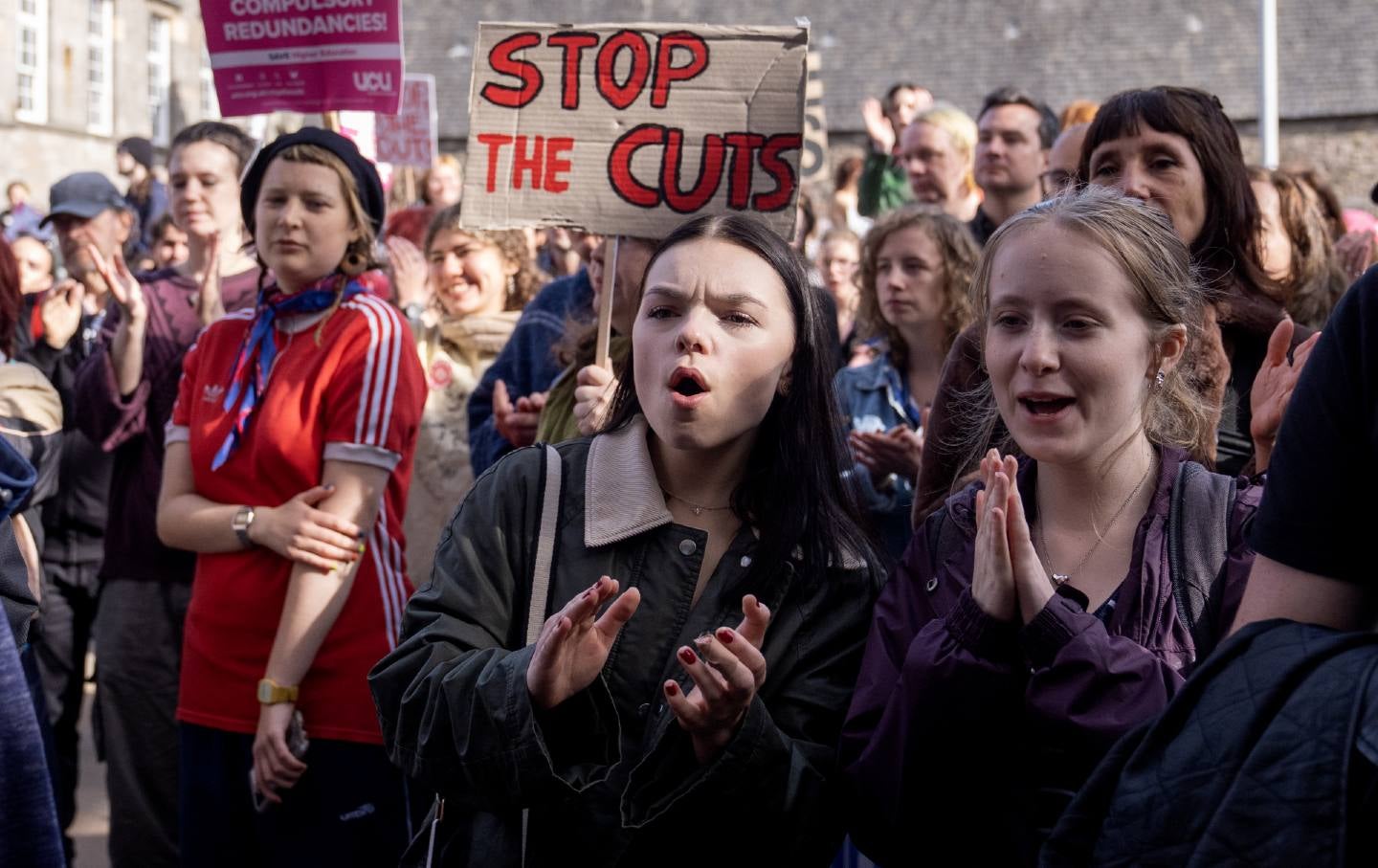
University College Union members and student supporters take part in a rally against cuts and job losses.
(Jane Barlow / PA Images via Getty Images)This fall, lecture halls that once held hundreds of students at the University of Edinburgh sat empty. LED screens outside large theaters and modest conference rooms glowed brightly with a daily calendar of lectures and tutorials that would not take place.
Scotland’s largest and wealthiest university ground to a halt following strikes led by its chapter of the University College Union (UCU), a group representing more than 100,000 higher-education workers across the United Kingdom.
The Edinburgh strike began on September 28 to protest a proposed £140 million in university cuts. The austerity measures will lead to the shuttering of close to 100 degree programs, and the union’s leadership calculates that around 1,800 of the university’s close to 18,000 employees stand to be axed. A reported £90 million of the cuts will come from slashing wages and staff.
Of the programs being eliminated, several deal with subjects core to Scotland’s cultural identity. The University of Edinburgh boasts the oldest Celtic and Scottish studies department in Scotland. Yet courses in Scottish literature, ethnology, and Celtic have admitted their final students. These cuts are part of necessary financial restructuring, according to university principal Sir Peter Mathieson, the head of the school.
The strike by lecturers, staff, and students reflect some existential questions with which universities across the world are contending. In an era of increasingly expensive higher education, wilting job markets for new graduates, and the looming threat of artificial intelligence taking our jobs (if not our lives), just what is a university for?
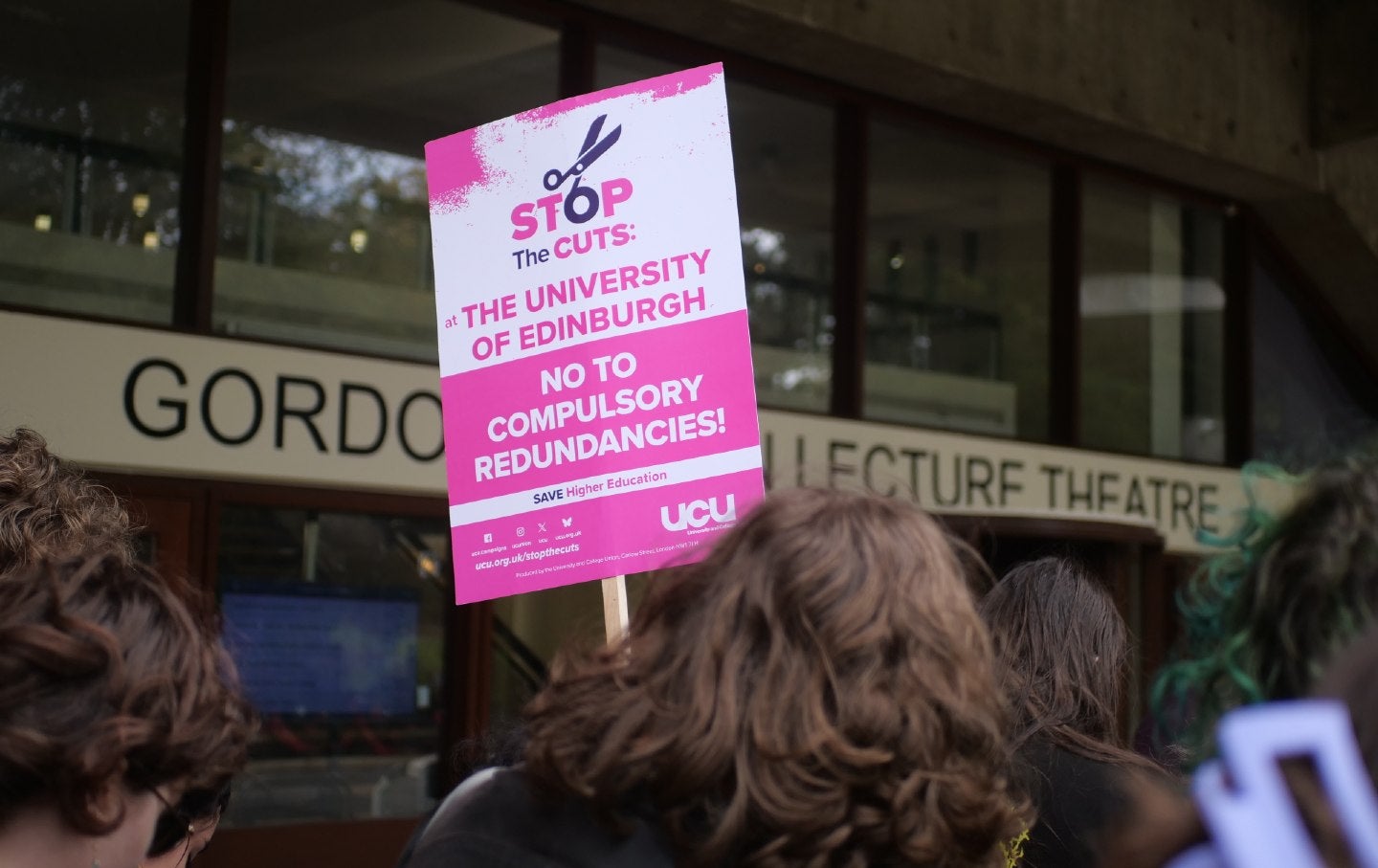
On September 24, before faculty were to strike, a deluge of students and staff stuffed two lecture halls—not for class, but for the first meeting of the Student and Staff Assembly. The assembly laid out the argument for why faculty were striking, and why the union opposed cuts. The crowd ranged from scraggly brunettes in keffiyehs to business students in rib-knit quarter-zips.
“We spend a lot of money on shiny buildings. We spend very little money on increasing staff pay,” Ben Goddard, a member in the mathematics department told the audience. “Staff costs are not to blame. Staff are the people who run the university, keep everything going, and give you your education. You do not learn from shiny buildings.”
In step with its contemporaries across the United Kingdom and broader Europe, Scotland’s universities are facing serious financial strain. In Scotland, drops in public funding, rising inflation, and diminishing international student populations have created a gap in funding of over £200 million. This problem is coalescing into a potentially existential threat for smaller schools. But Edinburgh, unlike its peers across Scotland, is not in an obviously dire position.
James Grey, the university’s chief financial officer, said during an April 2026 university business committee meeting that Edinburgh had an operating surplus of £20 million.
Grey stated that the surplus was primarily the result of “non-core activities, including better returns on investments.” What didn’t cause the surplus? “Core activities related to teaching and research.” In fact, according to Grey, teaching and research are “closer to break even or in deficit,” and there is a “pressing need to improve their financial performance.”
The real problem, according to the UCU, is irresponsible spending and opaque financial practices. Particularly puzzling to the union is that the university continues increasing capital expenditure to purchase and maintain its hundreds of properties rather than prioritizing the preservation of entire programs and potentially hundreds of staff members.
A £140 million slash would generate more capital for investment and operating costs, keeping the institution alive. But as university management stared down the barrel at these purportedly vital cuts, their spending jumped by a third.
A few dozen people huddled before Edinburgh’s Gordon Aikman lecture theatre, beneath a muddled gray sky, to recite Scottish poetry. Students and lecturers read from William Dunbar’s court writings to Norman MacCaig’s paean to an aunt who spoke Gaelic.
Over a dozen programs in Scottish and Celtic studies are being shut down by the university. After the current crop of first-years graduate, these programs will cease to exist. Before then, some staff in Celtic and Scottish studies are likely to be cut.
Part of the union’s strategy is to host alternative learning sessions to provide some educational content for students while lecturers strike. The reading was coordinated by the union in conjunction with the Scottish student’s association.
Edinburgh is one of Scotland’s four ancient universities, institutions that have survived from their inception in medieval, and in Edinburgh’s case, Renaissance-era Scotland into 2026. These institutions are world-class, with the universities of Edinburgh and Glasgow landing top-100 spots in the Quacquarelli Symonds global university rankings.
Scotland’s universities are tuition-free for students who grew up in Scotland, meaning there are thousands of guaranteed spots the government funds every year for Scottish students.
One of these students is Dana Freimute. Freimute immigrated to Scotland as a young girl, following Latvia’s financial crisis in 2008. Freimute grew up on a council estate—social housing—after her parents, once successful business owners in Latvia, left to give their children a steadier future.
Freimute describes education being a large part of her upbringing—her mother always read to her and engaged her intellectually, pushing her to be a top student. Now, Freimute is pursuing a joint degree in Spanish and art history at Edinburgh—becoming one of the few students in her community to study at the university.
Many of the programs the university is cutting are joint degrees, including Freimute’s. These programs allow students to study two subjects at one time, at the cost of one degree. The university says low enrollment is the major reason these programs are being cut; according to The Herald, a fifth of the programs on the chopping block had no enrollment. Freimute’s belief is that the slashing of joint-degree programs is a way for the university to make more money off students with more interests.
“If I’m a student who wants to study both Spanish and history of art, I would do a degree in Spanish first, so I would pay them for that degree and then I’d have to come back to university to study history of art again and pay them more,” Freimute said. “So they’re essentially getting double the income out of me.… The university is now looking more like a business than an educational institution…. I think it will just completely cut off the ladder for social mobility.”

The amount of funding Scotland gives its universities has not kept pace with inflation, according to a report by the Institute for Fiscal Studies. Many Scottish universities, especially the University of Edinburgh, heavily recruit international and English students to increase tuition revenue. The University of Edinburgh has the second-lowest population of Scottish students proportionally among Scottish universities.
The comparatively small number of Scottish students has led to a cultural stereotype that many Scottish students tend to be working-class in comparison to the posh English and internationals whom the university relies on for funding. The Scottish Society on Edinburgh’s campus started in 2024 as a response to Scottish students’ experiences of cultural and economic discrimination.
Dani Brady’s life has been shaped by Scotland’s past. A first-year student at Edinburgh, Brady grew up in Dunfermline, the nation’s ancient capital. The abbey in town holds the skeleton of Scottish king Robert the Bruce—or Braveheart. Brady’s father had a brief stint as a tour guide, and after he finished work she would sit and listen to him tell her about Scotland’s folklore, history and people. This led her to pursue a degree in Scottish ethnology and history.
So, on her first day, when the croons of bagpipes barreled across the university’s welcome ceremony, everything felt appropriately Scottish. But, when she heard about the cuts, the idea of Edinburgh as one of the Scottish institutions she’d grown up revering, changed.
“They were trying to give this impression of Scottishness without committing to the Scottish degrees, Scottish students, and Scottish traditions that came before all this,” Brady said. “No matter how small a course is, things should still continue. Universities used to only teach religious studies, and now they’re so expansive and teach so much. Why would you want to make something less inclusive, and less broad?”
Dr. Duncan Sneddon, a large man with long, dark hair, is a Celtic lecturer at Edinburgh. He told me the cuts are potentially lethal to Scottish fields of study. “Where will the next generation of scholars that carry us forward, carry our field of inquiry in new directions be?” he asked. “Where are they going to get the training and the expertise that they need if we’re not here to teach them?”
Sneddon says that he finds these cuts “baffling,” placing blame on the financial ideologies of university leadership that stand in direct contrast to what he sees as the purpose of a university. “A university is an intellectual community, where ideas can be pursued for their own sake, and where we remember things instead of actively choosing to forget them,” Sneddon said.
In a union office with a small boardroom cluttered with picket-posters, papers, and tea biscuits sat Courtney Stafford-Walter and Marion Lieutaud, vice presidents of Edinburgh’s chapter of the UCU.
Stafford-Walter, a lecturer in education studies, has the charm and style of a whimsical American schoolteacher—when I met her, she was wearing rainbow glasses. Lieutaud holds a steelier demeanor, but kindly offered me a cup of lemon tea before our interview.
They said this strike feels different from ones that have happened in years prior. Stafford-Walter told me that senior management, under the guidance of Sir Peter Mathieson, has refused to seriously negotiate with them about halting or minimizing staff cuts.
“We said, ‘If you make any movement on any of our demands, we will bring that to our membership,’ because we are so desperate to avoid the strike…and yet they said they had no flexibility,” Stafford-Walter said.
Mathieson became the university’s principal in 2014. Under his leadership, Edinburgh’s endowment has grown by tens of millions of pounds. The institution is now the third-wealthiest in the United Kingdom, behind Cambridge and Oxford.
“If you look at wealth, it’s very clear the university has never been wealthier than it is now. If you look at disposable income…we’re still in a very healthy place,” Lieutaud said. “If they continue to invest as much as they have been, eventually we’re going to have too much capital expenditure relative to income. The very simple answer is capital expenditure. They don’t need to make further capital expenditure.”
“It’s exactly the kind of moment where you should be using your reserves,” Lieutaud said. “We have three billions worth of them and they’re refusing to touch it.”
Mathieson went on BBC Radio to accuse the union of weaponizing students against the university, framing it as the enfant terrible, anti-establishment behavior of college students.
“It’s really disingenuous because we are the ones who spend all the time with the students. We are the ones who love our students,” Stafford-Walter said about Mathieson’s view. “This is not a moment where they can continue to pit the students and staff against one another. Because the truth is we are united in the same fight. Our working conditions are their learning conditions.”
“If Peter Matheson doesn’t come to work for five weeks, our students would never notice,” Stafford-Walter continued. “But if we don’t come to work for five weeks, they notice.”
Mathieson announced his resignation a few days after my interview with Stafford-Walter and Lieutaud. He will leave his post as principal and vice-chancellor of the University of Edinburgh in 2028.
By Tuesday October 20, a new activist group, “Students Against Scabs,” had occupied Gordon Aikman Lecture Theatre, jamming the revolving entrance doors with bins, chairs, and even a sack truck. They’d peppered the theatre with large banners demanding that the university divest from Israel, stop the program and staff cuts, and for the resignations of Sir Mathieson and the university’s provost, Kim Graham.
A notice from the local sheriff’s court, addressed to “the unauthorized occupiers,” ordering the protesters to leave was plastered on a side door.
Popular
“swipe left below to view more authors”Swipe →A lone security guard watched silently as some of the occupiers, clad in dark garb and balaclavas left through a side entrance. He counted four. I counted six. The guard told me he had just started the job a few days ago.
“Talk about a trial by fire,” I said.
He told me that the students would be allowed to hold the building for a few days, and if they were still there then they’d be physically removed. I tell him I’m shocked that any student group, especially those hanging up Palestinian flags, would be allowed to occupy an academic building for so long.
“You’re American. You guys probably would’ve had SWAT in there by now,” he said, chuckling.
Since the strike’s end on October 30, little has been resolved.
Students returned to class. The University of Edinburgh student newspaper uncovered that the university circumvented its democratic decision-making body, a Senate of 300 academic staff members, administrators, and students, to make the cuts. Students and staff dressed up as cows for a protest, accusing the university of treating its students as “cash cows.” The union and its student supporters effectively barred the university’s provost from an appointment to the board overseeing and advising on tens of millions in Edinburgh’s tourism taxes. The university is trudging along with its cuts anyway.
On November 18, the Student and Staff Assembly had its final meeting of the semester. The room was emptier than its standing-room-only first meeting, students and staff now occupying the front-end of the room. Lieutaud and Stafford-Walter ran the meeting.
A lecturer at the college of medicine and veterinary medicine announced that cuts in the college were further along than other schools. Teaching duties will be passed on and research ended. Union organizers announced that the university has still not come to the bargaining table with them. Next term is when many of the university’s cuts are thought to come into effect, changing the university’s scale and scope of study and leading to the unemployment of hundreds.
But still, for people in the room, there was hope. The meeting’s primary focus was to organize protests and events for next term. Organizers were told their tactics had frazzled senior management, and French student protesters currently blazing through Paris had pledged their support for the Edinburgh UCU’s actions.
“We’re dealing with management that’s incredibly stubborn,” Lieutaud said. “They have to feel like they’re being kicked on all corners and not getting a break.”
After the meeting, I sat with Stafford-Walter to ask about whether she thought this term’s strikes had been successful. “They refused to meet with us to negotiate throughout the entire five weeks,” she said. “We’ve taken a massive action, we’ve taken a huge pay cut, and those kinds of very clear and tangible goals like getting an agreement to to pause compulsory redundancies, didn’t happen. I think that’s been difficult for us to grapple with.”
But, she said, they’ve grown the size of their movement—increasing student participation in a way she hadn’t seen before. “Even though we don’t know what we can win, we do know what we can lose if we don’t fight.”
More from The Nation
Trump Wants to Quiet Quit the Iran War—but the War Won’t Let Him Trump Wants to Quiet Quit the Iran War—but the War Won’t Let Him
The president’s senseless war of choice has left him without any good choices.

Does Spain’s Leftist Government Stand a Chance? Does Spain’s Leftist Government Stand a Chance?
Pedro Sánchez’s coalition has been an exception to Europe’s reactionary turn. What went wrong?

Has Pedro Sánchez’s Luck Finally Run Out? Has Pedro Sánchez’s Luck Finally Run Out?
Spain’s progressive prime minister has defied political gravity over and over again. But this Sunday’s election might be his last act.

The Deportation Influencers The Deportation Influencers
A growing group of US deportees is documenting their new, post-deportation lives on social media, revealing the human cost of our Kafkaesque immigration system.

The Second Life of Gaza’s Rubble The Second Life of Gaza’s Rubble
The Strip is buried under 61 million tons of rubble. Some people are finding creative ways to use it as a resource.
Critical Condition: What Are We Doing About Nuclear War? Critical Condition: What Are We Doing About Nuclear War?
Doctors are calling for verifiable, deadline-driven agreement to eliminate all nuclear weapons. The flourishing—and even the survival—of the human species is at stake.