
Is Platonic Co-Parenting the Future of the Family?
Disillusioned with the nuclear family and apprehensive of tethering their reproductive futures to the bleak hellscape of modern love, young people are seeking a different way.
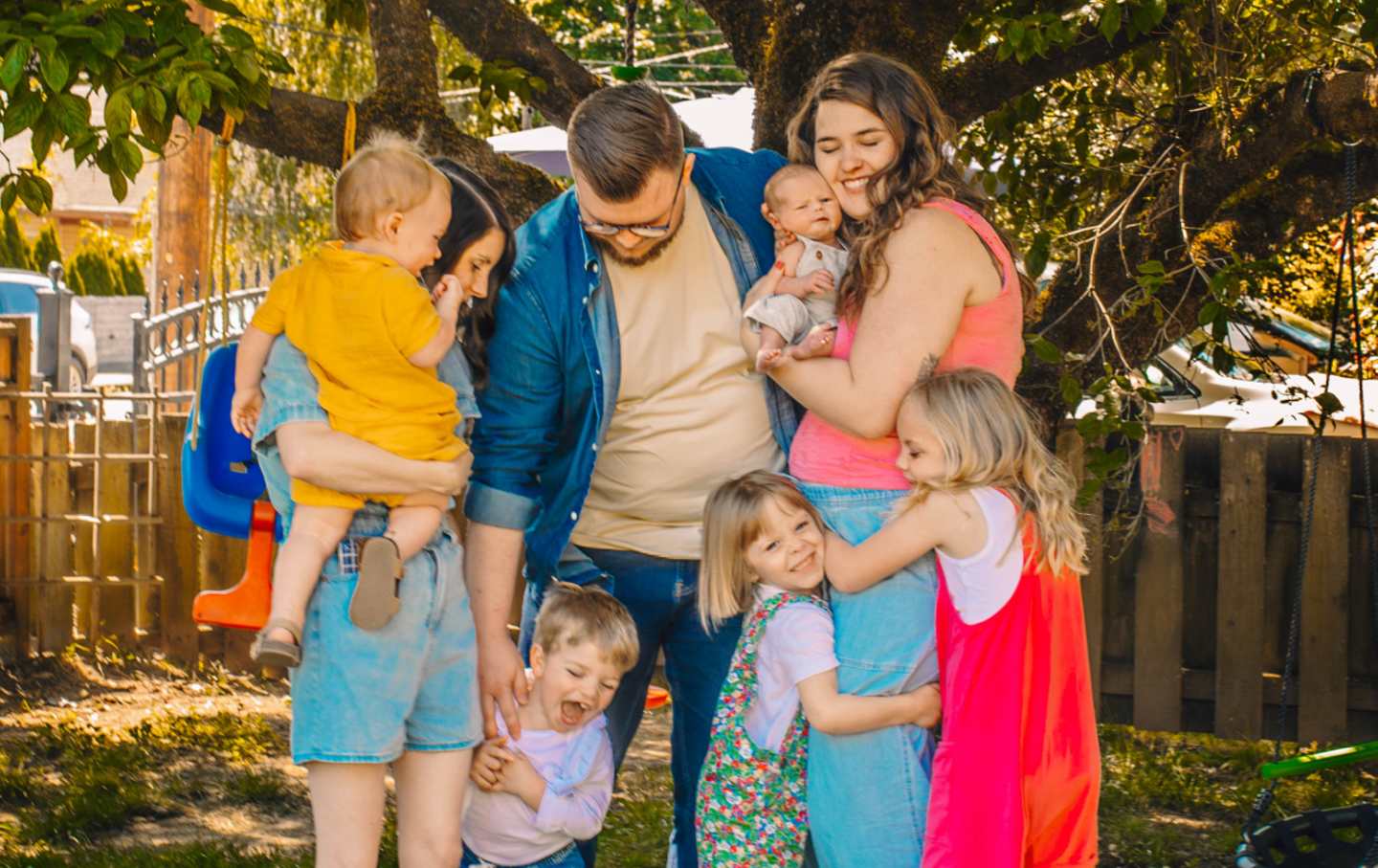
Caitlin Asher shares children with her best friend, Amanda Oelrich, and Amanda’s husband, Chris.
(Caitlin Asher)Caitlin Asher always knew she wanted children. But she never envisioned her family looking the way it does now.
Asher is single, but she doesn’t parent alone. She shares children with her best friend, Amanda Oelrich, and Amanda’s husband, Chris. Asher is not in a romantic relationship with the couple and never has been. Instead, the three platonically co-parent together in the same Portland, Oregon, home.
It all started when Asher and Oelrich were living as roommates in 2019. Motivated by their shared passion for helping children—Asher had interned with a child welfare organization and Amanda has an early-education degree—the women decided to become co–foster parents. “We’re both single,” Asher remembers thinking. But “we both love kids and we have the capacity to do it.”
Because the goal of foster care is primarily to reunify children with their families of origin, the pair imagined their co-parenting arrangement as short-term. “We figured we’d do it for a few years, then we’d both meet people and get married and then, you know, continue to be really good friends in separate houses,” Asher said.
In February 2020, they welcomed their first child—a baby boy—into their home; he only stayed for about a week. Then, in late March 2020, they got a call for a baby girl named Bella. Just a few months into Bella’s life, the pair were asked if they were open to adopting her. They now had to consider if they were committed to a lifetime of parenting together.
“We were very good friends. We knew each other well. We trusted that we both loved this kid and that we would commit to her forever,” Asher said. “Maybe that feels like a risk, but it is also arguably a risk in every single married relationship too.”
In March 2022, Asher and Oelrich, who was by then in a committed relationship with Chris, adopted Bella. Later, they fostered and adopted Bella’s sister, Sofia. While arrangements like Asher and Oelrich’s are still rare, the pair is not alone. Increasingly disillusioned with the traditional nuclear family model and apprehensive of tethering their reproductive futures to the bleak hellscape of modern love, growing numbers of young people are seeking a different way—not marriage nor single parenting, but the coveted “secret third thing.” For some, that thing is having kids with your friends.
There is no concrete data on the number of platonic co-parenting families in the US or the world. However, several specialty apps have sprung up over the last two years, catering to people interested in finding a platonic co-parent through the Internet, and their user numbers are on the rise. In 2020, one of the apps, Modamily, reported having 30,000 registered users; in 2025, it reported 100,000. A similar platform, CoParents, had 85,000 users in 2020; now, it boasts 150,000.
Women especially seem to be interested in exploring alternatives to the nuclear family. In a 2017 survey of 379 unmarried mothers by Lake Research Partners, 58 percent said they would be open to raising a child with someone who is not a spouse or romantic partner. More than 50 percent of unmarried mothers, unmarried women with no children under 18, and married women agreed there should be more ways to raise children with someone who is not a romantic partner.
Hannah Dees is doing it already. In 2015, she was living in Ontario, Canada, with her roommate, Andrew McAllister, and was considering becoming a single parent. She approached McAllister about being a sperm donor.
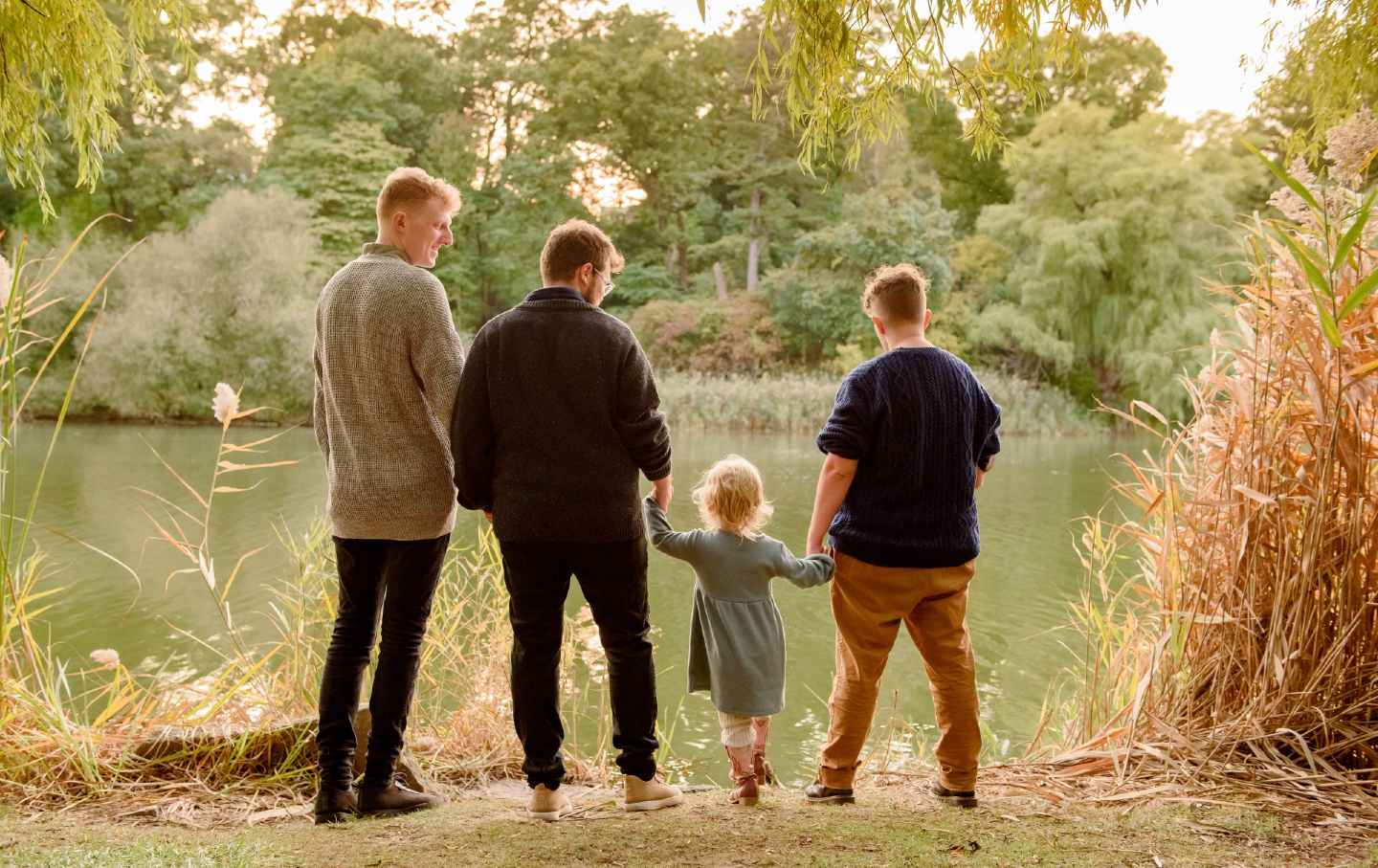
He was interested, but he wanted a role in the potential child’s life. He pulled his partner, Markus Harwood-Jones, into the conversation, and the trio settled on platonic co-parenting. It would be another seven years before they had their first child, using IVF.
Dees, McAllister, and Harwood-Jones used the time to approach their unconventional arrangement with care and intention.
While attending parenting classes for LGBTQ+ people using donor conception and surrogacy, they learned about written parenting agreements. These agreements help minimize conflict by allowing parents to hash out critical parenting decisions ahead of time, when all parties are presumably calm and prepared, Harwood-Jones said. His family’s final parenting agreement covers religion, holidays, educational choices, and discipline. It offers a framework for family decisions, which can be more complicated when they involve three people’s opinions rather than one or two.
The trio are now raising two children, and according to Harwood-Jones, “the benefits are huge.” The family has greater financial stability with three incomes, and sharing the work of child-rearing between three people frees up a lot of time. “I’m surprised more people aren’t doing it,” Harwood-Jones said.
Harwood-Jones points out that this kind of family structure is not new.
“Lots of straight families have breakups and end up separating and then have to platonically co-parent,” Harwood-Jones said. “I think what we’re doing is taking that model and we’re saying, ‘What if we did this in a way that centered our children and that was a choice from the beginning rather than a Band-Aid after a separation?’”
Despite the long history of alternative modes of child-rearing, many on the American right still insist that heterosexual marriage can be the only foundation for a healthy family. A January 2026 Heritage Foundation report demonizes no-fault divorce and claims that lower marriage rates will harm America’s children.
In a report from the Center for Law and Social Policy, an anti-poverty nonprofit, researcher Mary Parke did find differences between children raised in a two-parent biological family and those raised by a single parent or divorced parents. But she noted that “marriage may also be a proxy for other parental characteristics that are associated with relationship stability and positive child outcomes.”
She found that much of the higher risk for negative outcomes for children with non-married parents was attributable to reduced household income or turmoil when a children’s parents separate. Ultimately, the report finds that while marriage is most likely to provide the conditions needed for a child to thrive—“consistent, stable, loving attention from two parents who cooperate and who have sufficient resources and support”—these conditions can exist in other parental arrangements.
On social media, a few platonic co-parenting influencers—like @theaccidentalfamily, a pair of friends who foster together—are seeking to display the effectiveness of their familial arrangement. It seems to be working: The account, which has 21,000 followers and over 1.5 million likes on its videos, is inundated with comments from young people announcing their interest in trying something similar.
Opal Raleigh, 27, uses they/them pronouns and makes content about relationships, gender, sexuality, and sex on TikTok under the handle @opallauryn. They are interested in fostering and adopting, either as a single parent or with close friends. “I’ve never really considered having a partner to be the end-all be-all when having a family,” they said. Raleigh argues that alternative family styles do a better job at centering children and their needs than the traditional nuclear family.
Raleigh’s perspective is informed by years of experience as a childcare provider. It also comes from their own childhood in a nontraditional family— Raleigh’s parents split when they were young and their dad remarried a man.
“After working alongside mothers for so long, what I’ve realized is that the nuclear family is set up to fail them,” Raleigh said. “This idea that working mothers are supposed to be able to work full-time jobs and also come home and be the primary parent, be the primary mental load caretaker, is just absolutely detrimental to their health.”
Raleigh thinks that alternative parenting models, which more evenly distribute parental responsibilities, are a potential solution. They also say policy changes like better family leave and universal childcare, as well as greater community support, are crucial to strengthening families.
Toiell Washington, 28 (@thehoodactivist), also maintains that a nuclear family is not necessary for a child to thrive. Her content is a response to comments she’s seen on TikTok berating unmarried women for getting pregnant.
“I think that women deserve to have families, and I don’t think that [means you have to be] married,” Raleigh said. In her mind, only three things are necessary to have a child: financial stability, emotional stability and a “village.”
If Asher’s and Harwood-Jones’ families are any indication, these are three things platonic co-parenting families can offer aplenty.
Harwood-Jones pointed out that for some couples “children might just kind of fall into your lap,” the expected next step after marriage. For his family, and for Asher’s, that ease was never on the table—their path to parenthood required much more intentionality and forethought than what is considered standard.
When Oelrich was getting serious with her now-husband, Chris, she had to sit down with him to ensure that he was willing to adopt a child with a third co-parent. He agreed to the plan. But, then, without a blueprint, they had to figure out for themselves how to divide expenses, find a shared home, and keep all three of their families of origin happy on the holidays.
There were legal constraints to navigate, too—Oregon doesn’t have an option for multi-parent adoption. Asher is the legal guardian of the two girls, and her name was put on their new birth certificates when they were adopted. Oelrich and her husband have power of attorney, allowing them to take care of the girls’ educational and medical needs.
Popular
“swipe left below to view more authors”Swipe →These legal intricacies guaranteed that the family’s values were aligned and that intentions were clear. It gave the parents time to achieve greater financial stability (Asher noted that finding a home was much easier with three incomes to draw on). And in the case of both Asher’s family and Harwood-Jones’, children have three parents instead of two, resulting in more attention, more time with parents, and a wider extended family network.
Since adopting their daughters, Asher’s family has continued to grow. Asher went on to foster and adopt two boys on her own, while Amanda and Chris had a biological baby.
The family all lives together and the children consider each other siblings. Asher does the big stuff like doctor’s appointments for the two boys and Oelrich and her husband handle late-night wakeups for their baby, but they share day-to-day parenting of all five children.
With no concrete statistics, it’s hard to say if platonic co-parenting or other alternatives to the nuclear family are the way of the future. Are young people serious about raising children with friends or is it just fantasy, the type of thing to daydream about but never pursue?
Asher sees it as part of “a growing movement of girlhood” where women are recognizing the lasting power and depth of female friendships; many realize that their female friendships have outlasted a partner. If this is the case, why should having children be reserved for married couples?
Neither Asher nor Harwood-Jones knew any other families that they could model theirs on when they were contemplating becoming parents, and Harwood-Jones admits that such an unconventional life took a lot of effort to bring to fruition. To create something like this, he said, you must take charge and be truly committed to starting a family.
“It’s not just gonna happen to you,” he said. “But if you want it to happen, you can make it happen.”
Become a Sustaining Donor This September
Between the reemergence of right-wing red-baiting and Donald Trump’s use of the chilling National Security Presidential Memorandum–7 to criminalize left political organizing, we’re seeing McCarthyism reborn before our eyes.
This assault on democracy cannot be ignored or wished away. Resisting it requires bravery in the face of threats and repression, a steadfast commitment to the truth, and the unwavering belief that we can—and will—overcome this darkness.
We must have an independent media that sets the record straight, unearths corruption and abuses of power, and advances a politics of justice and dignity for all if we’re to win this fight.
That’s why I’m writing to you today. This September, The Nation needs to add 100 monthly donors to sustain our progressive journalism. Your contribution makes the next investigative report, the next truth-speaking column, and the next pathbreaking essay all possible.
I hope you’ll support our work with a recurring donation today. If you donate $10 or more a month, we’ll send you a brand new “Hands Off the Free Press!” sticker to recognise your commitment to our cause. Please, donate today.
Onward,
Katrina vanden Heuvel
Editor and Publisher, The Nation
More from The Nation


How Trump’s Crackdown on Speech Has Damaged the Student Press How Trump’s Crackdown on Speech Has Damaged the Student Press
I serve as editor in chief and president of The Stanford Daily. Our newsroom has keenly felt the effects of Trump’s campus crackdown, which is why we sued the federal government.

Treat Spotify Like a Public Utility Treat Spotify Like a Public Utility
Music streaming platforms have way too much control over musicians and music lovers. It’s time to rein them in.

What’s the Matter With Effective Altruism? What’s the Matter With Effective Altruism?
President Trump has decried the techbro creed for indulging in AI doomerism, but its excesses are far worse than that.

As Morale Sags, More Military Service Members Are Having a Crisis of Conscience As Morale Sags, More Military Service Members Are Having a Crisis of Conscience
According to multiple GI rights organizations, service members are inquiring in unprecedented numbers about seeking conscientious objector status.

What Remains of Riis? What Remains of Riis?
A new members’ club has revived Riis Park’s long-vacant bathhouse, reopening old questions about whom the People’s Beach is really for.

