The False Promise of Bob Woodward
He’s always been known as an intrepid journalist. But critics in The Nation, throughout decades, identified ways he held important stories for his own gain.
The False Promise of Bob Woodward
He’s always been known as an intrepid journalist. But critics in “The Nation,” throughout decades, identified ways he held important stories for his own gain.
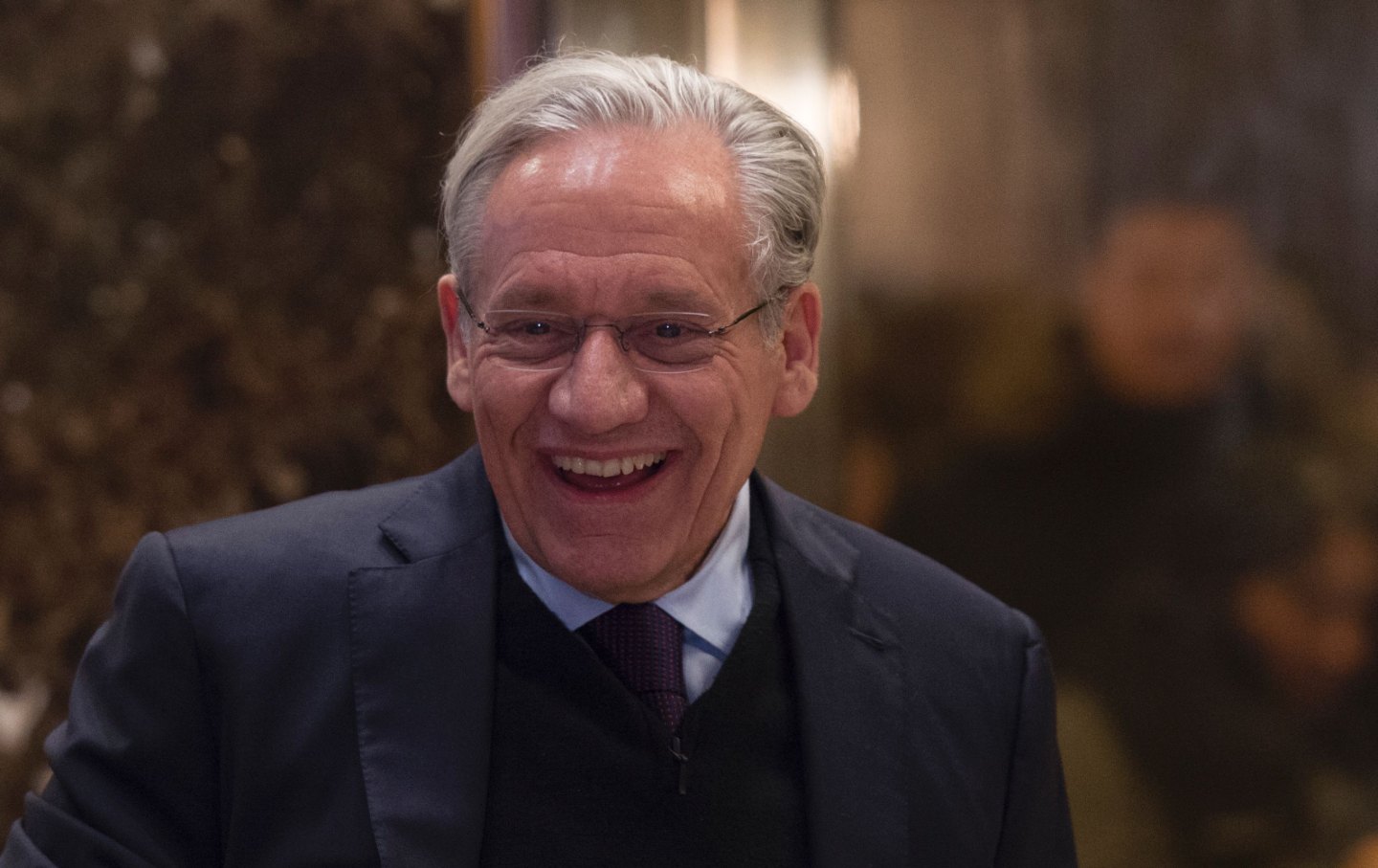
Bob Woodward arrives at Trump Tower for a meeting with Donald Trump.
(Don Emmert / AFP via Getty Images)
“Sometimes people have a vision of themselves that just doesn’t fit with reality,” Washington Post journalist Bob Woodward writes in his new memoir, Secret. For example, he does not feel the public’s understanding of him as “‘all business’ and cold” is quite right. But the problem is deeper than that. Woodward has always presented himself as a fearless and committed truth-teller, intent on getting to “the center of what was really going on.” Repeatedly, however, Woodward’s books, purporting to bring readers into the inner operations of the US government, have obscured more than they revealed.
Decades of reviews in The Nation of Woodward’s books show the consistent flaws and oversights that have marked the journalist’s work, not least a habitual reliance on the tropes and trivialities of inside-the-Beltway access-mongering. Jefferson Morley spotted the tendency early, reviewing Woodward’s 1987 book, Veil: The Secret Wars of the C.I.A., 1980-1987, which largely focused on Reagan’s CIA director, William Casey. “Woodward has not so much misreported his story as misinterpreted it,” Morley argued. Training his attention on minute “power struggles” between top officials, Woodward “tends to neglect the more fundamental and important news,” such as the Agency’s support for the contras in Nicaragua, which became international news while Woodward was reporting his book. Instead of telling readers about what the US government was actually up to—including the crimes that high officials were committing—the journalist focused on petty personal squabbles: “Because there was not much dispute among Woodward’s high-level sources about routine C.I.A. support for contra operations, he had no controversy to report on. No high-level controversy, no story.”
The excerpt of Woodward’s new memoir that recently ran in The New Yorker purports to recount a time when he courageously chose to publish the unvarnished truth about infighting within the George H.W. Bush administration, at the cost of losing a close friend who had been his source for the story. But Morley’s review highlights a consistent thread throughout Woodward’s career: His closeness to sources has often won out over a commitment to printing the truth. “Woodward probably has more access to top government officials than any other Washington reporter,” Morley noted. “But access always—always—has a price. Veil confirms that the more access a reporter has, the higher price he or she pays.” Indeed, Woodward himself acknowledged that he did not have the time to pursue the contras story because he was busy talking to Casey for the project that turned into Veil.
Reviewers have often pointed to the glaring lack of background information in Woodward’s supposedly immersive political narratives. Assessing 1991’s The Commanders, framed as an unparalleled glimpse into the (first) Bush administration’s deliberations on the eve of the (first) invasion of Iraq, Jon Wiener observed that “the book’s fatal flaw is that it contains virtually nothing about the political context in which Bush made up his mind in favor of war”— for instance, that his decision to invade was motivated by a sluggish economy and slumping poll numbers ahead of an important midterm election.
But Wiener identified an even worse problem with Woodward’s book, one that would keep cropping up throughout the journalist’s career: his tendency to keep a lid on important stories until the moment was right for him. In the run-up to the first Gulf War, it would have been useful for the public to know that the chairman of the Joint Chiefs of Staff was opposed to an invasion. Wiener asked, “What did Woodward know and when did he know it?… Why did that information become Woodward’s private property, which Simon and Schuster would sell to us months later for $24.95? The information Woodward possessed would have been a powerful weapon for the antiwar movement…. Woodward has privatized the news.”
As the Reagan era segued seamlessly into the reign of Clinton, Nation critics objected more strenuously to Woodward’s customary tricks and tics. Reviewing The Agenda, in 1994—a “work of intensive stenography,” about the early years of the Clinton administration—Christopher Hitchens wrote, “The portentous vacancy of neoliberal argot has met its chronicler in one who takes it seriously.”
Woodward’s next book was The Choice, a nearly 500-age tome about the 1996 election, which happened to be published months before that election. Republican challenger Bob Dole “cooperated readily” with the author, as Lynn Phillips wrote in her Nation review, while neither President Clinton nor first lady Hillary Clinton agreed to do so, an imbalance that Woodward never quite managed to rectify, as Phillips wrote: “And when a reporter gets so close to his candidates that he speaks from inside their mouths (Bob Dole, c’est moi!), his reportorial glasses fog up.”
Woodward’s glasses were especially foggy in the early years of this century. His 2003 book Bush at War, about the months after the September 11 attacks, was appraised in The Nation by Washington editor David Corn: “Woodward stuck with what has become in recent years his standard MO: Approach each power player and say, ‘All the other power players are telling me their side of the story, so you should do so as well.’ Woodward then weaves the various self-serving versions—supplied, of course, on background—into a quasi-official chronicle, with little overt sourcing.” While his Watergate investigations “excavated a story the big shots didn’t want public,” Woodward’s later work related only “what the powerful do want known.”
And so on, through the Obama, Trump, and Biden years, and into our own abysmal present. Most recently, in 2025, Matthew Duss, executive vice president at the Center for International Policy, assessed Woodward’s book, War, about the Biden administration’s handling of conflicts in Gaza and Ukraine. As Duss wrote, “Woodward consistently fails to interrogate any of what he is told, choosing instead to simply record and relay it and allow his readers to assemble the picture as they wish, as if the real journalistic feat was just getting the decision-makers and insiders to talk to him in the first place.”
Despite the self-serving accounts in his memoir, Woodward remains, as he has long been, a conduit for largely meaningless internecine battles among elites, a glorified stenographer haplessly doing the bidding of the powerful even while he presents himself as a heroic crusader for the vitality of the Fourth Estate. It’s a vision of himself that doesn’t fit with reality, even if Woodward’s first-draft accounts of history have done all too much to shape it.