
How Corporate Recruiters Took Over Campus—and What It’s Costing Democracy
Many students arrive at college with dreams of creating social change, but the corporate pipeline diverts them. A democracy in need of their talent is poorer because of it.
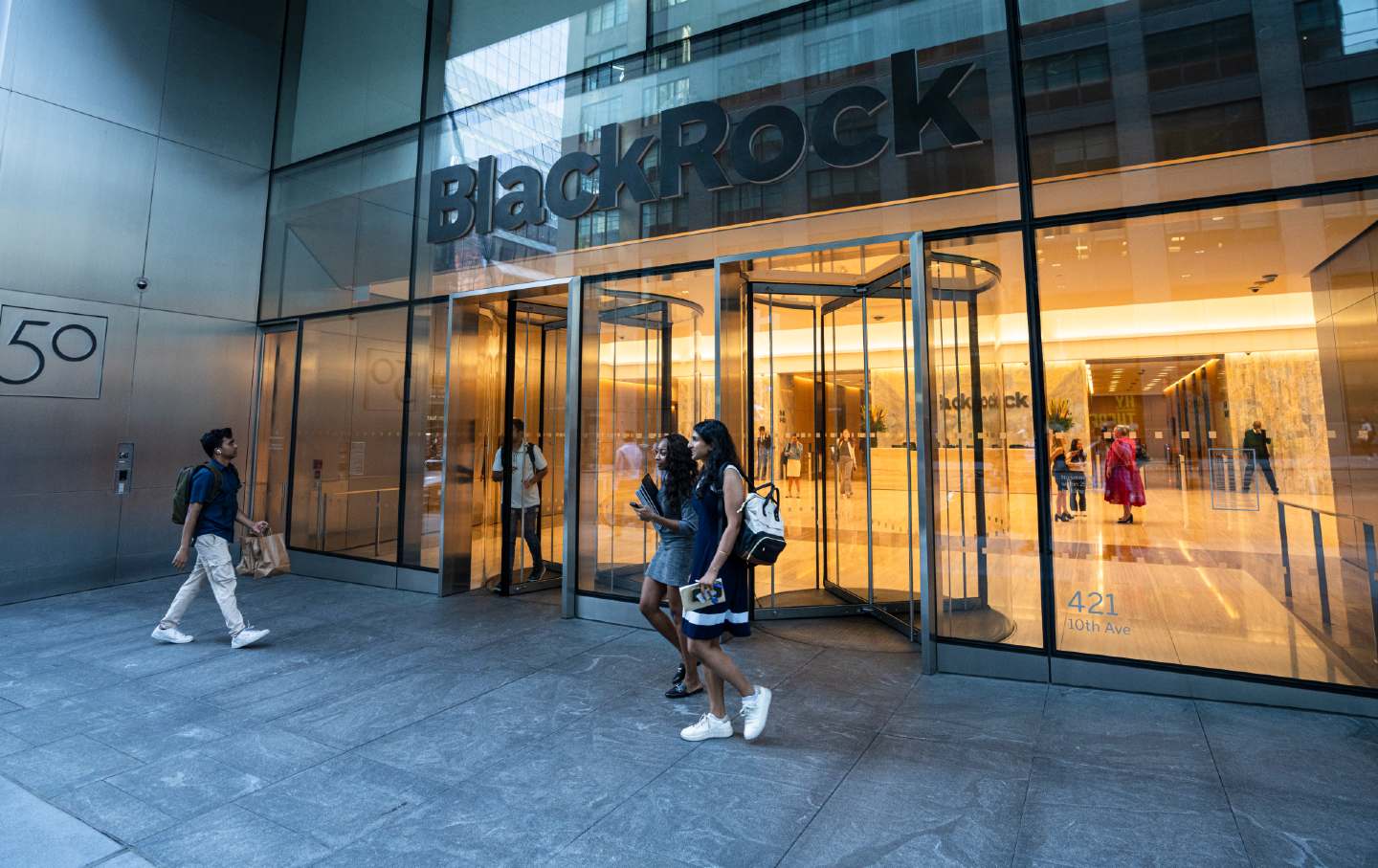
Young people walking in front of the BlackRock corporate headquarters in Hudson Yards
(Craig T Fruchtman / Getty Images)
“It feels like everything was conspiring to push us into corporate jobs.” That was how the college experience felt for Justin Portela, a 2023 Stanford graduate who entered campus with dreams of tackling global poverty, fixing the food supply or reducing the influence of lobbying on politics. But after completing his degree, Portela found himself as a Senior Business Analyst at McKinsey, where he spent two years “never really satisfied” with consulting.
Now pursuing his dream job as a writer and filmmaker, Portela sees that the pipeline from higher education into the corporate world is more than a coincidence. “The [corporate] recruiting process has hundreds of people and millions of dollars designed to make it as seamless as possible for students. The university is also pushing you towards these options, [from] selling your email address to companies… [to] allowing them to host lavish recruiting parties on campus.”
Portela’s experience is common, and this pressure extends far beyond Stanford. 58 percent of Ivy League graduates headed into jobs in business, finance, consulting, or technology, according to the most recent career data offered by each institution. What does this pipeline mean for the rest of us?
The easy answer is that these careers are some of the most lucrative the job market has to offer. The US Bureau of Labor Statistics reports that these industries tout a median salary of $93,455, almost twice the national median. Financial security is especially important for Gen Z, which grew up affected by one economic shock after another: the slow recovery following 2008, a pandemic that scrambled the job market, and skyrocketing housing costs. For the past five years, Gen Z has cited the cost of living as their top concern, with more than half delaying major life decisions because of their financial situation. Whether it’s to support their family, build a nest egg for graduate school, or simply have the chance to buy a home one day, it’s easy to see why so many students pick this path.
Ballooning student debt adds another incentive for students to pursue jobs in financially rewarding industries. More than 43 million US borrowers collectively hold $1.7 trillion in student debt, and nearly 20 percent of them have loans in default. Student debt is the second-largest category of debt among Americans, outpaced only by home mortgages. With so many people having tens or even hundreds of thousands of dollars in debt, with required monthly payments extending decades into the future, high-paying careers in business, finance, and tech become even more appealing.
But the story is more complicated than dollars and cents. It’s also about what colleges choose to build, fund, and allow onto campus in the first place. For instance, recruiters from big banking and consulting firms run dozens of info sessions a year on campus, stocked with free giveaways and slide decks that send an unspoken message: This is the path for the best of the best. Meanwhile, structured opportunities to explore career pathways in the humanities, social impact, or public sector are much harder to find.
This isn’t just the result of corporate recruiters having more resources—it’s also because universities open the door for them, and in many cases, point real resources their way. For example, higher-education R&D expenditures for business and management rose by 134 percent between 2011 and 2023, compared to just 40 percent in education, 38 percent in engineering, and 27 percent in biology. The rapid growth of college-sponsored business fraternities nationwide is another marker of this same trend: Between 2006 and 2015, the number of Alpha Kappa Psi chapters increased by 25 percent, while total membership grew by more than half.
FOMO, fear of missing out, does the rest. Once enough peers buy into the pipeline, opting out starts to feel less like a choice and more like a risk. A recently released documentary by Hope Mandler, a 2025 graduate of Vanderbilt University, explores this dynamic through dozens of interviews with Vanderbilt students. Together, their narratives encapsulate what researchers have dubbed “career funneling”: how students are conditioned to chase prestigious jobs.
Sociologists Amy Binder, Daniel Davis, and Nick Bloom, who coined the term, found that many students arrive on campus with little idea of what jobs like management consulting and investment banking even are. But over time, they pick up on the signals that indicate that these jobs are the most prestigious: 18-month-long recruiting timelines, six-round interview processes, and acceptance rates below 1 percent. By senior year, most have come to believe that corporate careers are the ones most worth pursuing, precisely because they have to jockey with their peers to secure them.
The cost of this process? Students who arrive at college with dreams of changing the world are redirected. “All the people who had these big socially impactful dreams early on just got so beaten down, so addicted to the money, and so overwhelmed by the tireless pace of work that they stopped caring about the idea of social impact,” Portela says.
And when this funneling takes place at colleges and universities nationwide, Mandler explains that it impacts an entire generation, “taking away potential talent from exploring important sectors such as policy, nonprofits, the arts, media, and more.”
That lost talent is needed now more than ever. Civic participation among young people is declining, and the public-interest sector faces a deepening shortage of the people it depends on, at the precise moment when our backsliding democracy can least afford it. When so many graduates are being routed into just four sectors, the schools, city councils, nonprofits, and advocacy groups that hold a democracy together are left competing for whoever remains.
“When higher education prioritizes career outcomes without cultivating civic identity, we risk producing graduates who are technically prepared but civically disengaged,” says Dorcas McCoy, a professor of political science and international studies at Bethune-Cookman University. She believes that college campuses need to ensure that “students graduate with both professional competence and a commitment to the public good.”
Through a collaboration with Project Pericles, a national consortium that seeks to center community-engaged civic learning in higher education, McCoy and Bethune-Cookman University developed the Rise to the Story Civic Story Lab, where students are able to directly engage with and report on women and faith leaders driving political change across Florida, where Bethune-Cookman is located.
Other universities have invested in leadership initiatives that empower students to address pressing social issues, such as Tufts University’s Tisch Scholars program. Tisch Scholars enroll in courses that help them “explore their civic identities, critically analyze the root causes of social issues, and develop skills to take action for positive social change in community settings,” while spending eight hours a week on capacity-building projects with local community organizations. Simisola Lawal, a political science major at Tufts and a 2025 Tisch Scholar, spent last year working as an Immigrant Services and Grassroots Intern at the Center for Supporting Immigrants Organizing (CSIO) in Boston. “The best moments were when families said ‘thank you.’ It means the world when you know you’ve made a difference,” she says. The experience pointed her toward a future career in law, with the goal of supporting organizations like CSIO directly.
Claire Yao, another Tisch Scholar, was placed at Boston’s Pao Arts Center, where she worked with immigrants and refugees processing grief and discrimination through art. “I find it really nourishing and rejuvenating to be part of the program,” she says, crediting both the institutional backing and the peers around her for keeping that direction alive.
Popular
“swipe left below to view more authors”Swipe →Meanwhile, at Skidmore College, history professor Eric Morser runs the Make Your Voice Heard policy competition, which asks students to pick an issue, build an advocacy campaign around it, and lobby a government official, all for the chance to win a $1,000 cash prize. Morser says that more than 250 students have taken part in the competition, leaving them “ready and able to practice democratic citizenship and change the world.“
Allegheny College’s Community Impact Hub has paired 850 students with 50 local partners on regional problems in health, sustainability, education, and the arts since 2020. “These civic connections lead students to sustain this impact in their careers after graduation,” says Tarah Williams, a political scientist deeply involved with the Hub.
The efforts underway at Tufts, Bethune-Cookman, Skidmore, and Allegheny show important alternatives to corporate pandering. After all, students choosing to pursue corporate careers aren’t the problem. Most are making a sensible call inside a system built to reward that choice, and some of them will find their way into public work later. The problem is that campuses have allowed the pipeline into business, tech, and finance to become the default.
As we celebrate America’s 250th anniversary in a time of deep polarization, hopelessness about the future of the country, and profound attacks on our civil rights, our nation’s colleges must choose a different path. They can fund public-interest career-advising the same way they fund business pathways. Faculty can build the kind of structure Lawal and Yao found at Tufts, providing opportunities for students to see the benefits of public service. Administrators can treat a Community Impact Hub or a Make Your Voice Heard competition as core infrastructure worthy of expanding, not just an extracurricular.
These structural changes must be complemented by real financial solutions that make pursuing public sector work a realistic choice. Eligibility for Public Service Loan Forgiveness can be expanded, schools with large endowments can directly offer postgraduate loan repayment for students creating social impact, and nonprofit employers can help support student loan repayment through the Cares Act and the Secure Act 2.0.
Gen Z doesn’t lack the will to become positive changemakers, only the educational on-ramps and financial security that make such a pathway possible. If our nation’s colleges and universities choose to show students that corporate careers aren’t the only option, the next generation won’t just inherit the myriad problems our world is facing. They’ll be inspired and equipped to tackle them.
More from The Nation

My Family’s Dark, Hidden History With Institutionalization My Family’s Dark, Hidden History With Institutionalization
My great-great-grandfather was the namesake of an infamous institution for the disabled. From long-neglected records of the property, the lives of forgotten people were uncovered....
Smoke and Mirrors: The Right's Latest Attacks Against Trans People Smoke and Mirrors: The Right's Latest Attacks Against Trans People
The MAGA movement is redoubling its attacks on trans healthcare in an attempt to win votes this November.

Is Blockbuster Video the Answer to Our Digital Privacy Woes? Is Blockbuster Video the Answer to Our Digital Privacy Woes?
The Supreme Court is weighing whether a 1988 video-store law can be used to protect our digital privacy.
How Congress Is Cashing In on the AI Boom How Congress Is Cashing In on the AI Boom
Roughly one in five members of Congress has household investments in the industry.
Obviously, the Knicks Should Not Visit the White House. Why Is This Even a Discussion? Obviously, the Knicks Should Not Visit the White House. Why Is This Even a Discussion?
The Knicks shouldn’t let their legacy include genuflecting to Donald Trump, one of the most hated figures in the very city printed on their jersey. New Yorkers deserve better.

Wendell Berry’s Unrelenting Vision Wendell Berry’s Unrelenting Vision
The poet wrote for The Nation for decades, always demonstrating conscience and prescience.

