
Why Democratic Leaders Keep Waging War on the Young
The party’s silver-haired establishment is caught up in an existential culture war.
Because reactionaries are always with us, every age has its unique assortment of moral panics, both serious and benign. As a late Gen Xer, I faced plenty of eager efforts to pathologize my unforgivable youth, including the failed War on Drugs, inquisitions into the scourge of video games and MTV, which were plainly rotting the brains of children, and a crusade to reverse the alleged epidemic of teen pregnancy. And because I grew up Southern Baptist in Alabama, I also contended with menacing subgenres of these panics. Rooted in religious strictures against secularism, they rhymed with what was happening in the culture at large if you were seeing it narrowly though a pinhole. At the time and place I grew up, I witnessed how culture warriors viewed Salman Rushdie’s novel The Satanic Verses (which they’d obviously never read) as a handbook of occult practices, repudiated the Catholic artist Andres Serrano’s Piss Christ as blasphemous, and reprised rumors from the 1960s suggesting that if you played certain rock songs backwards, demons would talk to you—only this time via cassette tape instead of vinyl.
This vivid array of scares and campfire stories had one key through line: an ostensible concern with the horrors that an amoral and predatory culture were wreaking on the youth of America. There was a far-from-complicated animus at the heart of these complaints, particularly when our Boomer elders were wielding them: A generation that had been thrust onto the center stage of mid-century consumer capitalism was now seething with resentment that a successor demographic was storming the leading edge of culture via art, changing social norms, and especially politics, which, as the right-wing Gen Xer Andrew Breitbart famously argued, is always downstream from culture.
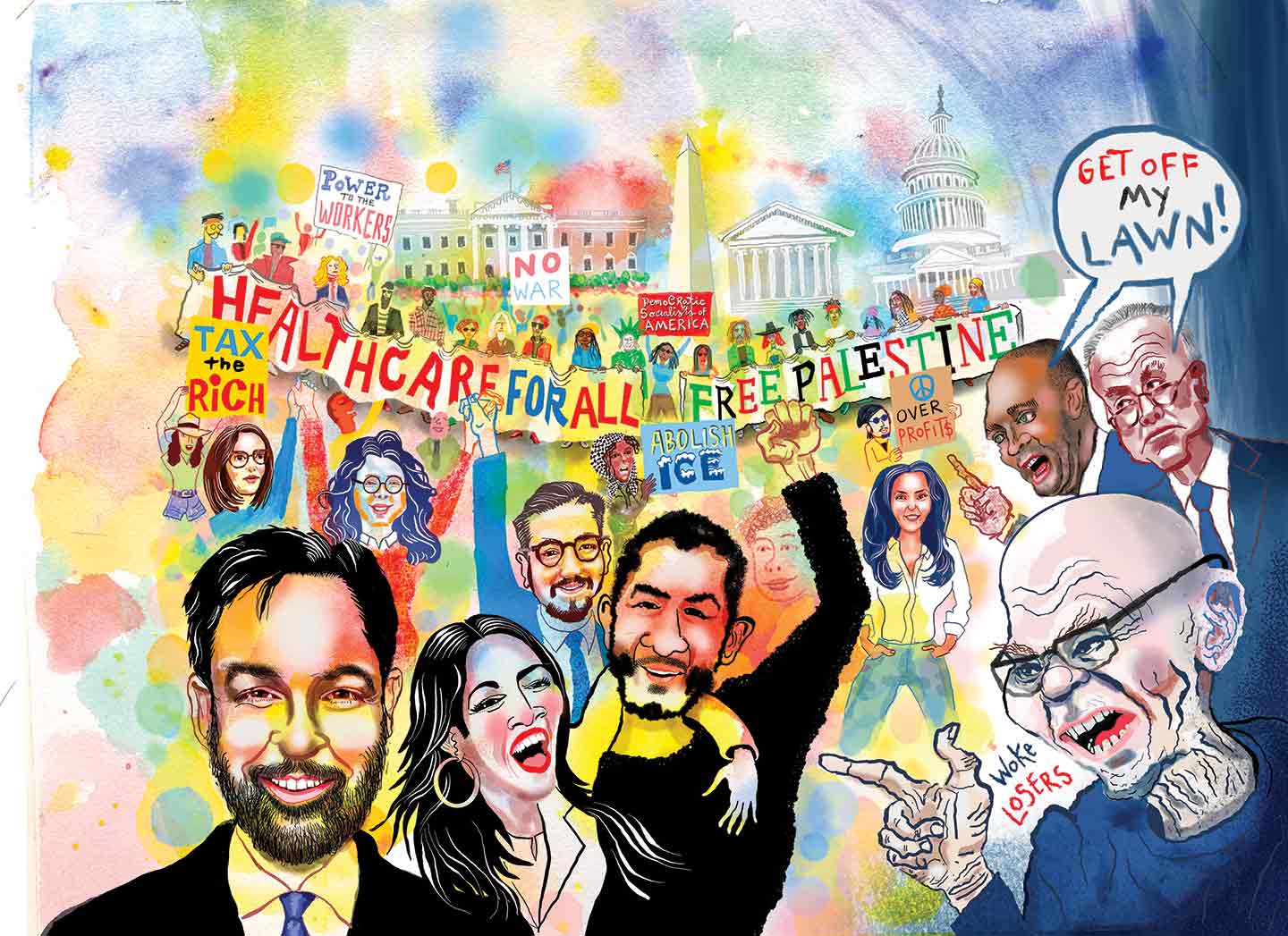
It’s hard to avoid viewing the current generational fractures within the Democratic Party through this lens. Where older Democrats differ from much younger ones, it’s generally along the lines of attitudes toward sexuality and gender and trust in institutions and authority figures (especially the police, the military, and religious and business leaders). These positions on culture and character in public life also readily translate into differing views on the role of government in society and the role of the United States in global affairs.
Nowhere are these fractures more apparent than in the growing, well-chronicled divide between the centrist and progressive wings of the party, the latter of which skews younger. So we’re not quibbling about definitions here, I’m going to use the Pew Research Center’s terminology for the two poles of the liberal coalition: The “leftward progressives” are the farthest left (and the youngest), while the members of the “order and opportunity left” are the farthest right.
Leftward progressives support trans rights and think billionaires are bad for society. They care about US involvement in global affairs but believe we mostly tend to make things worse. The members of the order-and-opportunity left are concerned about safety and are “moderate” on issues of sexuality and gender. This is a nice way of saying they’re happy with some immigration restrictions, generally trust law enforcement, think gender is mostly determined by sex assigned at birth, and tend to whine if anyone asks about their pronouns.
Leftward progressives overwhelmingly vote Democratic (97 percent went for Kamala Harris in 2024) but express some dissatisfaction with the party. In a survey published in 2026, Pew found a clear correlation between higher age and lower progressive sentiment within the party, with leftward progressives accounting for 26 percent of Democrats and Democratic leaners under 30 and 15 percent in the 30-to-49 cohort. From there, the drop-off is steep: Leftward progressives make up just 6 percent of the Democratic-aligned 50-and-older group. Not surprisingly, the picture for the order-and-opportunity left is a virtual photographic negative, comprising 15 percent of Democratic and Democratic-leaning voters under 30, 22 percent of those in the 30-to-49 cohort, and 31 percent of those in the 50-and-older group.
These categories are not perfect, but they still give a strong account of the generational disparities in voter attitudes. They are decent proxies for the younger, more progressive left and the older, more centrist liberals. The issues these two groups disagree on constitute the fault line that runs through the Democratic Party right now, presenting real challenges for a party that’s long been assailed as a stodgy gerontocracy—and, tellingly, the ascribed responsibility for this growing schism tends to increase as one moves down the life-cycle chart. According to much of the discourse coming from Democratic officialdom, the problem—as always—is kids these days.
The leftward progressives align closely in spirit and demography with the Democratic Socialists of America. Despite its relatively small national membership (in the low six figures), the DSA is a ready stand-in for the wide-ranging establishment lamentations about leftist overreach. The DSA’s status as the de facto brand for a political youth movement is not incidental to the critique; it’s a load-bearing wall.
And the DSA has gotten younger over the past decade. In 2013, the average age of a DSA member was 67. After Donald Trump was elected in 2016, it was 33—a trend that, like the overall growth of the organization, largely stems from the insurgent presidential candidacies of the outlying progressive octogenarian Bernie Sanders. Thirty-three isn’t that young, but given the median age of a member of Congress (57.5 in the House and 64.7 in the Senate as of January 2025), DSA members are practically tweens.
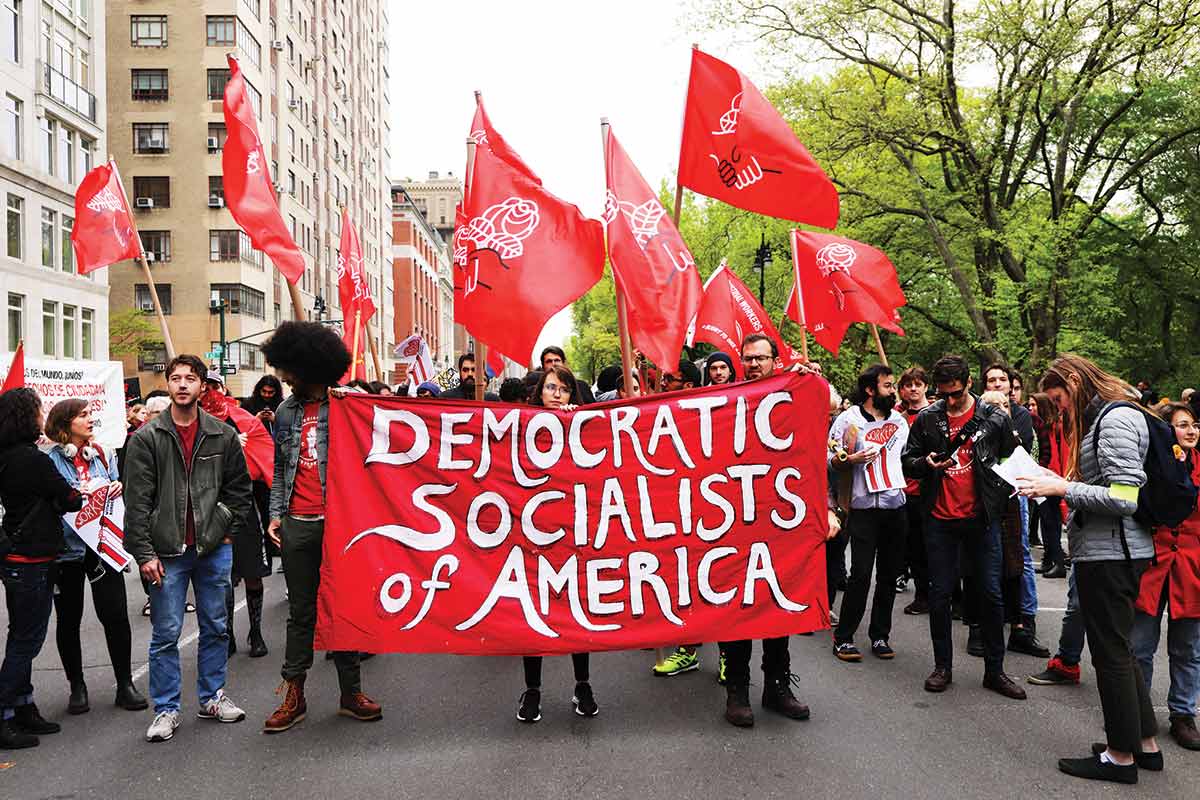
The fact that younger members of the DSA—the people most responsible for having increased the national membership so quickly, from 5,000 just before Trump’s first election to more than 120,000 today—are playing a more prominent role, as well as leadership fights within the organization, have led to some generational fractures even in the DSA itself, particularly over the issue of Israel’s genocide in Gaza. Maurice Isserman, who had been a member of the DSA for over 40 years, wrote in The Nation in 2023 about quitting the organization, claiming that it had become too harsh in its broadsides against Israel and wasn’t criticizing Hamas harshly enough. At its core, this is a rehash of the old antisemitism argument: that a particular concern for Palestinian lives is effectively a pointed attack on Jewish ones. Isserman cited “the singularly important role of Palestine in DSA’s rather short list of international concerns, completely overshadowing the attention paid, for example, to Russia’s invasion of Ukraine, or to the rights of other oppressed peoples, like the Kurdish Muslims, or China’s Uyghur Muslims.”
This has become a common refrain among older Democrats: that the situation in Gaza is of interest to young people only because it allows them to criticize Israel and, by extension, Jews. (This argument relies on a disingenuous and dangerous conflation of Israeli nationalism and Judaism that’s been weaponized by the right, but that is a sermon for another time.) It’s telling that Isserman elides the very obvious reason why younger progressives might be more vocal about the Gaza genocide: The United States has provided more economic and military aid to Israel than any other country since the founding of the Israeli state—an outlay of at least $21.7 billion since October 7 alone. We (and here “we” includes DSA members, who pay taxes just like the rest of the Democratic coalition) are not providing billions in aid to Russia, China, or the persecutors of Kurdish Muslims in Syria or Iran.
This posture, in other words, isn’t a consequence of undue hostility toward Israel so much as it’s a reflection of moral injury: the feeling that something must be done, but that structural forces block effective moral action. Older generations remember a very different set of attitudes toward Israel, and many assume that the relationship is or should remain the same as it has always been. Younger generations are more likely to view the US–Israeli relationship through the lens of Netanyahu’s regime and its attendant barbarisms, which they have more direct evidence of thanks to social media and a 24/7 news cycle. Of course they feel more strongly about it than conflicts in which the United States is either ostensibly on the right side (as in Russia’s war with Ukraine) or has far less involvement.
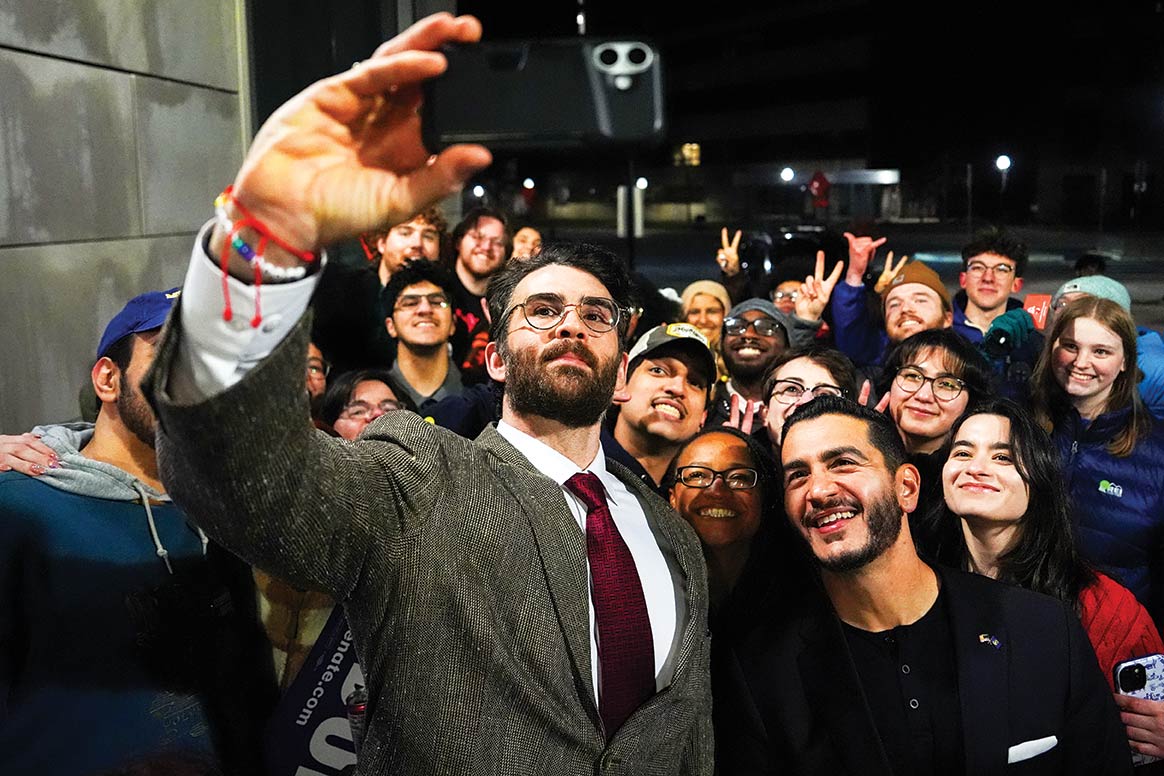
But that doesn’t stop high-profile centrists from insisting that anyone below a certain age who is critical of Israel’s actions in Gaza is antisemitic, especially if they happen to be a brown person. Case in point: The Atlantic’s Jonathan Chait, who wrote a column about Michigan Democratic Senate nominee Abdul El-Sayed’s relationship with Hasan Piker, whom Chait deems antisemitic for noting that it’s dangerous to conflate Israel and Judaism—a point echoed by many other Jewish people in the political center.
This brings us to another divide between the older generation and the younger: technology. If you don’t know who Hasan Piker is, he’s a political streamer on social media whose views are progressive. He is not the left’s Joe Rogan, because Rogan has said many more offensive things and no one is telling Republicans or California Governor Gavin Newsom to disassociate themselves from him. Nor is Piker formally connected to the Democratic Party apparatus. But he is popular with the youth. He has 3.1 million followers on Twitch and 1.9 million on YouTube. This level of influence is largely why centrist Democrats have determined that he is not just a problem but a “crisis,” in Chait’s alarmist formulation.
Determined to outdo Chait, the Democratic strategist James Carville has threatened to leave the Democratic Party entirely if Piker (who, again, is not a candidate, an operative, a consultant, or an officer of the DNC) becomes more of a “force.” “I am not going to be in the same party with Hasan Piker,” Carville proclaimed during one performance in his endless regress of kids-these-days cable hits.
Such tantrum-throwing may play well on television, but it makes for terrible political judgment. The ’90s-bred cult of studious difference-trimming and capitulation to the right that Carville helped pioneer continues to reinforce the Democrats’ image as a party terminally dedicated to preserving the status quo. In one recent, all-too-typical case, Representative Hakeem Jeffries, who will likely be the next House speaker if the Democrats do well in the midterms, faced a massive backlash after he met with Jared Kushner to discuss ways the Democrats could work with the Trump administration. Jeffries is on the younger end of the establishment (he’s 56) but is politically synched with his mentor Nancy Pelosi and Senate minority leader Chuck Schumer.
Our seniority-heavy caste of democratic leaders have been slower to acknowledge that we are in extraordinary times. In 2019, I wrote about Pelosi’s reluctance to impeach Trump (she said he was self-impeaching) and her simultaneous bigfooting of the newly elected leftist congresswomen who made up “the Squad.” Pelosi came around on impeaching Trump, but she went on to block Representative Alexandria Ocasio-Cortez from the senior position on the House Oversight Committee in favor of Gerry Connolly, a 74-year-old who died of cancer shortly after his appointment. Pelosi’s generation of leaders is quick to protect the management cohort of the party—which is now a full-on gerontocracy—from any encroachment by younger elected officials, even at the expense of the party’s future.
And they are incapable of acting as an opposition party; they don’t have the stomach for it. Their political instincts were formed during an era when elections were not determined, as they are now, almost entirely by negative partisanship. During the ’90s heyday of most of the figures who now make up the party’s leadership, engaging in civility theater was a sign of political maturity. Now voters view it mostly as a sign of weakness.
The former New York City comptroller and current Democratic nominee for Congress Brad Lander, a DSA-aligned progressive who jointly campaigned with Zohran Mamdani for mayor, has described the divide among Democrats as “folders” versus “fighters.” This line breaks down generationally, too. In this political environment, writing “very strong letters,” taking closed-door meetings with Trumpists, adopting Republican talking points about gender expression in the guise of “just asking questions,” and dismissing the concerns of women and people of color as “identity politics” looks like folding. Pushing for big systemic reforms that will trigger formidable political challenges (universal healthcare, tax reform that puts more of the burden on the rich and less on the poor, ambitious housing goals) looks like fighting. Standing up for trans people, criticizing the United States’ role in providing weapons to Israel, and biting back at GOP insults looks like fighting.
Younger Democrats are simply better equipped to act like an opposition party—in part because they don’t have the experience of being in power, either as a party or as an age cohort. They are less willing to wait patiently until the next election—or the next one or the next one—for Democrats to gain new seats or get around to exercising whatever power they already have.
I’m 49 years old and taught at New York University for six years and the School of Visual Arts for six years before that. I’ve worked on Democratic campaigns of all stripes, some with DSA candidates (including one with a younger Zohran Mamdani) and some with older, more moderate candidates in red states. I have been around many young Democrats; I’ve taught them, hired them, and also witnessed directly the pushback they get from Boomers and Gen Xers who resent their efforts to exert real political power instead of just sitting on the sidelines until they’re old and rich enough to own a house and have kids.
Yet the relevant divides remain as stubbornly cultural as they are material. It’s generally the case that older generations oppose student protests on the apparent assumption that students should earn their right to dissent, as if the First Amendment is something you graduate into.
When I defend younger activists and candidates, I always prepare for a barrage of facts about the alleged erraic levels of political engagement among this cohort that are technically true but often willfully misinterpreted. The first of these cherished data points is the one showing that younger people don’t vote as reliably as older people. But the people who cite this statistic assume it’s because the youths are too self-involved, or lazy, or possibly hungover from last night’s party. They almost never acknowledge that young people’s voter participation is heavily dictated by systems that fundamentally work against them.
Voting is a habit, and it’s instilled over many years as people get used to the cadence of elections—particularly in traditionally low-turnout contests such as primaries and downballot races. In addition, campaigns can’t afford to target everyone, so they often seek to identify likely supporters among those who have consistently voted over a period of years, which obviously leaves out younger people. Plus, the political participation of college students is actively suppressed by the right, which assumes that they’re more liberal than the general population. And it’s astonishingly easy to impose voter-suppression measures at universities and colleges where students are living away from home.
As a simple matter of self-preservation, elected officials (many of whom are much, much older if we’re talking about Congress) are less responsive to the needs of people who don’t have children or own homes. Younger voters are much less likely to fall within this charmed circle of the electorate than their grandparents—in part because of the political and economic windfalls that the older generation received.
Despite all of this, young people have been going to the polls in greater numbers over the past decade. As of this writing, the 35-year-old mayor of New York City is the seventh-most-popular Democrat in the country, and AOC is the fourth. Both are dues-paying members of the DSA.
If Democrats are in crisis, it’s not the fault of the young. They should not be held collectively responsible for a badly worded comment from a popular influencer who is not running for office. By contrast, Boomer Democrats have done nothing to hold their own cohort responsible for its ties to an ex-president and an ex–treasury secretary who palled around with Jeffrey Epstein. (James Carville is fine with Bill Clinton remaining a power broker in the Democratic Party, but a streamer he’d never heard of before last week is a bridge too far.) At 18, young people are deemed old enough by the US government to die for their country, sign up for hundreds of thousands of dollars in student debt, and be forced to bear children if they become unexpectedly pregnant. Many of them have to pay the same effective tax rates as older Americans who are far richer. They deserve political participation—and yet are continuously vouchsafed less than their fair share of it.
Leftward progressivism, as Pew calls it, is not just a youth movement (plenty of us on the left are old!). But it is a youth movement culturally, even as it’s built on the work of earlier generations. Because of that, older elements in the Democratic coalition find it threatening; it marshals a political movement around changing social norms, concerns motivated by a sense of moral injury during a formative period of life, differing expectations about what government can and should do, and a justifiably righteous conviction that it’s better to fight and lose on hard issues than not to fight at all. Which makes it very much like virtually every youth movement that came before it.
The idea that progressive young people are sabotaging the party from within with pronouns, keffiyehs, and wild, irrational ideas about what the government should be able to do for people that governments in other developed countries routinely manage to do is just another moral panic. I expect that the younger members of the party who emerge as leaders will prove their elders wrong. You can indeed see this process unfolding right now in Mamdanistan, where we have less violent crime, faster pothole repairs, a handful of city-owned grocery stores slated to open, and no open revolts.
More from The Nation
Pete Hegseth’s High-Tech Barbarism Pete Hegseth’s High-Tech Barbarism
In livestreaming Nidal Hasan’s execution, the secretary of war is marking his territory in the snuff movie business—and radicalizing people along the way.

Elon Musk’s James Talarico Smear Blew Up In His Face Elon Musk’s James Talarico Smear Blew Up In His Face
But that doesn’t mean the danger from Musk’s lies is over.

Latino Pride: Honoring Heritage, Challenging Columbus Day Latino Pride: Honoring Heritage, Challenging Columbus Day
Hispanic Heritage Month celebrates Latino culture and pride while prompting reflection on Columbus Day and Indigenous recognition.
This November, Vote Like Alito Is on the Ballot This November, Vote Like Alito Is on the Ballot
In this week’s Elie v. U.S., our justice correspondent gives Democrats another reason to vote in November. Plus: How Sarah Huckabee Sanders’s Medicaid unmasked the racists.
Does America First Really Mean Israel First? Does America First Really Mean Israel First?
Mike Huckabee’s aide shows how an extremist agenda dominates Trump’s Middle East policy.

