
4 Years After Dobbs, How Do We Count the Dead?
4 Years After “Dobbs,” How Do We Count the Dead?
In the post-Roe world, we know that abortion bans don’t stop safe abortions, but they do kill people.
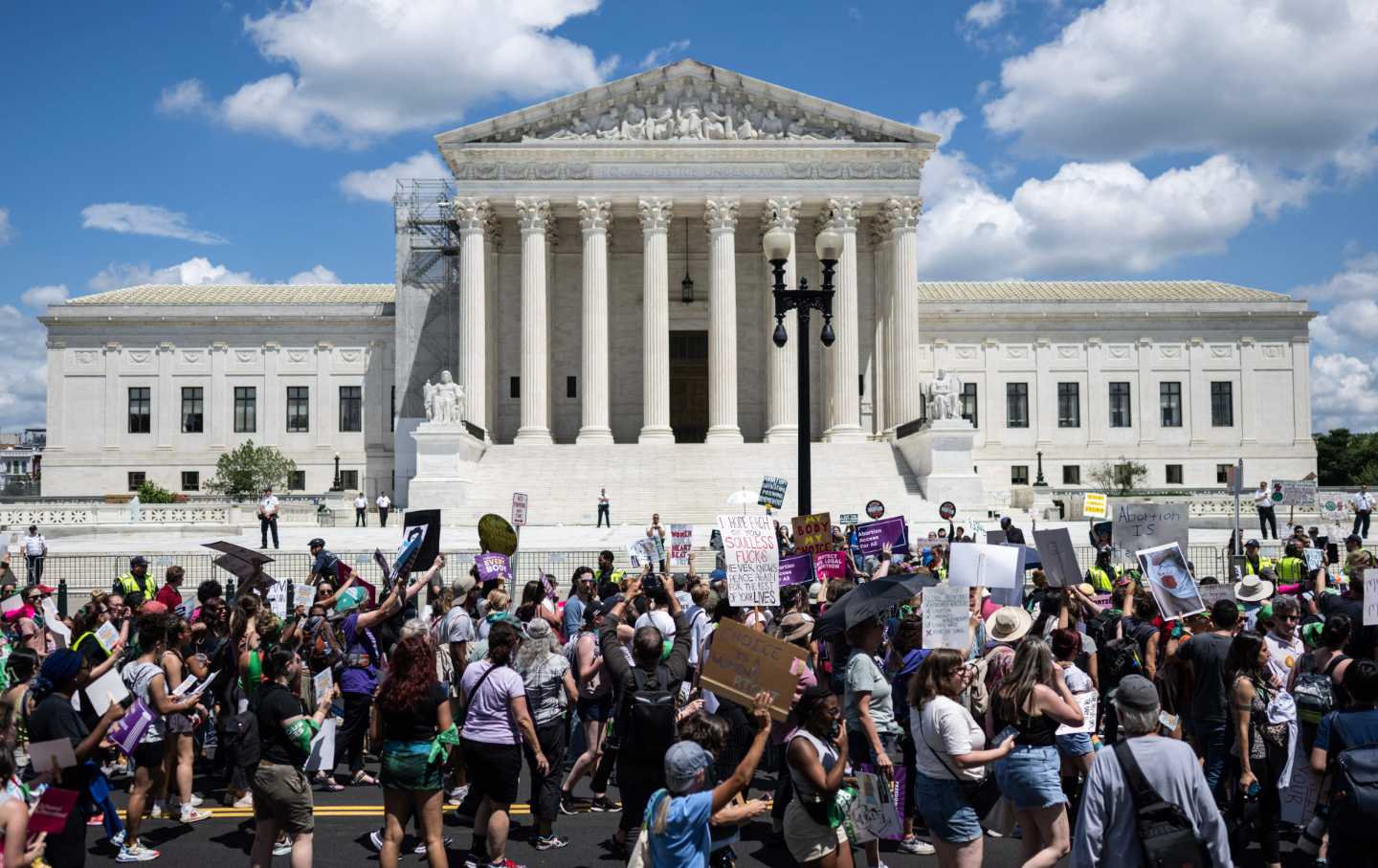
Abortion rights supporters rally to mark the first anniversary of the Supreme Court ruling in the Dobbs v. Jackson Women’s Health Organization case, which overtuned the right to abortion, on June 24, 2023.
(Andrew Caballero Reynolds / AFP via Getty Images)Four years after the Supreme Court overturned Roe v. Wade with its ruling in Dobbs, there’s an image I can’t get out of my head. Porsha Ngumezi was living in Texas when she suffered a miscarriage in 2023. Texas punishes medical providers who violate the state’s abortion ban with up to 99 years in prison. After Ngumezi showed up to the hospital bleeding and miscarrying at 11 weeks pregnant, ProPublica reported, doctors delayed providing a simple procedure to remove fetal tissue, and so she bled to death.
For months afterward, Porsha’s 3-year-old son would chase after women who looked like her on the street, shouting, “That’s Mommy!” That’s the detail I can’t forget. I can’t stop imagining that little boy chasing after strangers on the street.
Behind each death caused by an abortion ban is a loss of such immeasurable magnitude. So when we try to understand how many people have died from such bans since Dobbs, we can’t lose sight of the inestimable tragedy each death represents. Further complicating matters is that it’s very difficult for researchers to tell conclusively just how many deaths abortion bans have caused. One of the most comprehensive attempts, led by researchers from Johns Hopkins and UCLA, suggests that the number of such deaths by the end of 2023 might be 68. It’s a number that feels unfathomable, yet smaller than expected.
Also by Amy Littlefield
When the Supreme Court overturned Roe v. Wade, many in the reproductive-rights movement assumed that women would die in large numbers. Pregnancy was already more dangerous in the United States than in other developed countries. When more than a dozen states quickly banned abortion, it seemed likely many more people would be forced into pregnancy and some of them would die. Having covered pregnant women’s near-death experiences in Catholic hospitals prior to Dobbs, I also anticipated that more people would die in one particular circumstance: when they were miscarrying and doctors refused to end their pregnancy if the fetus still had a heartbeat. Research has revealed that, indeed, states that banned abortion saw an additional 22,180 births, an increase that was particularly high among those who have difficulty accessing abortion, including people of color and those on Medicaid. Additional reports show that at least a dozen women did die when lifesaving care was denied or delayed. But it’s been extremely hard to calculate just how many people have died because of Dobbs.
One reason for the ambiguity is the impact of the Covid pandemic, which killed a huge number of pregnant people—by some estimates, maternal deaths increased by nearly 60 percent between 2019 and 2021—making it hard to establish a baseline to which to compare post-Dobbs numbers. (It’s been especially hard because states that banned abortion also had some of the highest rates of Covid deaths.) In addition, even in a country with maternal mortality as unjustifiably high as ours, such deaths are still rare; in 2023, there were 662 maternal deaths and 1,979 deaths in the broader category of “pregnancy-associated” mortality. Such small sample sizes make it hard for researchers to reach solid conclusions, especially when they’re looking for changes in rural states with small populations. Nor does all the data researchers use to count these deaths appear to be accurate; Alabama, for example, reported fewer than 10 maternal deaths over a six-month period after it banned abortion, an inconceivably sharp departure from its previous track record, which was among the country’s worst. There’s also the fact that the states that banned abortion after Dobbs already had a host of abortion restrictions in place before the ruling, and those restrictions fell hardest on poor people of color—the very people most likely to die from pregnancy in America. Finally, there are controversies raging in the research community right now around how maternal mortality should be counted and whether our current approach is accurate.
With all those caveats, an article published in May in the American Journal of Public Health is the closest we’ve come to a Dobbs-related death toll. The researchers looked at death certificate data across all 50 states and Washington, DC, from 2016 to 2023, eliminated deaths that were attributable to Covid, and estimated that there has been a 9.2 percent increase in the number of pregnancy-associated deaths in the 14 states that banned abortion entirely or at six weeks in 2022. That’s the equivalent of 68 additional deaths by the end of 2023. Sixty-eight kids chasing after strangers on the street. Sixty-eight partners going to sleep without their wives. Sixty-eight moms wondering if they could have saved their daughters.
Those 68 deaths are considered “pregnancy-associated deaths,” which is the broadest of the three categories researchers use to track deaths related to pregnancy and childbirth. Pregnancy-associated deaths happen up to a year after delivery, and, while most are related to obstetric causes, about a quarter result from suicide, homicide, or drug overdose. It’s not out of the question to think abortion bans could have exacerbated even these non-obstetric deaths; a few recent studies have tracked an increase in suicides among reproductive-aged women following Dobbs, and pregnancy is a known risk factor for domestic-violence-related homicides. Researchers also detected a similar rise in the narrower category of pregnancy-related deaths, which are deaths up to a year after delivery that are obstetric in nature. The fact that the researchers didn’t find a rise in the narrowest category, maternal mortality—which includes deaths only up to 42 days post-delivery—doesn’t mean those deaths didn’t rise, given the limitations noted above, including the smaller sample size, which makes it hard to conclusively measure changes.
In fact, given these limitations, study co-author Alison Gemmill said she was surprised they were able to detect a measurable rise at all.
“When we first started this, I didn’t think we would be able to detect any signal, and then we went ahead and used our model and our methods, and we actually found something,” Gemmill, an associate professor at UCLA, told me, “and it persisted in the many ways that we test the robustness of our findings, so I think that surprised me.”
Her co-author, Suzanne Bell, associate professor at the Johns Hopkins Bloomberg School of Public Health, concurred. “Just the fact that we detected what looked like a pretty strong signal in relation to pregnancy-associated mortality and somewhat less so pregnancy-related [mortality], was honestly a bit shocking to us, and I think speaks to the strength of this potential relationship between abortion and mortality,” Bell said.
“Our findings suggest many preventable deaths have occurred in states that banned abortion,” Bell added, noting that today, even more states ban abortion entirely or at six weeks than the 14 she and her colleagues originally studied. “The number can only go up from there, so 68 and counting, I think, is a better way to define that number.”
But teasing out exactly how many deaths post-Dobbs abortion bans are responsible for will, in some ways, miss the point that such bans are not the only things making pregnancy in America uniquely dangerous. America’s maternal mortality crisis is inseparable from our ongoing twin crises of staggering inequality and structural racism, which make obtaining adequate medical care, especially for Black people, far more difficult than it should be.
“Inequality in our country is literally punishing; it gets under people’s skin and it kills them,” Amanda Jean Stevenson, associate professor of sociology at University of Colorado Boulder, told me. “There’s a causal effect of the fact that it is so hard to make it in America.”
In a country as unequal, stressful, and racist as ours, it’s incredibly difficult to isolate a single policy as the cause of someone’s death. The very states that banned abortion already had higher rates of maternal mortality, particularly among Black people, due to factors like lack of access to health insurance and care providers, Gemmill and Bell noted. Black women in America were already over three times more likely to die of pregnancy-related causes than white women. And abortion bans don’t impact people equally.
“There are many different ways that abortion bans impact deaths, and one of them is by preventing you from having an abortion, but a very important one is by making maternal care less good,” Stevenson added. “And who dies when the quality of care goes down? Who do doctors make exceptions for, to save their lives? Those are things that are going to fall along racial and class lines, because this is America.”
There’s a long-standing adage in pro-choice circles that abortion bans don’t stop abortions; they only stop safe abortions. Today, that adage needs a rewrite. The nature of abortion in America has fundamentally changed. Legal innovations in the form of shield laws that allow clinicians in blue states to mail medication abortion into states where it’s banned have driven an increase in the number of abortions, in part by extending access to people who couldn’t have made it to a clinic before Dobbs. In addition to wealth and geography, someone’s access to abortion today depends on an array of new factors, like whether they trust the Internet, and have a safe place to take abortion pills at home.
So a new adage for our era might be: Abortion bans don’t stop abortions; in fact, when clinicians and lawyers get creative, they can wind up leading to an increase in the number of abortions overall —but also, abortion bans have only exacerbated the crisis of racism and preventable pregnancy-associated death in this country. Or to simplify it a bit, abortion bans don’t stop abortions, but they do kill people. They kill women, in higher numbers, but in many of the same, preventable ways, that these women were dying before. All of which was completely and utterly predictable.
There’s a wider question that all this raises, which is one that preoccupied me as I was writing my book, Killers of Roe. It is how we’ve developed such a collective tolerance for women’s deaths. “How [did] we get to a place where 68 deaths isn’t very many deaths?” Stevenson asked.
The answer is that we started in a place where one death didn’t seem like enough.
Popular
“swipe left below to view more authors”Swipe →In 1977, Rosie Jimenez died in a hospital in agony after contracting an infection from an unsafe abortion that she sought because the Hyde Amendment had cut off Medicaid funding for abortion. Pro-choice activists like Frances Kissling who tried to draw attention to her death at the time were stymied not just by society at large but by their own movement. “I was told over and over that people are not concerned about the death of one woman,” Kissling later wrote.
According to Kissling, some of her peers in the white-led pro-choice movement didn’t see an unmarried Latina who was on her third abortion as a sympathetic enough figure to rally around. So the movement and the country moved on from this death of immeasurable magnitude.
At her mother’s funeral, 4-year-old Monique Jimenez watched as the coffin was lowered into the dirt, and asked, “Where is my mommy going?”
The policy that killed Jimenez endures to this day and has been renewed by every Congress, whether Democrat or Republican, since 1976. That is how we got here. When one death isn’t enough to stop the march of abortion bans, then that march continues, and more deaths will predictably follow.
“Any maternal death is a tragedy, because you’re thinking about the loss of a person,” Alison Gemmill told me. “But you’re thinking about the effects that it has on the family, and we know that a lot of mothers who die are not just first-time mothers. They have children at home. They’re part of their community.”
The number 68 is at once surprisingly low and unfathomably large, when you measure it in terms of daughters wondering where their mommies are going, when you measure it in terms of little boys who chase after strangers on the street.
So, to take another shot at updating the adage: Abortion bans don’t stop abortions, but they did kill an estimated 68 people by the end of 2023.
And that should be more than enough to stop us in our tracks.
Support The Nation’s June Fundraising Campaign
With the midterm elections now firmly upon us, the question is whether Democratic candidates will do more than merely occupy ballot lines as mild alternatives to the red-hot crisis that is Donald Trump.
As Trump spends over $1 billion a day on a globally destabilizing war on Iran and admits that he doesn’t “think about Americans’ financial situation,” millions across the country are struggling with the surging costs of essentials. Democrats must seize this moment and advance bold, small-“d” populist ideas—not settle for cynical caution that once again snatches defeat from the jaws of victory.
The Nation elevates progressive ideas, movements, and elected officials achieving real change across the country into the national conversation. At the same time, our journalists are exposing how crypto and AI-funded super PACs are spending hundreds of millions of dollars to knock out candidates they oppose, reporting on the devastating impact of the Supreme Court’s evisceration of the Voting Rights Act, and sounding the alarm on attempts by red states to quickly redraw electoral maps, disenfranchising Southern Black voters.
We can play this critical role because of support from readers like you. This June, we’re raising $20,000 to power The Nation’s independent journalism in the run-up to November’s immensely consequential elections.
It’s in our power to build a more just society, and your support at this critical moment brings us closer to that bold vision. I hope you’ll donate today.
Onward,
Katrina vanden Heuvel
Editor and Publisher, The Nation
More from The Nation
The Supreme Court Loves Religious Freedom—Just Not for Rastafarians The Supreme Court Loves Religious Freedom—Just Not for Rastafarians
In a far-reaching ruling, the court violated a man’s constitutional rights—and undermined fundamental civil rights protections.
250 Years of Genocide, Theft, and Displacement 250 Years of Genocide, Theft, and Displacement
Natives have nothing to celebrate as the United States stages another sick-making festival of self-congratulation.
The Celebration of the Nation's Birth Is Still a Sham The Celebration of the Nation's Birth Is Still a Sham
If America must observe its 250th anniversary, let it be by taking stock of Reconstruction’s unfinished mission.
How Can We Reimagine Higher Education in the Age of Climate Change? How Can We Reimagine Higher Education in the Age of Climate Change?
An interview with the founders of Gull Island Institute.
America Is Due a Third Reconstruction America Is Due a Third Reconstruction
The nation can thank the Supreme Court for its periods of turmoil. It’s time for a new jurisprudence.
Will America Ever Give White-Man Rights to Everyone Else? Will America Ever Give White-Man Rights to Everyone Else?
If we want to make it another 250 years, the Constitution is going to have to do a lot more than protect individual political and civil rights.

