The Supreme Court Loves Religious Freedom—Just Not for Rastafarians
In a far-reaching ruling, the court violated a man’s constitutional rights—and undermined fundamental civil rights protections.
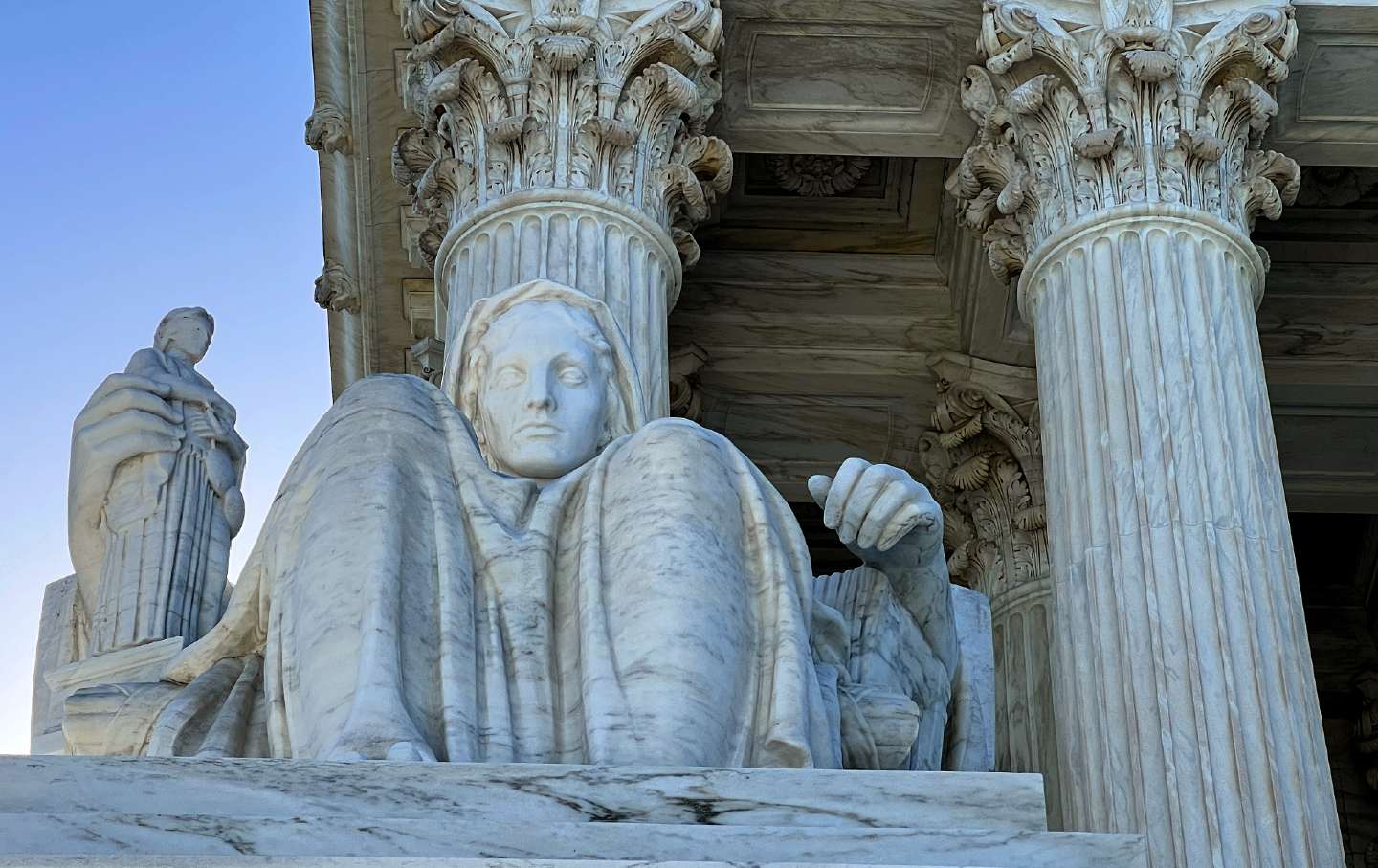
The statue Contemplation of Justice sits above the west front plaza of the US Supreme Court Building.
(Chip Somodevilla / Getty Images)Some days, the Republicans on the Supreme Court inflict rank harm on individuals who happen to be Black (or happen to be women or LGBTQ+). Other days, they attack the whole group, ripping down entire legal structures that Black people (or women or the LGBTQ+ community) rely on for protection.
On Tuesday, the Republican majority did both. In a 6–3 ruling that broke along fascist–Democrat lines, the court managed to ignore a blatant violation of a prisoner’s constitutional rights and neutered an entire federal law meant specifically to protect people in prison. And then, just for good measure, it continued its assault on congressional authority.
The case the Republicans used to do all this is called Landor v. Louisiana Department of Corrections. It involves the harrowing experience of Damon Landor, who was serving a short prison stint—just a few months—for drug possession. Landor is Rastafarian. As part of his faith, he is required to grow his hair into dreadlocks and not cut it. Landor had grown his hair for 20 years, including during his time at two different Louisiana prison facilities. In 2020, with about three weeks left of his sentence, Landor was transferred to a third one.
Landor was aware of his constitutional right—under the Free Exercise Clause of the First Amendment—to keep his hair, but he was also aware of Louisiana’s penchant for ignoring prisoner’s rights. He went to the third jail with a printed copy of the 2017 legal opinion that explicitly protected the right of religious prisoners to keep their dreadlocks.
According to court documents, the guards were “unmoved” by federal law. The intake guard literally ripped up Landor’s copy of the ruling and threw it in the trash. Then he called for the warden. The warden asked if Landor had a ruling from the specific sentencing judge in his case. Of course he did not, since the issue didn’t come up at sentencing, and judges don’t make a habit of writing the entire First Amendment of the Constitution into the margins of their decisions. Unable to produce what he didn’t need in the first place, the guards strapped him to a chair and forcibly shaved his head.
Landor sued the officers who violated his rights under the Religious Land Use and Institutionalized Persons Act of 2000 (RLUIPA). This federal law requires prisons that take federal funds to accommodate their residents’ religious rights. The law actually gives people in prison protections beyond what is required by the Constitution, including the right to sue correctional officers who violate those protections.
Or the law did do that—until the Supreme Court’s Republicans got ahold of it. The majority ruled that correctional officers cannot be sued under the RLUIPA unless they agree to be sued. You can imagine how often that happens. Despite the fact that Landor suffered a clear violation of his religious rights, and that there was an entire federal law that gave him the right to sue, the court ruled that Landor cannot hold anybody accountable.
Usually, the Supreme Court treats the Free Exercise Clause as if it were written on a Dead Sea Scroll. For at least a decade now, the easiest way to win in front of the Christofascist Republican supermajority on the court has been to claim a violation of religious freedom. But this case raises the question of whether their religious tolerance extends only to the right kinds of Christians: the ones who are using their “beliefs” to treat the country’s women as brood mares, not the ones who just want to grow their hair out and leave other people alone. If your interpretation of faith hinges on hating LGBTQ+ people so much you won’t bake a damn cake, the court will allow you to sprout hooves just so you can trample on the rights of others. And, I suspect that if a Catholic had said they needed to grow their hair out like the inaccurate depiction of white Jesus so many of them favor, the Catholics on the court wouldn’t have allowed the state to forcibly cut that person’s hair. Maybe Landor should have dyed his hair blond.
Landor wasn’t growing his hair out to protest metrosexual manscaping or whatever. He was engaging in a narrow and deeply personal act of faith. So, like the prison guards, the court was unmoved by his religious objections. Indeed, the way the court squared its normally robust protection of religious freedom with its decision to allow Landor’s rights to be flagrantly violated was to pretend the case wasn’t about religion at all. What this meant is that the justices who are normally loudest about the free exercise of religion when plaintiffs want to justify bigotry—Samuel Alito, Amy Coney Barrett, and alleged attempted rapist Brett Kavanaugh—were silent in this case. They let Neil Gorsuch, who is the least Jesus-freaky among the Republican justices, write the majority opinion.
Like the prison warden in The Shawshank Redemption, Gorsuch excels at being obtuse. There is never an elephant too big for Gorsuch to ignore.
In his Landor opinion, Gorsuch devotes all of one paragraph to the First Amendment violation at the heart of the case. Instead, he casts the whole thing as an examination of Congress’s power under the Spending Clause. Congress, Gorsuch argues, does not have the power to create a right to sue people just because those people work for an organization that receives federal funds. That means Congress cannot make the correctional officers in Louisiana answer to lawsuits simply because Congress passed a whole-ass law making them answerable to lawsuits.
Instead, Gorsuch argues that employees of institutions that accept federal funds have to agree to be sued under the RLUIPA before such lawsuits can proceed. He reformulates Congress’s legislative power as a “contract” and says that individuals cannot be held accountable to the terms of the contract unless they agree to them.
That’s not how laws work! Gorsuch’s formulation is a shocking repudiation of Congress’s right to legislate. Congress wrote a law, and it said that the law applies to all who “agree” to take federal funds. Correctional officers in Louisiana receive federal funds. Most people understand this transfer of federal dollars into private hands as a “paycheck.” Arguing that receiving a federal paycheck doesn’t bind people to following federal laws is madness.
It’s easy to think that Gorsuch is just taking another one of his swipes at congressional authority, and he is, but there is an even more sinister point to this argument. Justice Ketanji Brown Jackson exposes Gorsuch’s true motive in her dissent. She writes:
Popular
“swipe left below to view more authors”Swipe →Today’s decision magically transforms a federal statute into an invitation to be accepted or declined, deemed binding only if each particular defendant has explicitly agreed to be penalized. No matter that laws, as opposed to contracts, don’t ordinarily work this way. The trick here is the majority’s effortless conflation of law making and agreement making—two different sources of binding authority.
…In the end, the Court reduces some of Congress’s greatest legislative achievements—federal laws that secure civil rights, environmental stability, healthcare, and more—to nothing more than the wheelings-and-dealings of an especially wealthy private party. Because I would not so trivialize a federal statute or the constitutional powers pursuant to which it was passed, I respectfully dissent.
The entire structure of civil rights laws is based on the premise that receiving federal dollars makes you subject to federal rules and consequences. Gorsuch would throw that entire premise into the trash. In his world, you are subject to federal civil rights laws only if you personally agree to follow them.
Under Gorsuch’s reasoning, any civil rights law that is executed under the Spending Clause could be interpreted as a mere suggestion that can be ignored if you don’t personally vibe with it. That would include Title VI of the Civil Rights Act, which prohibits discrimination on the basis of race, and Title IX of the same act, which prohibits discrimination on the basis of sex. It would also include most of the enforcement mechanisms in the Americans with Disabilities Act.
This is the real reason Landor is a Supreme Court case at all. The Fifth Circuit Court of Appeals had already thrown out Landor’s claim under the RLUIPA. Since the Supreme Court merely affirmed the Fifth Circuit ruling, it didn’t really need to take the case at all. It didn’t have to expose its hypocrisy when it comes to whom freedom of religion is really for. The Republican supermajority took the case to take a shot at these fundamental protections of civil rights.
Whether or not the court carries through on Gorsuch’s extremist reasoning will be an issue for future cases. But we can expect those cases to come now that Gorsuch is telling everyone that civil rights laws are handshake agreements instead of actual rules.
Neil Gorsuch and the Supreme Court Republicans are no better than the mouthbreathing prison guards who forcibly violated Damon Landor’s rights. You can present them with an entire law, and they’ll just rip it up and throw it in the trash before taking away your rights.
Become a Sustaining Donor This September
Between the reemergence of right-wing red-baiting and Donald Trump’s use of the chilling National Security Presidential Memorandum–7 to criminalize left political organizing, we’re seeing McCarthyism reborn before our eyes.
This assault on democracy cannot be ignored or wished away. Resisting it requires bravery in the face of threats and repression, a steadfast commitment to the truth, and the unwavering belief that we can—and will—overcome this darkness.
We must have an independent media that sets the record straight, unearths corruption and abuses of power, and advances a politics of justice and dignity for all if we’re to win this fight.
That’s why I’m writing to you today. This September, The Nation needs to add 100 monthly donors to sustain our progressive journalism. Your contribution makes the next investigative report, the next truth-speaking column, and the next pathbreaking essay all possible.
I hope you’ll support our work with a recurring donation today. If you donate $10 or more a month, we’ll send you a brand new “Hands Off the Free Press!” sticker to recognise your commitment to our cause. Please, donate today.
Onward,
Katrina vanden Heuvel
Editor and Publisher, The Nation