
To Build the Anti-War Movement of the Future, We Must Learn From the Past
What history can teach us about where the anti-imperialist left should go now.
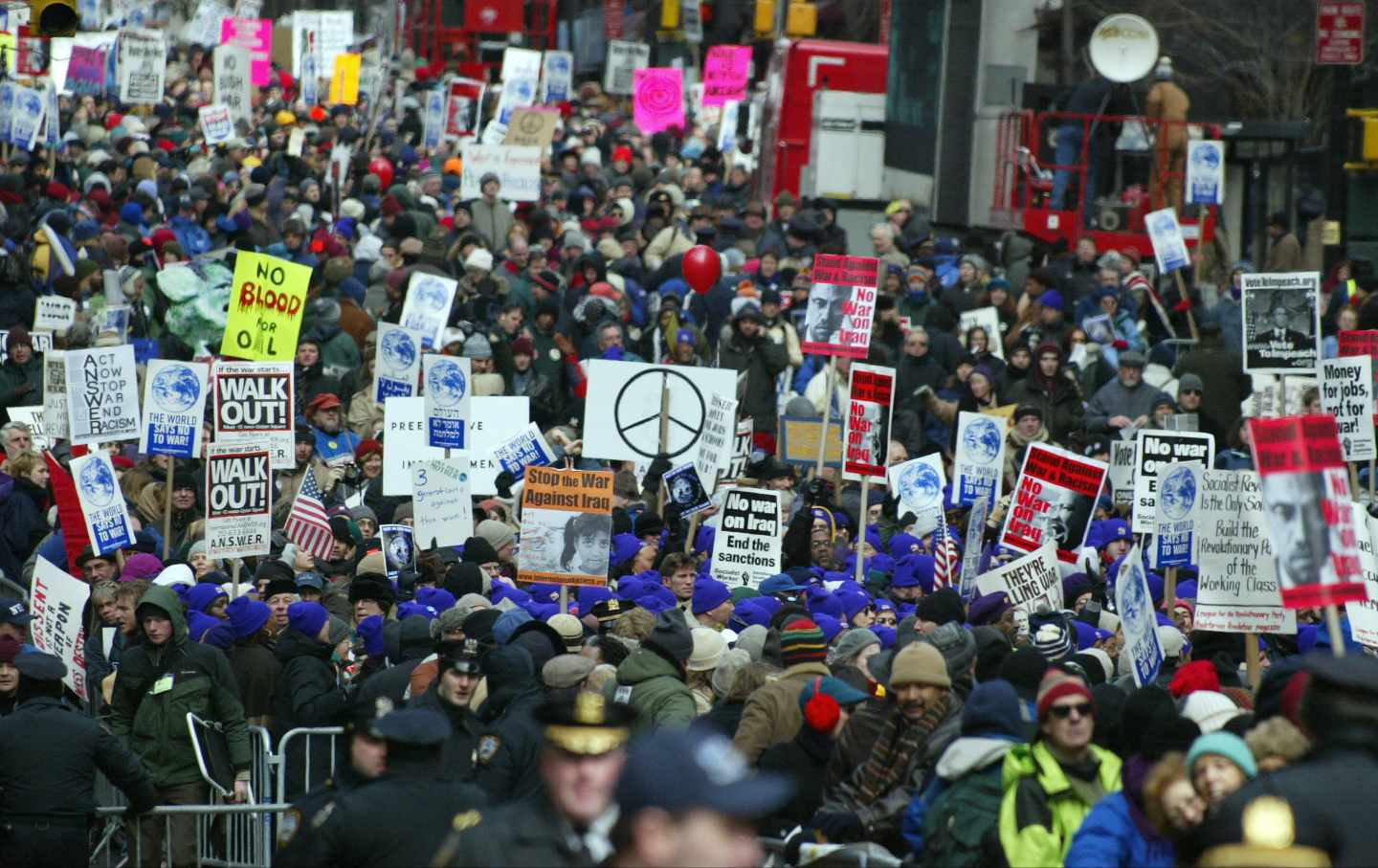
An anti–Iraq War demonstration in New York City on February 15, 2003.
(Don Emmert / AFP via Getty Images)During a phone call on a warm day in August 2002, the two of us came to an unmistakable conclusion: This bastard is going to take us into war with Iraq!
The “bastard,” of course, was then President George W. Bush, who was in the midst of an aggressive propaganda campaign about the alleged danger posed by Saddam Hussein’s weapons program.
As we all know now—and many of us knew then—that program did not actually exist. The real threat to the world was sitting in the White House, not in Baghdad. And the two of us knew we had to do something about it. So, along with many other allies, we got to work, helping to form United for Peace & Justice, the largest of the coalitions that mobilized against US aggression in Iraq.
It is with this background that we offer several thoughts in response to, or, better put, inspired by Eric Blanc’s excellent recent essay on the relative lack of a movement against the war in Iran—and the compelling need to build one. To be clear: This period is very different from the early 2000s, above all because we face a genuinely fascistic MAGA movement that makes the Bush/Cheney/Rumsfeld group look like amateurs. But the question still remains: Both Donald Trump and the Iran War are deeply unpopular, so why has no mass movement emerged to fight this conflict?
Before discussing the strengths and failures of the last major anti-war movement, we need to step back and look at US history. What that history shows is that the inability to build and sustain an anti-war movement or mass presence is directly linked to the absence of what one might call an anti-imperial/pro-democratic foreign policy on the part of progressive movements. As a result, those who adhere to the notion of a need for peace and justice find ourselves in a Groundhog Day scenario on a regular basis, trying our best to ignite or reignite a mass movement against US aggression each time that aggression raises its ugly head.
The United States has a long history of anti-war movements, and many of them have followed a similar pattern:
- They tend to be short-lived, particularly if most Americans don’t seem to feel the impact of the war in their own lives.
- They immediately conflict with and are often overwhelmed by pro-imperial/allegedly patriotic sentiment.
- They are focused on a particular crisis rather than the imperial system
Time and space do not permit an examination of each of these points, but we would note a few.
Anti-war movements are not instrumentally initiated or connected by only one political or social force, and people who share an opposition to war don’t always do so for the same reasons. There were those, for instance, who opposed the Spanish-American War and the US war against the Philippines because they did not want to see additional people of color becoming US citizens. Other people recognized the criminality of these wars and saw in them a contradiction with the formal and stated objectives of the United States.
This lack of agreement can hamper the sustainability of an anti-war movement. Once Spain was defeated, followed 11 years later by the defeat of the Philippine resistance, the wind vanished from the sails. There was no anti-imperialist consensus that could keep the forces engaged over a longer period of time. The colonized peoples of the Philippines, Puerto Rico, Guam, and Cuba became old news, and the power of Manifest Destiny appeared, to many, to justify the aggression and annexation carried out by Presidents McKinley, Roosevelt, and Taft.
Other movements had to contend with the harsh power of the federal government. There was significant opposition to US participation in World War I, including from the Socialist Party and the Industrial Workers of the World. Yet, taking advantage of the sinking of the Lusitania and revelations of the so-called Zimmerman Telegram, President Wilson successfully utilized jingoism and patriotism, along with active state repression, to crush anti-war opposition leading up to and following the US entrance into the war.
Opposition to US intervention in the Caribbean and Central America in the 1920s was courageous but largely short-lived. More concerted resistance could be found in the Black-led opposition to Italy’s invasion of Ethiopia in 1935, and the broad support for the Spanish Republic in the infamous civil war of 1936–39. But these last two movements were not precisely “anti-war.” Rather, they were a form of antifascist internationalism that, to varying degrees, sought to shift US foreign policy with respect to both conflicts.
Which brings us to the one powerful example of an anti-war movement that did advance a conscious critique of US imperialism and, at least briefly, posed an alternative. Well before the United States started bombing and sending troops into southern Vietnam in 1965, a few Members of Congress were insisting that the government’s broad policy of militarized containment in South Asia was a failure. Oregon Senator Wayne Morse used language in early 1964 that in other contexts would have been vehemently left-wing, insisting that the US was repeating “the great mistakes of France, Great Britain, the Dutch, and the Belgians in Asia. It is colonial, no matter what it may be called. Colonialism in the world is as dead as a dodo. American colonialism has no possible chance to succeed, either…. We are supporting a totalitarian, military, tyrannical, puppet government in South Vietnam…. I am not going to vote in the Senate to kill American boys to support tyranny in South Vietnam—or anywhere else in the world.”
At the time, Morse was an outlier, but by the early 1970s—thanks, in large part, to organized, committed anti-war and anti-imperialist activists who spread the kinds of principles Morse had expressed to a vast, nationwide movement—a substantial bloc in Congress was calling for demilitarization, an end to interventions both covert and otherwise, and a foreign policy based on respect for human rights.
The next two decades were marked by the lingering effects of the Vietnam movement, with grassroots organizing against European colonialism in Africa, white minority rule in Southern Africa, and US intervention in the Caribbean and Latin America. The CIA and FBI’s practices of external and internal counterinsurgency were exposed by Congress’s Church and Pike Committees. Reagan’s efforts to refight Vietnam in Nicaragua and El Salvador were hamstrung in Congress, which also passed comprehensive sanctions on South Africa in 1986 over his vetoes. But this alternative approach did not survive the end of the Cold War, and by 2002, as the Bush administration geared up to attack Iraq, the anti-war movement virtually had to start from scratch.
Through the work of myriad forces and individuals, United for Peace & Justice (UFPJ) was created as a broad and anti-sectarian coalition in October 2002. It was not owned by any individual or organization.
UFPJ, particularly through the leadership of the renowned Leslie Cagan, the energy of Code Pink, and the deep engagement of so many anti-war organizations and allies, became a center of attention within the movement. Particularly noteworthy were the massively successful February 15, 2003, mobilizations, carried out in alignment with anti-war movements across the planet.
And yet, we were unable to stop the invasion of Iraq. Although almost 60 percent of Democrats in the House voted against the October 16, 2002, “Authorization to Use Military Force Against Iraq,” the bipartisan pro-war consensus was overwhelming, and the WMD propaganda campaign—amplified by a credulous media—convinced a majority of the public that war was necessary.
Once the invasion took place and Hussein’s forces were defeated, much of the anti-war movement suffered from dismay, if not despair, that such a mass show of resistance had not stopped this atrocity. Instead of preparing for a protracted effort, many in the movement walked away. Although UFPJ kept organizing large protests both at the national level and locally through many hundreds of its member groups, we were unable to construct a strategy that would sustain large-scale engagement as that war settled into a quagmire. And there was little attention to the electoral fights that needed to take place to deepen the anti-war effort. This was compounded by the challenge of how to understand the nature of the military resistance that emerged in Iraq, resistance that was frequently sectarian and reactionary in its politics. (Anyone wanting to delve more deeply into the history of that movement should consult the historian Jeremy Varon’s Our Grief Is Not a Cry for War: The Movement to Stop the War on Terror.)
Looking back, UFPJ was the last iteration of the broad mobilizing coalitions that periodically assembled from the late Vietnam War years through the First Gulf War in 1991. We will probably not see its like again. So the question becomes, what kind of organized movement can we build now?
History may have caught up with us. The absence of any substantive attention to foreign policy in the progressive movements of the past 15 years—from Occupy to the Bernie Sanders campaigns to Black Lives Matter to the “resistance” of Trump’s first term—means that we are virtually back at square one. Neither of the two major national left formations in the present, Democratic Socialists of America and the Working Families Party, nor the bigger and broader left-liberal organizations like Indivisible, have much to say about the US role in the world. Fortunately, there is one large exception to this otherwise remarkable silence—the movement for Palestine, which has mobilized in ways not seen since the peak of the anti-apartheid movement in the 1980s. The entry of the anti-war message into the “No Kings Day!” rallies on March 28 is, perhaps, a further recognition of the need to integrate foreign and domestic policy. The question then becomes how to build upon that energy in order to offer a broader critique of empire ahead of the 2026 and 2028 elections.
Before considering options in the present, however, we need to look at underlying ideological factors.
Most Americans don’t see their country as the center of global empire. Patriotism becomes a mechanism to shield administrations from the mobilized criticism that is necessary in order to build a sustained anti-war movement. “Bad” wars are treated as mistakes or miscalculations, rather than actions driven by the larger objectives of capital and national elites. Thus, the resolution of a particular conflict becomes the apparent resolution of a crisis.
Anti-war movements cannot be sustained in the absence of internationalism. The examples of Ethiopia and Spain are noteworthy precisely, as noted, because the movements that emerged were not anti-war movements, at least in a traditional sense. While they obviously opposed the Italian invasion of Ethiopia and the Francoist/Nazi/Fascist war imposed on Spain, in both cases, these movements were also seeking a different policy by the US government. In that sense, these movements were not saying “US OUT,” which is the normal framing of anti-war protests. Rather, they were seeking something else. Therein lies the clue for the future.
To sustain an anti-war movement, the core of that movement must embrace a vision and program for an alternative foreign policy by the USA. We are not talking about a utopian future but precisely the sort of foreign policy we would want, let’s say, for the “Squad” or Bernie Sanders to implement, were they in office. Such an approach would move us away from single-issue opposition and toward a framework that helps masses of people understand that the atrocities that the USA unleashes go beyond the perverse mental framework of this or that political leader, but can frequently be advanced by politicians who have liberal, if not center-left, domestic policies.
Popular
“swipe left below to view more authors”Swipe →Concurrently, existing peace and justice forces must develop both a platform for a democratic foreign policy plus an internationalist strategy that is in line with antifascist initiatives in domestic politics. Much like the late and iconic Jack O’Dell suggested more than 20 years ago in his “Democracy Charter,” the platform for a progressive future must integrate the foreign and the domestic and, through doing so, demonstrate that the foreign is domestic.
Peace and justice forces must also grapple with the hard reality that the USA is one of many forces advancing international evil. We cannot afford to remain silent in the face of acts of foreign aggression, even if the perpetrator is not the USA (or one of its allies).
We must challenge unilateralist “America First” policies. This includes a fight to defend and reform the United Nations so that it is fully an instrument for global peace and cooperation and not a realm for the major powers to dictate outcomes. We must integrate foreign policy and the battle against environmental catastrophe, which is, absolutely, an internationalist issue.
Our approach to anti-war activity must shift toward a recognition that building a sustained anti-war presence is as much an ideological struggle against the framework of imperialism as it is a practical struggle involving mass mobilizations and creative tactics. It is a struggle that necessitates that progressives, including but not limited to anti-war activists, embrace a framework of internationalism that centers the struggle for progressive political power as an instrument to practice rather than rhetorize that same internationalism.
To put it another way, the internationalism that we need, and the anti-war activity that we need, must go beyond protests and resolutions. It must work itself directly into the activity of governmental bodies. We should ask not only what kind of government we are demanding but what kind of foreign policy progressives intend to implement once achieving governing power. That is truly where the “buck” will stop.
Become a Sustaining Donor This September
Between the reemergence of right-wing red-baiting and Donald Trump’s use of the chilling National Security Presidential Memorandum–7 to criminalize left political organizing, we’re seeing McCarthyism reborn before our eyes.
This assault on democracy cannot be ignored or wished away. Resisting it requires bravery in the face of threats and repression, a steadfast commitment to the truth, and the unwavering belief that we can—and will—overcome this darkness.
We must have an independent media that sets the record straight, unearths corruption and abuses of power, and advances a politics of justice and dignity for all if we’re to win this fight.
That’s why I’m writing to you today. This September, The Nation needs to add 100 monthly donors to sustain our progressive journalism. Your contribution makes the next investigative report, the next truth-speaking column, and the next pathbreaking essay all possible.
I hope you’ll support our work with a recurring donation today. If you donate $10 or more a month, we’ll send you a brand new “Hands Off the Free Press!” sticker to recognise your commitment to our cause. Please, donate today.
Onward,
Katrina vanden Heuvel
Editor and Publisher, The Nation
More from The Nation
Netanyahu Came to New York. New Yorkers Were Ready for Him. Netanyahu Came to New York. New Yorkers Were Ready for Him.
Scenes from the defiant protest against the genocidal leader’s UN speech.
A Message From Prairieland Prisoner Autumn Hill: “Don’t Be Afraid” A Message From Prairieland Prisoner Autumn Hill: “Don’t Be Afraid”
I talked to the political prisoner about the politics of love, her case, surviving as a trans woman in a men’s prison, and how she makes it through the day.
The Impossible Will Take a Little While: The Power of Persistence The Impossible Will Take a Little While: The Power of Persistence
In troubled times, history offers a lesson: Seemingly impossible change can begin with ordinary people who refuse to give up.
Gloria Steinem’s Many-Splendored Feminist Life Gloria Steinem’s Many-Splendored Feminist Life
The feminist icon lived the struggle for gender equality and always found time to lend support and solidarity to other women leaders, even in her final days.
No, Woke 1 Was Not Crazy No, Woke 1 Was Not Crazy
AOC and others are laughing off 2020 as a wild, isolated moment. None of that is true.
How Occupy Wall Street Still Explains Politics Today How Occupy Wall Street Still Explains Politics Today
It sowed the seeds for a new era of social movements—but its politics of powerlessness should act as a cautionary tale.

