The Iranian Diaspora Is Fracturing Over Trump’s War
Friendships have ruptured. Families have bitterly split around the kitchen table. Violent speech has become the dominant mode of discourse.
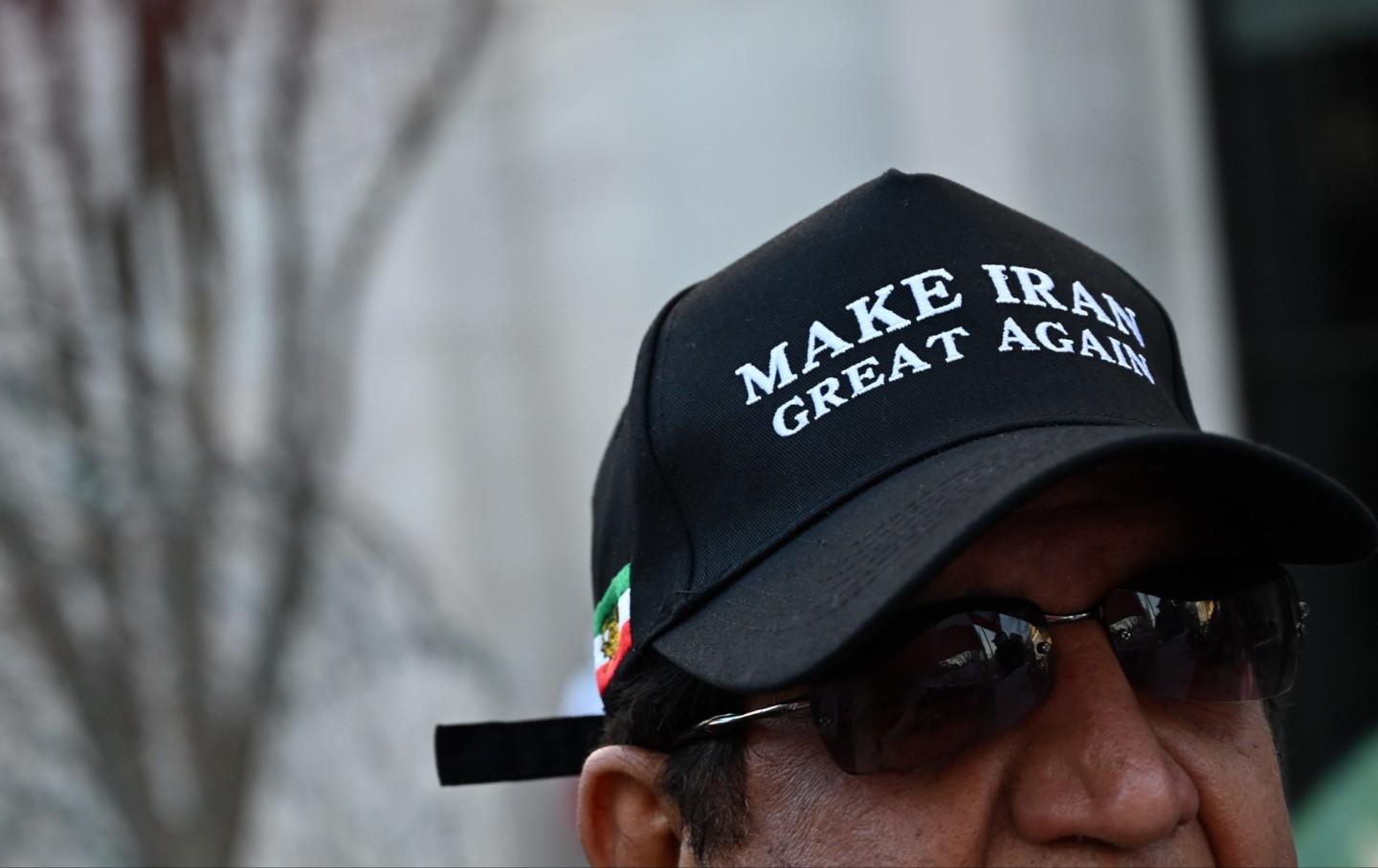
A demonstrator from the Iranian diaspora rallies near the White House on March 7, 2026.
(Alex Wroblewski / Bloomberg via Getty Images)“LOL why was a military base next to a school? Dige to bozorg shodi oonja [after all, you grew up there]. You know how the regime operates.”
That message arrived on Instagram from a childhood friend on March 1, as parents clawed through the rubble of a school in Minab, Iran, searching for the bodies of their children in the wake of a US bombing. This friend, like me, no longer lives in Iran. She was responding to something I had posted in protest of the US/Israeli war on Iran, the country where we both were born, raised, and where much of our families still live. She added that someone close to her in Iran had texted to say that even if a bomb struck their home, we should keep celebrating the war outside Iran. There was, in my friend’s view, no other choice.
Reflecting on this exchange, what strikes me is not merely the normalization of the war that the United States and Israel started on February 28 but the expectation that it be celebrated. For this person, the bombing of Iranian cities, the destruction of their civilian infrastructure, and the murder of children were not received as a catastrophe but as part of the necessary precondition for freedom. This position does more than justify violence; it redefines its meaning, collapsing the distinction between foreign intervention and democratic mobilization and recasting external force as a vehicle for liberation. In this framing, a war is not a tragedy to be resisted but a condition to be embraced.
Regrettably, this logic is not peripheral in the Iranian diaspora. The grotesquely branded Operation Epic Fury is deeply unpopular around the world, yet support for the war persists across significant segments of the diaspora, often articulated not just eagerly but with a sense of moral clarity. (It should be noted that early polling at the beginning of the war showed that support for military intervention was evenly split amongst Iranian Americans. More recent data suggests the support has dropped to 33 percent, which still represents a statistically significant bloc.)
Backers of the war have been highly visible, their voices amplified by powerful right-wing networks. The beleaguered minority in the diaspora who vocally oppose the war, on the other hand, are routinely smeared as terrorists or fifth columnists working for the Iranian military. I have lost count of how many times I have been accused of colluding with the Islamic Revolutionary Guard Corps, with some on social media even calling on the FBI to monitor my activities.
These fractures have also reached into the private realm. Friendships have ruptured over support for or opposition to the war. Families have bitterly split around the kitchen table, acrimoniously debating whether the path toward freedom can be paved with fire. Violent speech has become the dominant mode of discourse within a community that once prided itself on its intellectual and cultural pluralism. In the process, the space for political nuance has severely narrowed.
It wasn’t always like this. While strong opposition to the Islamic Republic has never been uncommon in the diaspora, there was nevertheless a rough consensus around supporting measures that could materially improve the lives of people in Iran. Millions of Iranians across the globe organized in support of the 2009 Green Movement protests, even though the explicit goal of the movement was not one of regime change. Similarly, when the framework for a nuclear deal was introduced in 2014, the diaspora overall felt unified by the possibility of a thaw in hostilities between Iran and the US, even though the deal was a boost for the Iranian government.
In recent years—and particularly since 2025, when the US and Israel began repeatedly bombing Iran—this fragile solidarity has publicly shattered. As American belligerence in the region has intensified, diaspora radicalization has also accelerated. The fantasy of regime change has so powerfully saturated this community that many now openly cheer the bombing of their homeland, convinced that its destruction will resurrect a mythologized era of past greatness. It is a logic that turns diasporic displacement into complacent complicity, a vision of restoration through annihilation.
The desire for regime change has long been a unifying force across many segments of the Iranian diaspora. In large part, this is why I have never felt fully at home in the diaspora community. This vision of change always felt misaligned with my experience of living inside Iran. That is because, to me, Iran is not a vision that one can abstractly experiment with. Rather, it is an actual place with a material reality populated by actual people. Diasporic displacement, while an undeniably painful experience, can distance and divorce the displaced from these realities.
What distinguishes this moment, however, is not that this desire has persisted but that a broad wish for regime change has narrowed into explicit support for bloody foreign military intervention. As hope in the success of diplomacy has eroded—in no small measure due to Americans’ unilaterally abandoning the 2015 nuclear deal—war has been reintroduced as the accelerant that could effectuate the end of the Islamic Republic.
In the last year, this reorientation has found its strongest expression in the figure of Reza Pahlavi, the exiled son of Iran’s last monarch. For years, Pahlavi was regarded as a marginal figure, often dismissed as an uninspired replica of his father—a perception that his lavish lifestyle and dilettantish behavior have done little to challenge. In the wake of the January protests, however, Pahlavi has intensified his efforts to promote himself as the most viable leader of a post-Islamic Republic Iran. He and his team claim that he was the catalyst for the protests on January 8–9, where thousands were killed in a brutal crackdown. (Iran’s government has claimed that the clashes were incited by foreign intelligence actors.) In the ensuing weeks, Pahlavi said that 150,000 military personnel had communicated their willingness to defect to his leadership, a wild assertion that has never been substantiated by any credible evidence beyond, as one of his surrogates recently said, “what his team says!”
But Pahlavi’s appeals for external pressure, including military action, have found a sympathetic audience among both pro-war factions in the diaspora and figures within the Trump administration. This political orientation is further reinforced by a diasporic media ecosystem that has expanded significantly in recent years.
“Idon’t watch Iran International, it’s too much propaganda,” my mother told me from Tehran a mere few hours before Iran went digitally dark on January 8. She was referring to a mainstream Persian-language satellite network financed by Saudi Arabia that presents itself as the “world’s leading news network on Iran.” With the proliferation of satellite access inside Iran, networks like Manoto, which leans more toward cultural programming, and Iran International have come to occupy a central position in the Iranian media landscape.
In recent years, Iran International has consolidated its role as the primary mouthpiece for hard-line opposition voices in the diaspora. While on paper it promotes itself as a mainstream news network, its coverage is structured by a distinct ideological logic: Regime change is proffered as the only path forward for Iran, and the restoration of the Pahlavi dynasty as its most legible form.
Popular
“swipe left below to view more authors”Swipe →This orientation is unmistakably aligned with Israeli, Saudi, and American interests, shaping not only what can be said but also what is thinkable about Iran. And these alignments are not subtly expressed, either. In 2024, during Israel’s ongoing genocide in Gaza, Iran International reporter Babak Eshaghi graffitied “Woman, Life, Freedom” on the wall of a destroyed Palestinian home, describing the inscription as a “gift from the people of Iran.”
However, this is only one dimension of a broader transformation that has aggressively narrowed the space for political disagreement within the diaspora. A well-funded ideological infrastructure, supported by foreign actors, has helped consolidate a hegemonic narrative of regime change centered on figures like Reza Pahlavi. While this infrastructure is critical to understanding the present moment, it does not fully explain the intensity of the fragmentation on display. Rather, it operates on a terrain that was already stratified by deeper historical and ideological formations.
For decades, Iranians in the diaspora have lived under the shadow of a “oneness” deriving from the belief that our identities—to quote the cultural theorist Stuart Hall—reflect “common historical experiences and shared cultural codes that provide us, as ‘one people,’ with stable, unchanging and continuous frames of reference and meaning.” This oneness, however, is less an expression of shared present conditions than a projection of a selectively remembered past. It can be more productively understood through what the late sociologist Zygmunt Bauman called retrotopia: a backward-looking orientation that locates political possibility in an imagined and idealized historical coherence. In this formulation, Iran was perfect before the Islamic Revolution—culturally cohesive, economically prosperous, and fundamentally unified.
But this utopic nostalgia—or retrotopia, to use Bauman’s language—seeks that which does not exist. Nostalgia, as a structure of feeling, does not recover the past so much as reorganizes it to soothe a pained yearning. In doing so, nostalgic representations also smooth over contradictions, suppress conflict, and promote an image of coherence that obscures the heterogeneity of lived experience. Within the Iranian diaspora, this retrotopian framework has long functioned to subsume ideological, generational, and experiential differences beneath the image of a unified national past.
Today, however, this nostalgic framework is under considerable strain. Economic collapse, war, and escalating geopolitical tensions have made the future an unavoidable terrain of political contestation. Questions of representation, legitimacy, and political strategy can no longer be deflected or deferred. They demand concrete articulation now. Yet nostalgia cannot accommodate such demands for rigorous engagement. It tends instead to reinforce affective attachment at the expense of critical differentiation.
As a result, what appears as bitter diasporic infighting could be better understood as the surfacing of contradictions that had previously been contained within a shared imaginary unity. The fragmentation is not new, in other words. It has just become newly and acrimoniously visible under conditions that do not allow for its deferral.
The image of oneness that once held the diaspora together depended on holding the past in place as stable, coherent, and recoverable. Confronted with a rapidly shifting political landscape that demands new forms of thinking, debating, and organizing, that image can no longer be sustained. As a result, our diaspora is splintering under the tension of trying to reconcile nostalgic myth-making with demands of political transformation.
This dynamic is not merely conceptual, either. It is materially reproduced in the contemporary media environment. Persian-language satellite networks like Manoto and Iran International exist to circulate a narrative of loss, in which the Islamic Republic ruptured and displaced an otherwise coherent national trajectory. The renaissance of Pahlavism is another expression of this narrative. The operational logic of this movement is restorative: Iran can be “saved” only if we can force a U-turn, by any means necessary, toward the idealized greatness of the pre-1979 era. Yet this vision points neither to a historically recoverable past nor to a politically viable future.
What is striking, however, is not simply the content of these nostalgic visions, or their incoherence in a moment where Donald Trump repeatedly threatens to destroy Iran’s civilization. Rather, it is the absence of any shared institutional framework through which these narratives can be contested, negotiated, or translated into a coherent political project. Today, there does not exist in the Iranian diaspora any widely accepted institution capable of mediating disagreement. Within this context, we are instead offered ideologically compromised media platforms and unimaginative leaders who seek to amplify division rather than facilitate negotiations about the future.
But this condition is not inevitable. In many other diasporic communities, tensions like these are mediated through political organizations, cultural bodies, or widely recognized leadership structures that can absorb disagreement and translate it into some kind of collective directionality. For example, the Armenian diaspora is deeply divided along political, generational, and geographic fault lines. Yet a dense network of institutions, including political parties, churches, and lobbying groups, provides a framework within which disagreement can be articulated and, at times, negotiated. Even where consensus is elusive, these institutions provide a shared framework through which disagreement can be rendered legible and governed.
The Iranian diaspora, by contrast, does not have any such infrastructure. Long removed from the material conditions of life inside Iran, and lacking institutional mechanisms capable of holding divergent perspectives in productive tension, disagreements are mostly expressed in highly visible and vitriolic forms that stymie all hopes of reasoned discourse.
In this sense, the fractures in our diaspora are not simply failures of unity but the outcome of a deeper structural condition: a community that is being forced to confront itself without the stabilizing fiction of oneness. But this moment also presents an opportunity, a chance for Iranians in the diaspora to redefine the boundaries of acceptable discourse. Whether this community is capable of doing so remains an open question, and our present condition inspires very little optimism. Be that as it may, we can hope that this moment compels the recognition that this war was never, and never will be, a rescue mission.
The future of Iran will not be defined from afar, through ill-conceived alliances with foreign regimes whose interests have always been misaligned with Iranian sovereignty. Rather, the future will be shaped by those within Iran, navigating its contradictions and defending its borders against external aggressors. The role of the diaspora, if it is to have one at all, is not to impose visions of restoration through military aggression, but to support the survival and sovereignty of Iran in this moment and beyond.
Support The Nation’s June Fundraising Campaign
With the midterm elections now firmly upon us, the question is whether Democratic candidates will do more than merely occupy ballot lines as mild alternatives to the red-hot crisis that is Donald Trump.
As Trump spends over $1 billion a day on a globally destabilizing war on Iran and admits that he doesn’t “think about Americans’ financial situation,” millions across the country are struggling with the surging costs of essentials. Democrats must seize this moment and advance bold, small-“d” populist ideas—not settle for cynical caution that once again snatches defeat from the jaws of victory.
The Nation elevates progressive ideas, movements, and elected officials achieving real change across the country into the national conversation. At the same time, our journalists are exposing how crypto and AI-funded super PACs are spending hundreds of millions of dollars to knock out candidates they oppose, reporting on the devastating impact of the Supreme Court’s evisceration of the Voting Rights Act, and sounding the alarm on attempts by red states to quickly redraw electoral maps, disenfranchising Southern Black voters.
We can play this critical role because of support from readers like you. This June, we’re raising $20,000 to power The Nation’s independent journalism in the run-up to November’s immensely consequential elections.
It’s in our power to build a more just society, and your support at this critical moment brings us closer to that bold vision. I hope you’ll donate today.
Onward,
Katrina vanden Heuvel
Editor and Publisher, The Nation
More from The Nation
Cuba’s Humanitarian Crisis: The United Nations’ Response Cuba’s Humanitarian Crisis: The United Nations’ Response
The UN confronts a “perfect storm” of US-sponsored deprivation on the island.
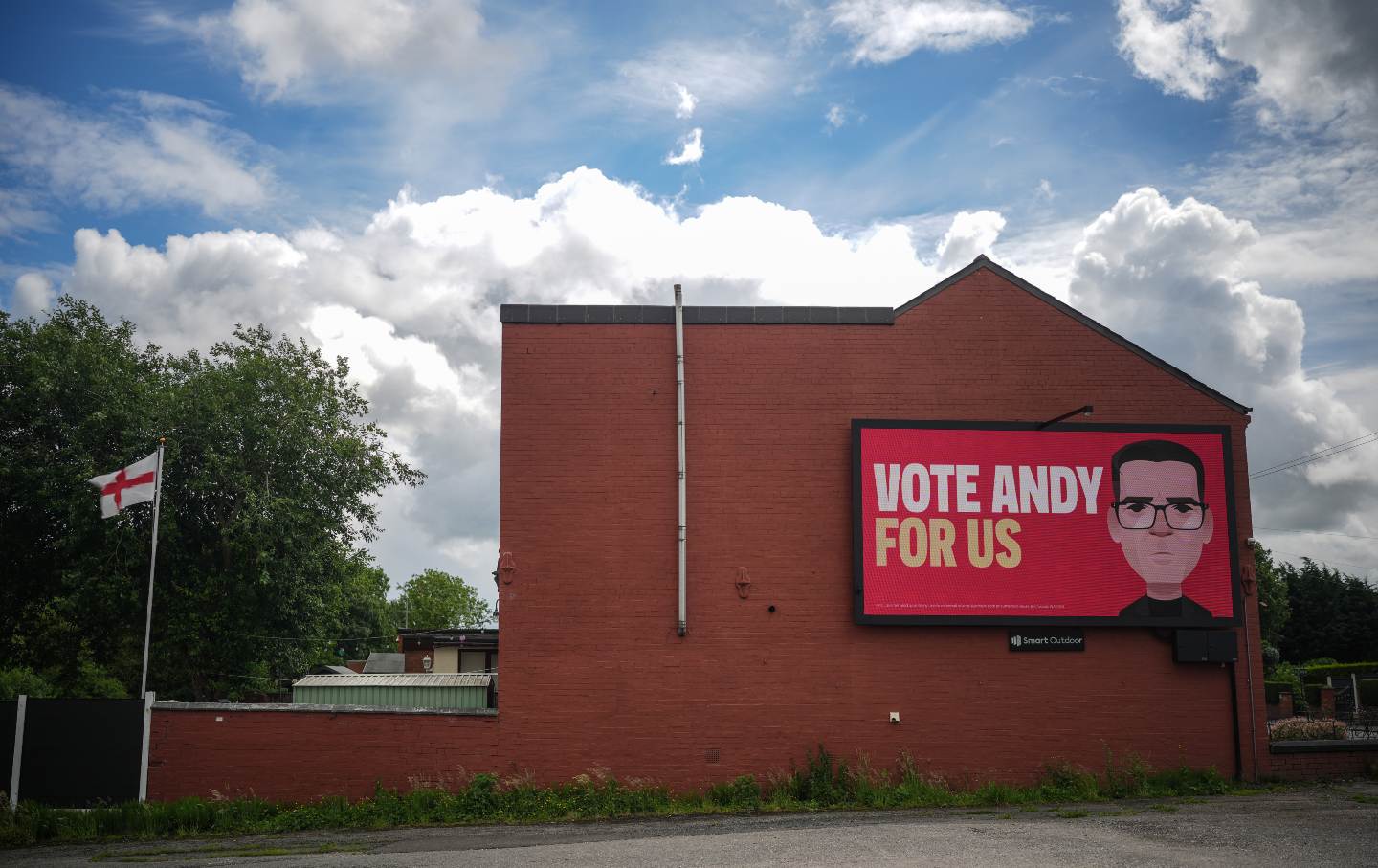
In Britain, an Election That Could Mark the Beginning of Prime Minister Keir Starmer’s End In Britain, an Election That Could Mark the Beginning of Prime Minister Keir Starmer’s End
Mayor of Greater Manchester Andy Burnham is expected to challenge Starmer for leadership of the Labour Party.
Bolivia’s Streets Have Erupted. Here’s Why. Bolivia’s Streets Have Erupted. Here’s Why.
Ordinary people are rising up against neoliberal orthodoxy.
Daniel Ellsberg vs. “Ordinary Insanity” Daniel Ellsberg vs. “Ordinary Insanity”
A new documentary issues an urgent warning about our dangerous nuclear delusions.
How Trump Has Boxed Himself Out of a Face-Saving Iran Deal How Trump Has Boxed Himself Out of a Face-Saving Iran Deal
By failing to absorb the lessons of Iran’s strategic victories, the White House is on course to turn the present stalemate into a disastrous quagmire.
The Revolution Heard Around the World The Revolution Heard Around the World
The global politics of 1776.

