The Knicks Lifted a City on Their Backs
After 53 years, the city and its basketball team can finally celebrate together.
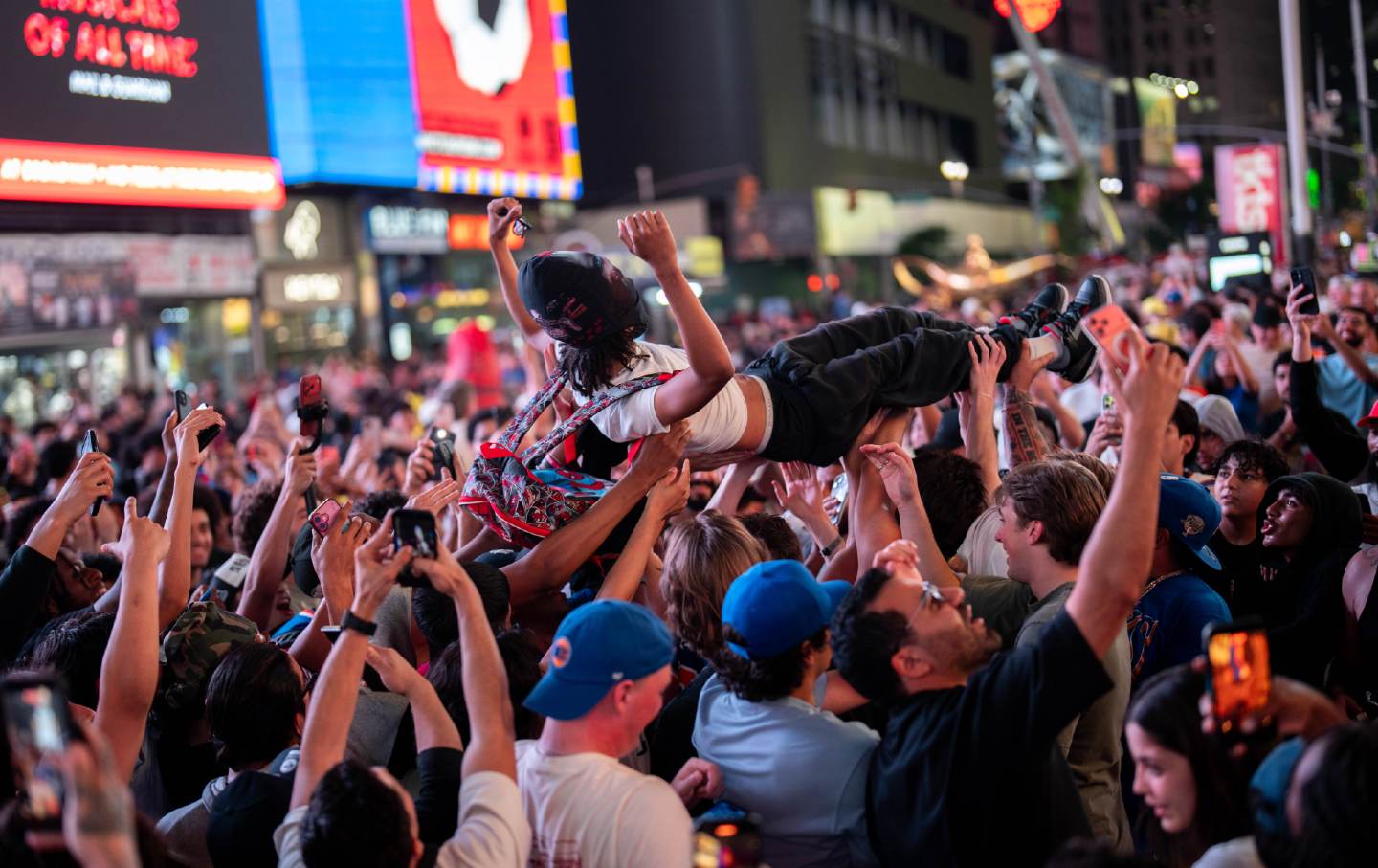
New York Knicks fans celebrate the Game 4 win in the NBA Finals between the New York Knicks and the San Antonio Spurs, on June 10, 2026, in New York City.
(Adam Gray / Getty Images)After a 53-year drought, the New York Knicks—my lifelong team—won the NBA championship. Many journalists are writing about how the squad’s improbable title run has transformed the city over the last two months: the impromptu chants on the subway, the hugs and high-fives with strangers, the watch parties that spilled out of bars and filled parks and streets, the way royal blue and orange made a city defined by loneliness among crowds feel connected and humane.
Others are writing about how their hardscrabble, masterful leader Jalen Brunson is now “the king of New York”—an implausible fate for a player once derided as “too small” to start for an NBA team, let alone lead a team to a title. Brunson is now the most unexpected superstar in the history of basketball. He was a second-round draft pick cast-aside by the Dallas Mavericks. Basketball podcasters, yipping heads, and other insufferable opinionists mocked the Knicks when they signed him as a free agent. He was an All-Star, but listed at only six-foot-two (and we can all tell he’s really a bit shorter), most pundits thought he could never be the best player on a title team. But Brunson will now forever be the the guy who scored 45 of his team’s 94 points, many over the outstretched arms of San Antonio Spurs’ seven-foot-four French skyscraper Victor Wembanyama, in the decisive Game 5 of the Finals.
I’m also not going to write too much about those gut-wrenching Finals contests—every one of which came with elevated blood pressure. By Game 5, it had the feel of a karaoke bar. The beats were similar every night: The Spurs came out as if shot out of a cannon. They took a big lead while the Knicks bided their time, counting on the Spurs to crack under the exhaustion and pressure. The Knicks, astoundingly, only led for 24 percent of the games yet won four games to one. They rope-a-doped the Spurs. This team was Muhammad Ali against George Foreman in the 1974 Rumble in the Jungle fight, in which Ali let Foreman punch himself out before he went in for the knockout. Now this whole never-say-die squad—particularly forward OG Anunoby—will never buy a drink in this town again.
Political writers are also analyzing how Zohran Mamdani, the city’s democratic socialist mayor, embraced the team and seems destined to receive a popularity bump on good vibes alone. The political writers will also undoubtedly point out that the only playoff game the Knicks have lost in the last two months was the one attended by sleepy UFC fanboy and scourge of New York City Donald Trump. Those writing about the world off the court will also write about the irony of such a beloved team’s being owned by the repugnant, deeply unpopular failson and Trump BFF James Dolan. This NBA title has produced a tapestry of tales for journalists, documentarians, lauded authors, and hot-take artists alike.
They can cover all of that. Instead, I want people to understand how it can feel to love a sport and love a city and then endure decades of disappointment over the inability of those two loves to align. The rhythm of the city comes with the beat of a basketball on the blacktop. But due to horrible ownership, this team has been discordant for decades—unable to move in concert with that ubiquitous beat. Basketball is life across the five boroughs, and having a team mired in defeat, scandal, and humiliation has long felt like a cruel fate, an O. Henry story where the championship trophy is always out of reach and the more you want it, the more elusive it becomes. Now a city’s deep love for basketball is finally aligned with a team worthy of their passion.
I became hooked on the Knicks after watching Bernard King score 50 points for a second consecutive game on February 1, 1984. I’d never seen anything like it. I did not understand basketball strategy; I couldn’t even dribble with my left hand. But I knew how King’s post-up game and unique ability to shoot the ball while he was still rising in the air made me feel. I didn’t know words like “dopamine” or “adrenaline,” but I knew Bernard King—not Michael Jordan—was the first athlete who made me feel like humans could fly. Within a week, I had a knock-off King jersey nailed to my wall. For years, it was the first thing I saw when waking up. As a kid, it was my personal dose of inspiration—my morning coffee.
Then came the harsh reality of being a Knicks fan: King’s team had their hearts ripped out in the playoffs by Larry Bird’s Celtics that year, giving me an irrational hatred of Bird that—in a calmer form—has lasted to this day. The following season, King’s knee ripped to shreds on a routine play, putting him out of action for over a year and forever altering his career. I was watching that game as well—by then, I was watching every game—and the horror of seeing King come up limping was another piece of Knicks trauma that would last, with the creation of a small pit in my stomach, for another 42 years.
I became convinced—and I was not alone—that however good the Knicks became, something would derail it: a missed layup, a disastrous shooting exhibition during a critical playoff game, an off-court scandal. That feeling of inevitable disappointment never left me during their appearances in the 1994 and 1999 Finals. I always thought something was going to go wrong, and invariably it did. These past two months, during every Knicks playoff game, that feeling returned. Even with comeback after comeback during the Finals, I never felt liberated from the assumption that the Knicks’ magic would run out. But as we all learned, the team was never about magic, luck, or mystique: It was about will; it was about having the mental strength to not only win a title but lift a city on their backs.
It’s all right to take a break from the political fray and relish a time of togetherness in a world built upon increasingly chasmic divisions. For now the pit in my stomach is gone, there is a parade to attend, and there is peace in the realm: The city and the city game are at long last aligned
Become a Sustaining Donor This September
Between the reemergence of right-wing red-baiting and Donald Trump’s use of the chilling National Security Presidential Memorandum–7 to criminalize left political organizing, we’re seeing McCarthyism reborn before our eyes.
This assault on democracy cannot be ignored or wished away. Resisting it requires bravery in the face of threats and repression, a steadfast commitment to the truth, and the unwavering belief that we can—and will—overcome this darkness.
We must have an independent media that sets the record straight, unearths corruption and abuses of power, and advances a politics of justice and dignity for all if we’re to win this fight.
That’s why I’m writing to you today. This September, The Nation needs to add 100 monthly donors to sustain our progressive journalism. Your contribution makes the next investigative report, the next truth-speaking column, and the next pathbreaking essay all possible.
I hope you’ll support our work with a recurring donation today. If you donate $10 or more a month, we’ll send you a brand new “Hands Off the Free Press!” sticker to recognise your commitment to our cause. Please, donate today.
Onward,
Katrina vanden Heuvel
Editor and Publisher, The Nation