How Stephen Miller Became the Power Behind the Throne
Miller was not elected. Nor are he or his policies popular. Yet he continues to hold uncommon sway in the administration.
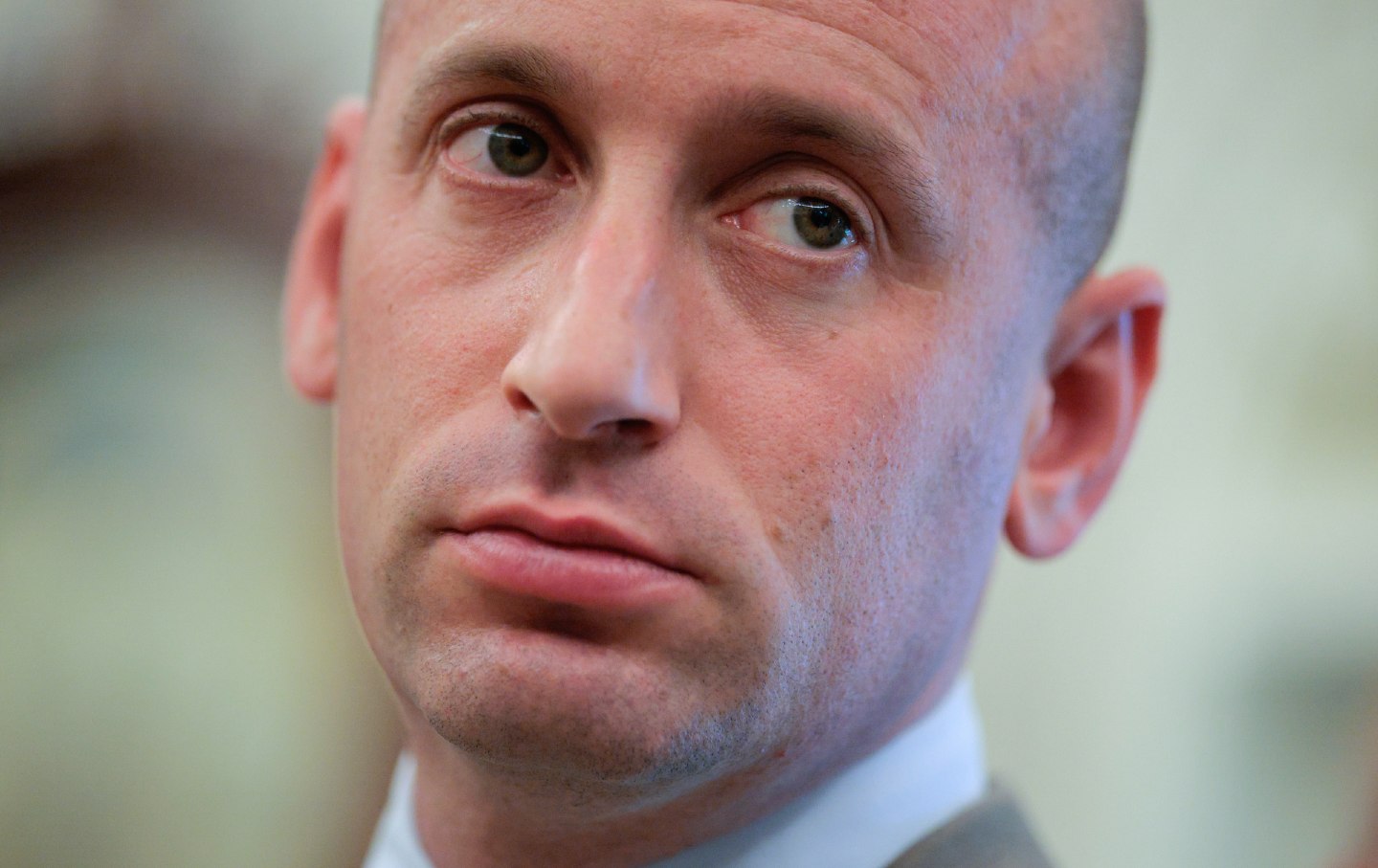
No one ever voted for Stephen Miller. Only a bare plurality of American voters pulled the lever for his boss, Donald Trump, in 2024—and even then, voters were concerned above all with the rising cost of living, not with immigration, Miller’s obsessive focus. But over the past year, Miller has become arguably the most consequential figure in the second Trump administration—the maximalist force behind a maximalist presidency. Guided by white-supremacist teachings like the dystopian novel The Camp of the Saints, Miller has made the ethnic purification of the American body and the expulsion of potentially millions of immigrants the administration’s central priority.
What makes Miller truly scary is that he is uncommonly effective at getting his way. Steve Bannon has described him as Trump’s “prime minister,” while White House press secretary Karoline Leavitt recently told The Atlantic that Miller “oversees every policy the administration touches.” His fingerprints can be found all over the deployments of ICE to US cities, including the one that culminated in the killings of Renee Good and Alex Pretti in the streets of Minneapolis; the rendition of scores of immigrants to a gulag in El Salvador without a shred of due process; the attempt to eliminate birthright citizenship and thus strip millions of native-born Americans of their most basic constitutional rights; and, increasingly, Trump’s most provocative and unilateral foreign-policy moves, from abducting Nicolás Maduro in Venezuela to his ongoing threats to annex Greenland.
Like Miller himself, none of this is popular. In Trump’s first year back in the White House, his net approval rating steadily declined from a high of plus 4 percent to a low of minus 19 percent—about as bad as has ever been recorded at this stage of a presidency—and the Democrats are favored to take back the House in this fall’s midterms. Voters are overwhelmingly concerned about the state of the economy, which continues to suffer from high inflation thanks to Trump’s much-publicized tariffs, and have expressed strong disapproval of his immigration-enforcement policies in particular, especially in the wake of the slayings in Minneapolis, which even many conservatives have struggled to defend. In a more rational administration, the way forward politically would be clear: Trump would marginalize (or ideally fire) Miller and pivot to a less abhorrent policy approach. Instead, Miller has seemed only to grow in stature and influence within the administration.
How did the most powerful government on earth come to be dominated by this unelected, viscerally unappealing 40-year-old right-wing extremist from Santa Monica? Last year, I reviewed the most authoritative biography of Miller, Jean Guerrero’s Hatemonger, for this magazine, and I came away with the impression that Miller has a handful of talents: a willingness to attract and capitalize on negative attention (colloquially, he’s good at “trolling”); an unusual skill at navigating office power politics and flattering the right people (in Trump’s first term, Miller won over Jared Kushner and Ivanka Trump even though neither shares his extreme anti-immigration views); and an uncommon sense of how to turn his ruthless dogmatism into policy.
The trolling is table stakes in the MAGA extended universe, where countless individuals, including Miller’s wife, have pursued careers as influencers channeling the myriad frustrations of the American right. Miller, a frequent guest on shock-jock radio since high school, certainly could have gone that route. But it was Miller’s cutthroat instincts on Capitol Hill and his unfailing loyalty to Trump that ensured that his legacy would be more than just talk, and that he would exert the kind of influence over a sitting president that malign figures like Henry Kissinger and Dick Cheney once did. The Venn diagram of competent Beltway operatives and ideologically committed neofascists has a very small intersection, but Miller sits comfortably at the center of it. He is hardly the most colorful character in the second Trump administration, where the competition includes Robert F. Kennedy Jr., Pete Hegseth, Kash Patel, and Kristi Noem. But his impact on policy is outsize, even when the administration itself might be better served politically by doing anything else.
“We live in a world in which you can talk all you want about international niceties and everything else, but we live in a world—in the real world, Jake—that is governed by strength, that is governed by force, that is governed by power,” Miller told CNN’s Jake Tapper recently in a defense of Trump’s Western Hemisphere expansionism. “These are the iron laws of the world since the beginning of time.”
The Darwinian flourishes are pure Miller, but the underlying imperial hubris recalls the 2004 quote that Ron Suskind got from a top George W. Bush official, widely assumed to be Karl Rove: “We’re an empire now, and when we act, we create our own reality. And while you’re studying that reality—judiciously, as you will—we’ll act again, creating other new realities, which you can study too, and that’s how things will sort out. We’re history’s actors…and you, all of you, will be left to just study what we do.”
Given how the Bush administration’s invasions of Afghanistan and Iraq worked out, there’s a lesson here for Miller—and for us. It’s true that with the power he currently wields, he can mold reality to a far greater extent than anyone should be comfortable with. But there is far less domestic support for Trump and Miller’s agenda than Bush and Rove once enjoyed for theirs, and neither financial markets nor foreign governments nor the ordinary citizens confronting ICE in the streets have passively bent to their will. Reality is never solely the product of any one small political clique, and it has a tendency to frustrate and foil those who would claim the right to shape it. It’s far simpler to outmaneuver one’s colleagues for control of the boss’s ear than it is to impose one’s will on the rest of the world. This, too, has been an iron law of the world since the beginning of time.
Become a Sustaining Donor This September
Between the reemergence of right-wing red-baiting and Donald Trump’s use of the chilling National Security Presidential Memorandum–7 to criminalize left political organizing, we’re seeing McCarthyism reborn before our eyes.
This assault on democracy cannot be ignored or wished away. Resisting it requires bravery in the face of threats and repression, a steadfast commitment to the truth, and the unwavering belief that we can—and will—overcome this darkness.
We must have an independent media that sets the record straight, unearths corruption and abuses of power, and advances a politics of justice and dignity for all if we’re to win this fight.
That’s why I’m writing to you today. This September, The Nation needs to add 100 monthly donors to sustain our progressive journalism. Your contribution makes the next investigative report, the next truth-speaking column, and the next pathbreaking essay all possible.
I hope you’ll support our work with a recurring donation today. If you donate $10 or more a month, we’ll send you a brand new “Hands Off the Free Press!” sticker to recognise your commitment to our cause. Please, donate today.
Onward,
Katrina vanden Heuvel
Editor and Publisher, The Nation