
Climate Disasters Are Traumatizing Brazil’s Children
The generation coming into the world now is expected will face unprecedented extreme weather events throughout their lives.
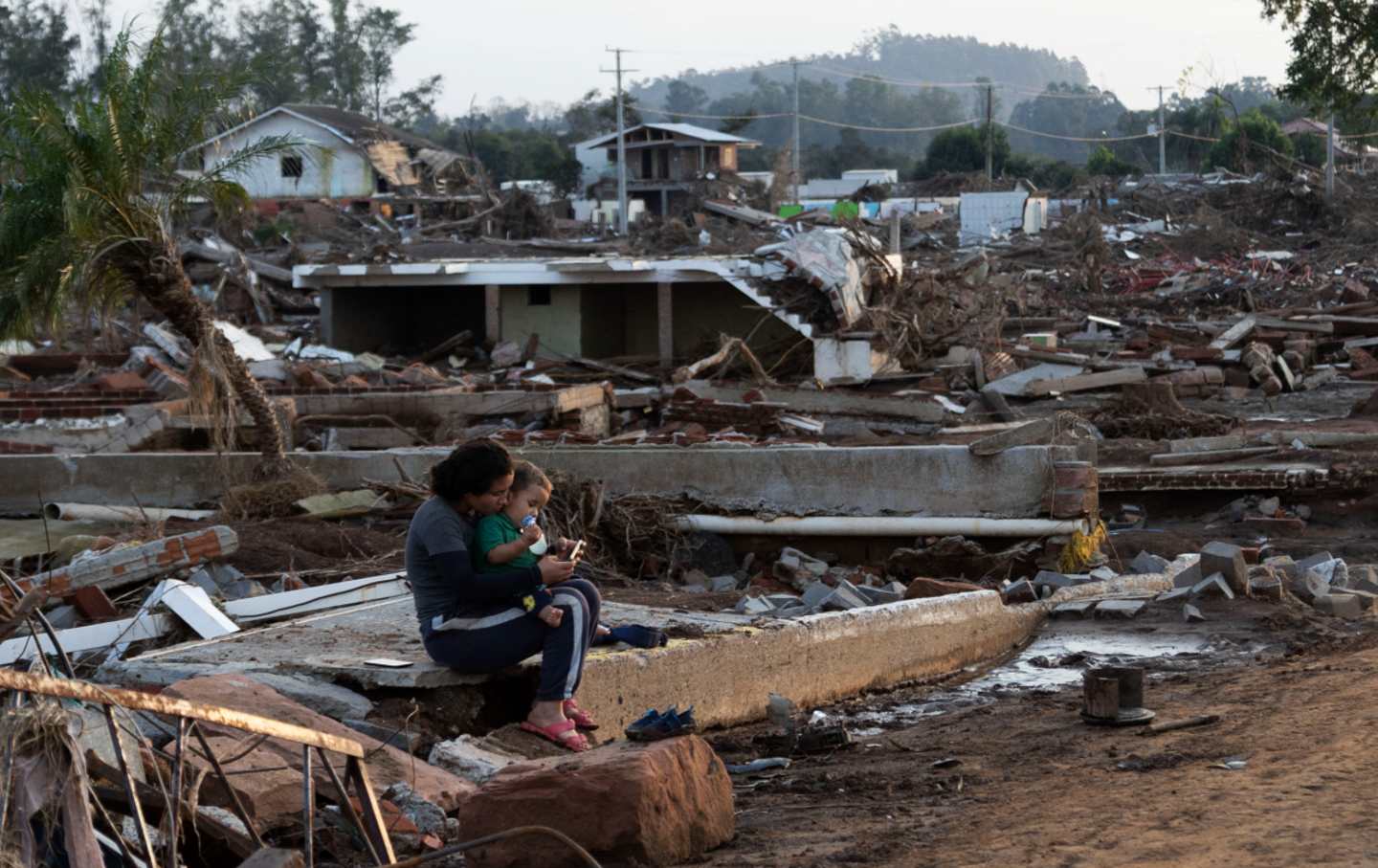
A woman sits with her baby among destroyed houses in the Passo de Estrela neighborhood in Cruzeiro do Sul, Rio Grande do Sul State, Brazil, on June 5, 2024.
(Silvio Avila / AFP via Getty Images)
Alvarães, Brazil—Patricia dos Santos was confident that her first daughter, Luna, would come into the world with the help of her grandmother, an experienced midwife from the riverside community where she lives in Alvarães in the state of Amazonas in northern Brazil. The prenatal exams indicated that everything was fine with the pregnancy, and the doctor had told her that a normal delivery could easily be done at home. But that’s how pregnancy can be—sometimes complications arise at the last minute.
And that last minute couldn’t have come at a worse time. When Patricia went into labor, her grandmother, the midwife, realized that the baby had turned and was in a seated position. And something else seemed wrong with her granddaughter. Patricia needed to be taken to the city hospital for a C-section. But the community of Santa Luzia do Catuiri, where they live, on the banks of Lake Tefé, was isolated.
It was September 2023, and the Amazon was going through one of the most severe droughts in recorded history. Around the same time, it was in that same Lake Tefé that a large number of pink river dolphins died, drawing media attention to the region’s drought.
In front of the community, the river that residents use to get around had disappeared. Therefore, it was necessary to walk a long distance to a spot with a bit of water, where canoes were waiting to take people to a larger boat bound for the city of Tefé. But that would take too long and be too exhausting. “My daughter and I wouldn’t have made it, because I was already tired, and she wasn’t responding much. Her heart was already weak and I was in a lot of pain,” Patricia told Agência Pública.
So she chose another difficult but seemingly faster option. A cousin offered to take her by motorcycle along an alternative, dirt road that had just been opened, connecting the community to downtown Alvarães. Patricia had never traveled along that road before, but decided to take the risk.
Supported by her grandmother—who also climbed onto the motorcycle, sitting behind her as a shield and protection—and wracked with pain, Patricia endured the bumpy ride for more than an hour until reaching the city. “It was terrifying. I kept praying to God for strength. But the farther we went, went, went…the longer the road seemed,” she recalled. Several times, the pain was so unbearable that she jumped off the motorcycle, thinking the baby was about to be born right there, in the middle of the dirt road.
But Luna would only come into the world once they reached the hospital—delivered in a delicate surgery, as Patricia discovered only then that she also had a fibroid blocking the baby’s passage.
Being born amid climate chaos is not a story unique to Luna, nor is this likely to be the only extreme event she will face in her lifetime. In fact, it already wasn’t. In 2024, when she was just a 1-year-old, the Amazon faced yet another drought—one even more severe. “Luna was very young and suffered a lot from the extreme heat, traveling with me along that same damn dirt road so we could try to buy food in town, because everything here got way too expensive,” Patricia said.
This is expected to become a much broader reality, shared by millions of children around the world, as several scientific and pediatric studies have shown.
The most vulnerable
Children under 1 years old and adults over 65 are the age groups most affected by heat waves globally, according to a report released on October 28 by the medical journal The Lancet.
The Lancet Countdown on Health and Climate Change 2025, developed in collaboration with the World Health Organization (WHO) and more than 150 institutions, shows that babies under 1 were exposed to a record number of heat waves last year, experiencing almost five times more heat-wave days, on the global average, than the annual average between 1986 and 2005. In 2024, infants experienced an average of 20.5 extremely hot days.
This data is alarming because very young children have not yet fully developed the body’s cooling mechanisms. They do not sweat like adults, which can lead to kidney failure, seizures, coma, or even death in extreme cases.
If global warming continues at its current pace—reaching 2.7°C by the end of the century, considering the emission reduction plans currently in place—those born from 2020 onward are expected to experience unprecedented levels of climate extremes throughout their lives.
That’s the warning from a document published this year by the NGO Save the Children, which compiled a series of scientific studies, including those assessed by the Intergovernmental Panel on Climate Change, highlighting the impacts of the climate crisis on children.
In 2021, based on another similar scientific review, the NGO calculated that children born in 2020 will live through two to seven times more climate disasters than their grandparents born in the 1960s.
Throughout their lifetimes, they will face, on average, twice as many forest fires, 2.8 times more exposure to crop losses, 2.6 times more droughts, 2.8 times more floods, and nearly seven times more heat waves.
It is a generation that will grow up surrounded by extreme events.
This same warning was one of the main messages reinforced by a report released a few months ago in Brazil by the Núcleo Ciência pela Infância (NCPI), a collaborative initiative led by the Maria Cecília Souto Vidigal Foundation. The initiative produces and disseminates scientific knowledge about early childhood development in Brazil to help guide the creation of public policies for this age group.
For science, the early period of human life (from birth to age 6) is key for a child’s development and for a healthy life. From pregnancy to 2 years old are the most crucial. For that reason, the stress a pregnant woman experiences can already affect the formation of her baby.
Impacts of all kinds during this stage—from violence to hunger, psychological trauma to pollution, forced displacement to the loss of family members—can have lifelong consequences. Climate change adds to this, worsening situations of vulnerability, said Marcia Castro, head of the Department of Global Health and Population at Harvard University and one of the coordinators of the NCPI report.
“Some of these climate effects can trigger inflammatory processes, can cause changes in the child’s body that will have consequences in adulthood and old age, associated with cardiovascular diseases, diabetes, and obesity. These diseases are actually the main causes of death not only in Brazil but worldwide,” she explained.
“Our battle is to show that early childhood is the beginning of everything. We focus on the climate crisis because if we already had difficulties, if inequality was already taking away some of that child’s potential in early childhood, now the climate issue is another layer that worsens everything,” she said. Marcia Castro spoke with Agência Pública for the podcast Good Morning, End of the World, which aired on October 30.
The greatest concern lies in those first 1,000 days starting with pregnancy, because that’s when development peaks, both in the formation of organs and in the creation of synapses, the brain’s connections. This phase is extremely sensitive to external impacts.
“It’s not just the climate, but toxic stress and violence. Yet some of these factors can also be worsened by the climate. For example, if a child loses their home or faces forced displacement, or if they have no housing, no daycare, or if they’re exposed to an extremely vulnerable environment. The entire process of synapse formation doesn’t occur as it should. As a result, the cognitive development, and the motor and behavioral development are compromised,” Castro said
The risks don’t stop there. The American Academy of Pediatrics estimated 10 years ago that 88 percent of diseases worsened by climate change will affect children under 5 years old.
It also pointed out that children’s health is already being affected by increased heat stress, reduced air quality, changes in patterns of climate-sensitive infections, the physical and mental effects of extreme weather events, and food insecurity in vulnerable regions.
There are also the growing risks of mosquito-borne diseases. The Lancet Countdown found that in Brazil, the risk of dengue transmission has increased by 108 percent since the 1950s. The data considers the entire population, not just children.
Brazilian Pediatrician Luiza Menezes, who works at a reception center for vulnerable minors in Madrid, also drew attention to the risks of so-called “climate anxiety.”
At the center, Menezes receives children in various vulnerable situations—from violence to refugee—but she has increasingly treated many suffering from heatstroke and dehydration during the brutal heat waves that have hit Europe, when entire families end up leaving their homes, which are not adapted to high temperatures.
Popular
“swipe left below to view more authors”Swipe →In October 2024, she recalled the challenges to care for those displaced by the powerful storm that struck the city of Valencia, causing floods that left more than 200 people dead. Some children who lost their homes and/or families were taken to the center where Menezes works: “A child’s proper development depends on basic conditions of health, nutrition, and domestic safety. It includes not only a routine of emotional bonding but also geographic stability. When children lose their home is extremely difficult. They arrive very insecure and unstable, because of the rupture of something that provided stability.”
The same happens with the loss of access to school. According to a UNICEF survey, last year, nearly 250 million children had their education interrupted because of the climate crisis. In Brazil, that number reached 1.17 million, mostly due to the more than 2,000 schools affected by flooding in the southern state of Rio Grande do Sul; 478 out of 497 cities were hit by floods, and 185 people died.
Living between one flood and another
The stories of babies born amid the tragic floods in Rio Grande do Sul in May last year are striking. Many of these children never even had the chance to return home after being born.
That’s the case of Manu, who was almost born in a shelter in the capital city of Porto Alegre. Her nine-months-pregnant mother, Raphaela Cunha Brito, had to be rescued by boat from her home in the city of Eldorado do Sul, in the metropolitan region of Porto Alegre, after her entire street was swallowed by floodwaters. She lost everything.
Raphaela’s older daughter, Isabeli, who was then 2 years old, and her mother-in-law were separated and taken to a shelter set up in a school.
The place had been opened specifically to receive women and children after reports of sexual abuse in mixed shelters following the floods. It was yet another cruel consequence of climate change for children and adolescents.
On May 20, 2024, about three weeks after the state had gone underwater, Raphaela arrived at the shelter already five centimeters dilated. There was just enough time for her to be assisted by a midwife before being immediately transferred to a hospital, recalls Victória Cosner, who was volunteering at the school and would later become Manu’s godmother.
However, Raphaela had contracted a urinary infection because of contact with the floodwater, which ended up being transmitted to the baby. Manu spent her first 10 days of life in the neonatal ICU. Raphaela spent her day at the hospital with her and returned to the shelter at night to sleep with Isabeli. When the baby was discharged, they still spent more than a month living in the school.
It wasn’t the first extreme event the family had faced. In November 2023, when the city of Eldorado was also hit by flooding, then-pregnant Raphaela recalls having to leave her house. She had water up to her knees and her older daughter, Isabeli, clinging to her back. It wouldn’t be the last episode: in June 2025, the city once again suffered flooding. Not as severe as the previous year, but still, the water reached inside their home.
Worried about the baby’s health, Raphaela decided to leave Manu in Porto Alegre with her godmother Victória for 16 days. Meanwhile, Isabeli, now 4, developed a fear of rain. “I have a book at home about Miami, with pictures of the ocean. When she sees it, she points and says: ‘flood,’” the godmother said. Raphaela added that when it starts to rain, the older girl becomes agitated and often talks about things she no longer has, things “the flood took away.”
The couple Marcelo Fontoura and Ana Cecília Nunes also went through an ordeal during the birth of their first child, Joaquim, in last year’s floods. They didn’t have to leave their home in Porto Alegre as their street didn’t flood, but the building’s water supply was cut off almost at the start of the storms, in early May 2024. They had no water for 18 days. To make matters worse, they had to take in a friend who had been forced out of his home.
The baby was expected to be born around May 22, but perhaps due to the stress of the situation, Ana Cecília’s blood pressure began to rise. “I kept saying, ‘Joaquim, wait. Joaquim, wait.’ But every time I watched the news at night, I couldn’t sleep. Then I’d get really nervous, check my blood pressure, and it was high,” Ana recalls.
For almost three weeks, she tried to negotiate with the baby while chaos only grew in Porto Alegre. The access to prenatal exams became more complicated, and at one point, the obstetrician decided it would be best to induce labor.
The procedure happened on May 19—one day before Manu was born. Joaquim’s first bath had to be cold, because the hospital had no hot water. “They even warmed some water in a microwave, but by the time the basin got to the room, it had already cooled down because it was so cold in Porto Alegre. He screamed,” the mother recalled.
Like Raphaela’s daughters, Joaquim has already faced another extreme event. “He was born during the flood, and when the wildfires [in the Amazon and the Pantanal] happened, the smoke reached here. He had a terrible cough because of it. At one year and four months old, he has already lived through two major environmental disasters. In our lifetime, we have never seen anything like that. So that also makes us worried. We love him so much—what kind of world are we leaving for these children?” lamented Ana Cecília.
Become a Sustaining Donor This September
Between the reemergence of right-wing red-baiting and Donald Trump’s use of the chilling National Security Presidential Memorandum–7 to criminalize left political organizing, we’re seeing McCarthyism reborn before our eyes.
This assault on democracy cannot be ignored or wished away. Resisting it requires bravery in the face of threats and repression, a steadfast commitment to the truth, and the unwavering belief that we can—and will—overcome this darkness.
We must have an independent media that sets the record straight, unearths corruption and abuses of power, and advances a politics of justice and dignity for all if we’re to win this fight.
That’s why I’m writing to you today. This September, The Nation needs to add 100 monthly donors to sustain our progressive journalism. Your contribution makes the next investigative report, the next truth-speaking column, and the next pathbreaking essay all possible.
I hope you’ll support our work with a recurring donation today. If you donate $10 or more a month, we’ll send you a brand new “Hands Off the Free Press!” sticker to recognise your commitment to our cause. Please, donate today.
Onward,
Katrina vanden Heuvel
Editor and Publisher, The Nation
More from The Nation
Big Oil’s Origin Story Big Oil’s Origin Story
Amy Westervelt’s new book, Brought to You By, exposes the deep history of today’s “information pollution.”
Is Nepal a Turning Point in Climate Coverage? Is Nepal a Turning Point in Climate Coverage?
Even CBS News and Bari Weiss, who fired the outlet’s entire climate unit, have used Nepal as a watchword for environmental disaster.

Oatly Says Climate Action Now Oatly Says Climate Action Now
The world’s largest oat drink company is printing summaries of what it calls “the ultimate climate solution” on every carton it produces.
Have We Forgotten Covid’s Lessons? Have We Forgotten Covid’s Lessons?
This summer’s deadly heat calls for news coverage based on science, not ideology.
As Europe Burns, a Climate Cover-Up Continues As Europe Burns, a Climate Cover-Up Continues
The UK’s Labour Party seems afraid to talk about the climate emergency.
World Cup Hydration Breaks Were Not About Commercials World Cup Hydration Breaks Were Not About Commercials
As the world gets hotter, playing sports in the heat gets more dangerous. Telemundo is the only publication that got this right.

