The International Olympics Committee Is Urged to Drop Oil Company Sponsors
Global warming means the future of Winter Games “is literally melting away.”
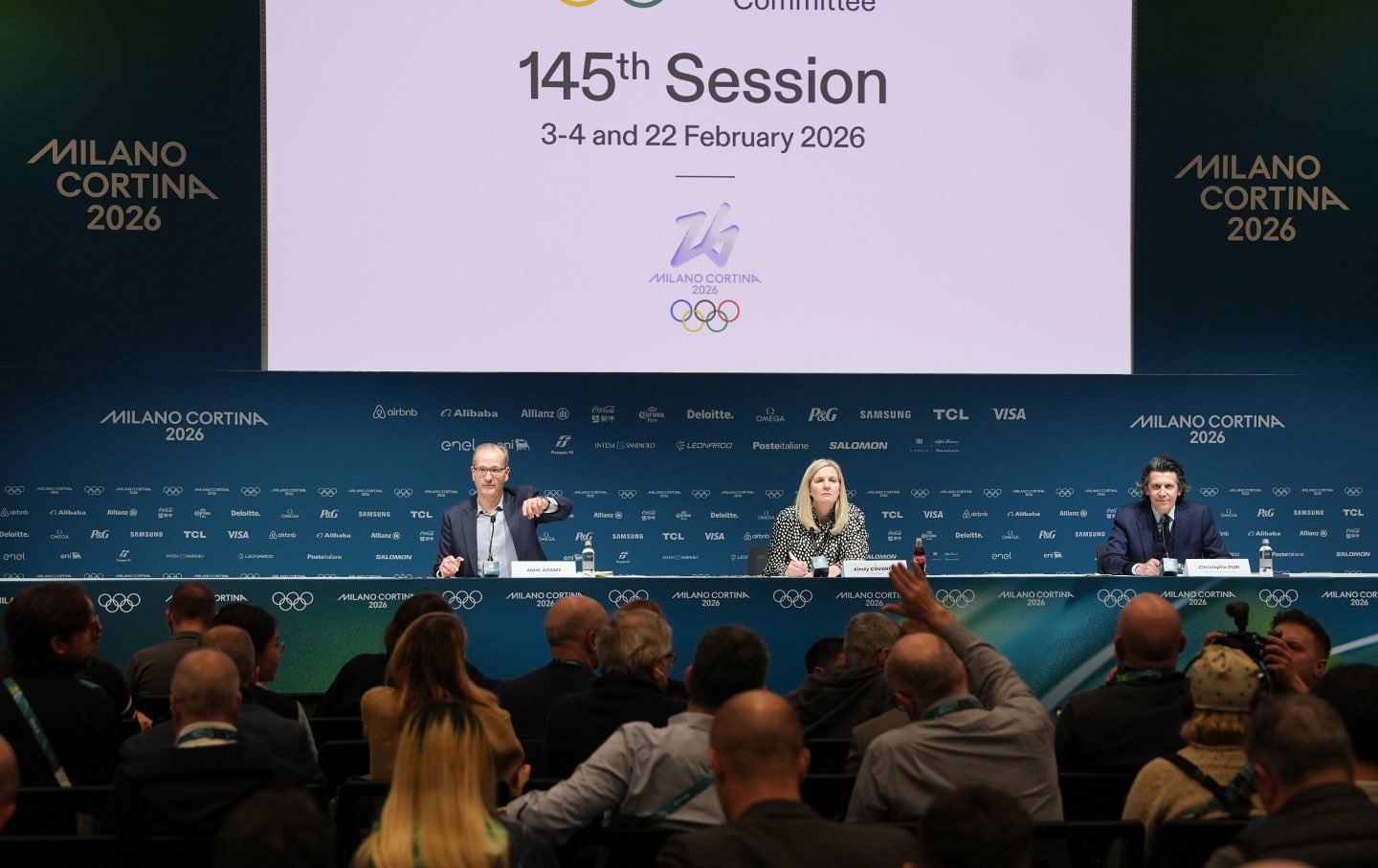
Some of the world’s greatest winter sports athletes have called on the International Olympics Committee to stop taking fossil fuel industry money, including from Italian oil giant ENI, a “Premium Partner” of the 2026 Winter Olympics. “The time has come to question the ethical implications of…normalizing the connections between our sports and the detrimental effects of the product that [fossil fuel companies] sell,” reads a petition delivered yesterday to IOC officials in Milan, Italy, where the Games’ opening ceremony takes place on Friday.
Burning oil, gas, coal, and other fossil fuels is the main driver of global warming, which is raising winter temperatures and reducing the snow cover that skiing and other winter sports require. Winters are rapidly warming across much of the Northern Hemisphere, threatening not only the Olympics but also communities economically and culturally dependent on skiing and other winter recreational activities.
To date, the petition to the IOC and the International Ski and Snowboard Federation has attracted more than 20,000 signatories, including Alex Hall of the US, who won the Olympic gold medal in freestyle skiing at the 2022 Winter Games; Helvig Wessel of Norway, the 2024 Freeride World Tour skiing champion; and Nikolai Schirmer, also of Norway, whose nonprofit Ski Fossil Free organized the petition and hand-delivered it to IOC officials on February 4; a full list of signatories is available here.
Although neither the IOC nor ENI have yet commented on the petition, the IOC did purchase 2.4 million cubic meters of artificial snow to enable reliable conditions for events taking place in the Italian Alps town of Cortina d’Ampezzo. ENI, which has said it aims to achieve carbon neutrality by 2050, announced in December that “90% of the fuels that Eni…will supply to power the Games will be derived from renewable feedstocks.”
February temperatures have warmed by 3.6 degrees Celsius (6.4 degrees Fahrenheit) over the 70 years since Cortina hosted the first Winter Olympics in 1956, according to new research from the scientific nonprofit Climate Central. Cortina now experiences 41 fewer freezing days per year than it did in 1956. Globally, only half of the locations deemed suitable for future Winter Olympics will have reliably cold temperatures by the year 2050, Climate Central found. “Unless we address human-caused climate change and the fossil fuel burning that we’re doing, the possibility of having Winter Olympics is literally melting away,” Kaitlyn Trudeau, a Climate Central scientist who conducted the research, said at a press briefing on January 28 cohosted by Climate Central and Covering Climate Now.
“People in my community aren’t discussing whether or not climate change is real.… it’s very, very apparent when we look at the high mountains,” said Graham Zimmerman, a professional alpinist and director of athletic alliance for the nonprofit Protect Our Winters, which supported the petition drive. Zimmerman and a team were 7,000 meters (23,000 feet) up Pakistan’s K-2, the second-highest peak in the world, when melting snow and ice forced them to shelter in place on a narrow ledge for 14 hours. “It’s an altitude where, generally speaking, you are putting on all of the puffy clothes to stay warm,” he said. “Instead, we found ourselves in temperatures of 42 degrees [F] in the shade, having to take shelter from avalanches and rock fall because the mountain was literally falling apart.”
Although amateur climbers, skiers, and snowboarders are not immune to such dangers, the greater risk for them is simply fewer opportunities to enjoy their favorite winter sports. “Climate Central data shows a steady decline in snowfall at nearly two-thirds of monitoring stations” in the United States, Ben Tracy, a climate journalist on assignment for Climate Central, said in a TV report shown during the briefing (and available for TV stations to air free of charge). “For the ski industry, that meltdown means billions in lost revenue.” A resort Tracy visited in Idaho that normally would have 42 ski runs open had only one—and that one was open only because of costly artificial snow.
That winters are rapidly warming even as bitter cold grips much of the US at the moment may seem counterintuitive to some people (including the nation’s climate-denier in chief), but scientists explain that weather is not the same thing as climate. “In a warming world we’re still going to have cold snaps, they’ll just be less frequent,” Trudeau said. A good way to think about it, she added, is that “weather is [the clothes] you’re wearing today. Climate is the clothes you have in your closet.”
The unreliability of winters on a warming planet leads Rocky Anderson, the former mayor of Salt Lake City, Utah, to emphasize the urgency of phasing out fossil fuels. Anderson was the mayor when Salt Lake City hosted the 2002 Games, a role it is scheduled to repeat in 2034. But during his interview with Tracy, he pointed to the majestic peaks east of the city and noted, “There’s almost no snow anywhere in those mountains,” adding, “I don’t think we’re going to see a Winter Olympic Games in Utah in 2034.”