Environment / January 15, 2026

Climate Hushers Need to Get Real

Political realism doesn’t outweigh scientific realism.
Mark Hertsgaard
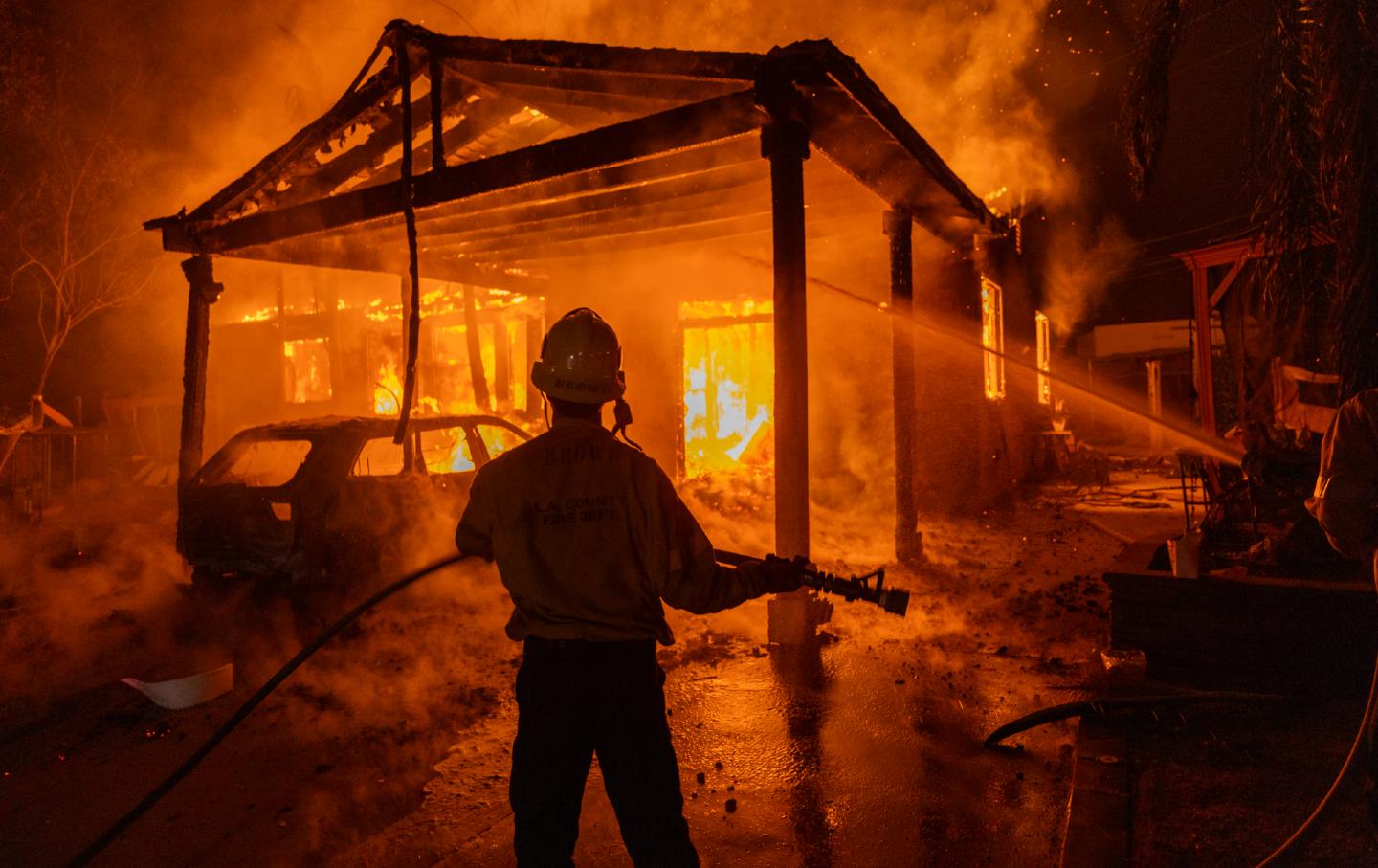
Homes burn as powerful winds drive the Eaton Fire on January 7, 2025, in Pasadena, California.(David McNew / Getty Images)

“Let’s be realistic.” That’s the advice coming from a growing number of voices in climate circles in the United States. In October, billionaire Bill Gates argued that a global temperature rise of 2 degrees Celsius is unavoidable and not a “super bad outcome”—a view unlikely to be shared by the millions of people whose homes would be destroyed by the resulting killer storms and rising seas. In November, The Washington Post analyzed social media posts and public appearances to document how Democrats across the country were “going quiet on climate” to focus on affordability—as if one can’t talk about both. In December, one New York Times opinion article applauded abandoning goals that supposedly were “never attainable” anyway, such as cutting global emissions to zero. A second asserted that Democrats must “support America’s oil and gas industry” if they’re to win the presidency in 2028.

Proponents of this strategic shift fashion themselves as paragons of realism at a time when President Donald Trump is attacking any form of environmental progress. But “climate hushing,” as the practice is known, rests on a fundamental flaw: It focuses on only one form of climate realism—the political—while ignoring a more important one, the scientific.

Hushers may or may not be right about what’s realistic to expect from current leaders and political configurations. But gaming out the politics of climate change must be weighed against what thousands of alarmed scientists have been saying for years: Civilization is hurtling toward irreversible catastrophe, and the only realistic escape route is via phasing out fossil fuels as soon as possible. “Things aren’t just getting worse. They’re getting worse faster,” Zeke Hausfather, a co-author of the UN’s latest climate science report, told the Associated Press last June.

Political realities, of course, matter, but they can be changed by human action; the laws of physics and chemistry cannot. This means citizens and leaders around the world somehow must find ways to bring their respective political realities into alignment with scientific realities: to create the conditions to elect candidates, pass laws, and implement the many available solutions that, scientists also say, could prevent unfathomable loss and suffering.

An overwhelming majority of the world’s people—80 to 89 percent of them—want their governments to take stronger climate action, as Covering Climate Now partners have reported through The 89 Percent Project. Even in the United States, a petrostate in all but name, the number is 74 percent. When a candidate wins an election by 60 percent or more of the vote, we in the media call it a landslide. A tally of 74 percent or higher amounts to super-landslide support for climate action.

People don’t necessarily vote that way, but US Senator Sheldon Whitehouse says it’s wrong to blame the electorate. Democrats keep “getting caught in this stupid doom loop in which our pollsters say: ‘Well, climate’s not one of the top issues that voters care about, so then we don’t talk about it,’” the Rhode Island Democrat said. “So it never becomes one of the top issues that voters care about.”

One of the most powerful things anyone can do about climate change is talk about it, says Katharine Hayhoe, lead scientist at The Nature Conservancy. And that goes double, she adds, for media professionals who reach large numbers of people. To think that any problem can be solved by not talking about it requires magical thinking, which is anything but realistic.
Support independent journalism that does not fall in line

Even before February 28, the reasons for Donald Trump’s imploding approval rating were abundantly clear: untrammeled corruption and personal enrichment to the tune of billions of dollars during an affordability crisis, a foreign policy guided only by his own derelict sense of morality, and the deployment of a murderous campaign of occupation, detention, and deportation on American streets. 

Now an undeclared, unauthorized, unpopular, and unconstitutional war of aggression against Iran has spread like wildfire through the region and into Europe. A new “forever war”—with an ever-increasing likelihood of American troops on the ground—may very well be upon us.  

As we’ve seen over and over, this administration uses lies, misdirection, and attempts to flood the zone to justify its abuses of power at home and abroad. Just as Trump, Marco Rubio, and Pete Hegseth offer erratic and contradictory rationales for the attacks on Iran, the administration is also spreading the lie that the upcoming midterm elections are under threat from noncitizens on voter rolls. When these lies go unchecked, they become the basis for further authoritarian encroachment and war. 

In these dark times, independent journalism is uniquely able to uncover the falsehoods that threaten our republic—and civilians around the world—and shine a bright light on the truth. 

The Nation’s experienced team of writers, editors, and fact-checkers understands the scale of what we’re up against and the urgency with which we have to act. That’s why we’re publishing critical reporting and analysis of the war on Iran, ICE violence at home, new forms of voter suppression emerging in the courts, and much more. 

But this journalism is possible only with your support.

This March, The Nation needs to raise $50,000 to ensure that we have the resources for reporting and analysis that sets the record straight and empowers people of conscience to organize. Will you donate today?

Mark Hertsgaard

Mark Hertsgaard is the environment correspondent of The Nation and the executive director of the global media collaboration Covering Climate Now. His new book is Big Red’s Mercy:  The Shooting of Deborah Cotton and A Story of Race in America.

More from The Nation

Fire breaks out at the Shahran oil depot after US and Israeli attacks in Tehran, Iran, on March 8, 2026.

A World on Fire Needs More Climate Reporting—Not Less A World on Fire Needs More Climate Reporting—Not Less

War is a climate story, but billionaire media owners don’t want to tell it.

Kyle Pope

Men watch from a hillside as a plume of smoke rises after an explosion on March 2, 2026, in Tehran, Iran.

The Iran War Is Also a Climate War The Iran War Is Also a Climate War

Climate change is not a peripheral part of what we’re seeing in Iran—it’s structurally embedded in modern warfare.

Mark Hertsgaard and Giles Trendle

Donald Trump looks over Japanese Prime Minister Sanae Takaichi as she speaks to US Navy personnel aboard the USS George Washington aircraft carrier at Yokosuka naval base on October 28, 2025.

Japan’s New Climate Bomb—in the US Japan’s New Climate Bomb—in the US

Bloomberg Green reveals the climate costs of the US-Japan trade deal.

Mark Hertsgaard

NewsGuild members are joined by other protesters during a rally outside the Washington Post office building on February 5, 2026, in Washington, DC.

Where Climate Coverage Goes to Die Where Climate Coverage Goes to Die

The very notion of public service journalism is under assault at precisely the moment that it’s most needed.

Kyle Pope

Winter Olympic Committee Press Conference

The International Olympics Committee Is Urged to Drop Oil Company Sponsors The International Olympics Committee Is Urged to Drop Oil Company Sponsors

Global warming means the future of Winter Games “is literally melting away.”

Mark Hertsgaard

Minnesotans film a federal law enforcement agent during a patrol in Minneapolis, Minnesota, on January 11, 2026.

Citizen Journalists Are Minneapolis’s Unsung Heroes Citizen Journalists Are Minneapolis’s Unsung Heroes

Without their videos of ICE shootings, we wouldn’t know what is really happening.

Mark Hertsgaard