The Unexpected Triumph That Followed the Overturning of Roe
Abortion numbers keep rising as providers and advocates adapt to the changing legal landscape.
The Unexpected Triumph That Followed the Overturning of “Roe”
Abortion numbers keep rising as providers and advocates adapt to the changing legal landscape.
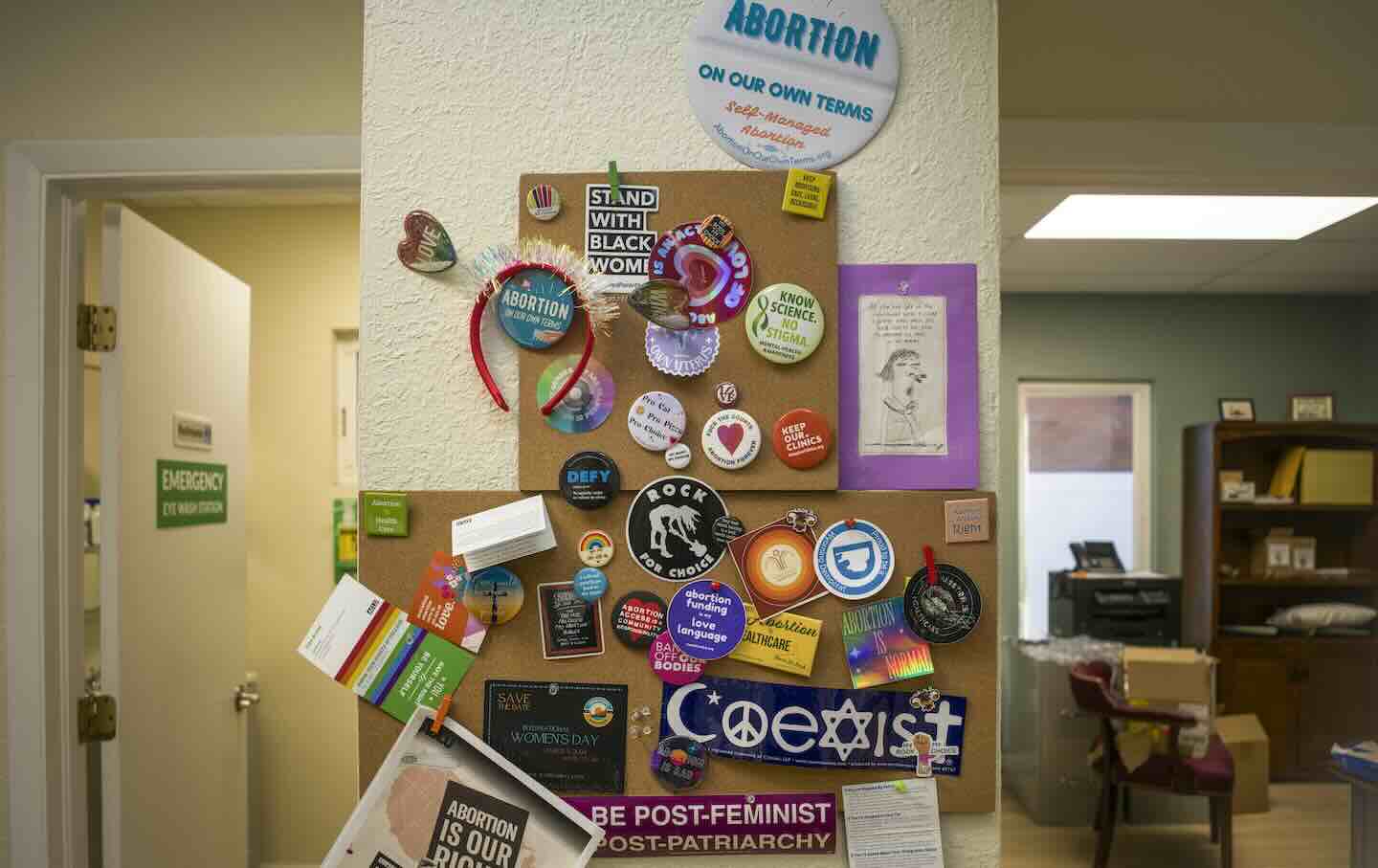
A detail of a bulletin board at Wyoming’s last abortion clinic, Wellspring Center March 10, 2025 in Casper, Wyoming. In late February the conservative legislature passed HB42, requiring abortion clinics performing in-clinic procedures to meet the regulatory requirements of ambulatory surgical centers, causing the clinic to pause all services.
(Natalie Behring / Getty Images)There are two stories that could be used to summarize what’s happened in the three years since the Supreme Court overturned Roe.
The first is a story of unmistakable tragedy: Millions of people lost access to an abortion clinic in their home state. Some people died from abortion bans. Many more were forced to parent.
The second story, equally true, though far less discussed, is one of unexpected triumph: The number of abortions rose in the year after Dobbs as providers and advocates scrambled to meet the challenge of a lifetime.
Two longtime experts on abortion, Carole Joffe and David Cohen, reveal the stories behind this surprising statistic in their new book, After Dobbs: How the Supreme Court Ended Roe but Not Abortion.
Even they didn’t expect it to be a hopeful book.
“When we started interviewing everyone in 2022, we probably both thought it was going to be the opposite story, like, here’s how abortion access gets even worse in this country,” Cohen, a law professor at Drexel University, told me. “This caught us by surprise.”
Instead, a combination of legal innovations, state-level reforms, and what Joffe, a professor at UCSF, calls the “passion and mission” that have always animated abortion providers and advocates conspired to make abortion more accessible and affordable than before.
A major factor was the shift in Democratic thinking.
Spurred by the Dobbs decision, lawmakers in Democratic-controlled states began eliminating abortion restrictions, funding abortions, allowing non-physician providers to offer them, and passing “shield” laws to protect providers who ship abortion pills into red states.
“These liberal, pro-choice states started doing things that advocates had been asking them to do for decades,” Cohen told me. “Dobbs motivated them.”
In one story of unexpected triumph, the owner of North Dakota’s sole remaining abortion clinic, Tammi Kromenaker, made the painful decision to close Red River Women’s Clinic and move five minutes away to Minnesota. A GoFundMe campaign went viral in the wake of Dobbs and Kromenaker raised over $1 million to move to a state where access was expanding; she promptly got a call and visit from her local senators, one of whom invited her to attend the 2024 State of the Union address as her guest. Democratic politicians and the media suddenly seemed to be treating abortion providers as heroes; in 2025, another abortion clinic owner featured in After Dobbs, Julie Burkhart, was named one of “The Most Influential People of 2025” by Time magazine.
“Can you imagine in the 1990s an abortion provider being in Time magazine[’s Top 100]?” Joffe said. “It couldn’t happen.”
Behind the scenes, hotline staffers and abortion fund workers operated as ad hoc travel agents, using a surge in post-Dobbs rage donations to pay for plane and bus tickets and book hotels for patients traveling to clinics out of state. The system couldn’t help everyone; in the nine months after Dobbs, 25,000 people were unable to get an abortion through the formal health system, one study showed. But another study found that the number of self-managed abortions rose by 26,000 in the six months after Dobbs, suggesting many of those who were denied care through a clinic were still finding their way to abortion pills.
The biggest game changer in post-Dobbs access was the expansion in shipment of abortion pills. Shield laws in eight states protect providers with services like Aid Access and The Massachusetts Medication Abortion Access Project (The MAP) who ship abortion pills into states where abortion is banned. More than 10,000 medication abortions per month are shipped through these services, Cohen said. While Texas and Louisiana have attempted to bring legal penalties against one of the doctors involved in this pipeline, they have so far not succeeded in stopping the services. A crucial caveat is that people seeking abortions in banned states still face legal risks; a Pregnancy Justice report found that at least 210 pregnant people faced criminal charges related to pregnancy, abortion, loss, or birth in the year after Dobbs.
To understand the staggering impact of these pill services, Dr. Angel Foster, cofounder of The MAP, asked me to consider Mississippi, which used to have one clinic and imposed restrictions on abortion that required multiple visits. Today, that clinic is a furniture store, yet The MAP is mailing abortion pills to Mississippians at a cost as low as $5 a pack.
“Now with telemedicine, Mississippians can get FDA-approved medications sent to their home for $5 and so we actually see more abortions taking place in Mississippi in 2024 than we do in 2019,” Foster told me. “I think that’s really hard for some people to kind of get their head around.”
One constituency that has gotten its head around the power of telemedicine abortion is the anti-abortion movement, which has filed a lawsuit and lobbied the Trump administration to roll back the Biden-era rules that allows delivery of abortion pills by mail. In response, the administration has announced it will review the safety of medication abortion. But even if the administration tries to require an in-person visit for these medications, it will not be able to stop the informal pill-circulation networks that are getting these pills into thousands of people’s hands. Services like The MAP have developed contingency plans, including stockpiling medication and mulling the possibility of using misoprostol alone, an option that can be more prolonged and painful but is used around the world.
Popular
“swipe left below to view more authors”Swipe →“Pills are here to stay,” Joffe said. “Even if there is a national ban, there always will be possibilities to get mifepristone and even more so misoprostol online; so there’s always going to be abortions.”
The conditions under which people seek these abortions might not always be ideal, depending on what restrictions the Trump administration might impose, and on the ongoing state and local efforts to criminalize people who seek abortions. Nor is it clear how much longer the current landscape can hold, given the dropoff in rage donations. But abortion will never go away.
“It’s like fire; you can’t undo the discovery,” Joffe said.
The left tends to be lousy at celebrating its partial wins, especially in this moment when the Trump administration is flooding the zone with losses. In March, I attended a speech by the leading feminist writer Roxane Gay, who encapsulated the prevailing malaise among liberals in the wake of Trump’s inauguration. In response to an audience question about These Difficult Times, Gay said something to the effect of “I keep wondering when it is we are going to take to the streets.” Then again, she mused, we hadn’t taken to the streets after Dobbs.
An audience member raised her hand.
“April 5,” she said. That’s when we were going to take to the streets. And indeed, millions did in cities across the country.
Joffe and Cohen’s book is a resounding rebuttal to the notion that people haven’t responded forcefully enough to the overturning of Roe v. Wade. Perhaps abortion-rights supporters didn’t take to the streets in the historic numbers seen during the Women’s March after Trump’s election in 2017. But people outraged over Dobbs did transform the landscape of abortion access for good.
“Our movement is so driven by—not exclusively—but abortion providers and access supporters and advocates, that they didn’t have time to take to the streets, right?” Cohen said. “They had to completely change their service delivery models or expand their service delivery models, deal with the influx of volunteers, deal with the influx of calls.”
“People didn’t necessarily take to the streets, but they donated a shit-ton of money,” Joffe added. And Democratic lawmakers woke up. And abortion providers, funds, and advocates put their heads down and did the work.
In this moment, it bears remembering that resistance to authoritarianism takes many forms, the most effective of which may not be visible.
Outside of the abortion world, another promising sign of less-visible resistance is the surge in progressives running for local office. Run for Something, a group that supports progressive candidates running for city, county, and state office, has seen “over 46,000 people raise their hands to say they want to run for office” since Election Day, “more than we had in the first three years of Trump’s first term,” president Amanda Litman told me. “It’s huge.”
The surge “tells me that people are really eager to fight back; they want to do it in a way that is effective; they want to do it in a way that is focused and practical,” Litman, author of When We’re In Charge: The Next Generation’s Guide to Leadership, added. “They are really hoping for local action.”
Running for office, she said, is not just about fighting Trump, but about “building something new.”
In the wake of Dobbs, that’s exactly what the pro-choice majority in this country managed to do.
Become a Sustaining Donor This September
Between the reemergence of right-wing red-baiting and Donald Trump’s use of the chilling National Security Presidential Memorandum–7 to criminalize left political organizing, we’re seeing McCarthyism reborn before our eyes.
This assault on democracy cannot be ignored or wished away. Resisting it requires bravery in the face of threats and repression, a steadfast commitment to the truth, and the unwavering belief that we can—and will—overcome this darkness.
We must have an independent media that sets the record straight, unearths corruption and abuses of power, and advances a politics of justice and dignity for all if we’re to win this fight.
That’s why I’m writing to you today. This September, The Nation needs to add 100 monthly donors to sustain our progressive journalism. Your contribution makes the next investigative report, the next truth-speaking column, and the next pathbreaking essay all possible.
I hope you’ll support our work with a recurring donation today. If you donate $10 or more a month, we’ll send you a brand new “Hands Off the Free Press!” sticker to recognise your commitment to our cause. Please, donate today.
Onward,
Katrina vanden Heuvel
Editor and Publisher, The Nation