Were They “Getting Yippy” or Was Trump Manipulating the Market?
I don’t know exactly what went down in the hours before Trump publicly announced a “pause” on tariffs, but it merits investigation.
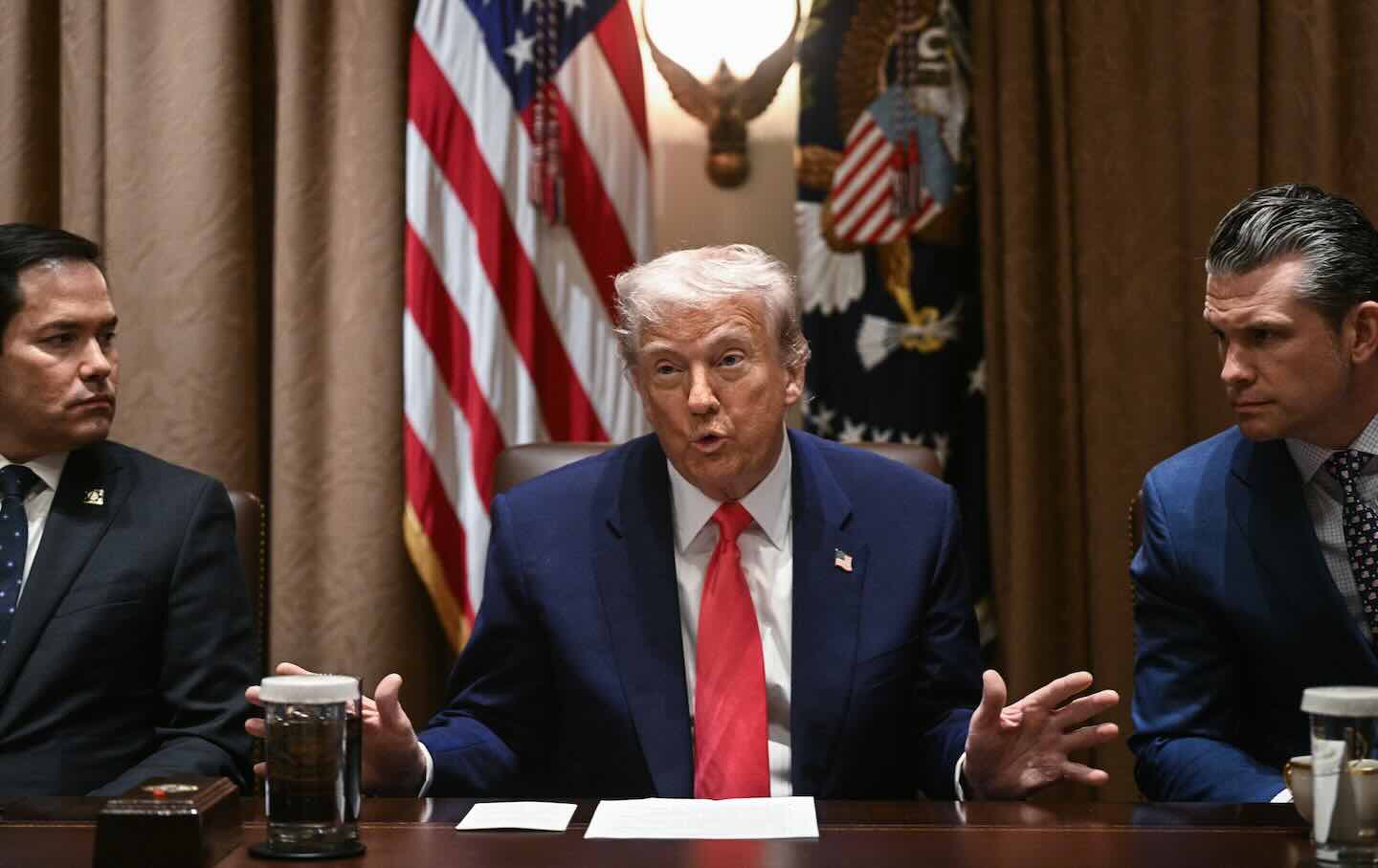
President Donald Trump, alongside Secretary of State Marco Rubio (L) and Secretary of Defense Pete Hegseth (R), speaks during a cabinet meeting on April 10, 2025, in Washington, DC.
(Brendan Smialowski / AFP)
Over the past week, the world may well have witnessed the biggest example of market manipulation in history—a manipulation that could yet plunge the global economy into recession but that appears to have made some investors, especially those who were reading and acting on Trump’s social media posts throughout Wednesday, huge sums of money.
I’m not a financial investigative journalist, but I do know when something smells fishy. What we’ve seen since April 2—a week in which tariffs were imposed by the United States on pretty much the whole world, and then abruptly withdrawn from most countries a week later, resulting in some of the largest stock market swings in history—smells like rotten fish.
Senator Adam Schiff has called for investigations into the possibility that some type of large-scale insider trading has occurred, and the Californian is backed by support from his colleagues Chris Murphy and Ruben Gallego. In the House, Representative Alexandria Ocasio-Cortez has demanded that her colleagues disclose their recent stock market trades.
What has infuriated these lawmakers is a week of whiplash economic policy that has plunged the global market into uncertainty and cast doubt on the reliability of the United States as the pillar of the international financial system.
Trump declared “liberation day” on April 2 and imposed a range of punitive tariffs—seemingly calculated either on the back of an envelope or by feeding certain simplistic instructions about trade deficits into Chat GPT—on pretty much every country on earth (except for a few Russia-aligned autocracies), global stock markets tanked.
This was entirely predictable, since trade underpins the international economy, and, in many ways, is a determinant of the value of globalized companies.
In the two days after Trump’s imposition of tariffs, just between the falls in the S&P 500 and the Dow Jones, roughly $12 trillion in wealth evaporated. It was one of the biggest two-day drops in the past 75 years. By my calculations, that works out to a loss of more than $35,000 per person in the country.
Around the world, a similar collapse of wealth took hold, reducing the values of retirement accounts and education savings plans, and, ultimately, making it far more likely that economies would tip into serious recessions, resulting in millions of people losing jobs and livelihoods.
Trump talked tough, telling investors not to panic and promising improbably glorious results from his tariff wars. He talked tough all the way to Wednesday, when the bond markets, which facilitate US borrowing, began to tank, the fall in the dollar’s value accelerated, and the treasury secretary and others told the president that the global financial system was on the verge of a meltdown. And then, like farm produce that has been hanging around on supermarket shelves too long, Trump wilted.
At 1:18 pm Eastern on Wednesday, Trump took to Truth Social and announced a 90-day pause on most additional tariffs beyond his 10 percent baseline tariff for almost all countries. The exception was China, which Trump raised the rate to an eye-popping 125 percent—only to clarify a day later that the rate would actually be an even more eye-popping 145 percent.
Predictably—as predictable, in fact, as the initial market collapse following the tariffs announcement of April 2—markets soared on Wednesday afternoon. Desperate investors, looking for any indication that “normalcy” was returning, flocked back into stocks, treating Trump’s announcement as if it were rocket fuel. In the hours after Trump hit the pause button, the Dow Jones rose nearly 3,000 points—a gain that lasted less than one day, until the reality of an escalating US-China trade war set in and the markets shed much of those gains in a route that picked up steam throughout Thursday.
A lot of people and institutions, who know when to buy and when to sell, made a lot of money during Wednesday’s brief market surge, buying low and selling high that afternoon, while the going was still good. And important questions are swirling about all of this. Indeed, hours before his policy reversal, Trump posted, “THIS IS A GREAT TIME TO BUY!!! DJT.” Nudge, nudge, wink, wink, know what I mean?, as they used to say on Monty Python.
While Trump occasionally signs his Truth Social posts with his initials, it seems noteworthy that the letters DJT are also the stock market symbol for Trump Media and Technology Group. Its value soared more than 22 percent on Wednesday afternoon, making the Trump family—Trump owns 53 percent of the company’s shares, which are held in trust by his oldest son—hundreds of millions of dollars in added worth. Tesla’s share values also shot Mars-ward Wednesday, as did the value of Elon Musk’s other ventures. Spread across all his companies, Musk’s net worth jumped an astounding $36 billion—almost the total annual budget of USAID pre-DOGE—in just those few hours following Trump’s hitting the pause button.
Many, many investors seemed to take note of Trump’s rather open hints that a tariff pause was coming. In the minutes before that pause was made public, watchdogs noted huge spikes in share buys on the major stock markets.
If I were a powerful politician of a mind to game the system on a vast, global scale, or to help my cronies game the system, there are a lot of steps I would probably take on the way there: I would be tempted to fire all the independent ombudsmen at government agencies whose job it is to monitor for unethical or illegal actions. I would order the Department of Justice to stand down its anti-corruption units. I would likely have the DoJ stop enforcing the provisions of the Foreign Corrupt Practices Act. I would make an effort to undermine the independence of the Securities and Exchange Commission, and in fact to take direct control over it. I would break down all the guardrails designed to stop my mixing of personal business with my political power, and I’d make sure to force my party’s congressional representatives into a position of prostrate loyalty.
All of that has happened since January 20. Now, I don’t know exactly what went down in the hours before Trump publicly announced a “pause” on tariffs against all countries not called China, but I do know that it merits investigation. There is more than a whiff of insider trading wafting through the halls of power this week, as leading Democrats in the House and Senate have already pointed out in calling for investigations. If Congress is to retain any credibility as a branch of government coequal to the executive, it must assert its investigative powers now. Too much is at stake, including trust in the integrity of global markets, to simply brush these actions under the table.
Become a Sustaining Donor This September
Between the reemergence of right-wing red-baiting and Donald Trump’s use of the chilling National Security Presidential Memorandum–7 to criminalize left political organizing, we’re seeing McCarthyism reborn before our eyes.
This assault on democracy cannot be ignored or wished away. Resisting it requires bravery in the face of threats and repression, a steadfast commitment to the truth, and the unwavering belief that we can—and will—overcome this darkness.
We must have an independent media that sets the record straight, unearths corruption and abuses of power, and advances a politics of justice and dignity for all if we’re to win this fight.
That’s why I’m writing to you today. This September, The Nation needs to add 100 monthly donors to sustain our progressive journalism. Your contribution makes the next investigative report, the next truth-speaking column, and the next pathbreaking essay all possible.
I hope you’ll support our work with a recurring donation today. If you donate $10 or more a month, we’ll send you a brand new “Hands Off the Free Press!” sticker to recognise your commitment to our cause. Please, donate today.
Onward,
Katrina vanden Heuvel
Editor and Publisher, The Nation