This Supreme Court Case Is About More Than “Defunding” Planned Parenthood
If South Carolina succeeds, there will be almost no check on states that discriminate against healthcare providers for any reason.
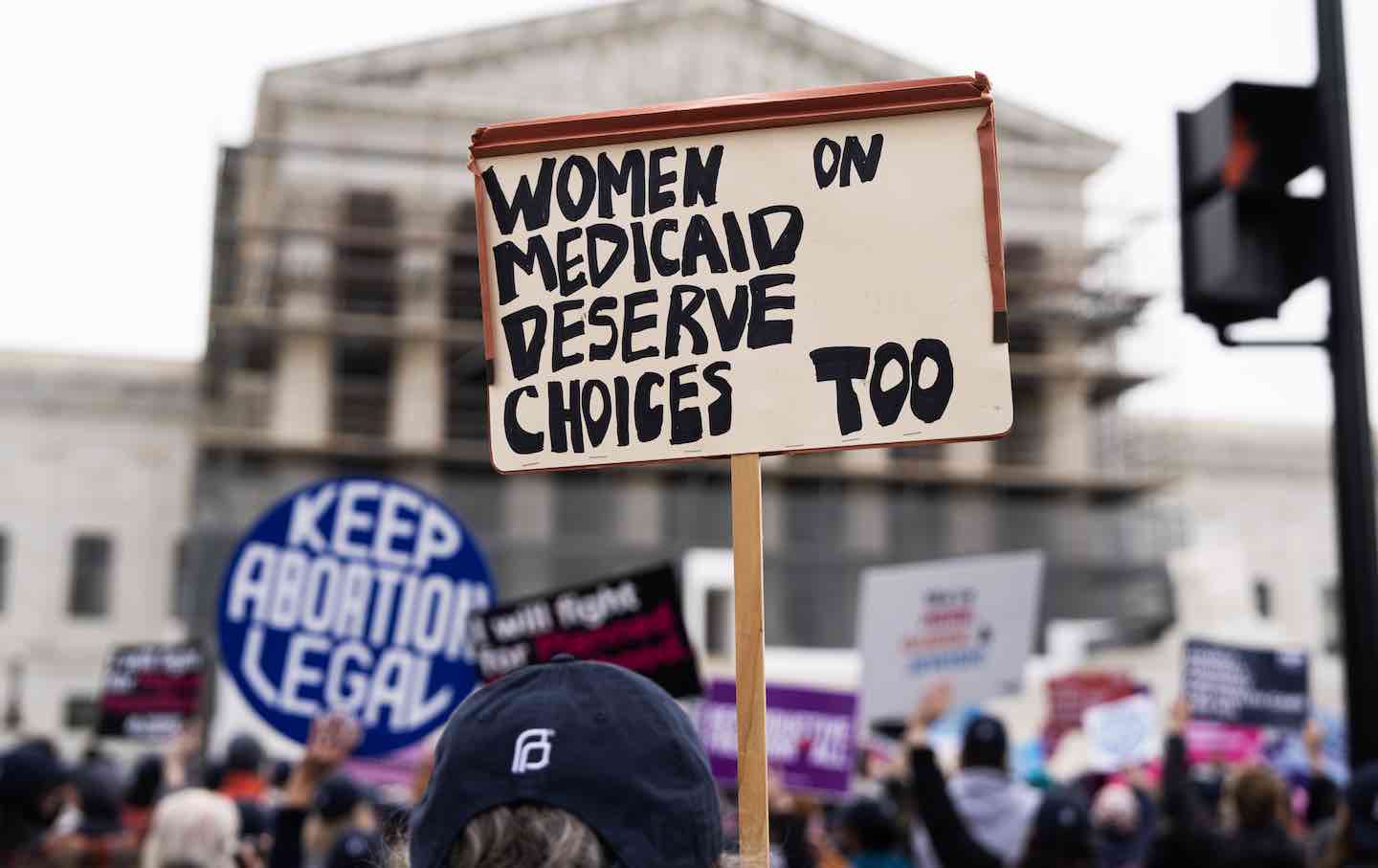
A demonstrator holds a sign in front of the US Supreme Court as the Medina v. Planned Parenthood South Atlantic case is heard on Wednesday, April 2, 2025.
(Tom Williams / CQ-Roll Call, Inc via Getty Images)
This week, the US Supreme Court heard oral arguments in Medina v. Planned Parenthood South Atlantic, a case that has received much less attention than others the court will hear this term, despite its potential to “destroy” the Medicaid program. The question before the court is, do Medicaid patients have a right to sue, in federal court, to enforce the “free-choice of provider” provision in Medicaid’s statute? If they do not have a right to sue, then states will be largely unaccountable for decisions to include or exclude providers from the Medicaid program.
As it sounds, the “free choice” provision allows patients to choose any qualified provider of family planning services participating in the program. Specifically, the provision states, “A State plan for medical assistance must…provide that any individual eligible for medical assistance…may obtain such assistance from any institution, agency, community pharmacy, or person, qualified to perform the service or services required.”
However, in 2018, South Carolina excluded Planned Parenthood clinics, and all abortion providers, from its Medicaid program, not because the clinics were unqualified to provide family planning services but because they also provided abortions. (The state currently bans abortion after six weeks, which is before many people know they are pregnant.) Abortion care is not covered under the federal Medicaid program, except in cases of rape, incest, or threat to the pregnant person’s life—and South Carolina, along with 17 other states, follows that standard. But the state’s policy means that Medicaid patients who choose Planned Parenthood as their preferred provider for services besides abortion care, like cervical cancer screenings and contraception, will not have their care reimbursed. Said another way, patients have to find another place to receive basic reproductive and preventive healthcare.
On Wednesday, the court heard arguments regarding the different interpretations of the statute regarding an individual’s right to challenge the state’s exclusion of certain providers. The justices asked questions that demonstrated that the court had addressed this question—whether individuals can sue under Medicaid’s law—in previous cases. In 2023, for instance, the court upheld a patient’s right to sue under a different provision but made clear that the test for whether such a right exists is a tough one to meet. An individual right is enforceable under a civil rights statute, Section 1983, when the provision is “phrased in terms of the person’s benefits” and contains “right-creating individual centric language with an unmistakable focus on the benefited class.”
Lawyers for South Carolina and the Trump administration (reversing the solicitor general’s position under the Biden administration) argued that the Medicaid provision has no such “right-creating, individual centric language.” Planned Parenthood argued the opposite. And every justice asked, multiple times, about how the parties thought the provision should be interpreted. Are there “magic words” that confer a right?
Interestingly, only two questions from the justices mentioned the word “abortion.” In fact, in listening to the oral arguments, one would have no clue what’s at stake for reproductive health care across the country in this case—but, in fact, a lot is at stake.
Medina is entirely about abortion animus. In signing an executive order prohibiting any abortion provider from participating in the state’s Medicaid program, South Carolina’s governor made clear that the order targeted the state’s Planned Parenthood clinics to force them out of operation by hamstringing their ability to provide non-abortion services.
The heart of the case, as Justice Amy Coney Barrett noted, is a state’s right to treat abortion providers differently from other Medicaid participants offering the same services. Justice Elena Kagan underscored the point that South Carolina isn’t and has never argued that Planned Parenthood is unfit or medically unqualified to provide family planning services. Indeed, the state offered no reason grounded in patient care or safety when they disqualified the clinics. What is to stop, Justice Kagan asked, a state from excluding a provider for any reason—for providing or not providing abortion or contraceptives or gender-affirming care? If individuals cannot sue states for taking providers out of the Medicaid pool, then there is almost no check on state discretion to discriminate against healthcare entities for any reason.
That’s exactly what Congress, in passing the free-choice of provider provision, wanted to prevent: funneling patients toward state-picked providers. If the Supreme Court finds that Medicaid beneficiaries have the right to bring an action to enforce their right to choose any qualified provider, the case will return to the federal district court to determine whether South Carolina acted according to law in stripping Planned Parenthood of its qualified status. But if the Supreme Court rules for South Carolina, then Planned Parenthood could appeal the governor’s decision, which, as the parties already have agreed, will not succeed.
That is the extent to which the justices talked about the consequences of the case. But much more is on the line. A Supreme Court’s decision for South Carolina will open the door for states to exclude providers, like Planned Parenthood, because of politics and not because of their medical or clinical qualifications. Texas, Arkansas, Indiana, and Missouri have already indicated support for or enacted Medicaid defunding policies.
Then, stripping Planned Parenthood from receiving Medicaid reimbursements or Title X grants, which the Trump administration has already moved to do, will bankrupt many clinics in those states and eliminate vital reproductive health services—cancer screenings, pregnancy tests, birth control—on which low-income patients depend.
Medicaid’s reach is hard to understate. It is a safety-net program that covers “one in five reproductive age women and is the largest source of coverage for women with low incomes, covering over four in ten.” It also is “the largest single public payer of family planning services.” Yet, the same week as the Medina arguments, the Trump administration froze almost $30 million in family planning grants under the Title X Family Planning Program, ostensibly to target organizations like Planned Parenthood for also providing abortion care in some communities.
Popular
“swipe left below to view more authors”Swipe →We know that making reproductive health care of any kind, including abortion, inaccessible correlates with unintended pregnancies, pregnancy complications, and higher infant mortality rates. These costs will be absorbed by those already unable to pay and they will burden an already broken healthcare system. But those consequences do not seem to trouble either South Carolina or the executive branch.
The Supreme Court is expected to issue its ruling this summer.
Disobey authoritarians, support The Nation
Over the past year you’ve read Nation writers like Elie Mystal, Kaveh Akbar, John Nichols, Joan Walsh, Bryce Covert, Dave Zirin, Jeet Heer, Michael T. Klare, Katha Pollitt, Amy Littlefield, Gregg Gonsalves, and Sasha Abramsky take on the Trump family’s corruption, set the record straight about Robert F. Kennedy Jr.’s catastrophic Make America Healthy Again movement, survey the fallout and human cost of the DOGE wrecking ball, anticipate the Supreme Court’s dangerous antidemocratic rulings, and amplify successful tactics of resistance on the streets and in Congress.
We publish these stories because when members of our communities are being abducted, household debt is climbing, and AI data centers are causing water and electricity shortages, we have a duty as journalists to do all we can to inform the public.
In 2026, our aim is to do more than ever before—but we need your support to make that happen.
Through December 31, a generous donor will match all donations up to $75,000. That means that your contribution will be doubled, dollar for dollar. If we hit the full match, we’ll be starting 2026 with $150,000 to invest in the stories that impact real people’s lives—the kinds of stories that billionaire-owned, corporate-backed outlets aren’t covering.
With your support, our team will publish major stories that the president and his allies won’t want you to read. We’ll cover the emerging military-tech industrial complex and matters of war, peace, and surveillance, as well as the affordability crisis, hunger, housing, healthcare, the environment, attacks on reproductive rights, and much more. At the same time, we’ll imagine alternatives to Trumpian rule and uplift efforts to create a better world, here and now.
While your gift has twice the impact, I’m asking you to support The Nation with a donation today. You’ll empower the journalists, editors, and fact-checkers best equipped to hold this authoritarian administration to account.
I hope you won’t miss this moment—donate to The Nation today.
Onward,
Katrina vanden Heuvel
Editor and publisher, The Nation