Politics / July 14, 2024

Trump Deserves Sympathy—but Not Support for His Candidacy

Getting shot does not ennoble the target or transform victims into moral leaders.
Katrina vanden Heuvel
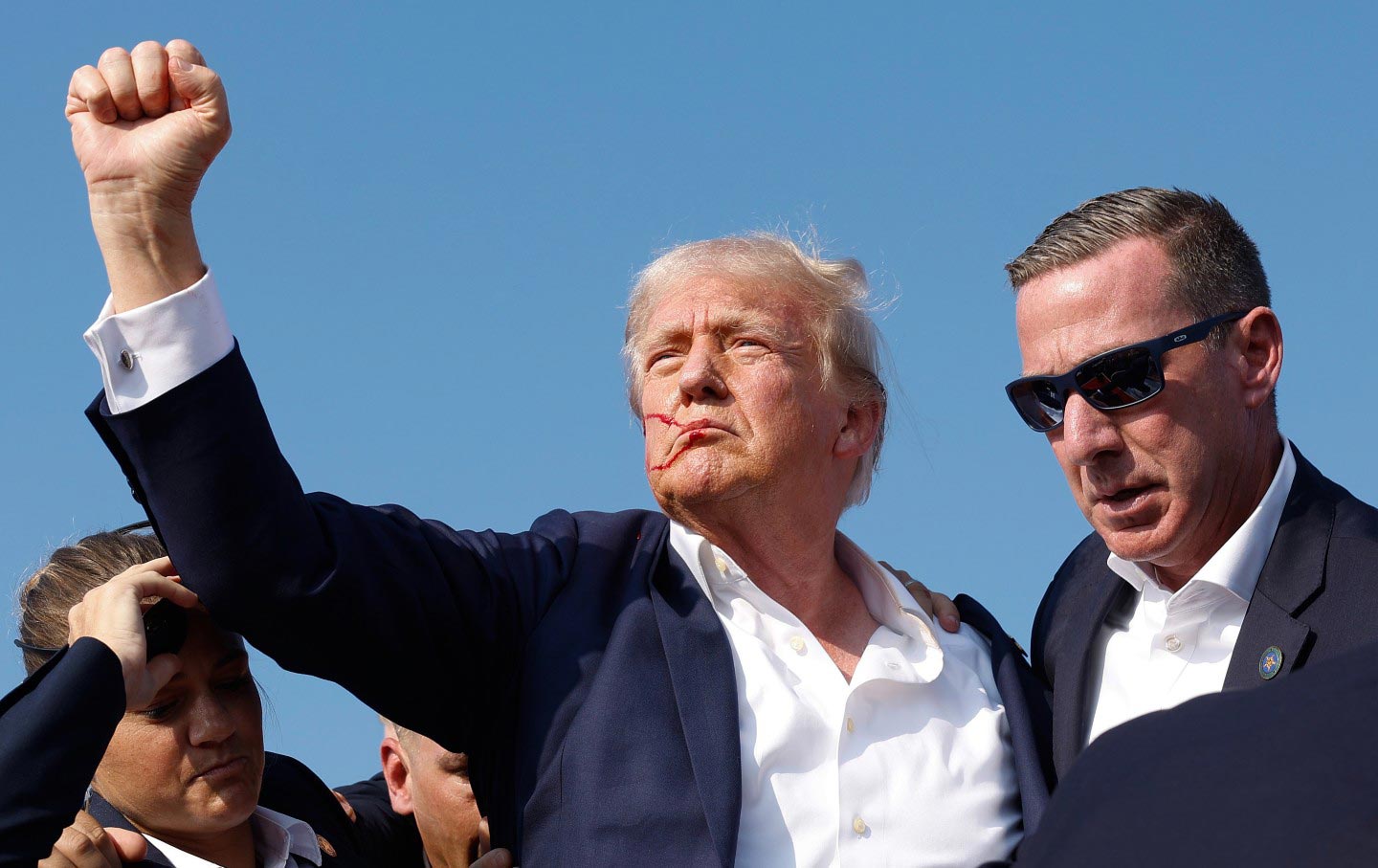
Republican presidential candidate former president Donald Trump pumps his fist as he is rushed offstage during a rally on July 13, 2024, in Butler, Pennsylvania.
Republican presidential candidate former president Donald Trump pumps his fist as he is rushed offstage during a rally on July 13, 2024, in Butler, Pennsylvania.(Anna Moneymaker / Getty Images)

I was on the phone with my daughter when e-mails started streaming through. “Trump has been shot.” She teared up, asking in a fearful and trembling voice: “What does this mean for our country?”

What it means, I think, is that we have entered a moment when, more than ever, we need perspective, context, history, and clarity about the threat of political violence in a time so charged as this.

Being the victim of a shooting is terrifying. Donald Trump and those wounded and killed deserve our sympathy and concern. We should not forget the risks that political leaders take in a society as polarized and as gunned-up as this one.

The shooting at Trump’s rally in Pennsylvania yesterday—which authorities have labeled as an assassination attempt on the ex-president—ended with two people critically injured and two killed: a rally attendee and the shooter himself, 20-year-old Thomas Matthew Crooks. Trump crouched down immediately, having suffered a wound to his ear.

In this era of 24/7 propaganda, the incident was quickly turned into campaign grist. Fox News suggested Trump’s reaction made him into a hero, a symbol of American strength and courage. MAGA zealots—most vociferously Ohio Senator J.D. Vance, a suitor of Trump for the vice presidential nomination—blamed Biden’s criticism of Trump for spurring the shooting. Vance ignored the reality that no one has done more to coarsen our political dialogue than Trump, whose language has grown ever more violent and divisive over time. It was Trump who called on Iowans to vote for him and defeat “all of the liars, cheaters, thugs, perverts, frauds, crooks, freaks, creeps,” just as it was Trump who slandered political opponents and immigrants as “vermin.”

It is not an exaggeration to note that Trump has gloried in the language of political violence for more than a decade. He has configured his campaign around a paranoid martyrdom. He shares a strong currency of violence with his followers—during this and previous elections.

What should we take from this horror? We should begin by decrying all political violence as unacceptable. President Biden has condemned the shooting ardently and unequivocally. So too did prominent Democrats who fundamentally disagree with the former president. Hopefully, leaders from across the political and ideological spectrum will join in these condemnations. Just as, one hopes, they will condemn the growing threats of violence that public officials from the president to poll volunteers to judges and jurors now receive.

But this is about more than politics and public life. This country has too much gun violence and too many guns. Most of the victims are not famous, or powerful. With children in grade schools now forced to take part in active shooter drills, it is long past time for all of us to get serious about curbing gun violence.

But surely, we also recognize that when a former president is shot at, this stirs up our already agitated politics. While we condemn political violence, we should understand that getting shot does not ennoble the target or transform victims into moral leaders. A presidential race is not a WWE wrestling drama. Trump should be assessed, as anyone who would lead this country, based on his behavior, his character, and his agenda. That responsibility does not disappear because someone took a shot at him. The prospect of a Trump presidency was as deeply unsettling before Saturday’s shooting incident, and it remains so after it.

With his instinct for vaudeville and venom, and the Republican Convention about to convene, Trump is likely to use this dangerous moment and event for political advantage.

No one should be fooled. Donald Trump deserves sympathy for the attack he experienced. That does not, however, make him an acceptable candidate for the presidency.
Disobey authoritarians, support The Nation

Over the past year you’ve read Nation writers like Elie Mystal, Kaveh Akbar, John Nichols, Joan Walsh, Bryce Covert, Dave Zirin, Jeet Heer, Michael T. Klare, Katha Pollitt, Amy Littlefield, Gregg Gonsalves, and Sasha Abramsky take on the Trump family’s corruption, set the record straight about Robert F. Kennedy Jr.’s catastrophic Make America Healthy Again movement, survey the fallout and human cost of the DOGE wrecking ball, anticipate the Supreme Court’s dangerous antidemocratic rulings, and amplify successful tactics of resistance on the streets and in Congress.

We publish these stories because when members of our communities are being abducted, household debt is climbing, and AI data centers are causing water and electricity shortages, we have a duty as journalists to do all we can to inform the public.

In 2026, our aim is to do more than ever before—but we need your support to make that happen. 

Through December 31, a generous donor will match all donations up to $75,000. That means that your contribution will be doubled, dollar for dollar. If we hit the full match, we’ll be starting 2026 with $150,000 to invest in the stories that impact real people’s lives—the kinds of stories that billionaire-owned, corporate-backed outlets aren’t covering. 

With your support, our team will publish major stories that the president and his allies won’t want you to read. We’ll cover the emerging military-tech industrial complex and matters of war, peace, and surveillance, as well as the affordability crisis, hunger, housing, healthcare, the environment, attacks on reproductive rights, and much more. At the same time, we’ll imagine alternatives to Trumpian rule and uplift efforts to create a better world, here and now. 

While your gift has twice the impact, I’m asking you to support The Nation with a donation today. You’ll empower the journalists, editors, and fact-checkers best equipped to hold this authoritarian administration to account. 

I hope you won’t miss this moment—donate to The Nation today.

Onward,

Katrina vanden Heuvel 

Editor and publisher, The Nation

Katrina vanden Heuvel

Katrina vanden Heuvel is editor and publisher of The Nation, America’s leading source of progressive politics and culture. An expert on international affairs and US politics, she is an award-winning columnist and frequent contributor to The Guardian. Vanden Heuvel is the author of several books, including The Change I Believe In: Fighting for Progress in The Age of Obama, and co-author (with Stephen F. Cohen) of Voices of Glasnost: Interviews with Gorbachev’s Reformers.

More from The Nation

Jeffrey Epstein and Steve Bannon, in a photo released by House Democrats.

Why Epstein’s Links to the CIA Are So Important Why Epstein’s Links to the CIA Are So Important

We won’t know the full truth about his crimes until the extent of his ties to US intelligence are clear.

Column / Jeet Heer

How the Border Patrol Moved Inland—and Created a Police State

How the Border Patrol Moved Inland—and Created a Police State How the Border Patrol Moved Inland—and Created a Police State

In 1994, the writer Leslie Marmon Silko wrote a piece for The Nation warning of a frightening new immigration regime.

Richard Kreitner

Students, researchers and demonstrators rally during a Kill the Cuts protest against the Trump administration's funding cuts on research, health, and higher education at the University of California–Los Angeles on April 8, 2025.

The Public Health Heroes of 2025 The Public Health Heroes of 2025

The Trump administration wants to destroy our health infrastructure. These warriors aren't letting that happen without a fight.

Gregg Gonsalves

Rob Reiner in 2018 in Studio City, California.

Rob Reiner, Bari Weiss, and the Shifting Politics of Hollywood Rob Reiner, Bari Weiss, and the Shifting Politics of Hollywood

Weiss’s ascent reveals the extent to which Hollywood, once a Democratic stronghold, has defected for a politics that puts the concerns and egos of wealthy people first.

Joan Walsh

Norman Podhoretz

The Longest Journey Is Over The Longest Journey Is Over

With the death of Norman Podhoretz at 95, the transition from New York’s intellectual golden age to the age of grievance and provocation is complete.

Obituary / David Klion

Seattle, Washington, 2022.

Organized Labor at a Crossroads Organized Labor at a Crossroads

How can unions adapt to a new landscape of work?

Books & the Arts / Nelson Lichtenstein