What’s at Stake in the UAW Strike
With so much riding on the outcome, it’s time for labor and its supporters—from the White House to the grass roots—to play for keeps.
Two types of shutdowns hit the headlines this week. The first is a nightmarish repeat: A handful of right-wing radicals in Congress is threatening to disrupt the lives of millions of federal workers and the millions of working-class Americans who rely on the services they provide by forcing a government shutdown.
The other shutdowns, however, move in the opposite direction: everyday people using their organizations to bring strategic sectors of the economy to a standstill to demand a society that works for the people who generate its wealth. These strikes—like the just-settled Hollywood writers’ strike, which saw workers build supermajority unity and wield it to shift the balance of power—are the real answer to the hooligans in D.C. and the billionaires they represent, at the ballot box and in the workplace.
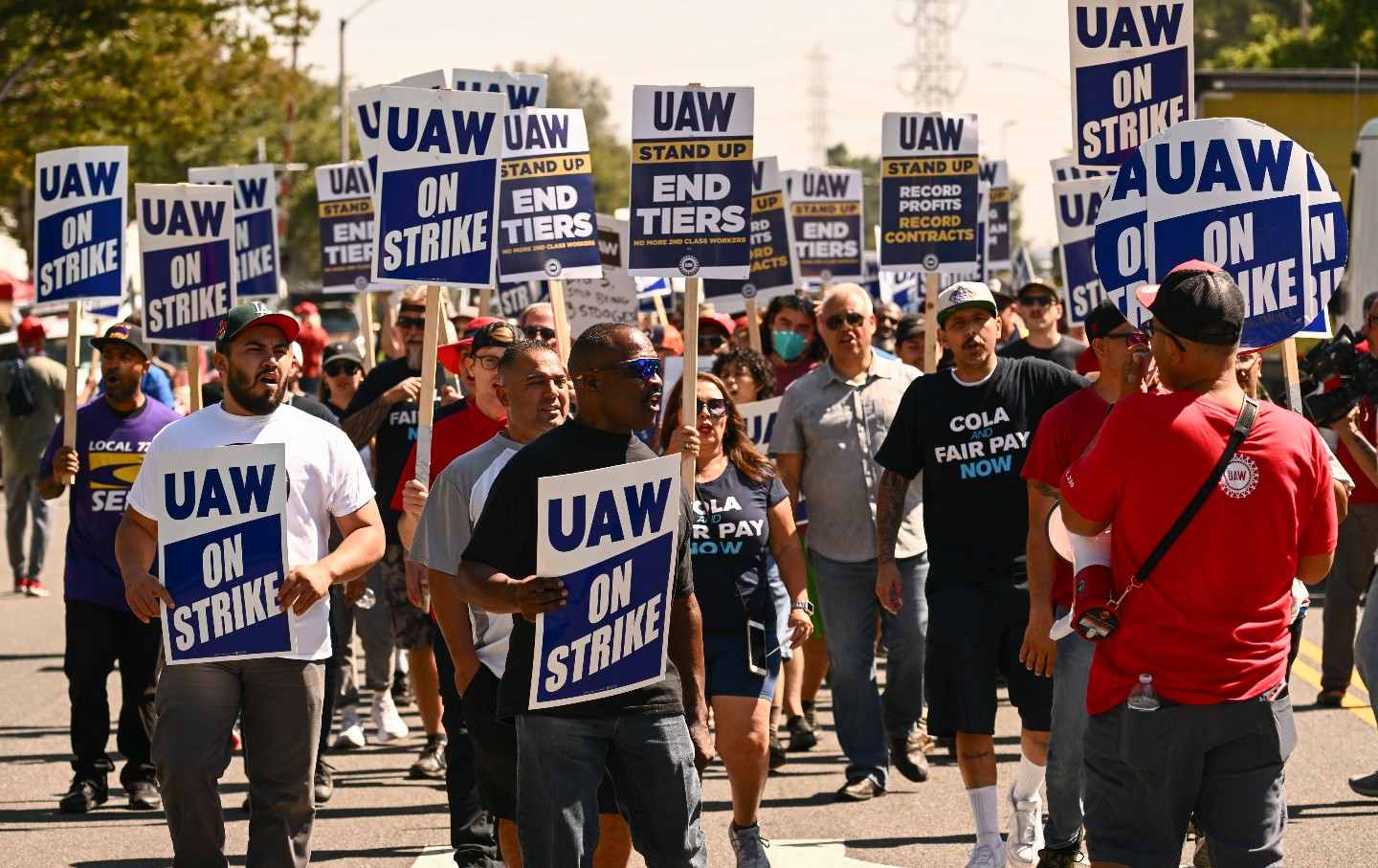
Although the United Auto Workers’ walkout is only the most recent among several substantial strikes this year, it has the highest stakes—for workers, for President Biden’s hopes for reelection, and for motivating his base to elect a Congress with enough pro-worker, pro-climate-justice members to pass meaningful legislation. The UAW strike started small, with just 8 percent of the workforce at the Big Three automakers. But it keeps expanding; as this article goes to press, 41 plants are out across 20 states. Human beings can’t survive without these workers championing the changes in their industry to move away from fossil fuels. The UAW has the power to make that transition a just one by winning an agreement that gives workers on electric vehicles the same contract standards that autoworkers enjoyed before the 2007 auto industry bailout. It takes more power to induce positive change than to block it—and the autoworkers have to not only force the hand of their employers but also move the Biden administration, which has advanced billions in taxpayer subsidies to the very industry that is scoffing at its workers’ demands.
It’s extremely hard to run supermajority strikes, and Shawn Fain’s new leadership in the UAW has had very little time to prepare. The union’s struggle to claw its way out of decades of corruption and graft has undermined its access to experienced leaders and staff, which matters. But the conditions shaping this moment—massive profits, tight labor markets, widespread outrage at inequality, overwhelming support for these strikes by Americans, key crossroads in technology, and synchronized contract expirations—mean workers have to act quickly and strategically to close that gap. The John Deere workers held their own without the support of the national union back in 2021. Holding the line, however, is very different from organizing the unorganized or achieving a model contract that addresses the twin crises of inequality and climate disaster.
Yet these two fronts are indivisible: unionized workers striking to win life-changing contracts, and workers newly organizing to secure the kinds of contracts they see unionized workers winning. This link actually makes the task much more daunting, especially as the UAW expands the strike, because “Bargaining to Organize” means compelling employers to relinquish power, not just money—and they won’t do that unless they’re absolutely forced to.
For the current strike to move us forward, workers need to lay the foundation for more power: more control over technology in the workplace, and better terms for building a broader base of power among newly organized workers. With the looming switch to electric vehicles, the UAW must come away from this fight with a strong, fair unionization process that facilitates mass organization of the electric car and battery sector. The future of the UAW’s manufacturing membership—not to mention the planet—depends on it.
This is also an opportunity for environmentalists and Democrats to push the “most pro-union president” in history to do more than just visit a picket line. That would give striking workers in key states—who have learned the real source of their misery on the picket lines—something worth voting for. The billionaires and their Republicans will try their best to set the terms of this fight in their favor, as they have with their Supreme Court and their Electoral College. It’s time to play for keeps—not only for the end of this strike, but for the days after.