Jalen Hurts Deserved Better. We All Do.
In a country that treats workers as expendable parts, Hurts playing through a blood clot is just the highest profile example of the price workers pay in an oligarchy.
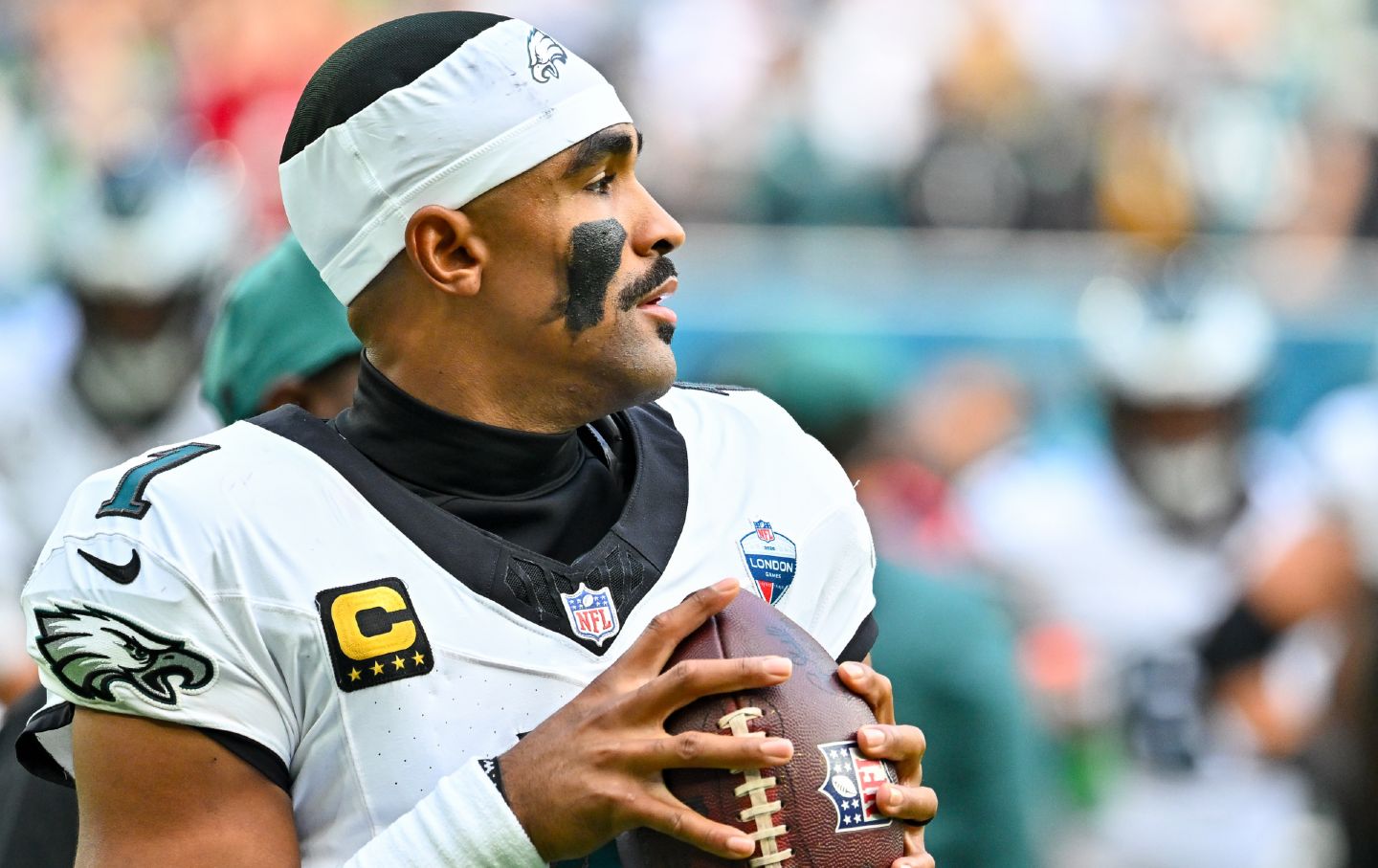
The Philadelphia Eagles’s Jalen Hurts during the NFL match between the Eagles and the Jacksonville Jaguars at Tottenham Hotspur Stadium on October 11, 2026 in London, United Kingdom.
(Vince Mignott / DeFodi Images/DeFodi via Getty Images)
In a world where the attention spans of sports commentators and fans is roughly the same as that of a cat chasing a laser pointer, sometimes a story breaks through that demands our undivided attention. Philadelphia Eagles quarterback Jalen Hurts could have died this week and, despite the relentless churn of the news cycle, we must not look away.
The 2025 Super Bowl MVP was told by the Eagles’s medical staff that he had a “superficial blood clot” after an opponent’s cleat smashed into his calf on October 8. Hurts found himself the night before game day in a London hospital until 3 a.m., where he was told that sleeping could cause the clot to spread and risk his life. Hurts then, according to reports, attempted to pull an all-nighter, though he may have taken a nap at the stadium before game time—this part of the story is unclear. He then played in the game, where he attempted 40 passes. The Eagles lost 19-17, and Hurts took another transatlantic flight home. After attending practice for another two days, an ultrasound revealed Hurts’s condition had worsened. He was diagnosed with deep vein thrombosis and bilateral pulmonary emboli, meaning he now had multiple blood clots in both lungs. Hurts is now out for the season, taking blood thinners, and fortunate that he avoided a pulmonary embolism.
When the story first broke, “NFL insider” Tom Pelissero had the following hot take: “How committed is Jalen Hurts to football?”
So committed, Pelissero wrote, that “after initially being diagnosed with a superficial blood clot in London, doctors told him not to sleep as a precaution, so he had been awake for roughly 36 hours when he started against the Jaguars, throwing for 220 yards and a TD.” (Pelissero later walked back the “awake for 36 hours” part, which was disputed by Hurts’ agent.)
It’s exactly that kind of tough guy “committed to football” narrative that puts Hurts’s life—and the health of all players—at risk. As former NFLPA chief DeMaurice Smith would remind people, “This is the only job with a 100 percent injury rate.” These injuries invariably get exacerbated because football players, with their non-guaranteed contracts, will always play unless stopped. This is more than a financial concern. It is built into the toxic, gladiator ethos of the sport.
But moments like these are precisely when a team’s medical staff is supposed to intervene. Without their involvement, coaches will do whatever they need to do to keep their jobs, and a quarterback willing to go through a wall to win a game will agree to it, even if it means playing with a blood clot in front of an indifferent London crowd. This is especially the case in Philadelphia, where the Eagles’s perpetually enraged fans were already calling for Coach Nick Sirianni’s job—despite winning the Super Bowl just 20 months before—because of an early season losing streak.
What happened with Hurts also makes one wonder where the NFL Players Association, the union that represents players, was as this news broke across the sports world. It should be up in arms, demanding answers for how this could have possibly taken place. Instead, it’s MIA, having not put out—as of this writing—even a boilerplate statement about health and safety guidelines or how players must be protected. The Nation has received no comment from the union, but I have received messages from former players frustrated that it has become so toothless and unwilling, even rhetorically, to shout from the rooftops that such an incident is utterly unacceptable.
The Hurts story feels bigger than one player avoiding a fatal tragedy. It is a microcosm of larger issues within the league, which treats its players—even star quarterbacks—as equipment. These aren’t “gladiators.” They are workers: workers whose average career is three and a half years. The league, despite all of its rhetoric about player safety, treats them like they’re disposable.
But the Hurts microcosm doesn’t end on the football field. This is about a worker who risked his life, with the approval of company doctors, and without the assistance of a union, which chose instead to cover its eyes and ears as long as the National Football League’s golden goose of app gambling and streaming services keeps laying eggs. In a country that treats workers as expendable parts of a production line, with many unions unworthy of the struggles that created them in the first place, Jalen Hurts is just the highest profile example of the price workers pay in an oligarchy. In this oligarchy, private equity overlords in the owners’ box look down on their expensive toys and think of themselves as the emperors of ancient Rome. In reality, they represent the worst of us, watching others inflict pain for their own profit and amusement.
Jalen Hurts deserved better than this. So do the rest of us. Now the NFL and its media partners are trying to move on to the next topic, hoping our addiction to gambling and Fantasy Sports will allow us to “thingify” and dehumanize Hurts enough that we can still enjoy the spectacle without considering the price paid. We can’t let them. This is a story of corporate and medical malfeasance, which is also a story too many of us know all too well in a country where cruelty has become more than “the point.” It has become currency.