
Millions of Ukrainian Men Are Fleeing a Cruel Conscription System
They are being written out of the narrative.
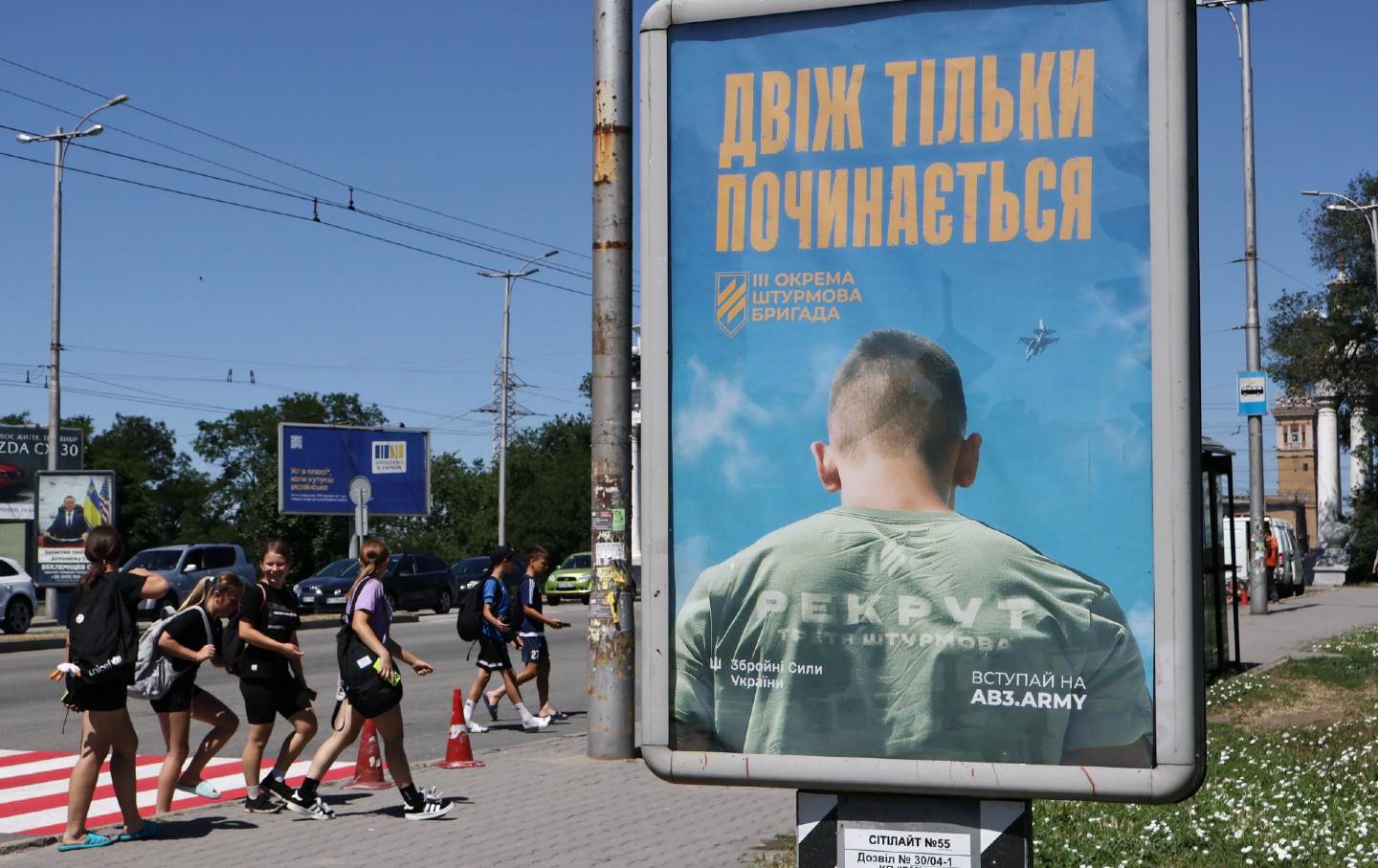
Odesa, Ukraine—A clear-eyed middle-aged man leans in closer, yelping in broken English: “I don’t want to die, understand? But they got me. Now I have to go.” He downs another shot of vodka. The restaurant terrace is full of people enjoying their shashliks. They don’t mind the man and his raucous friends, as send-off parties for newly mobilized soldiers are no longer noteworthy.
They are a part of the city’s soundscape just like the moped buzzing of Russia’s 440-pound Shahed drones or the howl of air raid sirens.
Every now and again these drones make car-size holes in apartment buildings and kill civilians. The front line is about 90 miles away from here, but the way locals treat it, it might as well be on the moon. Odesa is an eclectic, sun-soaked Black Sea port city where baroque Russian Imperial buildings mix with Soviet panel housing, looking out to steep beaches. Those beaches stay packed even when explosions cut through blaring American pop music—only a few foreign tourists gingerly jog for shelter.
But beneath the veneer of relative normality, just like in the rest of Ukraine, Odesa is home to a self-designated underclass of men aged 25–60, who live as fugitives in their own country. In Ukraine they are called uhylyanty, which is derogatory slang for “dodgers.” For years, the uhylyanty have been trying to avoid Ukraine’s massive military mobilization campaign that began the same day as the full-scale Russian invasion.
In the early months of 2022, volunteers were lining up for the front. Not anymore. It is unclear how many are hiding, but estimates range from 2 to 6 million. This is not widely researched, and in the English-language press the dodgers issue is drowned out by pieces highlighting Ukraine’s innovation and heroism.
Many in Western capitals describe the war as a struggle between good and evil, a fight for the West’s freedom and security. The Kremlin has also demonstrated its utter disregard for civilian lives. Russian soldiers torture, murder, and rape on a mass scale.
To stop Putin’s onslaught, Kyiv is desperate for people. Success, for all the high-tech drones, remains dependent on bodies. “If two years ago commanders needed rockets, now they need people,” said Oleksandr Syrski, former Ukraine military chief.
Yet millions of Ukrainians don’t want to fight. Why?
The Fear
In Odesa I met Taras (name changed at his request) at a beachside bar. A staunch Protestant, Taras recoils at the idea of killing. The bulky, six-foot-six 29-year-old does not look like a fugitive as he bites into his burger. “You see, I am big,” the IT developer says with a proud smile. “That’s why the Tetseka doesn’t bother me. I have no fear.”
TCR, pronounced as te-tse-ka in Ukrainian, stands for Territorial Center of Recruitment and Social Support. This is Ukraine’s state agency responsible for organizing mobilization.
The Tetseka officers move in groups of three to five men, sometimes dressed as civilians. Often they are accompanied by police. They drive Renault Masters, Ford Transits, or other generic minibuses with pitch-black tinted windows. These minibuses are how the mobilization got its folk moniker: busyfykatsia or busification.
In a poll last year, a record 68 percent of Ukrainians said they don’t trust the Tetseka. But some still view mobilization as necessary. I spoke with energetic Kateryna Musiyenko, 27, who is a part of the activist group Robymo vam Nervy (Making You Nervous), which advocates ridding Odesa of Soviet and Russian cultural heritage.
“For me [mobilization] is not a problem because most of my relatives and friends are already mobilized,” Kateryna says. “It’s constitutionally mandatory. And I don’t think it’s a problem because we have to do that. Who will do that if not the Ukrainians? Maybe the methods are not pleasant. But when people ignore [draft] letters for months and they try to escape it and they are sitting home just to not fight, for me, it’s really cringe.”
In October 2025, a month after I met Taras, three Tetseka men jumped out of a covert minibus and ran after him. He managed to escape, leaving his backpack and jacket behind.
In November, a different patrol spotted Taras again. “They ran after me. They got lost pretty fast, except for two who caught up with me at a cul-de-sac.” As the two men dressed in military fatigues got a hold on Taras, a gaggle of middle-aged women passersbys tried to pull him out of trouble, but the Tetseka men wouldn’t let go.
“They yelled at the women, threatening them with rape or beatings,” recounts Taras. Eventually, the Tetseka prevailed after calling for police backup. Taras was driven away.
Scenes like this have become the new normal. They are frequent and often more dramatic, sometimes featuring a conscript’s pleading and crying loved ones.
After being snatched by the Tetseka, Taras was brought in for a medical exam, alongside dozens of men from all walks of life. Taras sat in a dimly lit corridor painted in the customary Soviet institutional green, under letter-sized posters of scantily-clad models advertising military service.
“There was this rumor online that you can dodge by not letting them take a photo of you. That didn’t work by the time I got there,” he recounts, monotonously.
Taras says that after refusing to be photographed, he was forced into a small room where two plainclothed men took his picture while smacking him on the head. A bulbous colonel “with prosthetic legs up to his knees and mad eyes” yelled out that he would shoot Taras if he moved, aiming a handgun at him.
“Then they started selling us,” Taras remembers. The men were interviewed by the bulbous colonel and army unit commanders. “Commanders then came up to the colonel with envelopes of cash, bidding for men they chose.”
Taras was able to pitch his IT expertise. He was selected for a drone unit, but to his terror, he was designated as a fixik: a mobile one-man repair team. “I would have had dozens of drones in my car. I would have been the prime target,” he shudders.
Still, Taras didn’t argue much, seeing how one of his fellow recruits “got cocky and demanded better conditions. So, the unit that initially wanted him passed. He was given to Skelya.”
The rest of the time the once-cocky scrawny twentysomething was in the corridor, Taras wouldn’t dare look his way. Two armed soldiers from Skelya were beating the conscript. “You are ours now, they said to him,” remembers Taras.
Skelya, meaning “rock,” is Ukraine’s largest assault unit. Skelya is eponymous with its commander Yurii Harkavyi’s call sign, inspired by Dwayne “The Rock” Johnson. A few months ago, Johnson recorded a video for Harkavyi, sending him “mana.”
Skelya is infamous for torturing and killing dozens of conscripts sent its way. The Oleksandr Semenov case is well known. He arrived at the Kropyvnytskyi hospital in January 2026. Semenov claimed that during his time in Skelya he was beaten, tied to an ATV, and dragged on the ground. A few days later, he died. The official cause was listed as pneumonia.
No comprehensive public data exists, but it is common knowledge in Ukraine that there were quite a few murky deaths in Tetseka holdings, in training camps, or in units’ compounds. Since 2022, there have been more than 1,400 criminal proceedings concerning torture, opened against Tetseka centers and police stations.
Only 20 resulted in a conviction. One such conviction concerns a videoed case of a brutal beating of a conscript. Two Tetseka officers pleaded guilty and received one year of probation and fines of roughly $20.
The Mess
Tetseka has an unsavory reputation in the army at large, such that soldiers often wear patches and bumper stickers proclaiming “not Tetseka.” I saw these patches sold anywhere from Odesa’s expansive Privoz to Kharkiv’s flea market.
Many Tetseka officers have been wounded in action, like the bulbous amputee major who threatened Taras. Some are sent there because health issues make them unfit for frontline service. Despised and understaffed, the Tetseka comes out dysfunctional. Ukrainians are often able to escape them.
For example, Taras fell ill in a training camp after weeks of back-breaking labor in howling November wind. While he was at a hospital, Taras told me, his friends were able to kidnap him. Now the IT specialist is hiding from the Tetseka in a rental apartment back in Odesa. He stays indoors reading Chinese fantasy novels all day.
Taras’s acquaintance, another IT specialist Boris (name changed at his request), is a quintessential example of how messy mobilization might get.
The Tetseka caught Boris, 27, while he was summering in a country house, which he and his partner rented in a village on the outskirts of Kyiv. He said he deliberately searched for a place away from the main roads and population centers to avoid the draft. One morning, Boris was walking down an empty sunny street. Listening to stoner metal on the loop, he didn’t notice a police car pulling up.
Not very athletic, Boris didn’t try to run away. After spending a night at the Tetseka hold, he was driven off to a medical commission. An anarchist, Boris feels little but contempt toward the idea of fighting for a state.
Next, he says, “they drove me through this neighborhood in Kyiv. And I realized that I know that my boys live right over there.” Boris thought about it while the car idled at a red light. Then he opened the car door and walked out pushing into a jog and then a sprint when he heard screaming behind him. “It was like a trance,” he says.
For a few months Boris lived a normal life in Kyiv. When I visited him last fall he seemed completely nonchalant. “The Tetseka don’t come here. This is a wealthy neighborhood,” Boris explained.
But then, he wanted to save on rent. “I moved into a poorer neighborhood, more proletarian. And there they got me. A Tetseka guy just slammed me to the ground.”
The often-unsaid reality is that mobilization primarily targets working-class Ukrainians. Volodymyr Ishchenko, 44, is a soft-spoken Ukrainian sociologist based in Germany. He researches class dynamics in Ukraine and particularly mobilization.
“Those who are forcibly mobilized,” Ishchenko explains, “are disproportionately poor. They are factory workers or from rural areas.” He elaborates that wealthier men are able to pay the ever-growing bribes to get the Tetseka off their backs or at least afford a lawyer. Lawyers aren’t too safe either—a Kharkiv region lawyer was beaten by Tetseka till his leg broke.
There is a bribe price list compiled by Ukrainian reporters. One would pay $6,000 to avoid being taken by the Tetseka; $10,000 buys you a “special flight,” i.e., being driven out of the country in an ambulance. The list culminates with $50,000 for a fake disability status, removal from the draft database, and departure abroad. The prices vary across Ukraine, though. Taras said he was asked for a $10,000 bribe by the Tetseka staff just to be let go.
The average monthly salary in Ukraine is about $700.
Kyiv has been trying to reform the Tetseka, and clamp down on corruption and messiness. But a well-oiled Tetseka would only grab men more effectively. The system needs bodies. Especially, as long as Russia is able to reliably supply its own ranks with a motley of foreign mercenaries, conscripts, convicts, and highly paid contract soldiers.
The Resistance
Ukrainians are well aware of torture in the Tetseka and of the rampant corruption thanks to Ukrainian domestic media. So it is no wonder that Tetseka raids frequently provoke spontaneous riots. Odesa, Taras’s hometown, has had its share. In 2026 alone, some 20 officers of the Odesa region’s Tetseka were injured by uhylyanty or their sympathizers—with knives, fists, and bullets.
Across Ukraine, physical resistance to the Tetseka is bubbling up, although giving an exact figure is impossible: Just like with suspicious deaths, no comprehensive sociological mapping exists. Last year, Ukrainian police registered 341 cases of attacks on the Tetseka. In 2023, the parliamentary human rights chief said that there were over 1,000 recorded confrontations.
This July, in western Ukraine’s Lviv, a hundreds-strong crowd roughed up Tetseka officers who tried to grab a man off the street. They even turned the Tetseka car upside down. The next day, Zelensky’s chief of staff, Kyrylo Budanov, called for “a just law enforcement response.” A day later police detained several participants, while a local activist veteran posted a gloomy video, in which several men and teenagers are forced to apologize and chant “glory to Tetseka.”
In the light of this swift justice, it becomes obvious why mass riots against the Tetseka are not omnipresent, and traditional mass protests are nonexistent. “How would we do an anti-Tetseka maidan?” asks Boris, rhetorically. “It would be like protesting against the necessary.”
Ishchenko, the sociologist, elaborates further: “It is this narrow, privileged—yet easily mobilizable and highly visible in the public sphere—‘civil society,’ that is capable of sustaining and rapidly assembling a protest” like the ones against Zelensky’s sacking last month of military chief Mykhailo Fedorov.
Ishchenko goes on to argue that there is a fundamental class distinction “vis-à-vis the resistance to the ‘busification,’ which hit the less-privileged classes hardest. While the latter are far more numerous, they remain fragmented.”
So, to keep safe, Ukrainians resort to online resistance and grassroots documentation. For years, Ukrainian social media has been flooded with daily videos of the Tetseka roughing up men and shoving them in vans, often as relatives cry nearby.
In most cities there are specialized Telegram channels run by local enthusiasts. They are called something like Kyiv Weather or more directly Draft Papers Odesa. There, Ukrainians post information about the movements of the Tetseka. A typical message from Draft Papers Odesa, a channel of over 55,000 readers: Balkivs’ka St., corner of Dal’nyts’ka st—a patrol car snatched a Glovo deliveryman. His Glovo moped is still parked there.
In these channels, Ukrainians have developed a thesaurus of slurs just for the Tetseka: lyudolovy (people-catchers), pidory (faggots), nechist’ (ghouls), or simply cherty (demons). Some of these terms go back to Soviet, even Imperial times. The region has a storied tradition of resisting conscription: from Central Asia’s Basmachi uprising to Tbilisi’s largest market, still named Dezerter Bazaar. Serving in the military is generally stigmatized across the post-Soviet space, and the institutions enforcing the draft are not well-appreciated.
There is also a thriving digital ecosystem around those who escape Ukraine over the border. There are numerous vloggers who document their escapes and training regimens necessary to brave the rivers and forests of Ukraine’s southwestern border—which is patrolled by drones and armed guards. There is even an iOS game where the protagonist has to learn to swim over the Tysa border river. Dozens of draft dodgers have drowned in Tysa alone.
Anastasia Piliavsky, 45 years old and quick-witted, is a British Ukrainian anthropologist. She lives between Odesa and Cambridge. Her daughter, now in a Ukrainian summer camp, has been playing the all-popular “Tetseka game,” a variation of Cowboys and Indians. In the game, there are three factions, Piliavsky says: the uhylyanty, those who are helping the uhylyanty, and the Tetseka. “The Tetseka are the baddies in this,” Piliavsky concludes.
She expands: “In the rear the Tetseka is viewed as this brutal, corrupt enemy force, and experienced as much more dangerous and much more loathsome than the Russian enemy force. That’s critical. A breaking point.”
The Spin
years, the topic of mobilization hasn’t been widely present in mainstream Western discourse. Often when it is raised, it is met with cancellation campaigns.
The aforementioned Ukrainian sociologist Volodymyr Ishchenko was one of the first academics to research mobilization, meeting immediate pushback. An online panel on mobilization Ishchenko tried to co-convene at Central European University’s Democracy Institute was canceled by the institute, the day after the official announcement went live. The institute cited concerns from the “Ukrainian community.”
Ishchenko argues that the Western grant infrastructure created a particular creative class that is seen in the West as the only legitimate Ukrainian voice. Piliavsky elaborates that this creative class “is a professional class, not the richest, but a class in the business of words and ideas. They work as fixers, they dominate the scene where foreign journalists like to hang out. And they are also—overwhelmingly—not the ones fighting. Because many have either the means to buy themselves out—or the connections to avoid the front.”
There have been plenty of Western-funded programs over the years explicitly designed to select a new breed of Ukrainian leaders. Take MP Oleksandra Ustinova. She is an alumna of the State Department’s Future Leaders Exchange program, the Transatlantic Fellowship Program, and Stanford’s Ukrainian Emerging Leaders Program.
In 2024, Ustinova called for the imprisonment of men caught fleeing conscription. This caused quite a stir, as Ustinova’s husband, a Ukrainian man of military age, has been living in the United States since 2022. And Ustinova is not the only politician whose family is avoiding mobilization while she advocates for ramping it up. Lviv’s mayor called for a gender-blind conscription system—his two sons live abroad. An unnamed Ukrainian MP told reporters that only two MPs have children in the military.
Meanwhile, European policymakers increasingly discuss sending Ukrainian refugee men back to Ukraine, or otherwise impeding their flight abroad. Over 4 million Ukrainians have temporary protected status in the EU, and since the invasion European capitals adopted a humanitarian rhetoric. “They were received with open arms.… This is Europe’s spirit. A Union that stands strong together,” Ursula von der Leyen said in 2022.
Yet it seems that fleeing conscripts are getting written out of the EU’s humanitarianism. From March 2027, fighting-age men will be excluded from the temporary protection scheme.
Polish Defense Minister Władysław Kosiniak-Kamysz said recently that “all young Ukrainians fit for military service must return to Ukraine.” Already in 2024, the foreign affairs spokesman for the German far-right party Alternative für Deutschland’s parliamentary group said, “Before a single NATO soldier is sent to Ukraine, the Ukrainian men of military age should first be sent back.”
None of this is framed as stopping Europe’s military assistance to Ukraine. In fact, Europe’s reticence to accommodate the draft dodgers is painted as “something the Ukrainians asked us to do.” And indeed, Kyiv seems happy to cooperate, working to set up “Unity Hubs” in Germany, which are supposed to entice Ukrainian men to return. In 2024, Ukraine also cut all consular services to military-age citizens abroad.
The uhylyanty might have different ideas. As Taras puts it, “When a European comes to a Ukrainian, who is getting bombed every day, and asks: ‘Why don’t you want to be the shield of Europe?’ I don’t get it. If you want to defend your values—go and defend them, don’t throw us under the bus.”
Boris adds: “Many here don’t believe in Ukraine as something they want to risk their lives for.” Ishchenko echoes his point: “Ukrainians might love Ukraine. But they hate and distrust their state.”
To explain why the Western media rarely covered mobilization, the sociologist quotes Slovene philosopher Slavoj Žižek: “Wile E. Coyote runs off a cliff and is running in the air. But can only run as long as he doesn’t look down.” Covering “busification,” Ishchenko thinks, would be “looking down” and admitting many Ukrainians’ disillusionment in the liberal world order, tantamount to ceasing to believe in the end of history.
The Disillusionment
In March 2025, a Sky News team visited the aforementioned Skelya regiment. One of the team’s drivers stayed in her car at the Skelya command post. Then a masked man walked up and shot the armored car point-blank a dozen times and vanished into the midnight darkness. Another soldier soon appeared to collect the spent casings and tell the terrified driver to flee. Sky News filed complaints to no avail. Sky News producer Azad Safadov told the story on Facebook last July. He said that Sky News could’ve created “an international scandal, but didn’t do this because they support our country.”
When I read about the war in English, I see it presented as some glorious spectacle. Thousands of headlines and social media posts project triumphant messaging of a Ukrainian “Gondor” standing against the “Russian orcs.” Flagship Ukrainian English-language outlet Kyiv Independent recently published a playful video where a reporter said that Ukrainian men dodging mobilization are her biggest dating red flag.
Popular
“swipe left below to view more authors”Swipe →Online one might also encounter smiling Shiba Inu dogs decked out in Ukrainian uniforms, stills from The Lord of the Rings or The Mandalorian, proclaiming that “This Is the Way.” As The Atlantic put it, ”Ukraine is Winning the Meme War.”
The “red flag” uhylyanty, on the other hand, see an altogether different war. They know that serving does not look like fighting orcs alongside Gandalf the White. More likely, it looks like living in a dugout for months while defecating in a trash bag to avoid getting spotted—and when spotted eventually, bleeding out in a trench with your entrails out.
That is what Boris told me, when I visited his Kyiv hideout, three weeks before he moved to a poorer neighborhood to be mobilized. “You see, death is not as scary, what is scarier is the constant discomfort of serving—for God knows what. Death is momentary; discomfort is forever.”
After Boris was finally caught, he spent months in a dilapidated training camp with boarded windows, where the conscripts were monitored 24/7 lest they escape. He then became a soldier. The mood of the military, Boris says, is described in two sentiments: “God, help me survive this” and “I don’t fucking want to die for this country.”
“Now,” he wrote me from basic training, “I am listening to this guy who tells me I need to fight the Russians, because they will kill and rape my sister. But I wouldn’t let this guy anywhere near my sister either.”
When I ask Boris whether he thinks of himself as fighting for democracy and freedom, the now-soldier sardonically responds, “Of course not.” Simultaneously, Boris developed a more measured outlook on the Tetseka. “I understand that you can’t fight this war without mobilization. Maybe in the beginning there was a chance to trade some territory for peace,” he says. “But now, it will just keep going on. We’re in a zugzwang.”
Still, Boris is holding on to hope of eventually leaving Ukraine, saving up his army pay to later leverage it for an escape. “They kept telling me [at basic training] that they are going to teach me how to survive on the battlefield, but I already know how to survive there,” he says: “Stay off the fucking battlefield.”
More from The Nation
Why French Students Are Revolting Why French Students Are Revolting
France’s education system is stretched to its limits, as student anger kicks off a hot fall protest season.
Revolution or No Revolution Revolution or No Revolution
Eight years after Armenia’s “Velvet Revolution,” Nikol Pashinyan’s government has deepened the country’s neoliberal trajectory while reorienting Armenia toward the West.
The GOP Sells the Mirage of a Hormuz Victory The GOP Sells the Mirage of a Hormuz Victory
The American action in the contested strait isn’t sustainable—and won’t alter the economic and political fallout from its closure.

Japan’s Far Right Is Courting Young Voters Japan’s Far Right Is Courting Young Voters
Sanseitō has attracted young voters through a robust social-media strategy, Charlie Kirk–like public speaking events, and anti-establishment messaging.
This AI Panic Is Nothing New This AI Panic Is Nothing New
In the 1940s, The Nation asked questions about the atomic bomb we’re asking of artificial intelligence today.

The Decades-Old Roots of Trump’s War on Iran The Decades-Old Roots of Trump’s War on Iran
An interview with historian Behrooz Ghamari-Tabrizi about the generations of US presidents who have tried to destroy the Iranian regime.

