
The Blockheaded Thinking Behind Trump’s Plan for a Hormuz Blockade
The president’s latest proposal to force Iran to negotiate an end to his feckless war somehow makes less sense than all the other ones.
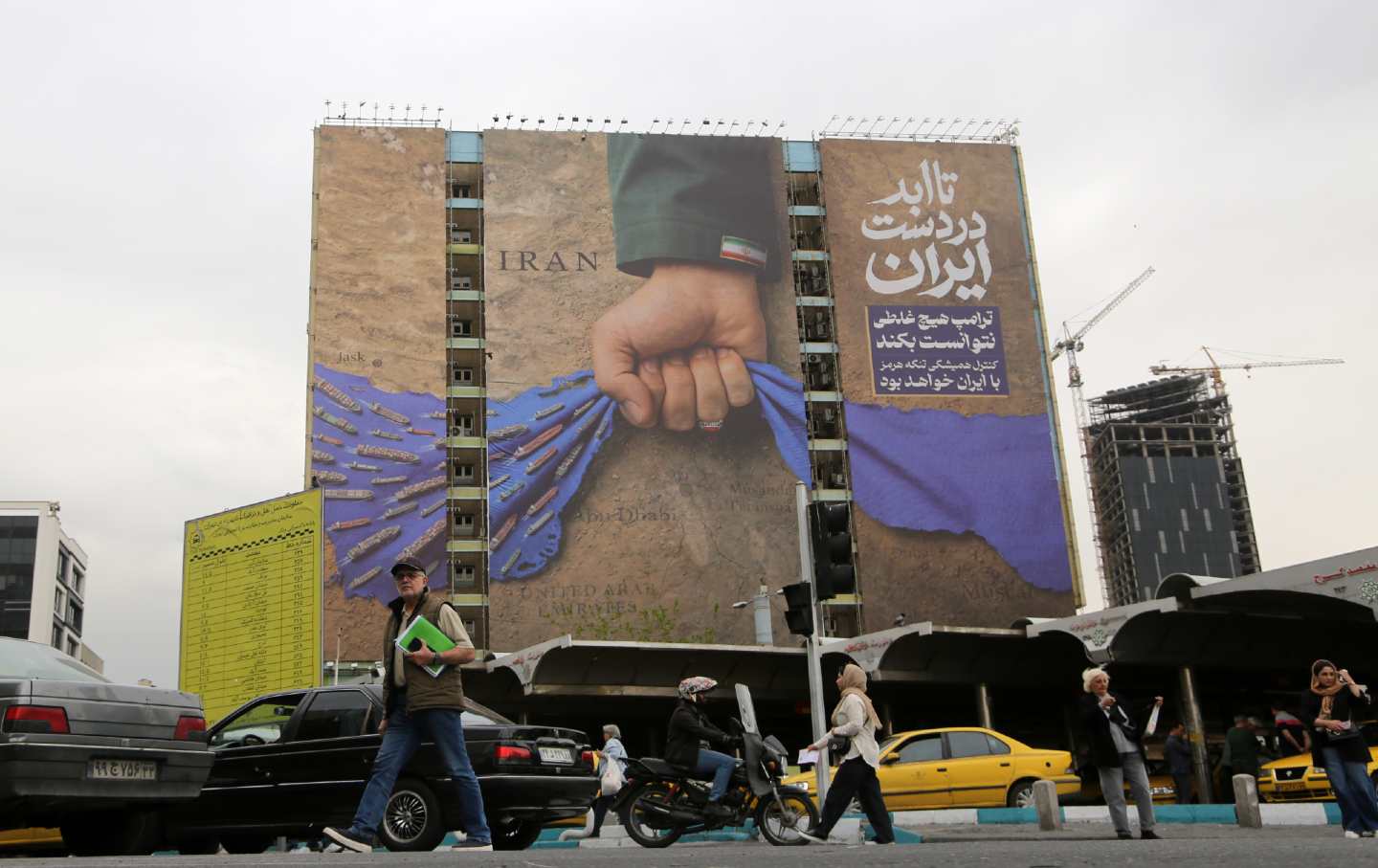
A billboard in Tehran asserts that despite the threats of President Donald Trump, Iran will retain control over the Strait of Hormuz.
(Fatemeh Bahrami / Anadolu via Getty Images)To almost no one’s surprise, the ballyhooed launch of last weekend’s “marathon” negotiations in Islamabad for a stable ceasefire accord with Iran collapsed in much less time than it took for Trump’s first-term communications director Anthony Scaramucci to be ditched. Then, in equally short order, President Donald Trump fired off another impulsive policy diktat from his social-media website, announcing a total blockade of the Strait of Hormuz by the United States. And no sooner than Trump had nonsensically assured the country that a double blockade of the vital shipping route would magically reverse the harm wrought by Iran’s initial bid to control it, the administration was walking back this latest smoke-and-mirrors bid to simulate progress in its disastrous Iran war; it amended Trump’s trademark policymaking-by-stream-of-consciousness, explaining that the United States would only blockade shipping traffic coming from or heading to Iranian ports.
It was the kind of “I’m rubber, you’re glue” diplomacy that has become synonymous with the Trump presidency, and it also quite plainly is not going to work. Trump’s congressional allies must soon face a very sour electorate that had been promised a golden age rather than indefinite, self-inflicted economic suffering. Meanwhile, Iran’s tyrants have proven quite willing to wantonly slaughter their own civilian protesters to preserve their grip on power. So the answer to the question of who can “endure more pain” in the Iran conflict should be obvious: It’s not us. The blockade also makes it plain that Trump continues not to understand, even on a basic level, why most ships refuse to transit the Strait of Hormuz and how difficult it will be to return to the status quo ante as long as Tehran’s leaders want the critical shipping channel to be choked off.
Trump has floated countless ideas to fix the Hormuz problem, and has seriously pursued precisely zero of them until now. It has, for example, been nearly six weeks since Trump said the United States would start escorting tankers through the Strait. That was around the same time he unveiled a harebrained scheme to have America insure everyone’s tankers. Once again, the second act in this policy set piece involved the realization that no one in the administration had the slightest idea how the breakthrough maneuver was supposed to work. With his other proposals flaming out, Trump ended up lifting sanctions on Iranian oil in March in a failed effort to keep prices down—an economic windfall for the enemy he was trying to outsmart. Before long, Trump was reduced to making the argument that high oil prices were actually good for the American economy—by which he meant, as usual, the corporate grifters who are his allies and donors.
It’s also been more than two weeks since Trump switched tactics again and declared, during a televised primetime national address, that America doesn’t need the Strait of Hormuz anyway and that it was up to unspecified allies to “build up some delayed courage” and then “grab it and cherish it.” In the same speech, he also argued that the Strait would “open up naturally” after the war, which would also end at any moment, given that he also said, “We’ve beaten and completely decimated Iran.” These words all came out of the same mouth in the same 19-minute speech.
Earlier in that very same day, the president had tried jawboning US allies by threatening to withdraw from NATO. But America’s sudden lack of friends is a testament to the sheer scale of the reputational damage Trump has inflicted on the United States. That in itself represents a major reason the blockade gambit is likely to fail. Earlier this year, for example, Trump’s endless bluster terrified Denmark, a peaceful NATO treaty ally, to the point that Copenhagen developed a plan to blow up the runways in Greenland if an American invasion materialized. Trump even pissed off one of his only remaining European friends in Italian Prime Minister Giorgia Meloni when he and our illustrious vice president started beefing with the pope this week. Iranian, Russian, and Chinese leaders all understand the additional leverage this public feuding grants them and are eagerly finding new ways to exploit it.
Having failed either to hand-wave the Hormuz problem away or strong-arm other countries into fixing it for him, Trump then pivoted again to the familiar comforts of threatening non-white people with annihilation. On April 7, he briefly rattled even the GOP’s committed lickspittles in Congress by threatening a jaw-dropping act of genocide against Iranian civilization if the Strait wasn’t opened by 8 pm Tuesday, April 8. When Iran called his bluff, he apparently then deemed a hilariously maximalist set of Iranian demands, including a permanent tolling system that would be a source of staggering new revenues for Tehran, a “workable basis” for negotiations in order to secure a two-week ceasefire that the Israelis immediately undermined by continuing their unhinged rampage in Lebanon. Trump then dispatched his son-in-law, one of his golf buddies, and the author of Hillbilly Elegy to the Islamabad negotiations to deliver a framework they all knew perfectly well was unacceptable to Tehran before high-tailing it out.
Worse, the situation in Hormuz has not improved even with Tehran abiding by the terms of the cease-fire. Iran reportedly laid an unknown number of naval mines in the Strait (while claiming not to know where they are), but is otherwise not doing much of anything else to actively obstruct it. For more than six weeks now, these mines—wherever and however many they may be—together with the threat of drone and missile attacks have been sufficient to discourage commercial shipping captains and their insurers from making the journey.
Trump and his apologists may not like it, but exporters and shipping companies are simply not going to resume normal operations in the Strait absent a conclusive resolution to the war. With Iran’s new leaders believing not without justification that they were holding the better hand in Islamabad, Trump pivoted to his instantly diminished blockade plan, which nails that MAGA sweet spot of being (of course) illegal according to international law and so far completely ineffective.
You can tell that it’s not working because on Wednesday morning Trump was back to flagrantly manipulating markets that appear to be in the grip of some kind of shared delusion that the conflict is about to wrap up. He sat down with regime stenographer and Fox News host Maria Bartiromo to issue his umpteenth declaration that the war is “very close to over” and also claimed without any evidence whatsoever that China had agreed not to send weapons to Iran if Hormuz is opened. He then took to Truth Social to proclaim that “China is very happy that I am permanently opening the Strait of Hormuz,” even though as a point of fact the president is currently burning millions of taxpayer dollars an hour to keep the Strait of Hormuz closed.
What actually seems to be happening is very much the opposite of Trump’s ongoing fantasia of decisive victory through successive vibes-driven word pictures from the American commander in chief. Iran is making new threats of counter-escalation; mediators are admitting that no new talks have been scheduled; and the global oil supply crisis is worsening even as oil futures and stock indices are sweatily gambling on a breakthrough. The “spot price” of oil—i.e., what is actually being paid for imminent deliveries—is at record highs, while futures still reflect faith that Trump belligerent postures will segue into more theatrical TACO-ing. Iran so far shows no signs buckling under the blockade, especially given the reality that Chinese leader Xi Jinping could easily make a crypto transfer to whichever commander of the Iran Revolutionary Guard Corps is currently running the country to make up for the drop in oil export revenue.
Popular
“swipe left below to view more authors”Swipe →The logic of the blockade itself therefore simply doesn’t add up. If Iran doesn’t capitulate or agree to terms, what happens next? As retired Navy commander Mark Nevitt argued in Just Security, Iran has demonstrated that it can continue fighting even without its oil revenue. Tehran has also proven conclusively, Nevitt writes, that it “can deny transit at an acceptable cost to itself—and no plausible U.S. military option can reliably reverse that in the near term”—including the military seizure of Iran’s Kharg Island export facility, the latest shiny new toy idea producing wide eyes and giggles among Trump’s armchair warriors in the commentariat.
New York Times columnist Bret Stephens and various Fox News chuckleheads like Mark Levin have been trying to foist this idea onto Trump’s decaying mind for weeks, part of the ongoing, disturbing pattern of the US president seeming to act abruptly on the advice of columnists and talking heads. Nevitt calls the idea “superficially compelling,” but notes that the “operational reality is far more treacherous,” given that Iran has spent weeks preparing the island for assault. He adds that even if the United States captured Kharg, “the operation collapses at the strategic level. A Marine garrison on Kharg becomes the most predictable target in the theater.” Iran could also simply detonate its own facilities on the way out, baking in more long-term economic damage to the global economy.
This does not sound promising. But it is related to the other significant factor that no one seems to want to say out loud: The United States rather obviously lacks the will to launch any kind of significant ground operation in Iran. Even after spending the past year purging the senior military leadership of women, minorities, and anyone not willing to pledge fealty to the president, America still has the capacity to seize a single island in the Persian Gulf, should it wish to do so, just like it has the theoretical capacity to invade Iran and depose its government at gunpoint.
But no one knows better than the Iranians that the United States doesn’t have the stomach for it. They, like the rest of the world, watched substantial American occupying forces backed by genuine initial public opinion majorities flail around in the Iraqi and Afghan hinterlands for years before slinking off in defeat. They also just saw Trump act as though the rescue of a single downed pilot carried the same stakes as the D-Day landings at Omaha Beach. Iranians therefore know that, especially without any public buy-in whatsoever, Trump does not have the political space to launch a ground war that even in a best-case scenario would produce a steady supply of flag-draped coffins while mandating a massive and expensive mobilization on the eve of the midterms.
Trying to predict what will unfold over the course of a single day in the Trumpazoic is a fool’s errand. Maybe Trump will soon be obliged to accept terms that look more or less like the Iran deal he spitefully tore up in 2018. In that scenario, Iran would agree to temporarily suspend nuclear activity in exchange for sanctions relief and robust protections against future American sneak attacks. Maybe he will agree to some kind of corrupt split of an illegal Hormuz tolling regime that involves propping up his crypto enterprises while claiming that he changed the regime like a boss. But at this point, any plausible end to the war that restores the Strait of Hormuz to its prewar state involves the United States signing off on some previously unthinkable concession to Tehran, and no amount of blockading is going to change that.
The word for that sequence of events is “defeat.”
Become a Sustaining Donor This September
Between the reemergence of right-wing red-baiting and Donald Trump’s use of the chilling National Security Presidential Memorandum–7 to criminalize left political organizing, we’re seeing McCarthyism reborn before our eyes.
This assault on democracy cannot be ignored or wished away. Resisting it requires bravery in the face of threats and repression, a steadfast commitment to the truth, and the unwavering belief that we can—and will—overcome this darkness.
We must have an independent media that sets the record straight, unearths corruption and abuses of power, and advances a politics of justice and dignity for all if we’re to win this fight.
That’s why I’m writing to you today. This September, The Nation needs to add 100 monthly donors to sustain our progressive journalism. Your contribution makes the next investigative report, the next truth-speaking column, and the next pathbreaking essay all possible.
I hope you’ll support our work with a recurring donation today. If you donate $10 or more a month, we’ll send you a brand new “Hands Off the Free Press!” sticker to recognise your commitment to our cause. Please, donate today.
Onward,
Katrina vanden Heuvel
Editor and Publisher, The Nation
More from The Nation
The Decades-Old Roots of Trump’s War on Iran The Decades-Old Roots of Trump’s War on Iran
An interview with historian Behrooz Ghamari-Tabrizi about the generations of US presidents who have tried to destroy the Iranian regime.
Emmanuel Macron’s Turbulent Exit Emmanuel Macron’s Turbulent Exit
Between a budget crisis and a cost-of-living squeeze, Macron is leaving a country feeling more insecure than ever—and ready to take to the streets.
Israel’s Election Can’t Fix What Netanyahu Broke Israel’s Election Can’t Fix What Netanyahu Broke
The fundamental problem is not the name of the prime minister, but rather the actions of the Israeli government and the urgent issues that need to be addressed.

The AfD’s Rise Isn’t Just About East Germany The AfD’s Rise Isn’t Just About East Germany
The Alternative für Deutschland has a stable national poll lead, including in the former West Germany. Its rise owes to much more than Eastern grievances.
Chinese Development Is the Betrayal Washington Cannot Forgive Chinese Development Is the Betrayal Washington Cannot Forgive
The prospects for Xi Jinping’s visit are dim because American leaders are blaming China for the failures of globalization.

Pinochet: The Verdict of History in the Letelier-Moffitt Case Pinochet: The Verdict of History in the Letelier-Moffitt Case
An act of international terrorism on the streets of Washington, DC, still reverberates 50 years later.

