
Drones? Europe’s Automakers Are Taking Orders.
French car company Renault seeks a foothold in rearmament.
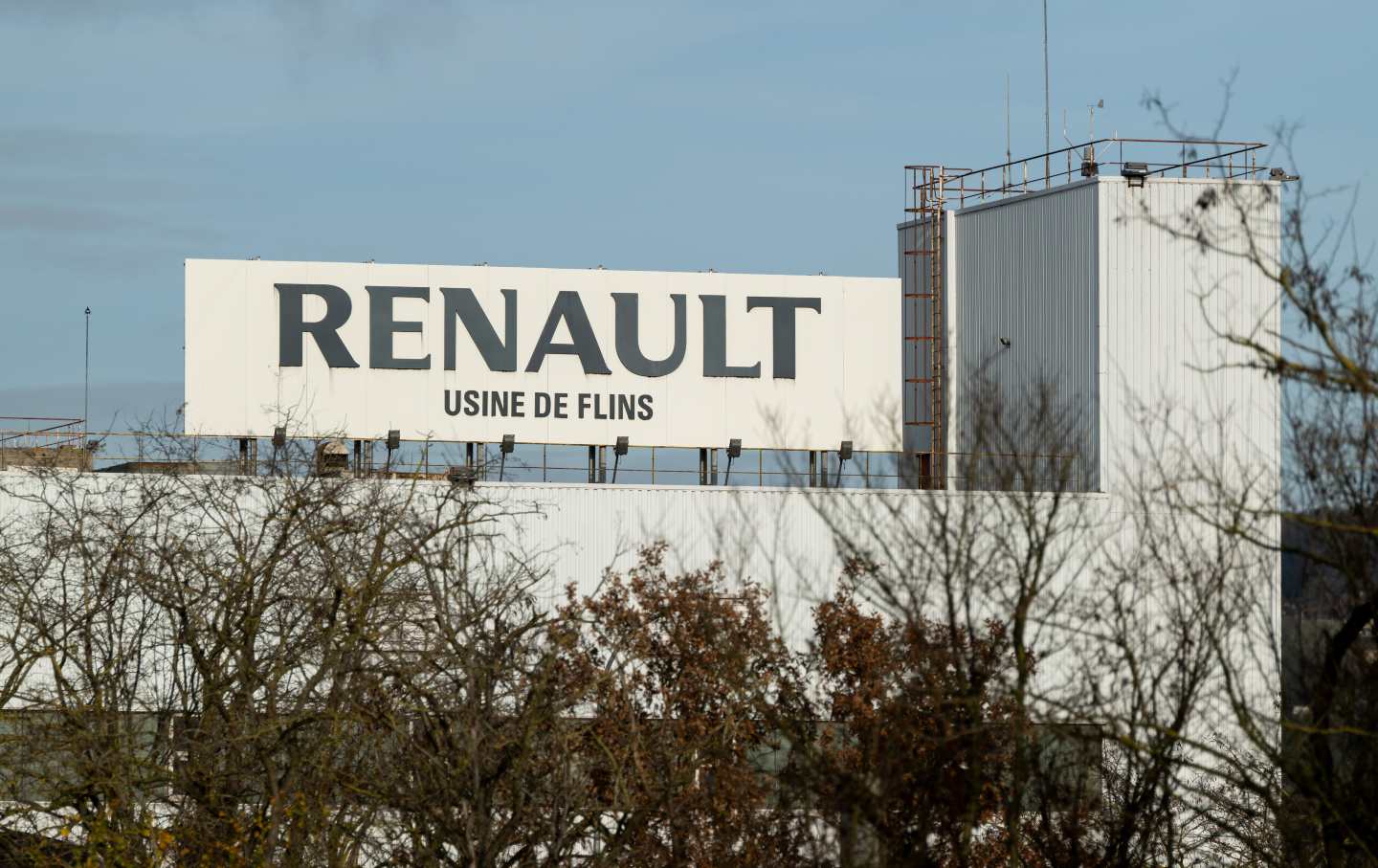
By early 2027, the first models of the “Chorus” will be rolling off assembly lines at the French car manufacturer Renault. It’s not a new emissions-free vehicle at an appealing price point—the elusive savior of Europe’s once confident automobile sector. Rather, the Chorus is the French brand’s first foray into the burgeoning market of military drones. Designed with weapons contractor Turgis Gaillard, the Chorus drone will be put together across two of the carmaker’s industrial sites. Engines manufactured at Renault’s Cléon facilities near Rouen will get final assembly at the group’s factory in Le Mans, a site usually known for its chassis frames.
The final product, according to the manufacturers’ magazine L’Usine Nouvelle, is an ordnance with dual offensive and reconnaissance capabilities. Lauded in industry circles as a reply to Iran’s Shahed drones or compared to Ukraine’s Flamingo cruise missiles, the Chorus will purportedly be capable of carrying a 500-kilogram payload with an estimated range of 3,000 kilometers (slightly over 1,864 miles), at a unit price of €120,000.
Renault management denies that drone production could ever become a pillar of business strategy. The group “does not aim to become a major actor in the defense sector,” it said in a press release this winter, after its drone partnership was approved by employee representatives. For now, the scale of its agreement appears minimal: Renault is said to be broaching a 10-year pact with the French state valued at €1 billion. (In 2025, the group reported just shy of €58 billion in worldwide revenue.) For now, monthly output is expected to reach 600 Chorus drones when production hits full speed over the next year, compared to the many thousands of engines or car frames manufactured at the two sites in question.
Yet these small steps are part of French President Emmanuel Macron’s calls to bring France to a “war economy” footing. Tony Fortin, of the Lyon-based NGO L’Observatoire de l’Armement, warns that Renault’s entry into the drone market has it starting down a familiar path. Denouncing “an extension of the military into civilian industry,” Fortin said that Renault’s deal “normalizes the notion that weapons are a market like any other.”
It also comes at a time of mounting difficulties for European automakers, with the twin threats of US tariffs and rising Chinese supply in the strategic market for next generation electric vehicles. At the peak of the critical metals crunch last October, when European heavy industry found itself in the crossfire of Trump’s tug of war with Beijing, its chief automobile lobby warned that European corporations were “days away” from full work stoppages. With operating profit margins declining by a little over one percent in 2025, Renault is still faring better than some of its European competitors. On May 21, Stellantis, which owns brands like Peugot, Jeep, and Fiat, projected an estimated 800,000 decline in its European automobile output by 2030.
Renault is also not the only automobile group leaning into military hardware. Volkswagon is reportedly considering a partnership with Israeli armsmaker Rafael over missile defense production. Ola Källenius, CEO of Mercedes-Benz, told The Wall Street Journal on May 15 that “Europe needs to strengthen its defense capabilities” and that “if [Mercedez-Benz] can play a positive role in that, we would be prepared to do so.”
Historically, industrial groups like these are no strangers to arms production, even if the trend since the 1990s saw them divesting from military-linked assets. In 2001, the French automaker sold off its military vehicles division, Renault Trucks Defense, to Volvo. Rebranded as Arquus, the firm is now owned by the Belgian industrial group John Cockerill. Two decades after its sale, Arquus is reportedly back at work on an un unmanned land vehicle with its former parent company. According to Le Figaro, Renault is also expected to roll out at June’s Eurosatory expo a mobile command post model with the French arms major Thales.
The drift toward rearmament has workers in a difficult bind, with traditional labor hesitation making space for acceptance at the prospect of new contracts. Weeks before abstaining at the social council vote held in February, the Renault branch of the left-wing CGT union wrote in a press release: “If there’s going to be weapons production, it must only serve the needs of national defense, be under strict public oversight, and can under no circumstances be driven by market forces, the search for profits, or as exports to fuel armed conflicts.”
Force Ouvrière was the only union at Renault to approve the partnership, and its Renault delegate Mounir Mestari claims that among workers, “many, if not a clear majority, look favorably” on the drone plan. Renault management agreed that work on the military hardware would be on an exclusively volunteer basis and guaranteed special security measures at the industrial sites manufacturing the Chorus.
The relatively mooted response at Renault is hard to dissociate from the crisis gripping the broader European auto industry. “Our position has been very clear: there’s no denying that car makers are struggling to really take off when it comes to electric vehicles, so any activity that could bring employment and industrial production is a good thing,” Mestari told The Nation. Though tapped as a site for producing engines for Renault’s electric vehicles, total employment at the Cléon facility is stagnant at around 3,000 workers, down by several hundred since the late 2010s. With Renault currently restructuring its Ampère electric line, Stellantis appears to be doubling down on partnerships with Chinese brands.
Without the state protections afforded to Chinese carmakers, corporations in the European Union have taken aim at the bloc’s environmental regulations, winning carve-outs last December to the EU’s planned 2035 phaseout of new internal combustion engines. Mestari expressed similar frustrations, claiming that 25 percent of staff at Renault’s Guyancourt site, its technical research and development facility in the outer suburbs of Paris, are employed in norms compliance. Yet, by that same logic, the technicians at the very same facility working on Renault’s drone projects are also diverted from the work of car making, at a critical juncture in the industry’s history.
Still, Renault executives have said that drones will be just a “complement” to the group’s regular business activities. But the French state will be there to coax things along too. Speaking before a senate hearing in February, Patrick Pailloux, director of the defense ministry’s arms procurement bureau, argued that the rapprochement with Renault was less about buying a line of drones that “will soon be obsolete” than it was about getting a system up and running: “This work will ensure that Renault, if the day comes, will be able to produce in volume.”
Become a Sustaining Donor This September
Between the reemergence of right-wing red-baiting and Donald Trump’s use of the chilling National Security Presidential Memorandum–7 to criminalize left political organizing, we’re seeing McCarthyism reborn before our eyes.
This assault on democracy cannot be ignored or wished away. Resisting it requires bravery in the face of threats and repression, a steadfast commitment to the truth, and the unwavering belief that we can—and will—overcome this darkness.
We must have an independent media that sets the record straight, unearths corruption and abuses of power, and advances a politics of justice and dignity for all if we’re to win this fight.
That’s why I’m writing to you today. This September, The Nation needs to add 100 monthly donors to sustain our progressive journalism. Your contribution makes the next investigative report, the next truth-speaking column, and the next pathbreaking essay all possible.
I hope you’ll support our work with a recurring donation today. If you donate $10 or more a month, we’ll send you a brand new “Hands Off the Free Press!” sticker to recognise your commitment to our cause. Please, donate today.
Onward,
Katrina vanden Heuvel
Editor and Publisher, The Nation
More from The Nation

Japan’s Far Right Is Courting Young Voters Japan’s Far Right Is Courting Young Voters
Sanseitō has attracted young voters through a robust social-media strategy, Charlie Kirk–like public speaking events, and anti-establishment messaging.

This AI Panic Is Nothing New This AI Panic Is Nothing New
In the 1940s, The Nation asked questions about the atomic bomb we’re asking of artificial intelligence today.

The Decades-Old Roots of Trump’s War on Iran The Decades-Old Roots of Trump’s War on Iran
An interview with historian Behrooz Ghamari-Tabrizi about the generations of US presidents who have tried to destroy the Iranian regime.

Emmanuel Macron’s Turbulent Exit Emmanuel Macron’s Turbulent Exit
Between a budget crisis and a cost-of-living squeeze, Macron is leaving a country feeling more insecure than ever—and ready to take to the streets.
Israel’s Election Can’t Fix What Netanyahu Broke Israel’s Election Can’t Fix What Netanyahu Broke
The fundamental problem is not the name of the prime minister, but rather the actions of the Israeli government and the urgent issues that need to be addressed.

The AfD’s Rise Isn’t Just About East Germany The AfD’s Rise Isn’t Just About East Germany
The Alternative für Deutschland has a stable national poll lead, including in the former West Germany. Its rise owes to much more than Eastern grievances.

