
An Alternative View of What’s Next After the Trump-Xi Summit
Hawkish rhetoric from the national security establishment isn’t grappling with the complex challenges posed by China’s rise.
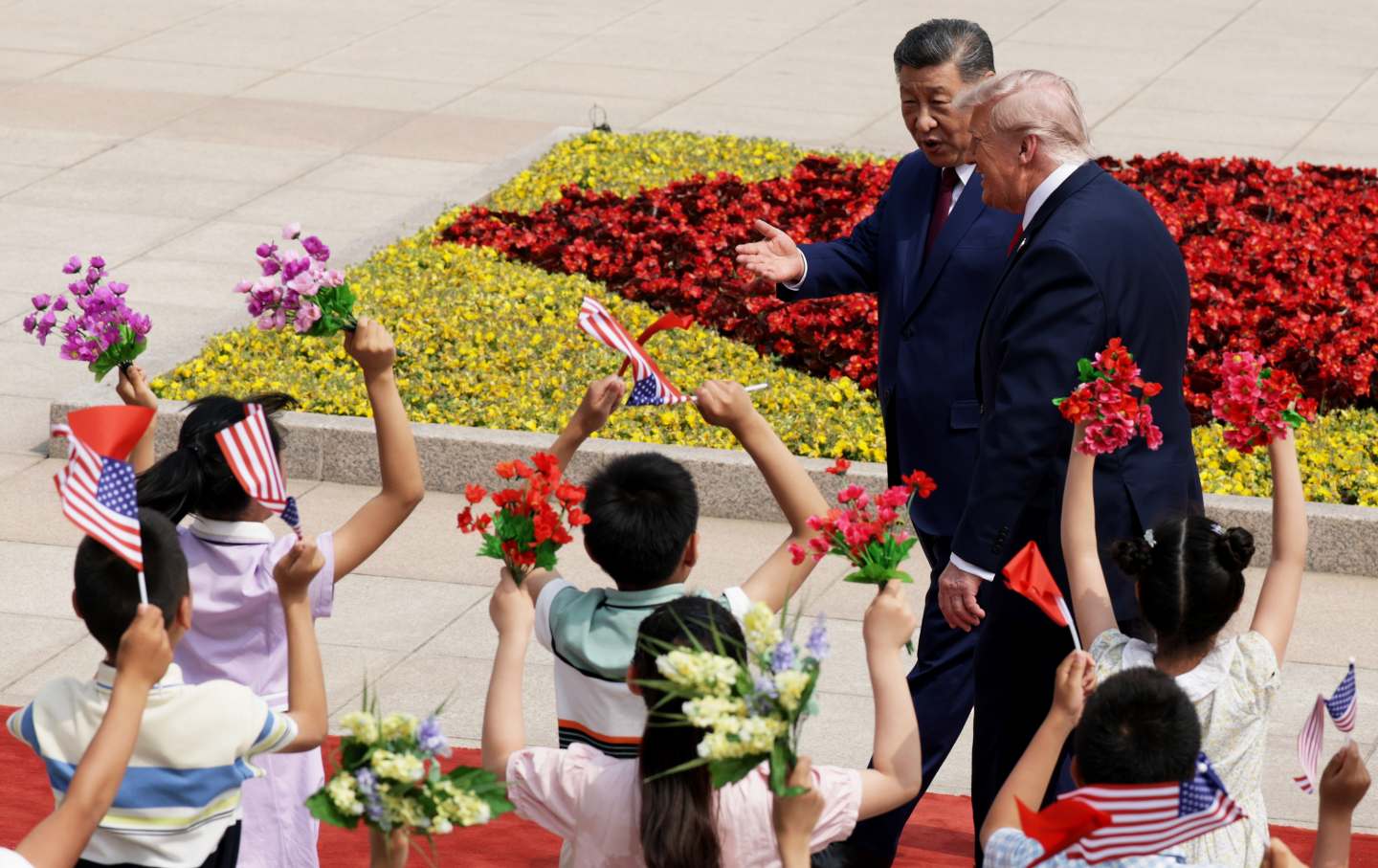
As Donald Trump arrived in Beijing last week for the first visit to China by a US president in almost a decade, it felt hard to remember the spiraling escalation of US-China economic warfare that could have easily ended in a permanent break between the world’s two most powerful countries.
After all, it took place last year. So many other crises have kicked off in that intervening 13 months that the world’s most consequential international relationship now seems like an island of stability in a sea of chaos.
But in judging the paltry outcomes of Trump’s summit with President Xi Jinping—some nice words and China’s promise to buy American soybeans and airplanes—it’s worth recalling that US-China conflict almost pushed the world into an out-of-control economic crisis last year. And because economic tension has provided cover to a US national security establishment pursuing confrontation with China, mutual economic aggression could have developed fairly rapidly into something more violent. Perhaps, then, it was enough that Trump and Xi agreed to pursue “constructive strategic stability” without offering much idea of what that would mean in practice.
Yet the summit also demonstrated how unhealthy the relationship remains. The United States seems to be stuck between two diametrically opposed approaches to China that somehow both manage to exacerbate the pressures driving us toward conflict: unsound peace or unfettered confrontation.
The first approach was crassly illustrated by Trump’s entourage of billionaires. Among the oligarchs who accompanied Trump on Air Force One were Elon Musk, Nvidia’s Jensen Huang, and a dozen of the other richest financiers and tech barons in the country. Trump’s “very first request,” he posted on the way to China, would be asking Xi “to ‘open up’ China so that these brilliant people can work their magic.”
It was precisely the entangled economic interests of elites in the two countries that, despite persistent tensions, kept the peace for decades before the US-China relationship collapsed starting in 2018. Yet this peace was built on fundamentally unhealthy foundations. The economic growth that enriched well-connected businesses and corrupt politicians in both countries also systematically decimated the power of labor—again in both countries. The outcome was devastating inequality and intense everyday insecurity achieved through the free-market form of globalization that bound the US and China together. Ultimately, symbiotic expansion of market society led to destabilizing populist politics in both countries.
In the United States, populism took on an anti-China cast: The dislocations of the globalization era were associated with China because of its outsize role in the system. The American politicians and corporate leaders actually responsible for union-busting and offshoring jobs were happy to play on xenophobia to escape accountability. And in a global economy defined by cutthroat competition, even progressives had difficulty articulating a vision of growth that would benefit workers of all nationalities rather than pitting them against each other. Labor activists and nativists converged on vilifying China. By doubling down on inequality and corruption as the basis for great power peace, Trump could push this animosity deeper.
If the capitalists are exacerbating the forces that drove the two countries apart, the militarists are exploiting the resulting discontent to move an agenda with a little popular support. For decades, the US foreign policy establishment saw its mission as orchestrating a global system that would institutionalize American power while privileging US business elites. As that system came undone in the populist passions of the 2010s—while China’s influence grew rapidly—status quo leaders sought to salvage their position by channeling popular anger against their main geopolitical competitor.
They redefined China not as a part of their system but as its primary enemy and started to build the institutional and ideological apparatus for great power conflict. Raising the specter of a threatening foreign power, they hoped to reestablish social unity and the legitimacy of the ruling class.
The new strategy came together under the first Trump administration, but it was systematized by Jake Sullivan at Biden’s National Security Council. Those officials who brought the US into the Gaza massacre were also committed to international conflict on a far larger scale.
Today, the prospect that Trump might take the United States off a confrontational posture with China is the occasion for much handwringing within the foreign policy establishment. The editorial board of The New York Times argued that “Trump’s China Policy Has Weakened America.” Oren Cass of the Trump-aligned American Compass was in a panic that, by welcoming Chinese investment, Trump “may be on the verge of tying the United States to China irrevocably.” Ely Ratner, Biden’s top China official at the Pentagon, denounced Trump’s lowering of the temperature as a dangerous “bid to placate Beijing.”
A resolution cosponsored by 16 of the Senate’s leading foreign policy figures from both parties defined China as “the foremost rival and strategic competitor of the United States” threatening all the core security, economic, and strategic interests of the US and its allies. Introducing the resolution, Democrat Chris Coons said, “Beijing is trying to create a more aggressive, coercive, and lawless international landscape that harms the American people.” His counterpart on the Republican side, Pete Ricketts, added: “Communist China is the greatest threat to the American way of life.”
Such hyperbole is a willful misrepresentation of China’s foreign policy motivations and goals, which are sometimes counterproductive, but—in contrast to highly coercive domestic policies—are generally cautious, restrained, and system-supportive. Rhetoric from the national security establishment is not aiming to grapple with the complex challenges posed by China’s rise, but merely to shut down discussion and channel American energies into conflict.
Is there an alternative to these two approaches, which seem to force us into a choice between peace and security? Yes, but it runs through the one thing that both the unconstrained oligarchs and the foreign policy elite refuse to consider: egalitarian social reform at home and abroad.
The kind of world that could accommodate both the United States and China is the same kind of world that would no longer pit American workers against Chinese workers. The global reform agenda needed to get there would focus on raising labor standards worldwide, expanding the global provision of public goods, acting decisively to resolve the climate crisis, and driving development investment into those places cut off from growth.
Popular
“swipe left below to view more authors”Swipe →This program would reduce inequality within and between countries. It would end the race to the bottom in labor conditions. It would raise wages and living standards across the world—desirable in its own right but also leading to greater consumer demand, thereby creating large new business opportunities and dampening speculative volatility.
Greater everyday security would deprive reactionary politics of the grievances that allow scapegoating of Chinese people and other foreigners. A broader and faster growing world market would end the sense of zero-sum competition that turns US-China commercial rivalry into an existential struggle and justifies attempts to prevent Chinese development.
Together, these outcomes would generate social cohesion in the only way possible—giving people a stake in their society. Imposing unity artificially, through the compulsory loyalty demanded by international conflict, is not just a danger to peace and civil liberties; it is also doomed to fail.
Could the United States and China work together on such a global reform agenda? China’s vision for world order remains exceedingly vague, but it often highlights long-standing demands of the Global South that would be accommodated by these reforms. Other components, such as how to improve labor rights and increase the level of consumption in the Chinese economy, would require difficult negotiations. Yet a shared goal of global reform is a far more promising starting point than the threats and denunciations that have marked the US approach to disputes with China for decades.
Perhaps the bigger question is whether the United States would ever embrace a voluntary diffusion of power in the global system to build a multipolar world based on positive-sum multilateralism, rather than the world of all-around strife we are currently encouraging. That, however, is a question for the American people—one we have refused to face for too long.
Become a Sustaining Donor This September
Between the reemergence of right-wing red-baiting and Donald Trump’s use of the chilling National Security Presidential Memorandum–7 to criminalize left political organizing, we’re seeing McCarthyism reborn before our eyes.
This assault on democracy cannot be ignored or wished away. Resisting it requires bravery in the face of threats and repression, a steadfast commitment to the truth, and the unwavering belief that we can—and will—overcome this darkness.
We must have an independent media that sets the record straight, unearths corruption and abuses of power, and advances a politics of justice and dignity for all if we’re to win this fight.
That’s why I’m writing to you today. This September, The Nation needs to add 100 monthly donors to sustain our progressive journalism. Your contribution makes the next investigative report, the next truth-speaking column, and the next pathbreaking essay all possible.
I hope you’ll support our work with a recurring donation today. If you donate $10 or more a month, we’ll send you a brand new “Hands Off the Free Press!” sticker to recognise your commitment to our cause. Please, donate today.
Onward,
Katrina vanden Heuvel
Editor and Publisher, The Nation
More from The Nation
The Decades-Old Roots of Trump’s War on Iran The Decades-Old Roots of Trump’s War on Iran
An interview with historian Behrooz Ghamari-Tabrizi about the generations of US presidents who have tried to destroy the Iranian regime.

Emmanuel Macron’s Turbulent Exit Emmanuel Macron’s Turbulent Exit
Between a budget crisis and a cost-of-living squeeze, Macron is leaving a country feeling more insecure than ever—and ready to take to the streets.

Israel’s Election Can’t Fix What Netanyahu Broke Israel’s Election Can’t Fix What Netanyahu Broke
The fundamental problem is not the name of the prime minister, but rather the actions of the Israeli government and the urgent issues that need to be addressed.
The AfD’s Rise Isn’t Just About East Germany The AfD’s Rise Isn’t Just About East Germany
The Alternative für Deutschland has a stable national poll lead, including in the former West Germany. Its rise owes to much more than Eastern grievances.
Chinese Development Is the Betrayal Washington Cannot Forgive Chinese Development Is the Betrayal Washington Cannot Forgive
The prospects for Xi Jinping’s visit are dim because American leaders are blaming China for the failures of globalization.

Pinochet: The Verdict of History in the Letelier-Moffitt Case Pinochet: The Verdict of History in the Letelier-Moffitt Case
An act of international terrorism on the streets of Washington, DC, still reverberates 50 years later.

