
In Defending Mohammed bin Salman, Trump Sinks to a New Low
Trump was incandescent with anger that journalists would have the temerity to question his wealthy “guest” with the bottomless wallet.
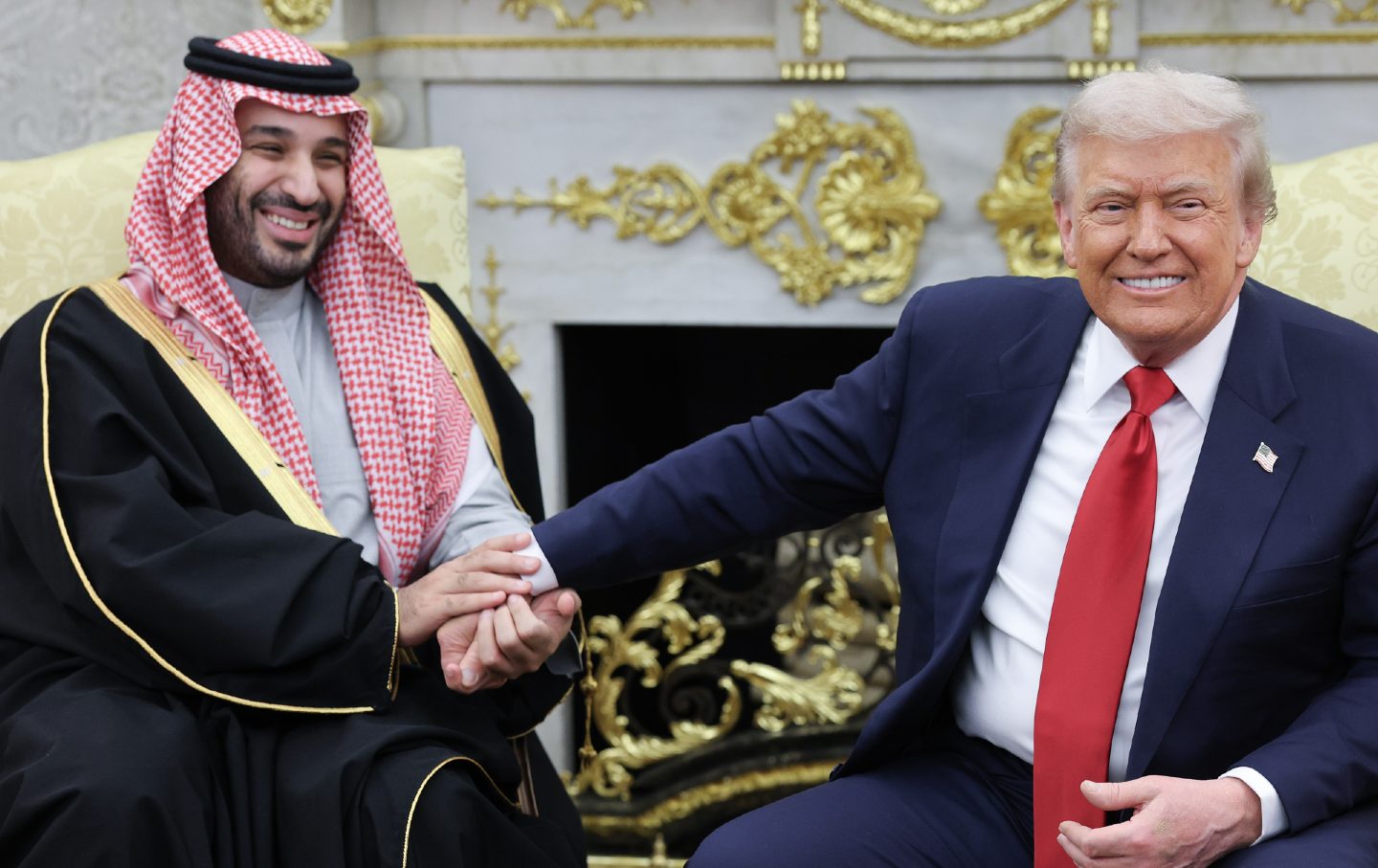
President Donald Trump meets with Crown Prince and Prime Minister Mohammed bin Salman of Saudi Arabia during a bilateral meeting in the Oval Office of the White House on November 18, 2025 in Washington, DC.
(Win McNamee / Getty Images)On October 2, 2018, the dissident Saudi journalist and Washington Post columnist Jamal Khashoggi went into the Saudi consulate in Istanbul to pick up a document. He never came out.
For more than two weeks, the Saudi government denied all knowledge of what had happened to him. It was only after international scrutiny intensified that a government spokesman announced he had died in a “fight” after resisting arrest by officers intent on returning him to Saudi Arabia.
Then, on November 15, the kingdom’s deputy public prosecutor said Khashoggi’s killing had been the result of a “rogue operation” led by Saudi agents—and that he had been forcibly restrained, injected with drugs, and dismembered. Turkish government investigators reached slightly different conclusions, finding that a hit squad of 15 Saudis had come to the consulate, disabled security cameras, and, when Khashoggi arrived, had immediately suffocated him and then dismembered his body.
In a trial that human rights groups dismissed as a sham, five people were sentenced to death for Khashoggi’s killing—though their sentences were subsequently commuted to long prison terms.
A month after the killing, the CIA concluded that Saudi Crown Prince Mohammed bin Salman had ordered the murder of Khashoggi. Then-President Donald Trump called the killings, and the Saudis’ attempt to deflect blame, “the worst cover-up ever,” and then–Secretary of State Pompeo revoked the US visas of 21 suspects.
All of this is in the public record—a mere Google search away. None of it is hard to understand: The Saudis lured a dissident journalist into a consulate, a hit squad flown in from the kingdom for the specific purpose of neutralizing Khashoggi killed him and then dismembered his body, and nobody in the higher echelons of the Saudi decision-making process was ever held to account for that heinous action.
Seven years on, however, not only has Trump forgiven the Saudis but he seems to have concluded, in his own warped, likely senescent mind, that Khashoggi kinda, sorta, when push came to shove, brought his dismemberment upon himself. After all, he refused to toe the party line in how he reported on the kleptocratic, thuggish, Saudi ruling family, so what did he expect to happen?
Trump went public with his change of heart during his meeting with Mohammed Bin Salman on November 18 in the Oval Office. At the meeting, an ABC journalist, Mary Bruce, shouted out questions about the Khashoggi murder. The president wasn’t amused. Rather than waiting for the Saudi crown prince to answer, Trump jumped in, stating—the Central Intelligence Agency’s findings in 2018 notwithstanding—that bin Salman “knew nothing about it.”
“You don’t have to embarrass our guest by asking a question like that,” Trump admonished Bruce, as if she had pointed out that bin Salman had food in his beard, rather than asked him questions about a high-profile murder. Trump then accused ABC of being “fake news. One of the worst in the business.” He denounced Bruce for asking a “horrible, insubordinate, and just a terrible question.” He called her a “terrible person.” Later in the evening, he demanded that ABC lose its broadcasting license.
Astoundingly, before he launched into denouncing an American journalist, Trump had been praising bin Salman’s “incredible record” on human rights. True, the Saudi human rights record is “incredible,” but not in a positive way: Saudi Arabia has incarcerated an estimated 5,000 political prisoners, and Human Rights Watch calculates it has executed 241 people in the first seven months of 2025, many of them for political crimes. Even more astoundingly, Trump went on to castigate Bruce by saying, “You’re mentioning somebody [Khashoggi] that was extremely controversial. A lot of people didn’t like that gentleman that you’re talking about. Whether you like him or didn’t like him, things happen.”
Spoken like a true mobster. You question the boss, you end up sleeping with the fishes. Things happen, you know what I mean? You don’t respect the don, you’re gonna pay the price. You wanna remain in one piece, you learn how to kiss the ring. His face contorted into his signature scowl, Trump looked like he hoped that the journalists in front of him would meet the same gruesome fate as that which befell Jamal Khashoggi.
All this is in keeping with Trump’s increasingly senescent, barking, attacks on journalists who haven’t been subordinate enough for his liking. Consider the bizarre moment on Air Force One on November 14 when Trump responded to Bloomberg reporter Catherine Lucey’s questions about the Epstein files by shouting out at her, “Quiet. Quiet piggy,” then wagging a finger in her face.
Imagine what sort of field day the White House press corps, not to mention the GOP Congress and its ecosystem of hard-right social media warriors, would have had if an aging and gaffe-prone Joe Biden had made a similar remark. In the Trump era, however, where there’s a new outrage every few minutes, the story merely sank into the muck.
Sometimes Trump makes outrageous statements simply to blast white noise into the ether, or to poke whatever bear he chooses to torment that day. Witness his ferocious demand on November 20, largely ignored by the US media, that Democratic legislators who urged military personnel not to obey illegal orders ought to be arrested, imprisoned, and possibly executed.
Popular
“swipe left below to view more authors”Swipe →But his recent onslaught against journalists, and the concept of a free, inquiring press, doesn’t fit this mold. In the greater context of his fawning encounter with bin Salman at the White House—a meeting devoted to finalizing Saudi purchases of billions of dollars of high-end American weaponry, and likely to smoothing the way for the Trump family to open lucrative businesses in the kingdom—Trump’s noxious interjections about Khashoggi seemed entirely from the heart. As Bruce asked bin Salman the million-dollar question, Trump was incandescent with anger that journalists would have the temerity to question his wealthy “guest” with the bottomless wallet. In Trumplandia, such concern for human rights, not to mention the concept of press freedom—which happens to afford journalists the ability to report on corruption without ending up chopped into little pieces—is simply “insubordinate.”
Each day I try to calculate what is the most un-American thing that felon Trump has done during his second stint in the White House. There’s stiff competition, there, but his statements on the Khashoggi killing, and his escalating efforts to bulldoze the First Amendment, surely rank pretty damn high on that list.
More from The Nation
Opposing Trump’s Cruel Assault on the Cuban People Opposing Trump’s Cruel Assault on the Cuban People
An interview with Representative Jim McGovern.
A New Report on Alexey Navalny’s Death A New Report on Alexey Navalny’s Death
Boris Kagarlitsky and hundreds of unknown political prisoners remain in Russia’s prisons.
Rubio, Rodeo, and Tall Tales of Empire Rubio, Rodeo, and Tall Tales of Empire
The secretary of state has provoked the ire of Britain’s first black woman lawmaker and put the spotlight once again on how the US has historically treated people of his own herit...
Mexican President Claudia Sheinbaum and the San Quintín Justice Plan Mexican President Claudia Sheinbaum and the San Quintín Justice Plan
Field workers’ highway blockades send a warning to Mexico’s president.
Inside the Iran War Industry Inside the Iran War Industry
Using an old playbook with powerful new tools, it may be closer than ever to turning a US–Iran war into reality.
The Cost of US Withdrawal From 66 International Organizations, Conventions, and Treaties The Cost of US Withdrawal From 66 International Organizations, Conventions, and Treaties
How going it alone reduces our own sovereignty.

