
Opposing Trump’s Cruel Assault on the Cuban People
An interview with Representative Jim McGovern
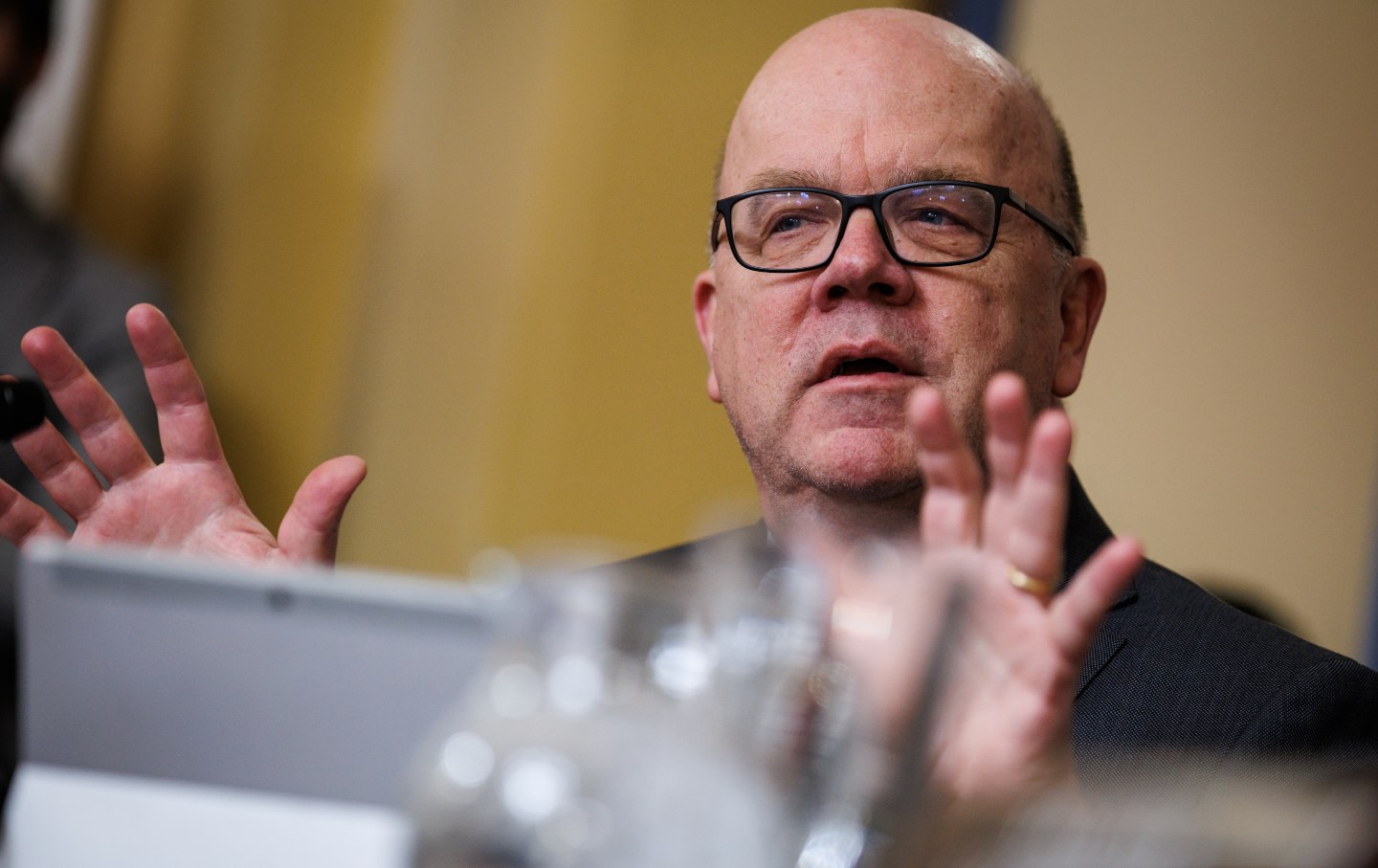
On February 12, Congressman Jim McGovern (D-MA) introduced legislation to finally lift all provisions of the U.S. trade embargo against Cuba and advance the cause of normalized relations between Washington and Havana. The United States-Cuba Trade Act “would repeal or amend several laws codified over decades that restrict trade, exchange, telecommunications, and travel with Cuba,” according to a statement issued by McGovern’s office. The bill also calls for a bilateral dialogue, mandating that “the President should take all necessary steps to advance negotiations with the Government of Cuba.”
“I think we have to establish an opposition to Trump’s policy,” Congressman McGovern asserted in an interview with The Nation. “I think we have to say there’s another way to do this.”
The legislative initiative comes as tensions between Cuba and the United States have turned deadly. On Wednesday, Cuba’s border patrol intercepted an armed group of exiles on a Florida-registered speed boat within one nautical mile of Cuba’s northern coastline. An exchange of gunfire killed four and injured six on board; one Cuban commander was also injured. The boat was loaded with assault weapons, Molotov cocktails, and camouflage uniforms, indicating “an infiltration with terrorist ends,” according to Cuba’s Ministry of Interior. “In the face of current challenges,” the Cuban government stated, “Cuba reaffirms its commitment to protecting its territorial waters…in order to protect its sovereignty and stability in the region.”
Those “current challenges” are the result of the Trump administration’s decision to ratchet up economic pressure on the Cuban people by cutting off shipments of Venezuela petroleum and threatening other oil-producing nations to halt all oil exports to the island. The “total pressure” policy of energy deprivation is suffocating Cuba’s basic economic activities—creating a burgeoning humanitarian crisis for the Cuban populace. Foreign airlines ferrying tourists from Canada and Russia have suspended flights because they cannot refuel their planes once they land; tourist hotels are shuttered, costing thousands of Cuban jobs; the Canadian mining conglomerate, Sherritt, has suspended its operations on the island. Clinics and hospitals are closing. For average Cubans, “every day brings extended power cuts, intermittent water, spoiled food, suspended classes, canceled surgeries, and transportation that stops without warning,” Maria José Espinosa and Emily Mendrala reported in El Pais. “Families spend entire days searching for fuel, cooking gas, or basic goods.”
Across the international community, leaders are addressing the cruelty of U.S. sanctions. At the Vatican, Pope Leo has expressed his concern for the “pain and anguish” of the Cuban people and urged both Washington and Havana to engage in a “sincere and effective dialogue,” free of coercion, to resolve rising tensions. “The blockade that the United States has imposed on Cuba,” stated Chilean president Gabriel Boric, “violates the human rights of the entire population.” “You cannot strangle a people like this,” Mexico’s president Claudia Sheinbaum has asserted, while offering the good offices of her country to facilitate talks between Washington and Havana and dispatching naval vessels filled with humanitarian assistance.
Just this week, at a meeting of Caribbean nations—CARICOM—attended by Secretary of State Marco Rubio, leaders across the region condemned the humanitarian impact of U.S. economic pressure on Cuba. The prime minister of Jamaica, Caricom chair Andrew Holness, called for a “constructive dialogue between Cuba and the US aimed at de-escalation, reform and stability. We must address the situation in Cuba with clarity and courage,” Holness said.
“The situation in Cuba is dire,” McGovern, and Massachusetts Senators Elizabeth Warren and Ed Markey warned President Trump in a February 25 letter to the White House. “Given that Cuba poses no credible national security threat to the United States, we urge you to lift the oil embargo on Cuba immediately to prevent unnecessary human suffering and reduce the potential for a regional refugee crisis.” As their letter admonished Trump: “Your escalation of the embargo and use of tariffs to starve a nation of critical resources are forms of economic coercion without a defensible rationale.”
This interview has been edited for length and clarity.
The Nation: Representative McGovern, you have introduced a resolution to lift US sanctions and finally end the Cuba trade embargo. In the MAGA-controlled Congress, the votes aren’t there. What, then, is the purpose of moving this bill forward at this time?
Jim McGovern: I think we have to establish an opposition to Trump’s policy. I think we have to say there’s another way to do this. There has been a very little discussion on Cuba, you know, in recent years in Congress. I think a lot of people on the left have thought it’s a hopeless cause. And, you know, the people on the right just figure it’s a matter of time before the government collapses and they can put in whoever they want.
But I think if we care about the Cuban people then we care about opening political space. In Cuba, opening things up economically is the way to go, and that is why the embargo should be lifted. We have introduced this legislation because we need to start building a movement again—a movement calling for lifting the embargo, you know, and turning the page once and for all on what has been a Cold War policy for over six decades and restarting the effort [under Obama] to normalize relations.
TN: Indeed, in a few weeks it will be the 10th anniversary of President Obama’s history-making trip to Havana, a major symbol of his breakthrough with Raúl Castro to turn that page and normalize bilateral ties.
JM: I was part of a small group that pressured Obama to open things up—and he did. Ten years ago, I went with him to Cuba when he went on that trip, and I thought things were getting better on the island.
TN: In your opinion, what are the lessons from the Obama–Raúl Castro breakthrough a short decade ago?
JM: First, that it worked! I mean, more political and economic space opened up in Cuba. More Americans could travel to Cuba.
But I think the Cubans and people in the United States were too slow in kind of taking full advantage of that opportunity. If there had been more exchanges, more business investments, more, you know, cultural exchange…. I think there should have been a greater sense of urgency. I think it would have been harder for Trump to turn it around when he became president.
I thought when Biden became president for sure he’d go back to the to the Obama policies. Biden was in those meetings that some of us had with Obama on Cuba. Vice President Biden actually called me to tell me that they were going to change the policy. But then he didn’t do anything until the last few days of his presidency. He symbolically went back to the Obama policies. But it was too late.
Biden messed up. I don’t know what they were thinking. I don’t know whether they thought they had more time so let’s not piss off the right-wing Cubans in Florida. We might need them in the next election. It was a political calculation, I think.
TN: That has been the fate of Cuba policy for decades. A policy mortgaged to swing state political calculus.
JM: Cuban policy has been more of a domestic political issue than it has been a foreign policy issue.
Popular
“swipe left below to view more authors”Swipe →TN: What do you think the end game is of this Trump-Rubio “maximum pressure” campaign against Cuba, essentially blockading all oil shipments to Cuba and deliberately creating a humanitarian crisis?
JM: I think they fantasize that the government Cuba will collapse.
TN: What is your sense of Trump’s statements that Rubio is talking to “high-level” Cuban representatives? Do you see any evidence of a dialogue between Washington and Havana?
JM: Well, the Cuban government has said they’re willing to talk about a wide range of issues. The Cuban government has never said that they’re not open to conversation. The question is: What Is Trump asking for? You know, like return the [expropriated] property? Or maybe just to build a Trump Hotel in Havana? Maybe that’s all they want.
TN: There’s been talk of congressional delegation possibly going to Cuba to highlight the humanitarian crisis. Would you go?
JM: I would, I would, I would like to go. I don’t know whether the current speaker of the House or the committees of jurisdiction would allow it…if they would provide funding for such a trip. It takes about a month or so to get authorization. So the process of planning an official trip to Cuba would move slowly.
TN: Can Congress play a role in fostering a Cuba policy is in the national interest of the United States and the best interests of the Cuban people?
JM: We have to talk about it. Democrats, you know, and thoughtful Republicans, need to talk about it. We can’t be afraid to talk about it. If the issue is immigration, the more misery you cause, the more immigrants are going to be coming to the United States. But that’s what the Trump administration is doing. Again, Trump is always dangerous. He’s arrogant, and he believes that if I say, if I tell somebody to jump, their response should be, how high? You know that history is not in his portfolio.
The future of Cuba needs to be determined by the Cubans who live on the island. Not by Trump and Marco Rubio. Not by those in the United States who want to dictate what Cuba’s future looks like.
More from The Nation
A New Report on Alexey Navalny’s Death A New Report on Alexey Navalny’s Death
Boris Kagarlitsky and hundreds of unknown political prisoners remain in Russia’s prisons.
Rubio, Rodeo, and Tall Tales of Empire Rubio, Rodeo, and Tall Tales of Empire
The secretary of state has provoked the ire of Britain’s first black woman lawmaker and put the spotlight once again on how the US has historically treated people of his own herit...
Mexican President Claudia Sheinbaum and the San Quintín Justice Plan Mexican President Claudia Sheinbaum and the San Quintín Justice Plan
Field workers’ highway blockades send a warning to Mexico’s president.
Inside the Iran War Industry Inside the Iran War Industry
Using an old playbook with powerful new tools, it may be closer than ever to turning a US–Iran war into reality.
The Cost of US Withdrawal From 66 International Organizations, Conventions, and Treaties The Cost of US Withdrawal From 66 International Organizations, Conventions, and Treaties
How going it alone reduces our own sovereignty.
The Munich Security Conference Marks the End of the US-Led Order The Munich Security Conference Marks the End of the US-Led Order
US politicians flooded the summit—but Europe no longer sees the United States as a reliable partner.

