The Munich Security Conference Marks the End of the US-Led Order
US politicians flooded the summit—but Europe no longer sees the United States as a reliable partner.
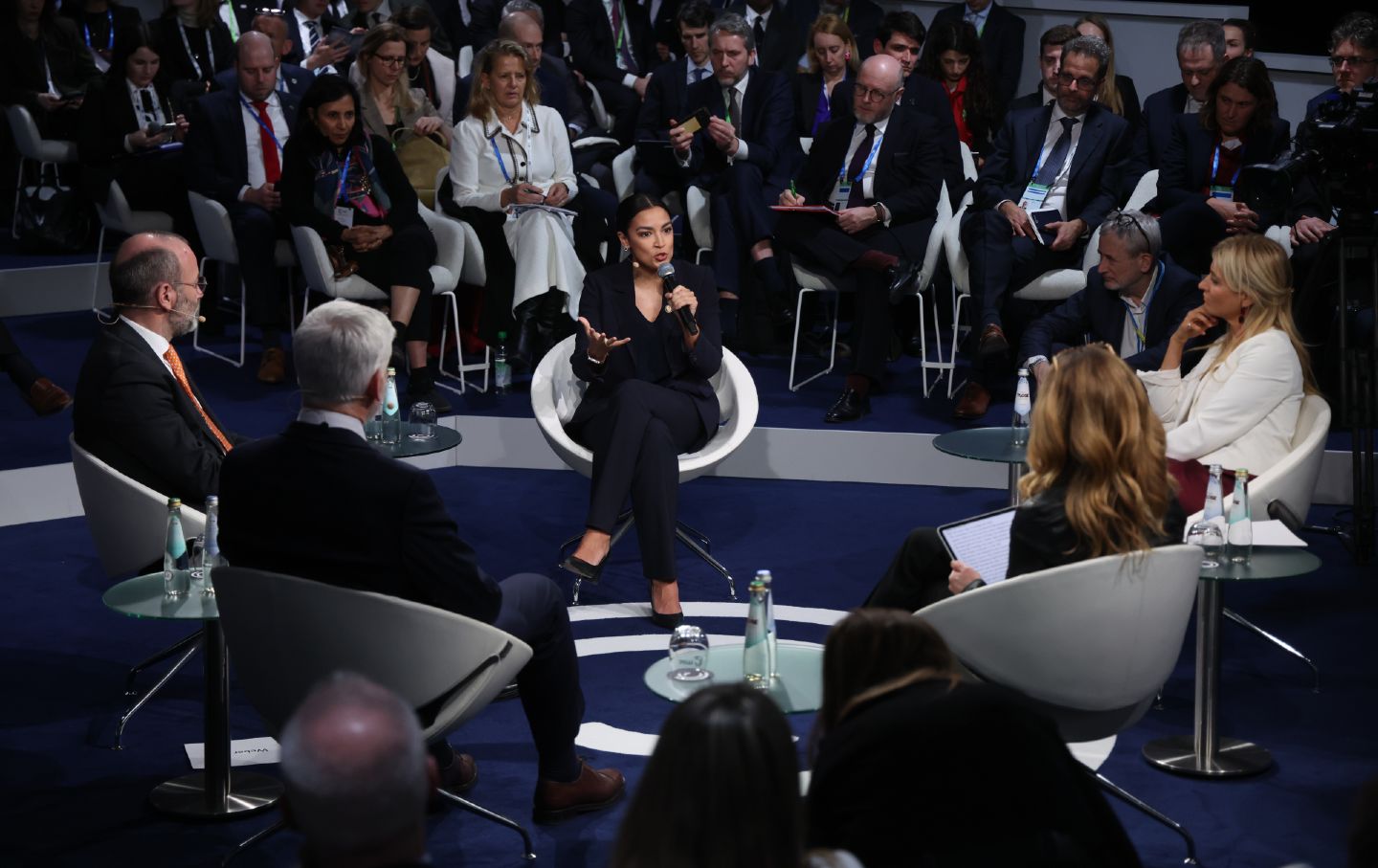
Representative Alexandria Ocasio-Cortez speaks on a panel on populism at the 62nd Munich Security Conference on February 13, 2026, in Munich, Germany.
(Sean Gallup / Getty Images)Munich—There was one question the kept floating around the Munich Security Conference (MSC) this year. “Will this be the last one?”
The future of “Davos with guns” has never been more in doubt since its founding 1963 by the national-conservative publisher and World War II German resistance member Ewald-Heinrich von Kleist. President Donald Trump’s repeated claims that he would invade Greenland and Vice President JD Vance’s antagonistic speech last year have made the transatlantic alliance feel more uncertain than ever. According to the headline of the official security report released by the conference, “the world has entered a period of wrecking-ball politics.”
This did not stop US lawmakers from making an appearance, especially Democrats, including several 2028 presidential contenders, who were eager to signal an alternative foreign policy to the one promoted by Trump. At one point, a panel attendee quipped, “It seems that Munich is the new Iowa.”
Among the Americans present were California Governor Gavin Newsom, who headlined several panels on climate change and security, Senator Mark Kelly (D-AZ), Senator Ruben Gallego (D-AZ), Michigan Governor Gretchen Whitmer, and perhaps most notably, New York Representative Alexandria Ocasio-Cortez.
In her first major trip abroad, AOC stepped onto the world stage. But for a politician that has built a progressive platform on criticism of US military interventionism and domestic policies aimed at benefitting the working class, her presence at MSC, widely considered to be the biggest international annual security event in the West and a major hub for hawkish military elites, seemed at first glance out of line with her values.
“I think the congresswoman shares a lot of that skepticism of traditional security institutions,” said Matt Duss, former foreign policy adviser to Bernie Sanders and an informal adviser to AOC on this trip to Germany. “But she clearly thought that there was value in coming to engage this conference, to listen, and to share a perspective that is very rarely heard at this kind of gathering.”
She and other Democrats were eager to call out Trump’s destruction of the transatlantic alliance.
“They are looking to withdraw the United States from the entire world so that we can turn into an age of authoritarians that can carve out a world where Donald Trump can command the Western Hemisphere and Latin America as his personal sandbox, where Putin can saber-rattle around Europe,” she said on a panel, urging the United States to instead recommit to global humanitarian projects like the United States Agency for International Development, which Trump dismantled early upon retaking office in 2025.
But few Europeans seemed convinced that the transatlantic partnership could be fully mended.
“And we, Europe,” German Chancellor Friedrich Merz said in a speech, “have ended a long break from world history,” before continuing to explain that the world order is now “openly characterized” by great-power politics.
He stopped short of writing off the United States as a partner, saying, “I understand the unease and doubt that surface in such demands. I even share some of them. And yet, these demands are not well thought-out. They simply ignore harsh geopolitical realities in Europe, and they underestimate the potential that our partnership with the United States still holds, despite all the difficulties.”
“A sovereign Europe is our best answer to the new era,” he added. “Uniting and strengthening Europe is our most important task today.”
This message of Europe strengthening its military is part of a longer vision of a world order without the United States as a reliable partner. For decades, European leaders invoked “strategic autonomy” as a kind of aspirational slogan—something to be developed slowly, cautiously, without antagonizing Washington. Now it is urgent operational doctrine.
Privately, US and European officials spoke less diplomatically. One senior Democratic staff member described what was happening between the United States and Europe as a long divorce, where Vance’s message last year was one partner storming out of the room, while Rubio’s return this year was a more measured message in front of the divorce court.
This was perhaps the central paradox of the conference. Even as Democrats arrived to reassure allies that another United States still existed—one committed to alliances, multilateralism, and the liberal international order—their very presence underscored the fragility of that promise. European officials could listen politely, but they could not ignore the structural reality: US foreign policy now appeared contingent on domestic electoral outcomes in a way that made long-term planning difficult.
For AOC, this was precisely the argument for engagement. In panel discussions and smaller side events, she emphasized that US politics was not monolithic and that transatlantic relationships extended beyond any one administration. Her argument rested on the idea that alliances were not simply agreements between governments but relationships between societies.
“This is a moment where we are seeing our presidential administration tear apart the transatlantic partnership,” she said. “I think one of the reasons why not just myself but many Democrats are here is because we want to tell a larger story, that what is happening is indeed very grave. And we are in a new era, domestically and globally. There are many leaders that have said, ‘We will go back,’ and I think we need to recognize that we are in a new day and a new time.”
“But that does not mean that the majority of Americans are ready to walk away from a rules-based order and that we are ready to walk away from our commitment to democracy,” she said, adding, “Many of us are here to say, ‘We are ready for the next chapter,’ not to have the world turn to isolation but deepen our partnership on greater and increased commitment to integrity to our values.”
Yet even some sympathetic observers wondered whether such reassurances could meaningfully alter Europe’s trajectory. The momentum toward self-reliance had already begun during Trump’s first presidency, accelerated during the war in Ukraine, and now appeared irreversible.
The evidence was everywhere at MSC. Defense tech start-ups, particularly from Ukraine, made battlefield technology designed explicitly to reduce dependence on US suppliers. Panels focused on European industrial capacity, supply-chain resilience, and independent command structures. And in his speech, Merz highlighted that the German army is establishing the largest brigade in modern German history outside of its own territory, in Lithuania, as well as talks with French President Emmanuel Macron about renewed nuclear deterrence. Merz promised to “make the Bundeswehr the strongest conventional army in Europe as quickly as possible—an army that can stand its ground when it needs to.”
What had once been framed as burden-sharing within an alliance was increasingly framed as preparation for its absence.
This shift was not purely military. It extended into energy, technology, and finance. European leaders spoke of building parallel systems that could function independently of US control—alternative payment networks, domestic semiconductor production, and sovereign cloud infrastructure.
All this said, there is little confidence that Europe can cleanly separate from the United States. US military power still underwrites Europe’s security architecture, and US intelligence remains indispensable.
Underlying these arguments was an implicit acknowledgment: The United States could no longer guarantee stability.
“They see us as a wrecking ball,” Governor Newsom said, speaking to CNN’s Kacie Hunt. “They see us as unreliable, and a lot of them think it’s irrevocable. They don’t think we’ll ever come back to our original form.”
“I’m not as convinced of that. Whatever happens, we can undo, we can shapeshift, we can fix it,” Newsom added, explaining that Trump was temporary.
Climate change, in particular, emerged as a bridge between progressive domestic priorities and international security concerns. Panels discussed rising temperatures, migration pressures, and resource scarcity not as abstract environmental issues but as drivers of instability.
Popular
“swipe left below to view more authors”Swipe →There was also recognition that the erosion of the transatlantic relationship would reshape global power dynamics far beyond Europe. China loomed large in discussions. A divided West, many warned, would weaken the collective ability to respond to Beijing’s economic and military ambitions.
The Munich Security Conference has always served as a kind of barometer of the Western alliance. During the Cold War, it was a forum for coordinating strategy against the Soviet Union. After the Cold War, it became a venue for managing the expansion of NATO and the integration of Eastern Europe.
Despite the anxiety, there was little sense of imminent collapse. Institutions rarely disappear all at once. They weaken gradually, adjusting to new realities before anyone fully acknowledges what has been lost.
By the conference’s final day, the question that had floated through hotel corridors—“Will this be the last one?”—seemed less like a literal prediction than a recognition that something intangible had already ended.
For decades, the Munich Security Conference served as a gathering of allies who assumed their shared future. This year, it felt increasingly like a gathering of partners preparing for uncertainty.
The conference will likely endure. But the US-led order it was built to stabilize is wobblier than ever.