
What Is Mark Carney Really Offering the World?
The Canadian prime minister has put himself forward as a bold critic of Trump’s neo-imperial order, but his actions have been far more muted.
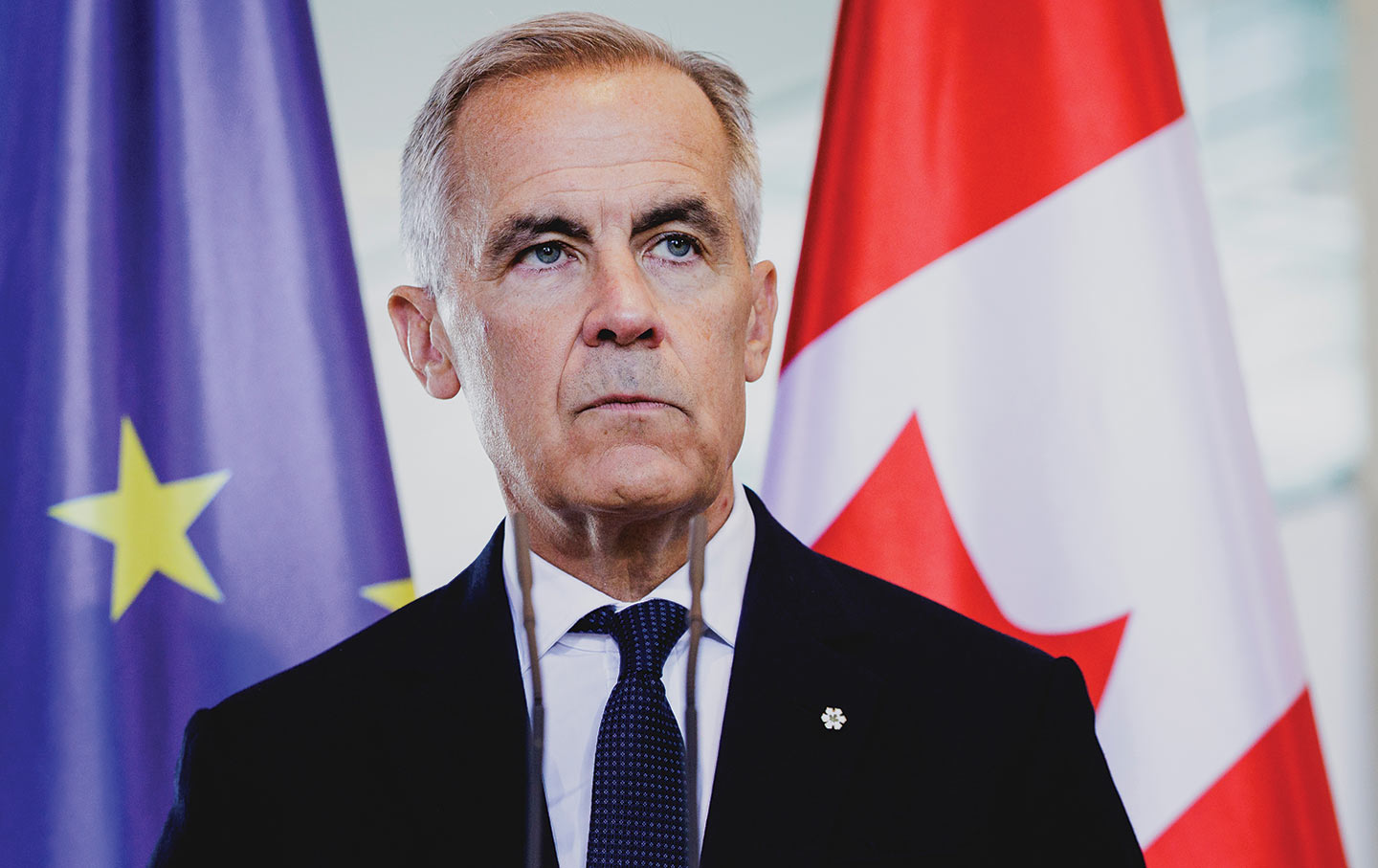
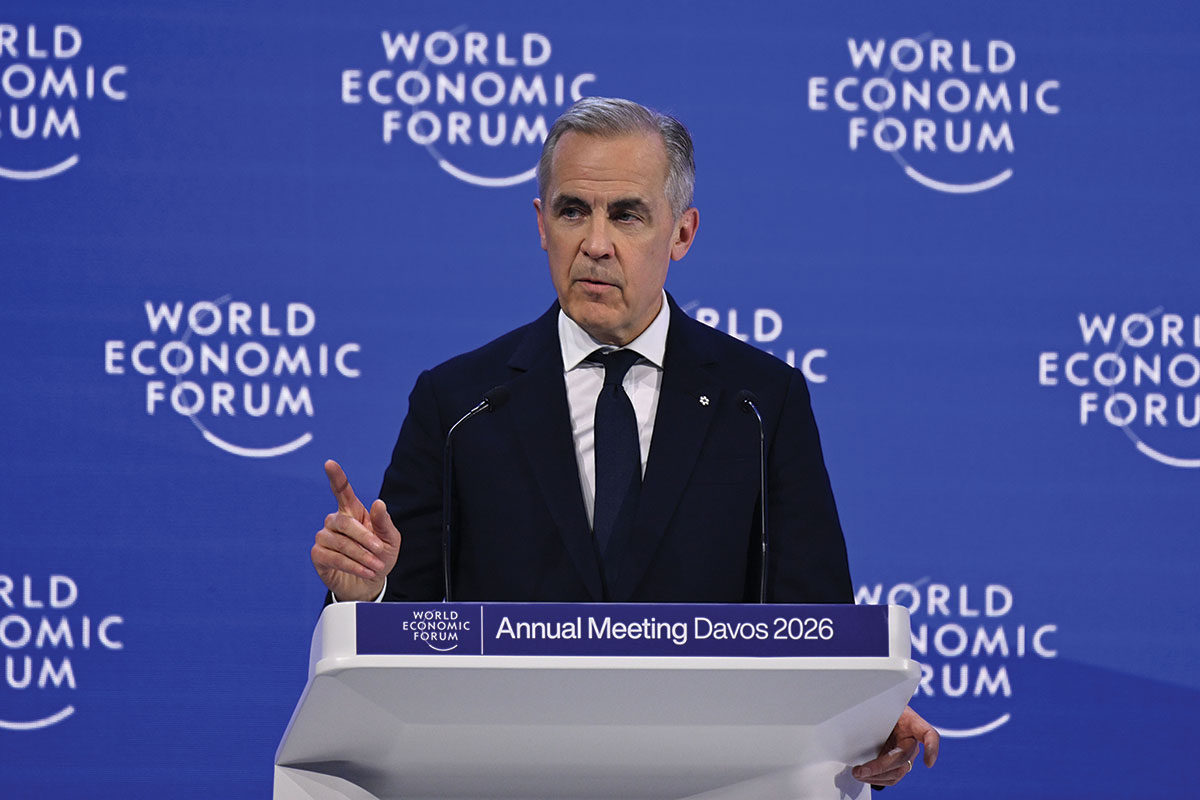
On January 20, Canadian Prime Minister Mark Carney emerged as an unexpected hero, at least among those looking for an alternative to Trumpism, in an unlikely place: the World Economic Forum at Davos. Normally, Davos is a snooze-fest where the global elite exchange self-congratulatory clichés celebrating the status quo. But Carney broke from that dismal tradition by offering both a radical analysis of the failed present and a plausible alternative for the future.
Carney’s speech was delivered on a continent where the response to Donald Trump’s erratic and destabilizing return to power has consisted mostly of degrading supplication. NATO Secretary General Mark Rutte, for instance, nicknamed Trump “Daddy” when discussing the president’s mediation between Russia and Ukraine. Rutte then compounded his shame by saying, “Daddy has to sometimes use strong language.” Of course, putting yourself at the mercy of a capricious and abusive “Daddy” is not only debasing but an invitation to further bullying, as Trump showed when he mocked Rutte, quipping, “I think he likes me: ‘Daddy, you’re my daddy.’”
Against this background of European humiliation, Carney’s speech was a breath of fresh air. He candidly described how Trump’s lawless, zero-sum foreign policy has prompted the death spiral of American global hegemony, upended the liberal international order, and created a system of “intensifying great-power rivalry, where the most powerful pursue their interests, using economic integration as coercion.” But it also acknowledged the “fiction” of that order, which always had one rule for the US and its allies and another for everyone else. More important, Carney’s speech sketched out a new path for “middle powers” such as Canada to move outside the shadow of US domination by forging new alliances and trade relations.
Against Trump’s nihilistic vision of a world dominated by great-power imperialism, Carney advocated a much more inviting future, arguing that “intermediate powers like Canada are not powerless. They have the capacity to build a new order that encompasses our values, such as respect for human rights, sustainable development, solidarity, sovereignty, and territorial integrity.”
The speech won Carney a standing ovation at Davos and lavish praise in the international press. Der Spiegel described it as “the speech the world has been waiting for.” The Washington Post hailed Carney as “the star” of Davos. The New York Times’ Ezra Klein celebrated it as “the most important foreign policy speech in years.”
But it wasn’t only the avatars of centrist conventional thinking who were heartened by Carney’s words. Anti-imperialists and anti-interventionists found themselves cheering his bracing critique of US domination. The Quincy Institute’s Trita Parsi enthused that he “never thought we would hear this level of honesty from a Western leader” and said Carney’s words would “be warmly welcomed in much of the Global South.” Other figures not normally given to extolling the Davos utterances of former central bankers, such as the libertarian Glenn Greenwald and the leftist Hasan Piker, were similarly impressed.
In purely rhetorical terms, Carney’s speech deserved the applause it received. It was bold and far-reaching, grappling honestly with political choices that will shape humanity’s common future. Yet the very fact that the speech was praised by both establishment stalwarts such as Klein and rabble-rousers such as Piker should give us pause. While both centrists and radicals could welcome Carney’s critique of Trump’s neo-imperialism, it’s far from clear what sort of “new order” he has in mind for the middle powers to build.
That’s because Carney’s speech actually contained two very different models of middle-power internationalism. One in effect promises neoliberalism, re-creating a 1990s-style world where economic growth is driven by international trade, domestic deregulation, and austerity.
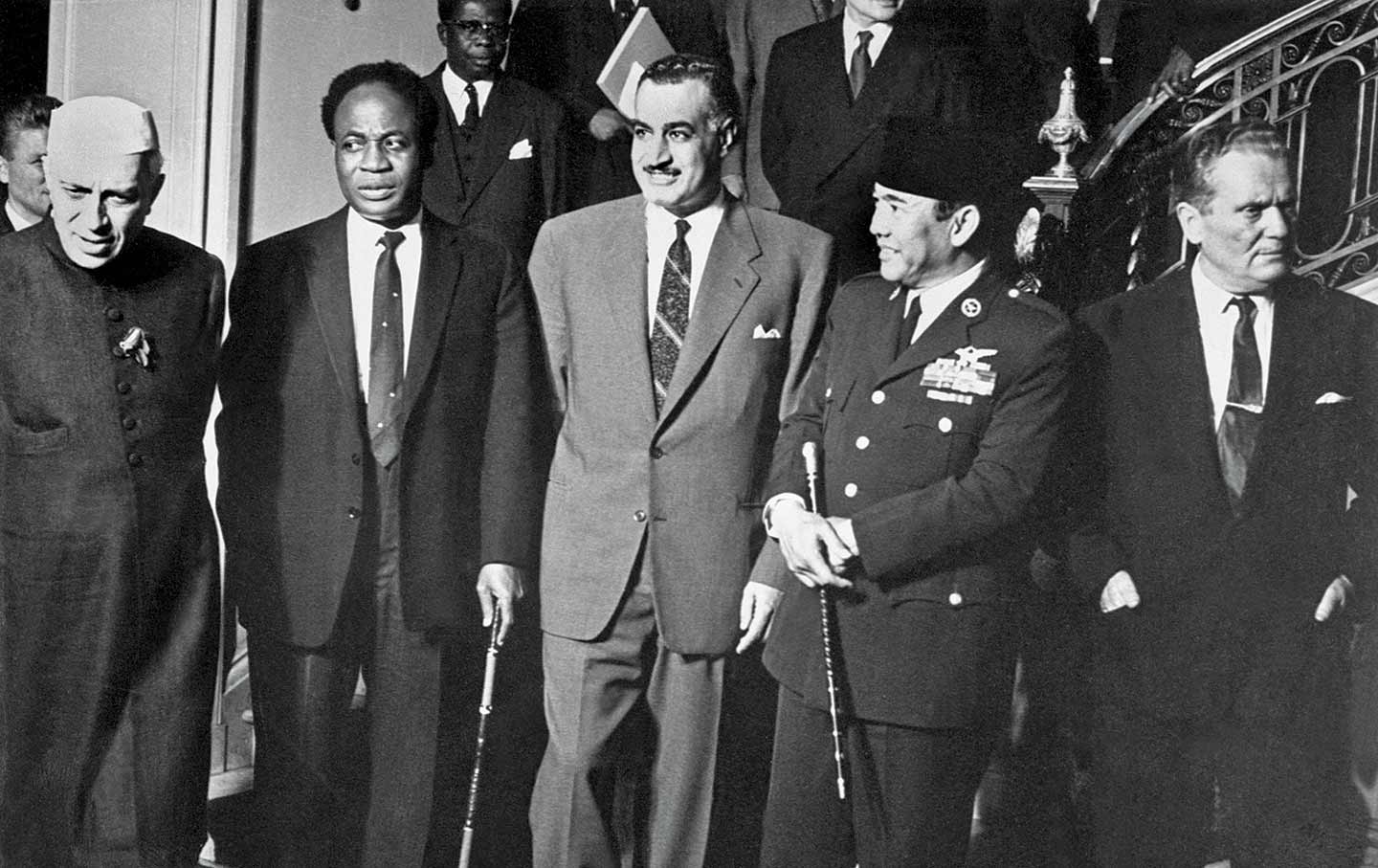
The other model—glimmers of which are evident in Carney’s stress on human rights and sustainability as well as his critique of the hypocrisy of the old order—would be much more radical. It is a vision of a new international order committed to the idea of global equality, one that calls to mind the Bandung Conference of 1955, where African and Asian countries tried to assemble a nonaligned pact outside the destructive polarity of the Cold War. While the Bandung project failed, the current fraying of US hegemony raises the possibility of a renewed push for a multipolar system whereby smaller nations would work together to tackle pandemics, inequality, and climate change—and also, when necessary, unite to counter lawless great powers. This would be a project of middle-power social democracy: a world united to create a more equitable planet.
Carney is fascinating precisely because his vision contains both of these strands. He’s a political figure divided against himself, one whose signature move is to combine radical critique with conservative solutions. He is both a central banker and an antiestablishment thinker, a globalist who is also aware that neoliberal globalization is in a deep crisis. He has an outsider’s analysis of where the world has gone wrong, but he yearns for new institutions and policies that would essentially re-create a discredited old order. Carney’s Davos speech thus offered not a solution but a pressing question: What is the best path forward—middle-power neoliberalism or middle-power social democracy? And if Carney is the best alternative we currently have to Trumpism, what version of middle-power internationalism is he most likely to pursue?
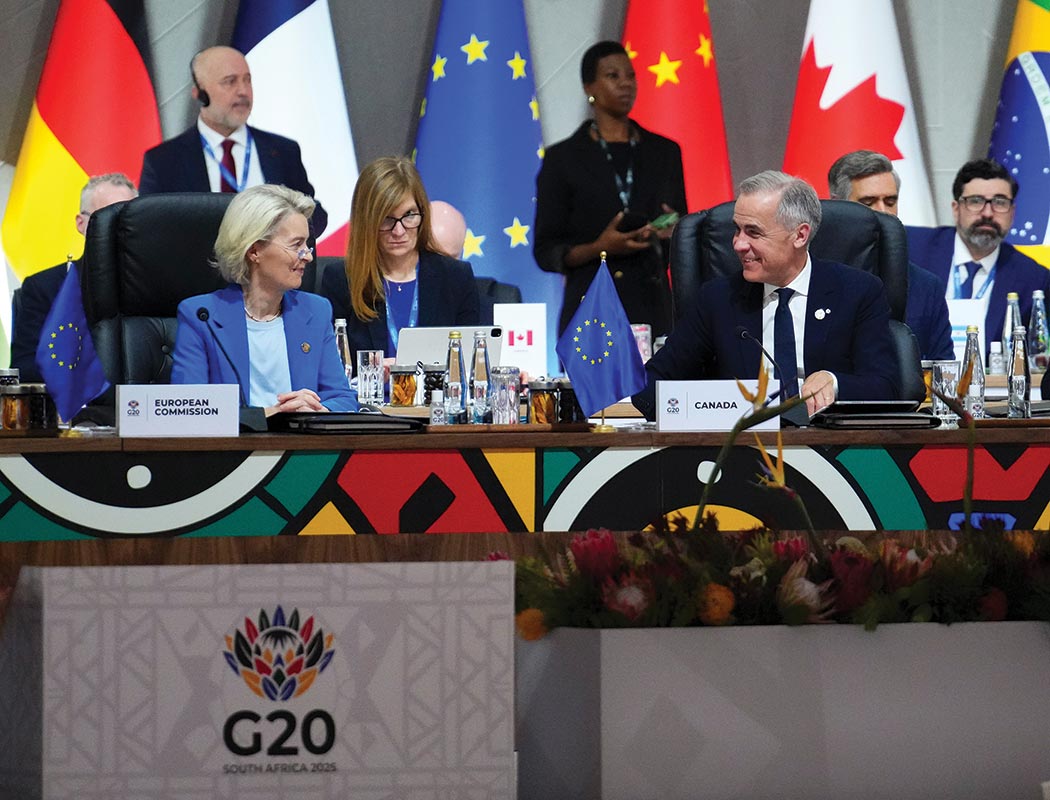
Political ambiguity runs deeply through Carney’s biography. He was born in 1965 in the far north of Canada, in Fort Smith, Northwest Territories. (“The permafrost that underpins the land where I was born is now melting,” he reflected with rare melancholy in his 2021 manifesto, Value(s): Building a Better World.) When Carney was 6, his family moved to oil-rich Alberta, which he describes as “my home province.” Alberta is the most politically conservative province in Canada, with strains of evangelical Christianity, populist rage, and big-business boosterism that align more with the United States’ contemporary Republican Party than with Canada’s more traditionally sober conservatism. (It’s not a surprise that Trumpists such as Steve Bannon and Treasury Secretary Scott Bessant have recently tried to encourage Alberta’s growing separatist movement.) But his father, Robert Carney, was an educator at both the high-school level and at the University of Alberta and was also active in the Liberal Party of Canada. The Liberal Party has always been a multifaceted alliance, with both a conservative business wing and a progressive wing. Yet being a Liberal partisan in Alberta was a lonely and contrarian vocation.
Thanks to a hockey scholarship, Mark Carney went to Harvard, where he attended life-changing lectures by John Kenneth Galbraith, a fellow Canadian of Scottish descent and the foremost liberal economist in the United States. Impressed by Galbraith, Carney switched his major from math and English to economics. Broad themes from Galbraith’s work still echo in Carney’s thinking, notably a wariness of laissez-faire boosterism, as well as the awareness that capitalism rests not just on individualism but also on institutions. After Harvard, Carney went on to Oxford, where he completed a doctorate in economics in 1995, focusing on competitive advantage in international trade.
This was followed by 13 years at Goldman Sachs, during which Carney became a true globe-trotter, working at desks in Tokyo, London, New York, Boston, and Toronto. His portfolio at the investment-banking firm included emerging debt-capital markets. He helped negotiate South Africa’s reentry into the bond market after the end of apartheid. If you want a shorthand for the contradictory nature of Carney’s worldview, you could do worse than to describe it as “Galbraith plus Goldman Sachs.”
Even as he rose in the world of high finance, Carney always nursed an ambition to succeed in Canadian politics. Central banking provided him the pathway; he became a deputy governor of the Bank of Canada in 2003, rising to become its governor in 2008. In 2013, he crossed the pond to become the governor of the Bank of England, serving until March 2020.
As he ascended the ranks of government, Carney had a front-row seat at the major crises of the 21st century: the global economic meltdown of 2008, Brexit, the pandemic of 2020, and the worsening climate catastrophe. During the Great Recession, his Goldman Sachs experience put him at the forefront of coordinating the development of new regulations to tamp down on speculation. Because Canada’s staid and prudent banking system was able to weather the storm better than those of most other wealthy nations, Carney emerged with a reputation as an adept crisis manager.
Carney has kept his eyes open as he and his fellow elites grappled with the polycrisis engulfing the planet. He seems to know as well as any Marxist that neoliberal globalization has failed. There are many passages in Value(s) that could easily have been written by Naomi Klein, Greta Thunberg, or Greg Grandin. The major theme of the book is that there is a radical disjunction between ethical and economic values—one that threatens to undermine the very health of the social system.
Carney argues that we are living through “a crisis of value in which the values of the market are usurping those of humanity” and that “politicians who worship the market tend to deliver policies that hurt people.” He quotes the economist Branko Milanović, who has been at the forefront of highlighting the dangers of global economic inequality, in stating that we are creating a “utopia of wealth and a dystopia of personal relations.” (This sentence is itself a variation on Galbraith’s warning in The Affluent Society that capitalism leads to “private opulence and public squalor.”)
Carney insists that the financial system has to “fulfill its role as a servant, rather than master, of society.” This chimes with his tenure as the United Nations secretary-general’s special envoy on climate action and finance from 2019 to 2025, during which he pushed for policies that would, in his words, “create a financial system in which a company’s contributions to climate change and climate solution are fundamental determinants of its values.”
Intriguingly, Value(s) doesn’t locate the crisis of US hegemony with Trump but rather with the 2008 crash. Carney recalls a G20 meeting in 2008 when President George W. Bush told his fellow world leaders, “We need you to get behind this. We will be stronger together.” While praising Bush’s “humility,” Carney also notes that his “much wiser colleague” Mario Draghi, an economist who would later serve briefly as prime minister of Italy, compared the United States to the USSR under Gorbachev, a superpower now in need of assistance. This leads Carney to ask: “Could the system survive without a hegemon?”
These sections lend Value(s) a radical sheen. Yet at its core, it is a fundamentally conservative book, one that offers as a solution to the depredations of neoliberalism the hope that the ruling class can become more enlightened. For instance, Carney argues that the best way to deal with the banking crisis was not to fundamentally change the system but rather to “get the right people around the table.” As the Canadian journalist Luke Savage noted in The Baffler, “We are finally—and confusingly—left with a vision for reform that revolves mainly around elite cooperation and the fostering of a more ethically minded business class.”
At the end of the day, Carney remains an establishment figure. He has also emerged as something of an arch-traditionalist. Carney insists that his staff use British spellings (catalyse rather than catalyze, if you please) and has pushed for closer ties with the monarchy that Canada shares with Britain. He has described Canada as “the most European of non-European countries.” After becoming prime minister, he imposed a strict dress code on his staff; as Stephen Maher reported in Maclean’s, Carney “wanted people to be punctual and dress as they would in a bank, with black shoes for the men. He told even the most senior public servants that their days of coming to the office in open-necked shirts and blazers were over.” These cultural affectations point to a hierarchical view of the world whereby elites should be enlightened and restrained while subalterns should be obedient. It’s perhaps not an accident that Carney is a notoriously hard-driving and domineering boss.
This fusion of radicalism and traditionalism is profoundly Canadian. Because of its loyalist past and ties to the British Empire, Canada has long nurtured a particular political tradition called “Red Toryism,” which combines a mixture of social consciousness and skepticism of US empire with Anglophilia and a reverence for the institutions, rituals, and social forms created by the UK-leaning gentry who rejected the American Revolution. While the Red Tory tradition has had little purchase in the popular imagination, it has existed as a persistent strain among the elite, making them more amenable to supporting state-building projects, including national healthcare. The great 20th-century thinker in this tradition was George Grant, whose 1965 book Lament for a Nation both decried US Cold War militarism and extolled Canada’s British ties.
In the Red Tory synthesis, the Tory part (nationalism and hierarchy) can easily overwhelm the shades of red. Historically, Red Tories coalesced in conservative parties, but as the Canadian right becomes more populist and pro-American, the Liberal Party has emerged as a haven for this strand of thought. Carney won in 2025 in part because progressive voters, scared by Trump’s threat to annex Canada, shifted from the social-democrat New Democratic Party (NDP) to the Liberals. Carney appealed to those voters not just by saying he has the skills to engage in tough negotiations with Trump but also by promising a return to the robust government-sponsored housing program that Canada enjoyed after World War II.
But since he took office, there’s been little sign of radicalism, or even social democracy, from Carney. He’s governed as a national-unity leader with significant overtures to the right—notably on climate, where he has tossed his principles overboard. In Value(s), Carney wrote, “Effective public policies include carbon prices such as Canada’s legislated path to $170/tonne in 2030 with the proceeds rebated to Canadians.” In office, Carney has canceled this carbon tax. This is no doubt motivated in part by a desire to curb Alberta separatism by foreclosing the idea that the federal government is harming the oil industry.
And the actual policies Carney advocated in his Davos speech were notably conservative: He promised to double defense spending and took pride in the fact that his government “cut taxes on incomes, on capital gains and business investment. We are fast-tracking a trillion dollars of investments in energy, AI, critical minerals, new trade corridors, and beyond.” This plan of investment in “energy” and “critical minerals” includes a push to build a new oil pipeline connecting Alberta to the Pacific coast. In other words, far from offering an alternative to Trumpism, Carney is in fact pursuing the same fossil-fuel nostalgia embraced by the GOP. Yet unlike Trump, Carney is not a climate denier—indeed, he is eloquent on the existential threat that climate change poses for humanity—which makes it all the more scandalous that he is doubling down on environmentally suicidal resource extraction.
The Canadian journalist Nora Loreto told me, “Nothing that he’s done as prime minister of Canada suggests that the [Davos] speech was anything more than a good performance. He’s defunding Canada’s social services to fund our military in the name of protecting our sovereignty, even though it would serve us much more to have a strong social-safety net, well-funded cultural production, and a domestic economy that doesn’t rely so much on Canada exporting oil to the US.”
In Davos, Carney called for new alliances that are “principled and pragmatic” and noted that “not every partner will share all of our values.” On the plus side, this has meant new trade agreements with South America and China. (Significantly, Canada is opening up to electric vehicles made in China.) The downside of this is less emphasis on human rights and international law. Carney has been muted in response to Trump’s neo-imperialism in the Western Hemisphere, including the push for regime change in Cuba and the kidnapping of Venezuelan leader Nicolás Maduro. And he strongly supported Trump’s illegal and unprovoked war on Iran. Not only are these policies wrongheaded, but they run counter to what the world actually needs: a broad alliance of middle powers to pressure the great powers to obey international law.
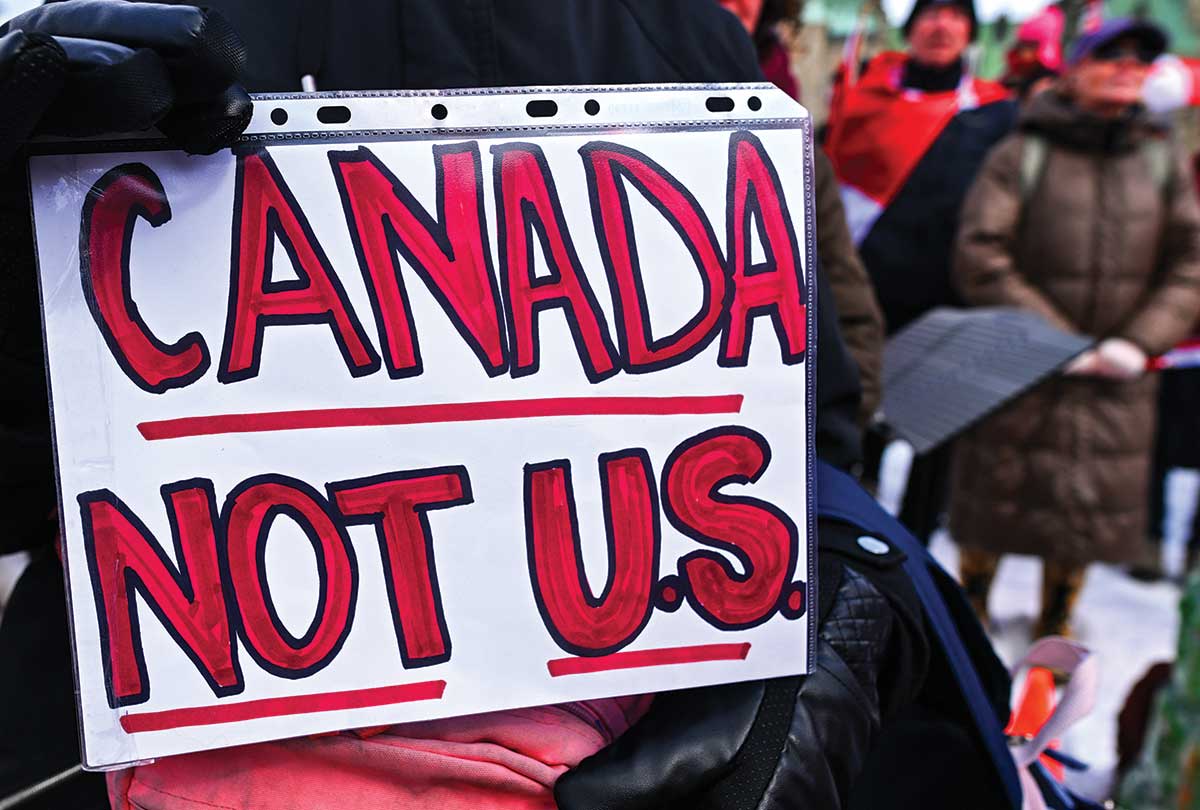
Currently, Carney is riding high in the polls on a wave of patriotism and anti-Trump sentiment. But his Red Tory governance risks alienating important voting blocs. Frank Graves of EKOS Research Associates, a pollster who has often advised Liberal campaigns, told me that right-wing populism remains an “extraordinarily powerful force” in Canada, one with a strong appeal to young people priced out of the housing market. Graves also thinks that progressives who voted for the Liberals in 2025 are being “orphaned.” Carney’s politics risks splintering the left wing of the Liberal Party, especially if the NDP adopts a more economically populist stance, as might happen if the journalist and activist Avi Lewis wins the NDP leadership race in March. Lewis has articulated a particularly trenchant critique of Carney. He acknowledges that Carney is “a smart guy” who is “very popular” because he “has a diagnosis about where we are in history.” But Lewis also notes that Carney’s solution would mean turning Canada into “a militarized petro-state, a junior arms dealer on the world stage.”
Branko Milanović, whom Carney quoted in his book, said in an e-mail that the Davos speech amounted to a policy of “national market liberalism” that consists of “the deepening of neoliberal reforms at home with the creation of new international economic links.” Milanović is unsure whether these policies are sufficient to create a new international order. More likely, he suggests, Carney has adopted stopgap measures to survive Trumpism until the United States elects a saner president.
But the impact of Carney’s Davos speech could transcend his own mixed record as a politician. There is no need to accept his conservative solutions, since his radical analysis points in other directions.
A more radical Carneyism would see middle-power internationalism as a matter of more than just trade alliances to foster economic growth. Instead of middle-power neoliberalism, we could have middle-power social democracy. The middle powers—including the nations of the Global South—could bind together to find ways to counter the bullying of the great powers. They could start taking seriously all the issues raised in Value(s)—inequality, pandemics, climate change—and create new treaties to address them, even if it means sidestepping the United States. Middle-power social democracy could challenge the hypocrisy of the United States’ treatment of Cuba and Israel’s treatment of the Palestinians. This would be a middle-power internationalism that is closer in spirit to the Bandung Conference than to Carney’s goal of a neo-NATO.
In Canada, there might well be a market for such a middle-power social democracy if voters become disillusioned with Carney’s middle-power neoliberalism. For that matter, as a candidate in 2028, Alexandria Ocasio-Cortez might do well to argue that the United States should give up imperialism and join the ranks of middle-power social democracies.
Support independent journalism that does not fall in line
Even before February 28, the reasons for Donald Trump’s imploding approval rating were abundantly clear: untrammeled corruption and personal enrichment to the tune of billions of dollars during an affordability crisis, a foreign policy guided only by his own derelict sense of morality, and the deployment of a murderous campaign of occupation, detention, and deportation on American streets.
Now an undeclared, unauthorized, unpopular, and unconstitutional war of aggression against Iran has spread like wildfire through the region and into Europe. A new “forever war”—with an ever-increasing likelihood of American troops on the ground—may very well be upon us.
As we’ve seen over and over, this administration uses lies, misdirection, and attempts to flood the zone to justify its abuses of power at home and abroad. Just as Trump, Marco Rubio, and Pete Hegseth offer erratic and contradictory rationales for the attacks on Iran, the administration is also spreading the lie that the upcoming midterm elections are under threat from noncitizens on voter rolls. When these lies go unchecked, they become the basis for further authoritarian encroachment and war.
In these dark times, independent journalism is uniquely able to uncover the falsehoods that threaten our republic—and civilians around the world—and shine a bright light on the truth.
The Nation’s experienced team of writers, editors, and fact-checkers understands the scale of what we’re up against and the urgency with which we have to act. That’s why we’re publishing critical reporting and analysis of the war on Iran, ICE violence at home, new forms of voter suppression emerging in the courts, and much more.
But this journalism is possible only with your support.
This March, The Nation needs to raise $50,000 to ensure that we have the resources for reporting and analysis that sets the record straight and empowers people of conscience to organize. Will you donate today?
More from The Nation
The “Rules-Based Order” Is Gone The “Rules-Based Order” Is Gone
Trump has destroyed a global system that mostly benefited the rich and powerful. We need to create something completely different in its wake.
The Urgent Search for an Alternative World Order The Urgent Search for an Alternative World Order
The horrors of Trump’s unchecked global aggression call for a truly visionary foreign policy—not a return to the failed status quo.
The Global Politics of Kwame Nkrumah The Global Politics of Kwame Nkrumah
Through Nkrumah’s story, Howard French charts the history of African decolonization and the American civil rights movement.
The Iran War Is a Disaster for Gaza The Iran War Is a Disaster for Gaza
How the crisis leaves Gaza’s 2 million people more friendless, isolated, and vulnerable than ever before.

