
“I Couldn’t Ask if She Was Still Alive”: A Girl, Her Mother, and a Bloody Night in Gaza
“I felt something warm on my hand. I couldn’t see what it was in the darkness. Then I realized it was blood.”
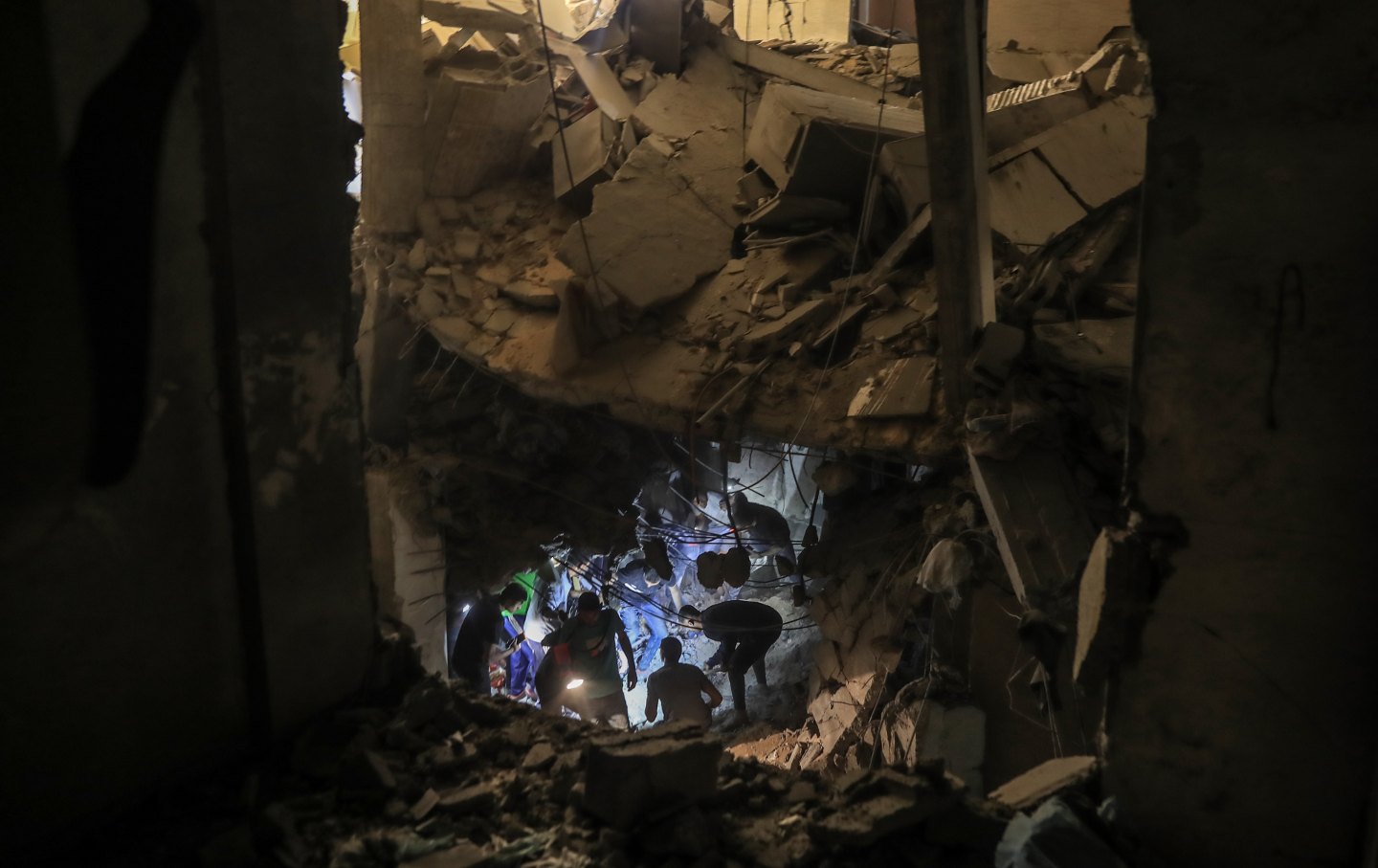
In April, we published “The Bulldozer Kept Coming,” a dispatch by Lujayn, a 14-year-old from Gaza. Months later, Lujayn is with her family in Rafah, and she is still writing. We are proud to publish another piece by her today.
I am Lujayn, a 14-year-old girl who has survived many wars in Gaza, though this is the worst one I have ever experienced. In the last week of May, my family and I had to leave the place where we were living after the occupation forces threatened to invade Rafah. It was the ninth time we’d had to move since October.
At the beginning of this war, we were bombed out of our beautiful home in Gaza City, which was destroyed. Ever since then, we have been displaced to different houses, makeshift shelters, and even tents in Khan Younis, Rafah, Deir al Balah, and Al Bureij.
This time, we tried to find a place that’s safer than the so-called safe zones, which were in the same areas where the occupation army had burned children alive in tents. The best we could find was a small place in Al Bureij. As usual, we bought some supplies and settled in. The bombing was frequent in the following days, and we scrambled to grab some food, water, and the medication my mother needs to treat injuries sustained in the 2014 Gaza war.
June 3 was full of bombing and destruction. The next evening, we heard tanks approaching from the east. Although the occupation forces had been here earlier, they entered again.
The evening was terrifying—the sky was filled with aircraft, and the ground shook under the tanks. We tried to stay away from the windows and took shelter by the walls, even though we knew they wouldn’t protect us much. Night fell, and my mother made me eat some canned corn. It was all we had. She hadn’t eaten anything; I knew she was saving the food for me, as we didn’t know when we could go out again to get more. I begged her to eat a little, but she refused.
We lay down on the ground. My mother made me sleep by the wall, while she lay down beside me on the exposed side, surrounding my head with pillows. I felt drowsy and tired.
I dozed off, only to wake up to the sound of bullets flying in the street, bombs, and shrapnel hitting the walls and windows. My mother shielded me with her exhausted body, smiled at me, and said, “We’re OK, don’t be afraid.”
This went on for several minutes. We couldn’t move. I felt cold despite the summer heat—until I felt something warm on my hand. I couldn’t see what it was in the darkness. Then I realized it was blood. A piece of shrapnel had pierced my mother’s shoulder—which she was using to shield my head—and it had made no sound.
I couldn’t comprehend it. I couldn’t ask if she was still alive. Fear paralyzed me, and I wondered if death had claimed her this time. I kept searching with my hand for her heartbeat to see if there was a pulse.
Her faint voice startled me. “Are you OK?” she asked. I told her she was hurt, and she calmly replied, “It’s nothing. Don’t worry.” At that moment, I wished for a miracle. Like in the movies, I wanted to turn back time and make my mother OK again.
We stayed like that for what felt like an eternity, with bombing all around us. Dawn broke on June 5, and we were still alive. My mother tried to treat herself, and I helped her remove that cursed shrapnel from her shoulder while she continued to bleed. No ambulance could reach us in such circumstances. I didn’t know I could handle seeing so much blood, but I did it for my mother. Without her body to protect me, the shrapnel would have hit my head. Instead, it was lodged in my mother’s shoulder, and she still hasn’t recovered from the damage it caused.
It’s a strange feeling to know that death is lurking everywhere while you fight to stay alive. I had no news about my father, who was sheltering elsewhere in Gaza, or my friends. Each of us is facing death. We are surrounded by it. I knew I had to tell my uncle about my mom, and I did.
I write these lines while we are still in the house with nowhere to go. The bombing continues. They keep discussing ceasefire proposals at the cost of our blood. I may not be able to finish my story this time, and I hope anyone who reads my words and feels the bitter reality we live in will wish for my mother, my people, and me to complete our stories with the end of this war. I don’t know when I’ll be able to send more lines again.
Will the day come when we don’t hear bullets, bombs, and missiles? I don’t want anyone to live through what we are experiencing.
My mother keeps whispering in my ear, “Be safe and well,” and I tell her, “There is no life, no goodness, no peace without you.” Together we will bury that shrapnel that wounded her and was stained with her blood. It will sprout and grow into courage, dignity, and love.
For my land only grows good things. Pray for us.
Popular
“swipe left below to view more authors”Swipe →More from The Nation
Opposing Trump’s Cruel Assault on the Cuban People Opposing Trump’s Cruel Assault on the Cuban People
An interview with Representative Jim McGovern.
A New Report on Alexey Navalny’s Death A New Report on Alexey Navalny’s Death
Boris Kagarlitsky and hundreds of unknown political prisoners remain in Russia’s prisons.
Rubio, Rodeo, and Tall Tales of Empire Rubio, Rodeo, and Tall Tales of Empire
The secretary of state has provoked the ire of Britain’s first black woman lawmaker and put the spotlight once again on how the US has historically treated people of his own herit...
Mexican President Claudia Sheinbaum and the San Quintín Justice Plan Mexican President Claudia Sheinbaum and the San Quintín Justice Plan
Field workers’ highway blockades send a warning to Mexico’s president.
Inside the Iran War Industry Inside the Iran War Industry
Using an old playbook with powerful new tools, it may be closer than ever to turning a US–Iran war into reality.
The Cost of US Withdrawal From 66 International Organizations, Conventions, and Treaties The Cost of US Withdrawal From 66 International Organizations, Conventions, and Treaties
How going it alone reduces our own sovereignty.

