
Jimmy Carter’s Biographer on the Late President’s Biggest Regret
Carter summoned Menachem Begin and Anwar Sadat to Camp David to make peace, not apartheid, in the Middle East. But the Israeli president broke his promise to freeze settlements.
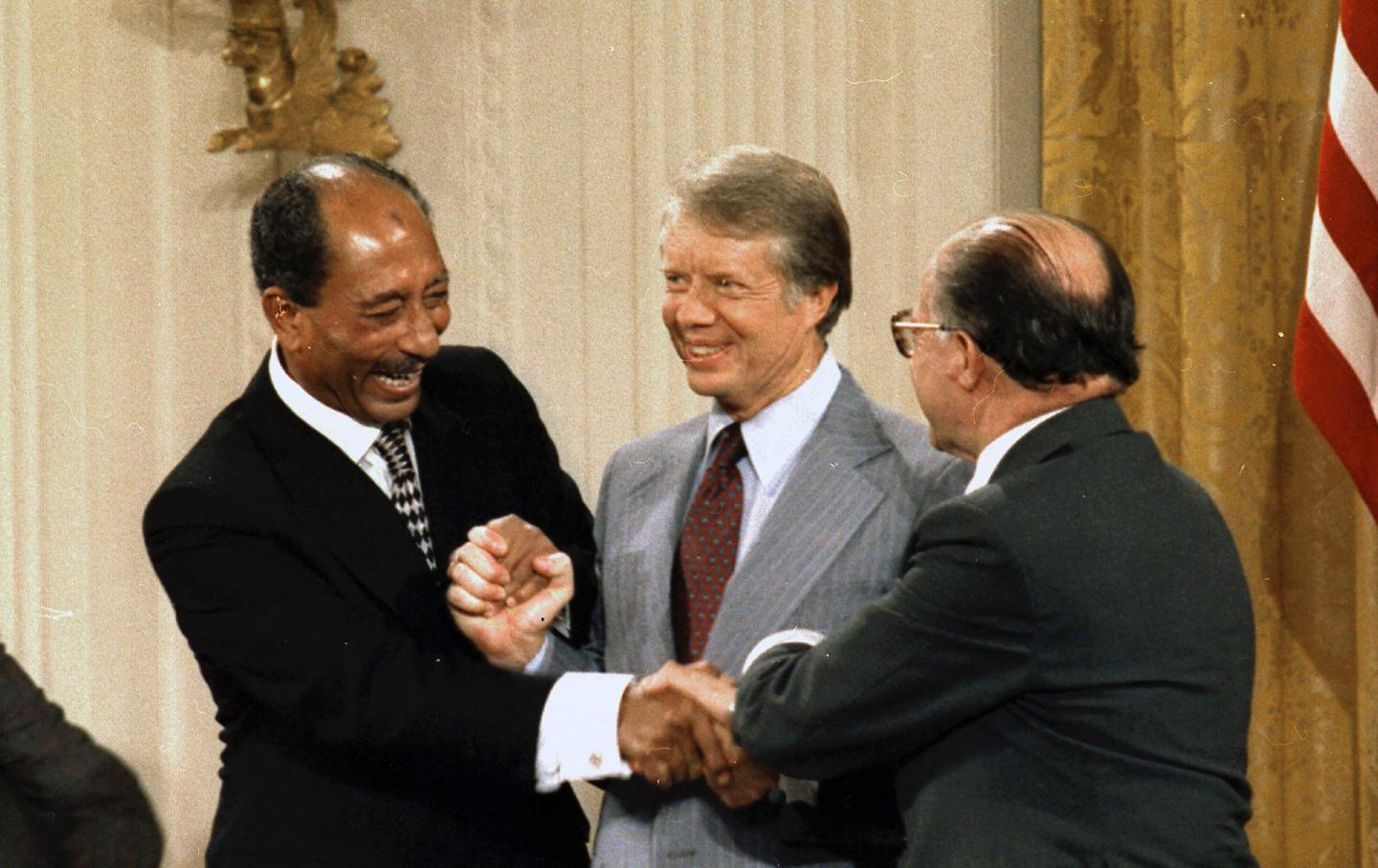
Last summer, ex-president Jimmy Carter was having a gentle, halting conversation with one of his great-grandchildren. Approaching his hundredth birthday, he’d been in home hospice care for nearly 15 months. He remarked that he’d had a pretty wonderful life. He’d been successful in everything he’d attempted—a stellar career as a Naval submarine officer, working under the notoriously domineering captain, later admiral, Hyman Rickover; governor of Georgia; president of the United States; winner of the 2002 Nobel Peace Prize; author of 33 books, including a childhood memoir—An Hour Before Daylight—that was short-listed for the Pulitzer Prize. Yes, he told his great-grandchild, he’d been successful in everything, and had no regrets: “But I don’t seem to be any good at this dying business.” So he still possessed that wry, acerbic sense of humor.
Speaking as his biographer, however, I can venture to say with some certainty that he had one deep regret in his long life. It was called Camp David—ironically, the scene of his greatest personal diplomatic triumph. Yes, the 1978 Camp David Accords ushered in nearly a half century of peace between Israel and Egypt. Carter single-handedly took Egypt, Israel’s only serious conventional military threat, off the battlefield. To be sure, it remains a cold peace, and one that survives in part only because Egypt is still governed by a brutal military dictatorship. But still, two nations that had fought four major wars against each other established diplomatic relations and never went to war again.
But Carter had wanted, and expected, much more. Indeed, he thought he had achieved a comprehensive peace of the entire Arab-Israeli conflict, including a concrete road map for Palestinian self-determination. Specifically, Carter thought he had won Israeli Prime Minister Menachem Begin’s promise to freeze all Israeli settlements in the West Bank for a period of five years—during which time negotiations would take place for an agreement on Palestinian self-rule and autonomy. The explicit but unspoken assumption was that Palestinian autonomy would lead to a demilitarized Palestinian state. The world’s most intractable and incendiary conflict would finally end with a two-state political compromise.
It did not happen. Carter was deeply disappointed—even outraged—by what he deemed Prime Minister Begin’s betrayal. “He’s trying to welsh on the deal,” Carter noted in his diary. Two days later, Carter again noted that Begin was publicly “denying the agreement we had worked out Saturday night, on which I have a complete record and a perfect memory.” Moshe Dayan, a member of the Israeli delegation at Camp David, confirmed Carter’s account on the critical question of the settlement freeze. On September 20, 1978, Dayan conveyed to Carter that he was “extremely upset over Begin’s public disagreement with the President over the duration of a settlements freeze.”
Three months later, Carter was incensed when Begin announced a major expansion of settlements in the West Bank. He bitterly complained to his chief domestic aide, Stuart Eizenstat, that the Israeli had lied to him. When Eizenstat gently pushed back, Carter reached into a drawer of the Resolute desk and pulled out a document: “These are my notes from my meeting with Begin,” he said. “Here you can see ‘five-year settlement freeze.’”
Carter wanted more than just a separate peace between Egypt and Israel. So, too, did Egyptian President Anwar Sadat—who also understood that his own political viability, and even his personal safety, depended on achieving an agreement that could not be perceived by the Arab street as abandoning the Palestinian cause.
Begin got what he wanted, a separate peace with Egypt, and he reneged on his promises to the president of the United States. Carter felt betrayed, and this is clearly why in the years and decades to come he would relentlessly speak out against the Israeli settlements. This forthrightness cost him dearly. The Jewish American establishment turned against him.
A majority of Jewish American voters began to turn against Carter in the 1980 election. Carter won only a 45 percent plurality of the Jewish vote, the first and only time a Democratic presidential candidate lost the Jewish vote.
Carter lost his bid for reelection for many reasons, but he was particularly embittered that Jewish Americans had abandoned him after he had risked so much of his presidency to take Egypt off the battlefield for Israel.
Sadat lost his life three years after Camp David, assassinated by Islamist army officers enraged by his abandonment of the Palestinians. Sadat’s killing reinforced Carter’s determination to use his presidency to speak out against Israeli encroachments in the West Bank. He did so repeatedly. But no one was listening.
Finally, in 2006 Carter published a book on the conflict. He gave it the provocative title, Palestine: Peace Not Apartheid. His editor at Simon & Schuster, Alice Mayhew, reportedly tried to talk him out of using the incendiary word “apartheid.” So too did Stu Eizenstat and other former aides. One longtime aide at the Carter Center, Ken Stein, resigned in protest.
Carter wanted to provoke. The title was certainly provocative, but the word apartheid was there in the title as a warning—a clear observation that if Israel did not achieve peace with the Palestinians, then the growing facts on the ground, the increasing number of settlements in the West Bank, would rule out forever a two-state solution. Notably, Carter’s text in the book made no argument that Israel was already an apartheid state.
Israel’s friends were outraged, and Carter made himself even more of a pariah in the Jewish American community. Some accused him of antisemitism. Carter tried to explain that he had not meant to offend. But he defended his book, which leapt onto the bestseller lists and managed to sell an extraordinary 275,000 copies in hardcover.
That was 19 years ago. Of course, since then, things in that dangerous neighborhood have become unimaginably worse. Some Palestinians cheered as Hamas committed war crimes, killing some 1200 Israelis on October 7, 2023. And since then, Bibi Netanyahu has been indicted by the International Criminal Court for committing war crimes in Gaza, killing, so far, some 45,000 Palestinians, 90 percent of whom were civilians, thousands of them completely innocent children.
Carter’s book has proved prescient. He was always a prophet, speaking uncomfortable hard truths, but now his voice is not so lonely. Sadly, he was right about the settlements in 1978—and right about them in 2006. There are now more than 700,000 Jewish Israeli settlers in the West Bank, a territory crisscrossed by “Israeli only” roads and a maze of civil and legal constraints on the Palestinian population that make it impossible to pursue a normal life.
Popular
“swipe left below to view more authors”Swipe →I would argue that if the international community could muster the necessary courage, a two-state solution could still be crafted. But it would have to be imposed through very concerted political and diplomatic pressure, backed by economic and military sanctions. This, sadly, is not likely.
More probably, Israel will proclaim its annexation, first of the major settlements, and gradually, of the entire West Bank. Palestinians will be pushed to leave. It is all a very bleak prospect.
This is why Camp David became Jimmy Carter’s deepest regret. He wanted more for Israel than for it to be continuously at war. He wanted peace, not apartheid.
Become a Sustaining Donor This September
Between the reemergence of right-wing red-baiting and Donald Trump’s use of the chilling National Security Presidential Memorandum–7 to criminalize left political organizing, we’re seeing McCarthyism reborn before our eyes.
This assault on democracy cannot be ignored or wished away. Resisting it requires bravery in the face of threats and repression, a steadfast commitment to the truth, and the unwavering belief that we can—and will—overcome this darkness.
We must have an independent media that sets the record straight, unearths corruption and abuses of power, and advances a politics of justice and dignity for all if we’re to win this fight.
That’s why I’m writing to you today. This September, The Nation needs to add 100 monthly donors to sustain our progressive journalism. Your contribution makes the next investigative report, the next truth-speaking column, and the next pathbreaking essay all possible.
I hope you’ll support our work with a recurring donation today. If you donate $10 or more a month, we’ll send you a brand new “Hands Off the Free Press!” sticker to recognise your commitment to our cause. Please, donate today.
Onward,
Katrina vanden Heuvel
Editor and Publisher, The Nation
More from The Nation
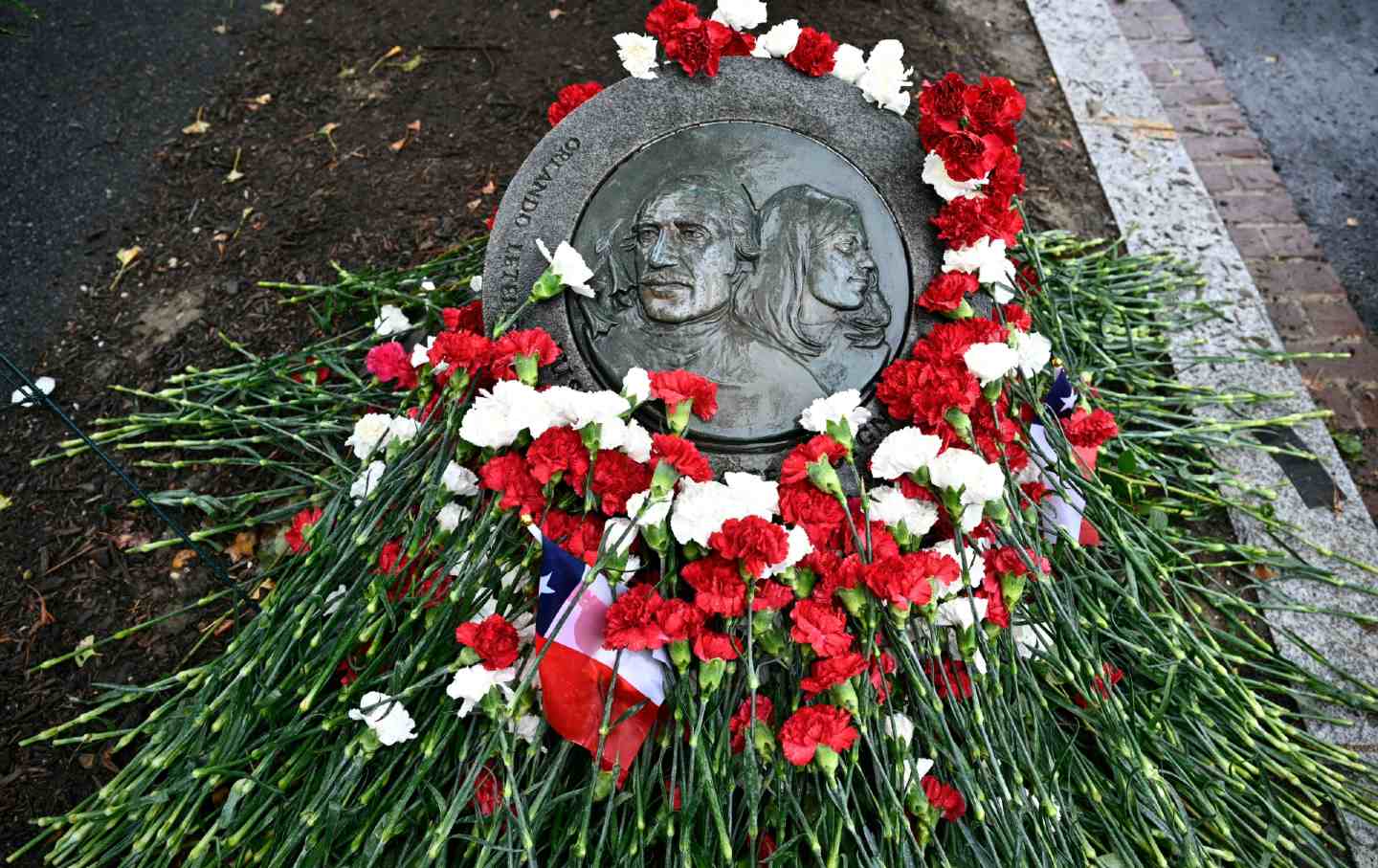
Pinochet: The Verdict of History in the Letelier-Moffitt Case Pinochet: The Verdict of History in the Letelier-Moffitt Case
An act of international terrorism on the streets of Washington, DC, still reverberates 50 years later.
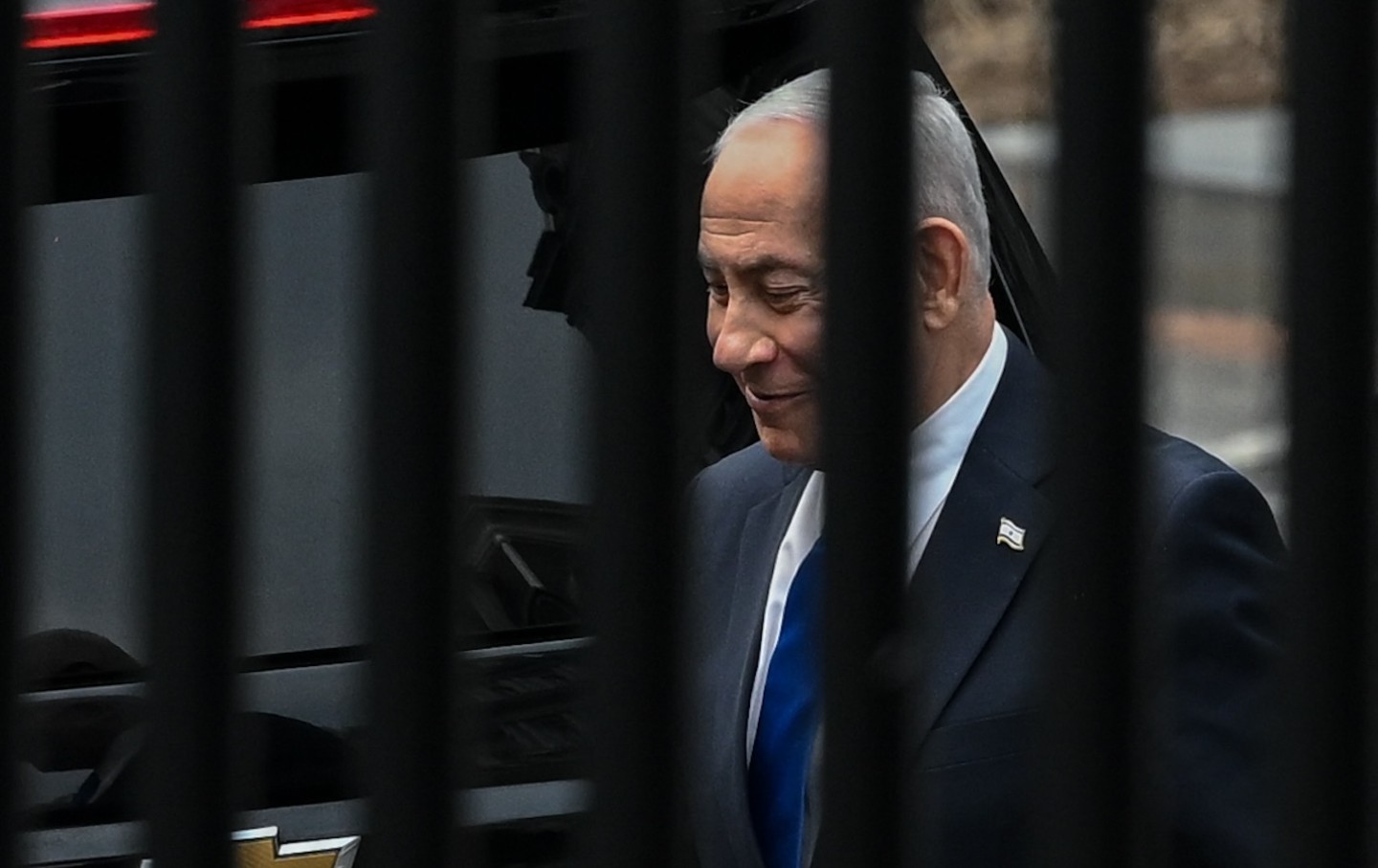
How to Arrest Benjamin Netanyahu How to Arrest Benjamin Netanyahu
Make no mistake: The United States can seize Netanyahu for crimes under US law and prosecute him in US courts when he is in New York City this week.
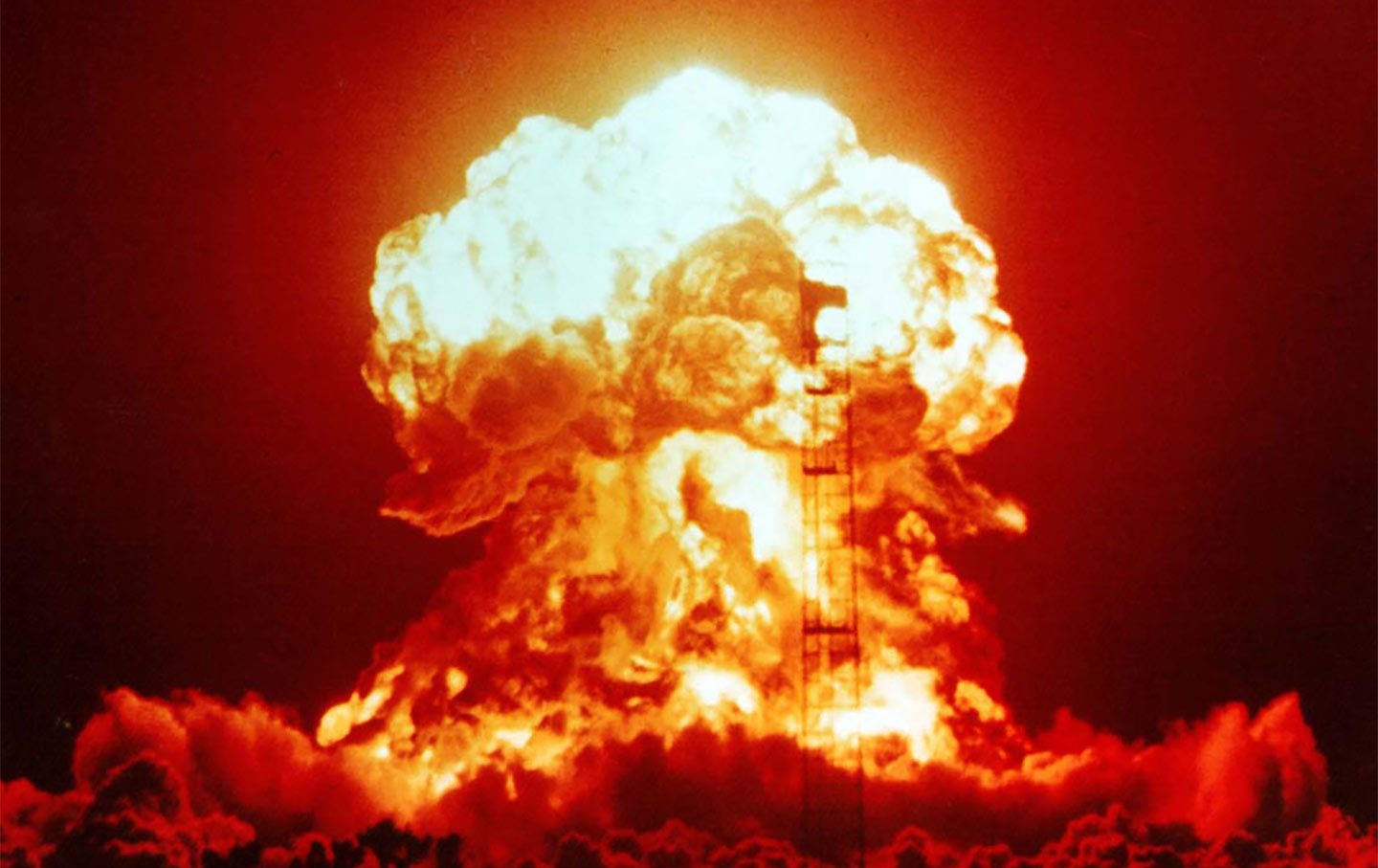
In the Age of AI, Nuclear Weapons Abolition Is a Renewed Imperative In the Age of AI, Nuclear Weapons Abolition Is a Renewed Imperative
As long as we have nuclear weapons, the job of ending humanity will continue to be as easy as the push of a button—or an AI agent hacking into a nuclear command-and-control system...
These Students Are Shaping UN Human Rights Policy These Students Are Shaping UN Human Rights Policy
Princeton undergraduates are helping the organization develop standards for post-mortem digital privacy and death in custody.
The Peril of Trump’s Final Act: Would He Use a Tactical Nuclear Weapon in Iran? The Peril of Trump’s Final Act: Would He Use a Tactical Nuclear Weapon in Iran?
Trump is trapped in a war that has already been lost, a reality that he will never allow himself to admit.
A Spreading War Rattles Global Energy Markets A Spreading War Rattles Global Energy Markets
Analysts say the consequences for energy prices and the world economy may be more serious in this later phase of a war that many had expected to be largely over by now.

