The Party Promising Kashmiri Statehood Wins an Election
In the first vote since India revoked the statehood status of Jammu and Kashmir, the National Conference party emerged with the most seats in the Legislative Assembly.
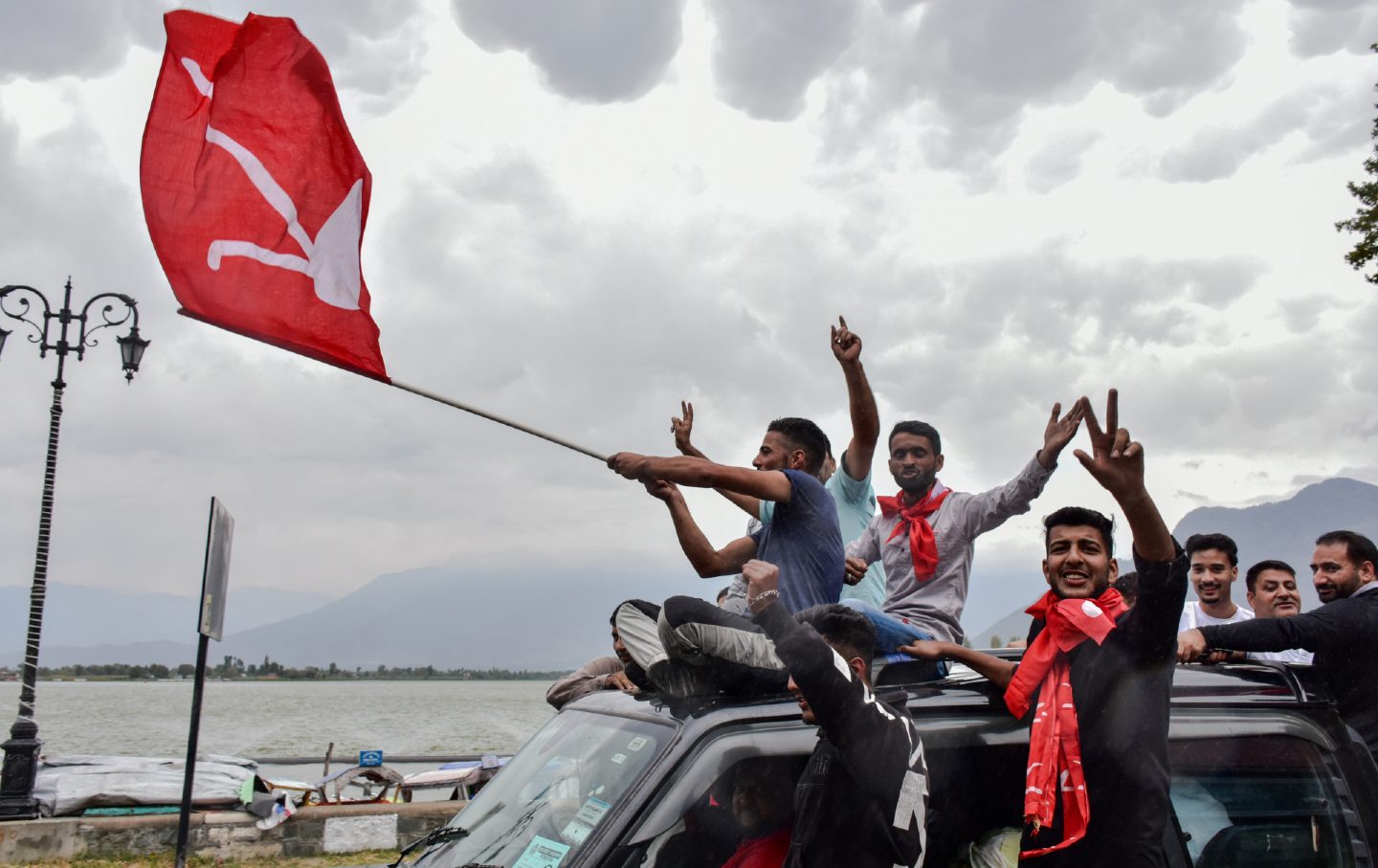
After winning the assembly election, supporters of the National Conference party celebrate on October 8, 2024, in Srinagar in Jammu and Kashmir, India.
(Saqib Majeed / SOPA Images / LightRocket via Getty Images)
Srinagar, Kashmir—Raza, 21, voted in Central Kashmir on September 25 for the candidate from the National Conference (NC), a party that emerged from the local elections with 42 of the 90 seats in the region’s Legislative Assembly. As he came out of the polling booth, Raza told me, “Innocent people are in prison or facing cases, and I have voted for them. I have voted for human rights and dignity. People fear the government—they are powerful.”
In its manifesto, the NC promises to release political prisoners, repeal a “public safety” detention law, return the region of Jammu and Kashmir to statehood status, supply 12 free cooking-gas cylinders to each household, and provide pensions to senior citizens. Raza, like many Kashmiris, believes that the NC can bring stability to the lives of ordinary people.
In August 2019, Prime Minister Narendra Modi downgraded Jammu and Kashmir from a state to a federal territory, revoking most of the region’s autonomy. This year, people were voting in response to the last five years of central government rule. The NC won the most seats, while the ruling Bharatiya Janata Party managed to win 29, mostly in Hindu-dominated areas of Jammu.
But for New Delhi, even if an opposition party came out ahead, the vote was a success. Peaceful elections without any boycotts or shutdowns is an improvement over past elections. In the last local elections in 2014, several separatist groups called for an election boycott. Modi, in his first message after the results, said that these elections were “very special” because they “witnessed a high turnout, thus showing the people’s belief in democracy.”
Since becoming a federal territory, Jammu and Kashmir has been largely ruled by Manoj Sinha, the Modi-appointed lieutenant governor. Unlike past assemblies, the new one will not, for instance, have the power to pass financial bills or control law-enforcement agencies. The Legislative Assembly can address issues like healthcare, education, and infrastructure, but Sinha will control the police.
The elections were held in three phases—September 18 and 25 and October 1—spanning more than 90 constituencies amid heavy security. The two regional parties—NC and People’s Democratic Party (PDP)—ran vehemently against BJP rule. The elections also saw the surprising entry of candidates backed by Sheikh Abdul Rashid, known popularly as Engineer Rashid. Last June, Rashid won a parliamentary seat in the Baramulla Lok Sabha constituency even though he was in a Delhi prison on charges of funding terror. Rashid’s People’s Unity party ran on self-determination for Jammu and Kashmir, but the NC and PDP accused People’s Unity of being supported by the BJP in order to split the opposition vote.
A Delhi court released Rashid on interim bail on September 11 to allow him to campaign for his party, but People’s Unity could win only one seat, losing 33 seats in which it had fielded candidates.
On September 25, the day of voting in Beerwah, Fareeda Banu, 37, walked into a voting booth with her two young children, to cast her ballot, she said, for ending “poverty and unemployment and for helping the youth.” She wouldn’t say which party she voted for but made clear that it wasn’t BJP. Above all else, she wanted local representation. “We have faced hardships, and now the new government should end this struggle for people,” she told me. “There should be change now. We are facing poverty, unemployment, drug abuse.”
After the election, NC regained its position as the primary political force in the region, reflecting a return to the pre-2002 political landscape. The electoral history of Kashmir is a complex interplay between militancy, separatism, and democratic participation. In 1987, the last election before separatist violence consumed the region, voter participation was 74.9 percent; by 1996, it had dropped to 53.9 percent. The 1996 election was marred by violence, while the 2002 vote had only 43 percent turnout amid boycott calls and violence. But by 2014, 65.9 percent of eligible voters cast their ballot.
Popular
“swipe left below to view more authors”Swipe →But after the revocation of statehood and limited autonomy in 2019, the political landscape shifted again. The BJP-led government cracked down on separatist politics and militancy. Separatist leaders have been jailed, and their groups either banned or disbanded. Among them is Jamaat-i-Islami Kashmir (JeI), a powerful socio-religious organization banned in 2019 for alleged anti-India activities.
Despite the ban, JeI publicly backed 10 independent candidates this year. The group’s former chief, Hameed Fayaz, endorsed its electoral efforts during his brief release on interim bail. But all the group’s candidates lost badly. Compared to Jel’s earlier sway in the region, the group’s influence has diminished, and its political prospects seem dim.
Mirwaiz Umar Farooq—the chairman of the Hurriyat Conference, an amalgam of separatist groups—also weighed in. Addressing a gathering at Srinagar’s Grand Mosque, he said that the Hurriyat had never opposed elections and he urged political parties to unite beyond personal interests to protect the rights of the people. He criticized the government’s actions since 2019, saying, “People fear for their land, jobs, water, and electricity. Today, our resources are no longer in our hands.” He acknowledged that elections could address civic matters and insisted that the Kashmir dispute required dialogue, not force.
“The Hurriyat’s position remains clear: This issue must be resolved through peaceful dialogue,” he reiterated. “We will always raise our voice for this, and we are ready to support such efforts.”
Rekha Chowdhary, who taught political science at the University of Jammu, told me that the separatist politics in Kashmir are no longer tenable. “Kashmiris, in a way, have reconciled with the situation. They seek normalcy and good governance, preferring stability over continuous disruptions. The central government’s tough stance post-2019 has significantly diminished separatist influence.”
She added that New Delhi has effectively tackled separatism in public spaces since 2019, using a muscular approach that has put an end to protests, strikes, and stone-throwing. “This shift is largely credited to the central government’s strategy,” she said. “Separatist assertions have been notably curbed.”
More on India:
New rules imposed by the federal government, according to Radha Kumar, author of The Republic Relearnt: Renewing Indian Democracy, will further weaken the assembly. The lieutenant governor now mandates that his representative sit in on cabinet meetings and that his office vet all policy decisions.
Kumar said that the division of powers sets up a battle between elected officials and the lieutenant governor’s office that will harm the ability of both to do their jobs. “There are a host of critical issues to be tackled by an elected administration and assembly, from statehood to land rights to the economy and unemployment, especially of youth,” she said.
In Srinagar, Arif Mohiudin Bhat, a 40-year-old businessman who voted for People’s Unity, said that people do not have proper facilities, which is why so many people came out to vote. He gave credit to the BJP for bringing “some peace back in the valley.”
“People have embraced normalcy, unrest has decreased, and focus has shifted to careers and development,” he said. “This marks a significant change in the valley. Kashmiris now have a broader vision for the future. While issues remain unresolved, the focus is on development, but we lack representatives to drive it forward.”
While militancy remains a concern—gunfights still occur—the politics of Kashmir are moving away from separatism. But for a long-term embrace of the voting booth, elected officials will have to be able to do something. Bhat emphasized the importance of having politicians who understand the people’s concerns, of not letting New Delhi make all the decisions from hundreds of miles away. Kashmiri residents will be watching closely how the newly formed government manages its relationship with the federal government and tries to fulfill its campaign promises. With the election, the public has made clear what it wants: the restoration of statehood and return of autonomy. It is unclear whether Modi will let this happen.