
The Iranian Voices America Isn’t Hearing
We need to listen to those who oppose both the Islamic Republic’s authoritarianism and foreign military escalation.
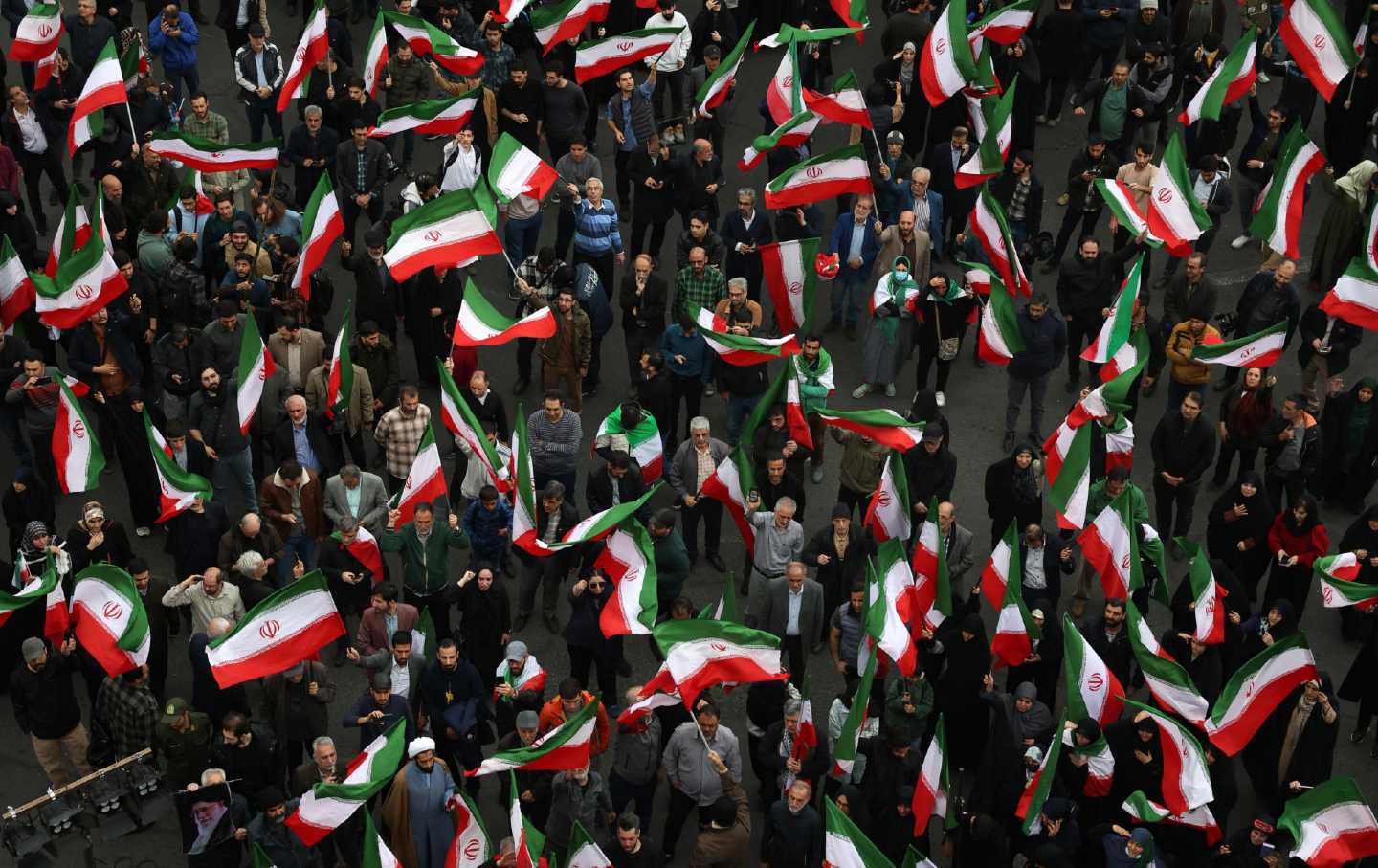
Iranians gather at Palestine Square in Tehran carrying Iranian flags, chanting anti-US and anti-Israel slogans to protest the attacks by the United States and Israel on February 28, 2026.
(Fatemeh Bahrami / Anadolu via Getty Images)When the streets of Iran ran red last January, when mothers searched hospital corridors for sons who never came home, when the internet went dark and the state called its own people “rioters,” something remarkable happened.
From prison cells.
From house arrest.
From union organizers and writers’ circles.
From Kurdish towns and Tehran universities.
Iranian civil society spoke.
They condemned the Islamic Republic’s mass killings as crimes. They demanded accountability, freedom, and transformational change. They called for a referendum and a constituent assembly. They rejected clerical authoritarianism.
And they rejected war.
Now that war has been launched—after weeks of US and Israeli officials speaking casually about “bombing” and “military buildup,” and many of the people most battered by the Islamic Republic warning that foreign military intervention would not liberate them. It would bury them.
Mir Hossein Mousavi is not an exile or a fringe dissident. He was Iran’s prime minister during the war with Iraq in the 1980s. He was the leading challenger in the disputed 2009 election that gave birth to the Green Movement. For more than a decade he has been confined to his home, cut off from public life, for demanding accountability and fundamental political change.
In the aftermath of the January massacre, which left thousands of protesters dead, Mousavi declared that “the game is over.” He called the killings a historic crime. He urged security forces to lay down their arms. And he proposed the formation of what he called an Iran Salvation Front, a broad national coalition to guide a peaceful democratic transition.
His framework rested on three principles: no foreign interference, no domestic tyranny, and a nonviolent path to democracy.
Four hundred sixteen political and civic activists immediately endorsed his call. They demanded the release of political prisoners, an independent investigation, and guarantees of basic freedoms. They warned that desperation can drive citizens to pin their hopes on foreign powers or authoritarian alternatives. But that path, they cautioned, would only reproduce another form of subjugation.
A similar message came from 17 prominent dissidents in January, including filmmakers, lawyers, and representatives of imprisoned Nobel laureate Narges Mohammadi. They called the mass killings an organized crime against humanity and named Supreme Leader Ali Khamenei responsible. They demanded justice and the release of political prisoners. But they also warned that any path that bypasses popular sovereignty risks plunging Iran into catastrophic violence.
Even from behind bars, that same warning was being voiced. From a cell in Evin Prison, Mostafa Tajzadeh, once a deputy interior minister and now one of the Islamic Republic’s most outspoken critics, described the massacre as predictable and preventable, the inevitable product of governance by fear. He called for national dialogue and an independent fact-finding committee. He also warned of the “ominous specter of war still flying in our country’s sky,” cautioning that escalation would compound, not cure, the nation’s wounds.
Labor unions with deep organizing roots echoed a similar message. The Syndicate of Workers of the Tehran and Suburbs Bus Company, one of the country’s most prominent and durable independent labor organizations, rejected foreign military intervention and insisted that liberation must come through organized internal struggle. Student coalitions from leading Iranian universities jointly declared, “Neither the Islamic Republic, nor monarchy, nor MEK,” referring to the exiled Mujahideen-e Khalq organization, and rejecting authoritarianism in every form, whether domestic or imported. And the Association of Iranian Writers, one of Iran’s oldest and most respected independent cultural institutions, condemned killings and enforced disappearances while rejecting the illusion that freedom could be delivered by missiles.
This anti-war, anti-authoritarian stance did not begin in January. During the June 2025 war between Iran and Israel, some of the clearest rebukes of war came from inside prison walls. In a declaration from Evin Prison, four imprisoned women, Reyhaneh Ansari, Sakineh Parvaneh, Verisheh Moradi, and Golrokh Iraee, denounced what they called “genocide” and “systematized savagery” in Gaza and condemned the complicity of global powers, especially the United States. They rejected the instrumentalization of human rights to justify war or intervention, warning that reliance on such powers would betray both Iranians and the broader region.
Pakhshan Azizi, an Iranian Kurdish political prisoner sentenced to death, delivered a similar message. While rejecting the charges against her, she rebuked US warmongering, its backing of Israel’s war, and the sanctions that have battered ordinary Iranians. If Washington truly cared about human rights, she wrote, it must end its attacks, its support for war, and the sanctions that have inflicted relentless suffering.
This is the part of the Iranian story rarely told in American debates. In Washington, the discourse often reduces Iran to two caricatures: the ruling elite in Tehran and the exiles who promise that pressure and war will bring about regime change. But inside the country, a third current has always existed. It is anti-authoritarian and anti-war at the same time. It rejects both domestic tyranny and foreign intervention. It demands self-determination through nonviolent civic struggle.
Outside the country, however, a different voice dominates. Reza Pahlavi, the son of the last shah whose authoritarian monarchy was toppled in 1979, has positioned himself as the face of regime change and has openly called for foreign military intervention.
In a climate of economic hardship shaped in large part by sweeping US sanctions, his message has gained traction, amplified by well-funded Persian-language satellite networks such as Iran International and Manoto, as well as Israel-backed social media manipulation efforts. The scale of this ecosystem is staggering. Public filings show that Iran International alone reported cumulative operating losses exceeding half a billion dollars between 2017 and 2022, without disclosing its ultimate financial backers.
While the protest movement began on December 28, Reza Pahlavi escalated the moment by urging Iranians to flood the streets on January 7 and 8. He cast it as a decisive turning point, arguing that the Islamic Republic was fracturing and claiming that tens of thousands of military and security personnel had registered as defectors with him. Thousands of mostly young and deeply disaffected Iranians answered that call, believing the balance might finally be shifting.
At the same time, President Donald Trump was issuing ominous threats that the United States was “locked and loaded,” repeating before and after the January 7–8 bloodshed, and again after the early morning attack on Iran, that Washington stood with the protesters, that they should “take your institutions,” and that help would be on the way.
According to Iranian opposition channels, demonstrators on those days moved toward police stations, military facilities, and government buildings in dozens of cities. What followed was not a collapse of the regime. Security forces opened fire. Thousands were gunned down.
This is precisely the scenario that Iran’s “third current” warned against. Again and again, dissidents inside the country have argued that militarization, whether from the regime or from abroad, closes the space for civic organizing and leaves ordinary people exposed.
Popular
“swipe left below to view more authors”Swipe →Their alternative is not passivity. It is disciplined, nonviolent mobilization. It is the release of political prisoners. It is the protection of open communication. It is a referendum under international supervision and a constituent assembly that allows Iranians to decide their future without foreign tutelage. They are asking not for bombs but for breathing room.
Against this backdrop, Taghi Rahmani, a veteran democracy activist and husband of Nobel Laurate Narges Mohammadi, has warned that Iran now faces not only the authoritarianism of the Islamic Republic but also the rise of what he calls a “modern far right” within parts of the opposition. Unlike a conventional conservative politics that accepts pluralism and rotation of power, this current thrives on enemy-making, extreme nationalism, and concentrated leadership. It risks replacing one totalitarianism with another.
Ultimately, this war will not weaken repression in Iran. It strengthens it. The June 2025 escalation was followed by tighter controls, expanded criminalization, and a further suffocation of the information space. Escalation consolidates the security state. When bombs fall or sanctions tighten indiscriminately, power flows to the most coercive institutions, and civil society becomes more exposed and more vulnerable.
No one understands this more clearly than those who have already paid the highest price. The Mothers of Laleh Park, whose children were killed in earlier waves of state repression, have explicitly condemned the government’s killing of protesters as brutal state violence and demanded the immediate release of detainees. Linking today’s uprising to past traumas, they warn against repeating the catastrophes of Iraq and Afghanistan.
Foreign intervention, they caution, risks dragging Iran into “the fate of Afghanistan and Iraq,” where promises of liberation dissolved into instability and suffering.
More from The Nation
Israel’s Extremist Election Israel’s Extremist Election
The run-up to the vote on Tuesday is exposing the façade of Israeli democracy—and the fealty of the country's so-called opposition when it comes to matters of Jewish supremacy.
“NAZA” and Israel’s History of Automated Warfare “NAZA” and Israel’s History of Automated Warfare
As violent technologies like spyware, predictive targeting algorithms, and 2,000-pound warheads become ordinary instruments of military rule, once-abhorred practices become routin...
Brazil’s Workers’ Party Is Not Stopping Brazil’s Workers’ Party Is Not Stopping
With just a few days remaining before the runoff election, supporters of Lula’s party are doing everything possible to rally support behind the president.
Brazil’s Decision Brazil’s Decision
The moral compass and basic humanity of political leaders really does matter.
Albanian Student Strikes Spur a Political Crisis Albanian Student Strikes Spur a Political Crisis
A new round of protests against the ruling party’s corruption has Prime Minister Edi Rama giving cops bonuses to crack down on dissent.

