Don’t Cry for Me Argentina
The truth is I had to leave you.
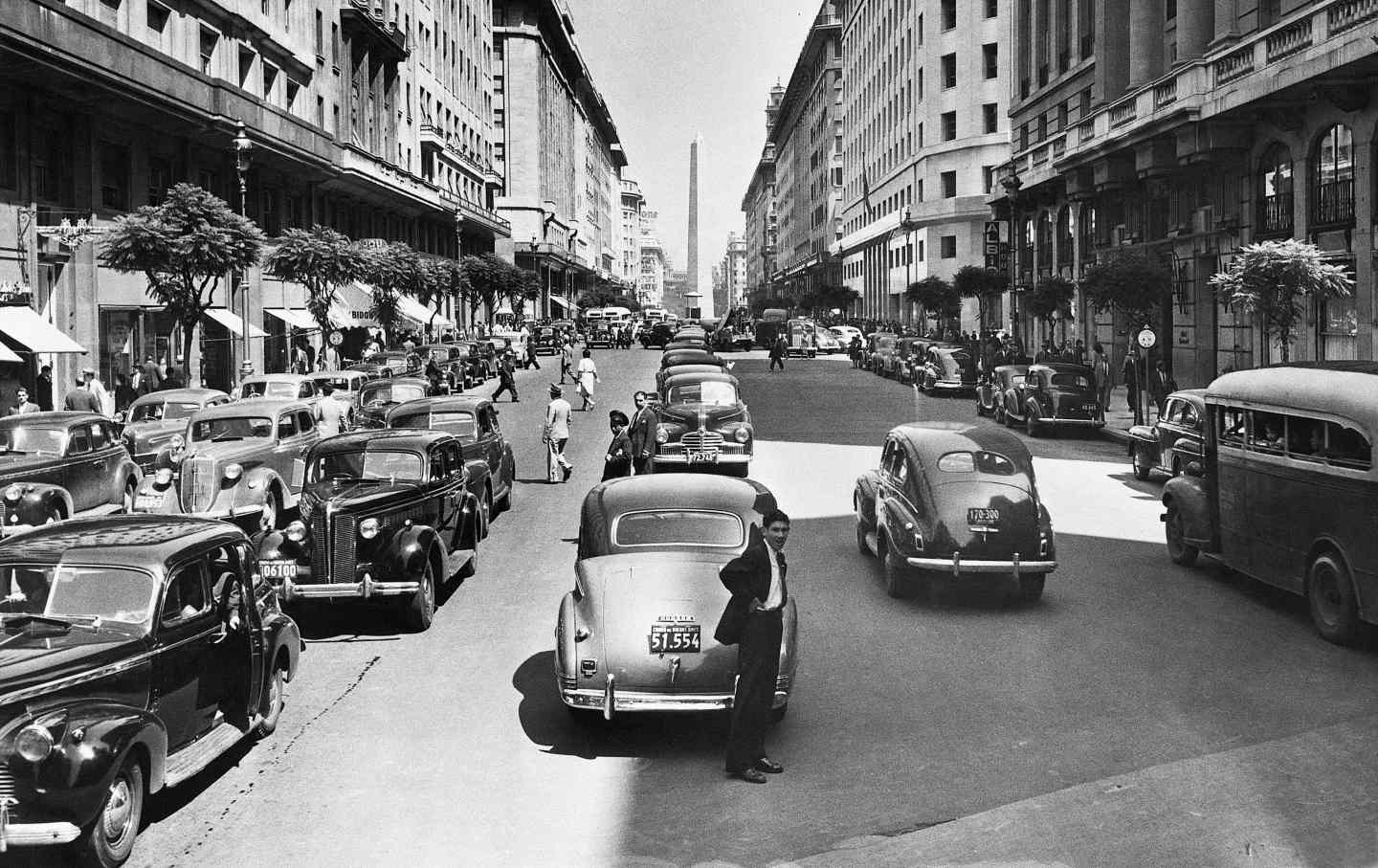
Buenos Aires, Argentina, 1951. The obelisk at the head of Diagonal Norte is a familiar landmark.
(Getty Images)
One Thursday night in mid-September, as the shooting of Charlie Kirk and the yanking of Jimmy Kimmel and the escalation of violence in Gaza hung in the air, a friend asked me if I still thought that New York City—and the United States more broadly—was the place for me.
“What do you mean?” I asked after saying yes.
I hadn’t thought about my answer; I hadn’t needed to. But it was true, it occurred to me seconds after, that increasingly, the idea of leaving was gaining some real cultural purchase. “I’m just hearing more people I know talk about it,” my friend continued. “It does seem like things are getting worse than they’ve been.”
The leaving gene, I have to admit, runs in my family. I can’t exactly locate its originator—the amount of paperwork necessary to yank a burgeoning bloodline from its place of origin once a generation tends to complicate genealogic research—but I am familiar with several of its expressions. My father’s father got on a ship some time in the late 1940s bound for Buenos Aires, after war had left the town in Southern Italy where he’d been born decimated and impoverished. As family lore has it, he quit school when he was eight and on at least one occasion had to resort to making a meal from a single bell pepper stolen from a neighbor’s garden. In Argentina, in this order, he: got married, had children, and finished learning to read.
Before him, there had been others who left. Italians on my mother’s mother’s side; Spaniards on her father’s. Spaniards somewhere on my father’s side, too. Two of my maternal grandmother’s brothers left Argentina in the 1950s, settling separately in Santa Barbara and New York City. One of them a physicist and the other a physician, they’d managed, even as immigrants, to attain for themselves a coveted piece of what we imagine was once the American Dream. Their success was a live billboard for what America made possible—what leaving made possible—and the images it stirred swirled around in the family imagination for decades. From where we stood, we couldn’t tell if, after leaving their old problems behind, my family members found themselves amidst new ones—we only perceived that familiar troubles that framed our lives every day, in their new world, didn’t exist. The act of leaving, and the way we imagined that act, created the illusion, however temporary, of total reinvention.
When I was eight years old, living in Buenos Aires, two of my mother’s American cousins visited the extended family with their own children—five of them total, all around my age. I perceived them as alternate yet impossible versions of myself; our differences an accident of circumstance but still insurmountable. They were like me—my grandmother was their grandfather’s sister!—but also not at all. They spoke English; I knew only the word for “door.” Their clothes seemed brand new; I wore hand-me-downs. And crucially, my country, I surmised, belonged to them, but theirs didn’t to me.
My second cousins had a legitimate connection to the culture that I’d been born into—after all, their grandparents had been born in Argentina and had grown up there. But there’s a particular strain of escapism that seems to emerge even without such a connection. I’ve lived here since 2002—more on this shortly—and have been hearing some version of “I’ll just move to Canada” since then, though I’ve never met anybody who actually followed through on it.
The statement is a kind of protest, and it’s also an implication of ownership, an individual expression of the sort of geopolitical relationships the United States has cultivated throughout its history. (In a word: imperial.) In 30-second videos on Instagram and TikTok, people (mostly women) born in the United States explain what leaving actually looks like. They enumerate the things they wish they’d known before they moved to—let’s say, Spain, though the content of the videos basically remains the same regardless of the location to which they move—or the things they’d never do again now that they live in Spain; or things they know they’ll never get used to no matter how long they live in Spain. For these “expats,” the way it seemed to be for all my distant and not-so-distant emigrant relatives, moving to “Spain” has been a solution to a problem: among others, their inability to afford homeownership in the United States, to provide their children with a true bilingual education, or, increasingly it seems, to cope with the vulgar and violent political reality of the country of their birth. Yet still, their new lives abroad seem to have disappointed them in some way.
While there is certainly an uptick in the instances of people talking about moving abroad, both online and off, as well as an increase in interest reported by companies with names like “GTFO Tours,” so far the actual numbers don’t seem to reflect a mass exodus. What this uptick actually reflects is the increasingly widespread, generalized entertaining of the idea of leaving, which likely doesn’t go so far as to include the procurement of visas or the finding of new schools for children or the grand challenge of adult second-language acquisition. In this imaginary version of events, life gets grafted from one place to the next like a plant into friendly soil: There is no rebuilding; only flourishing. This picture is tempting to imagine because it is devoid of all instances of friction—homesickness, desires that can’t be fulfilled; devoid of the impossibility of return, the way that once you leave you no longer have a true home anywhere.
Popular
“swipe left below to view more authors”Swipe →It doesn’t surprise me that this particular daydream would gain traction now, not because America is more full of issues than at any other given moment in history, but because—at least for people with the cultural, social, or literal capital to entertain moving abroad—it has become more difficult to perform that ages-old coping ritual: ignoring them. In one online video, an emigrant woman describes her consumerist habits back in America: how large her home was, how massive her and her husband’s trucks were, how numerous her children’s clothes and how new their backpacks at the start of each school year. I think about what existential discomfort such consumption must’ve been covering up, and how difficult all that purchasing must have been to sustain. No wonder she wanted to leave.
Leaving—in the image that develops in one’s head when one watches someone else do it on Instagram—also means shedding your historical context, freeing yourself from social and cultural implications you never chose. When the leaving gene manifested in my parents, Argentina was in crisis. The economy had collapsed; at the end of 2001, the country had cycled through five presidents in eleven days. It had become unclear when things had not been like this, or if they ever wouldn’t be. The leaving was done in order to escape something perceived as irreparable, which was also, if unconsciously, an attempt to live outside the forces of history; another impossibility. But, against all odds, suddenly it did seem possible—for a time. For approximately the first decade I lived in the United States, until I was in my early 20s, I felt like the national history that had once belonged to me was far away and no longer accessible. In this new place, I could become a perfectly ahistorical subject. Nothing here was irreparable because nothing was broken, or if it was, I didn’t know enough—about the history of this place, about its politics—to perceive it as such. If there had once been a time when things were “better,” I hadn’t been here for it, and neither had anyone I knew or trusted, which meant that I had nothing to complain about. When George W. Bush became president for a second time—despite my objections to his warmongering, his decision to create ICE, and the xenophobia he had stoked which directly impacted me—I didn’t feel like I’d had anything to do with it. I couldn’t vote, and neither could my parents. I lived, outwardly, the life of the teenagers I had seen in the dubbed shows I’d watched on a tube TV as a child: I went to school, I played soccer, I took dance classes. I applied to college. I daydreamed about what kind of job I might want to have. I threw a baby shower for my friend who got pregnant as a teenager without thinking about how she might have ended up that way. (Read: all of the political and interpersonal systems that had failed her.)
This was, I see now, a version of the American Dream, even if it wasn’t quite what I had imagined my cousins had when they visited Buenos Aires all those years before. All Americans had been born into it: the illusion that somehow you can escape the consequences of politics, that your life can exist free of those burdens, always hovering with that infamous “unbearable lightness.”
And it was, indeed, unbearable. If coming here had solved certain problems—money was easier to come by; everyday living safer; the country more politically stable, if only temporarily—it had also created a whole slate of new ones. I was ahistorical, sure, but that quality came with a marked lack of agency. I felt like I lived in a stereotype; I was only able to perceive this country and its people through pre-existing narratives about convenience (and the corrupting abundance thereof), community (and the alienating lack thereof), and culture (and the corrosive lack thereof). I was full of anxiety. I’d been brought here without a say at best and against my will at worst—I cried for days after the dinnertime announcement of our family’s relocation to a small, rural town in Tennessee—and I wished to be plucked out by a similar Act of God. I counted the days, months, and years that passed in a process like the exact inverse of an inmate’s, always getting farther away from the goal rather than closer to it, each tally a mark against me.
I was trapped in a chimera, an impossibility, and I longed for, in a word, reality. It came, unexpectedly, in the form of Donald Trump. By the time of his first election, I had been a US citizen for a few years. I was a graduate student at Berkeley. That night, sitting in a basement lecture hall listening to Douglas Crimp weave together ACT UP and art history, I felt the energy in the room turn toward the door at the back. First in ones and twos, and then in whole rows, people rushed out. After a woman looked up from her phone and with bewilderment announced “he’s winning,” I joined them, jumping in a cab with two friends to meet some others who were watching the results at a bar in the city. The next morning, on the BART back to the East Bay, the mood was funereal. Silence. Some tears. The woman across the way from me started forlornly at the ground. A man in his fifties stood searching the faces of other commuters for sympathy or commiseration, I couldn’t tell. A certain idea, I think, of America had died. Justice, opportunity, a place where anything is possible for anyone.
It has died again countless times since then: with the 2017 Muslim ban, with George Floyd, with the millions dead by COVID-19; with each announcement that health insurance premiums will go up next year, that SNAP benefits will cease, that rents keep increasing, that houses have never costed more. The dream dies again with each news item that reveals a gaping hole where a moral center should be.
It keeps dying, and that’s what keeps people searching for it in the fantasy of leaving; it’s the dream of keeping the dream alive. But in that death, for me, as well as for hundreds of thousands of others, there was something of a birth, too. An opportunity to see this place as it really was and try, impossible as it might seem or feel, to do something about it. To do the work of making life work where it already is. It’s more difficult than the fantasy appears to be, and more weighty—but it’s real.