Activism / February 19, 2026

The Job of Being Jesse Jackson

Jackson’s lessons for today’s Democrats.
Bruce Shapiro
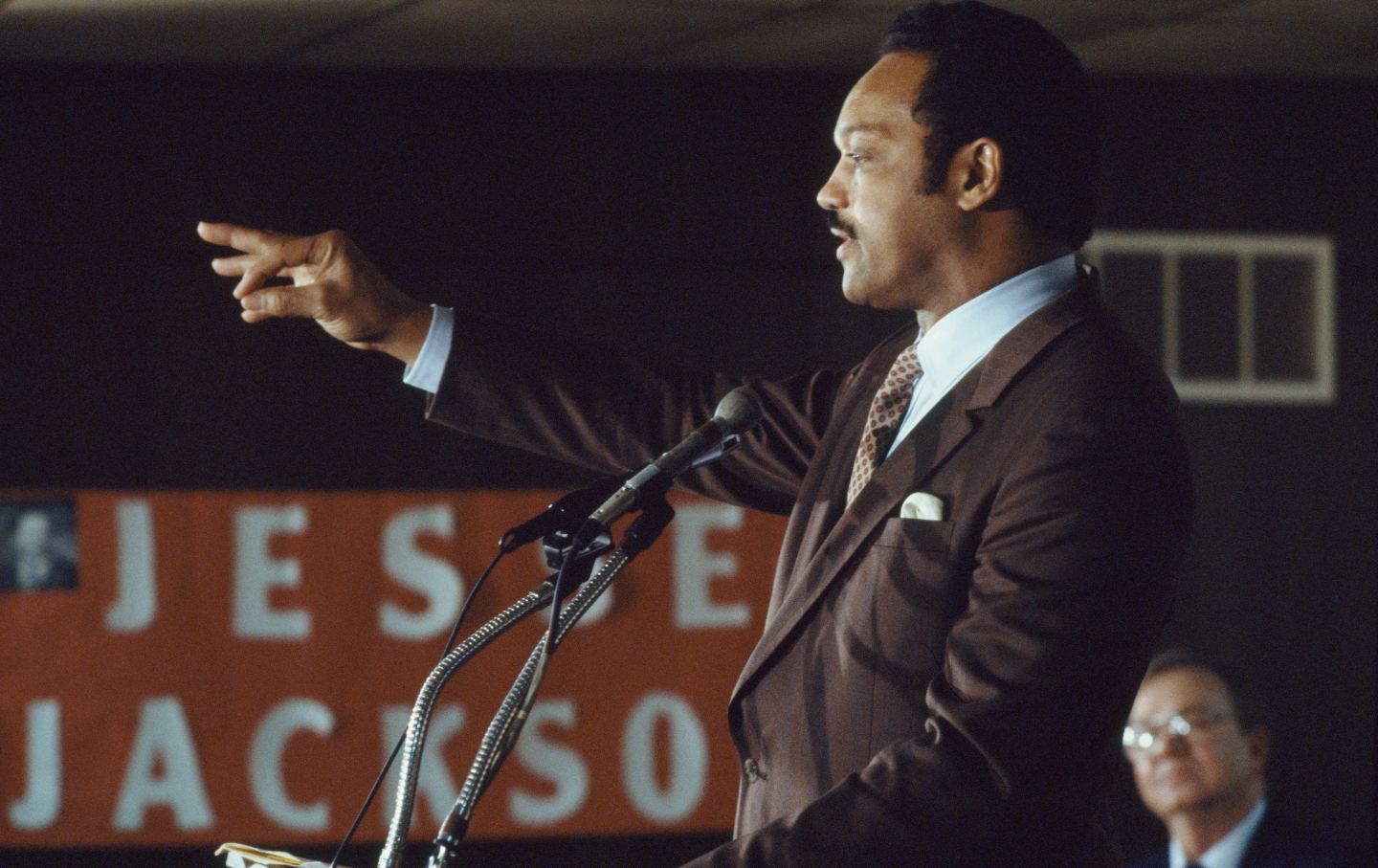
Reverend Jesse Jackson addresses supporters in the lead-up to the 1988 Iowa Democratic Presidential Caucuses, on February 1, 1988.
Reverend Jesse Jackson addresses supporters in the lead-up to the 1988 Iowa Democratic Presidential Caucuses, on February 1, 1988. (Jean-Louis Atlan / Sygma via Getty Images)

In 2000, I got to spend some intense hours with Jesse Jackson, when he and his son Jesse Jackson Jr., then in Congress, collaborated with me on a book about capital punishment. Commitments across the country kept the elder Jackson constantly on the road, so I would grab writing time with him in hotel rooms, airport lounges, breakfast joints.

It was the Bush-Gore presidential election year, and virtually every time I arrived Jesse was working the phone. I got to overhear a strikingly different style of persuasion from that of the stentorian public orator I’d intermittently covered. Jesse’s off-camera political voice was generally forbearing: quietly connecting, humorously cajoling, deal-making with the artful rhythm and grace of a choreographer. Jesse held in his head a map of the nationwide grassroots Democratic Party: Which clergy could turn out the church buses in East St. Louis? Which banker could arrange a campaign donation in Des Moines? Which union local could swing Maryland? Jesse knew all the players, knew the tone and the particular words that would stir each one to action. He was the great Democratic national chairman we never had.

Following Kamala Harris’s loss to Donald Trump, I thought often of Jesse’s relentlessly human-scale, ward-level organizing—especially when I looked at the 2024 election results in my own city of New Haven and realized just how dramatically Democratic turnout had fallen since 2020: another election lost, in the words of Jesse’s 1984 Democratic Convention speech, “by the margin of our despair.” Our present catastrophe is the sum total of tactics embraced by two generations of liberal campaign technocrats, their eyes on deep-pocket contributors and computer modeling, who willfully ignored the lessons of Jackson’s transformational and inclusive cross-class, cross-racial tree-shaking.

Jesse’s major-media obituaries make dutiful note of the complications and contradictions of his career. (The best assessment of much of the press coverage of his death can be found in Jesse’s own 1984 SNL opening monologue. Look it up.) But I’ve been thinking of the issues on which Jackson simply kept on keeping on, unshaken by shifts of political winds. One of them was capital punishment. By 2000, the Clinton administration had expanded the federal death penalty. Racially coded mandatory minimum sentences were adopted nationwide; criminal justice reform was dismissed, and soon September 11 would drive forward a new national race to the bottom in human rights. No politician had anything to gain then (or ever) from writing a book arguing for death-penalty abolition—let alone anything remotely like Jackson’s career-long investment of thousands of hours intervening for individual death-row prisoners in the US and overseas.

Jesse could read a room with extraordinary acuity. Like Babe Ruth pointing to the bleachers before hitting a home run, he would pick out which politician at a breakfast or rally was about to approach him for an autograph or a favor, and in my experience always called it right. But over those few months of our collaboration, I saw another side too: how on some days, just how hard it could be to be Jesse Jackson. He’d sometimes wake depleted, facing yet another 20-hour day, nerves abraded, circles under his eyes. His aides would coax him back into his suit and tie. But then he would step into the hotel hallway and instantly resume the job of being Jesse Jackson. He’d perfected this skill at instant transformation for the benefit of the chambermaid or porter who—every day, no matter where he was staying—would almost immediately approach him to share a moment of grace: a word or a touch or blessing from the man who had urged them to say aloud, “I am somebody.”

Support independent journalism that does not fall in line

Even before February 28, the reasons for Donald Trump’s imploding approval rating were abundantly clear: untrammeled corruption and personal enrichment to the tune of billions of dollars during an affordability crisis, a foreign policy guided only by his own derelict sense of morality, and the deployment of a murderous campaign of occupation, detention, and deportation on American streets. 

Now an undeclared, unauthorized, unpopular, and unconstitutional war of aggression against Iran has spread like wildfire through the region and into Europe. A new “forever war”—with an ever-increasing likelihood of American troops on the ground—may very well be upon us.  

As we’ve seen over and over, this administration uses lies, misdirection, and attempts to flood the zone to justify its abuses of power at home and abroad. Just as Trump, Marco Rubio, and Pete Hegseth offer erratic and contradictory rationales for the attacks on Iran, the administration is also spreading the lie that the upcoming midterm elections are under threat from noncitizens on voter rolls. When these lies go unchecked, they become the basis for further authoritarian encroachment and war. 

In these dark times, independent journalism is uniquely able to uncover the falsehoods that threaten our republic—and civilians around the world—and shine a bright light on the truth. 

The Nation’s experienced team of writers, editors, and fact-checkers understands the scale of what we’re up against and the urgency with which we have to act. That’s why we’re publishing critical reporting and analysis of the war on Iran, ICE violence at home, new forms of voter suppression emerging in the courts, and much more. 

But this journalism is possible only with your support.

This March, The Nation needs to raise $50,000 to ensure that we have the resources for reporting and analysis that sets the record straight and empowers people of conscience to organize. Will you donate today?

Bruce Shapiro

Bruce Shapiro, a contributing editor to The Nation, is the executive director of the Global Center for Journalism and Trauma.

More from The Nation

Representative Alexandria Ocasio-Cortez articulates her vision of an anti authoritarian

Trump’s War in Iran Opens a Foreign Policy Debate Democrats Can No Longer Avoid Trump’s War in Iran Opens a Foreign Policy Debate Democrats Can No Longer Avoid

The war is forcing Democrats to confront a question they have long deferred: whether the party can offer a coherent anti-war alternative to Washington’s foreign policy consensus.

Blaise Malley

Disastrous Tides of Fortune

Disastrous Tides of Fortune Disastrous Tides of Fortune

The consequences of US actions on other nations.

OppArt / Peter Kuper

Should Alexandria Ocasio-Cortez Run for President in 2028?

Should Alexandria Ocasio-Cortez Run for President in 2028? Should Alexandria Ocasio-Cortez Run for President in 2028?

David Faris argues that the New York representative is the new national leader the Democrats need, but Daraka Larimore-Hall claims she can get more done in Congress.

The Debate / David Faris and Daraka Larimore-Hall

Anti-AIPAC protesters in Farmington Hills, Michigan, on November 10, 2025.

Is AIPAC Doomed? Is AIPAC Doomed?

The hard-line pro-Israel lobby is facing more opposition than ever before. But fully defanging it won’t be easy.

Column / Jeet Heer

New York Police Commissioner Jessica Tisch briefs the press on the attack outside of Gracie Mansion as Mayor Zohran Mamdani looks on.

A Trial by Fire for Tisch and Mamdani, New York’s Premier Odd Couple A Trial by Fire for Tisch and Mamdani, New York’s Premier Odd Couple

How this weekend’s failed attack outside Gracie Mansion could reinforce the strange-bedfellows alliance between the mayor and the police commissioner.

D.D. Guttenplan

Anthropic CEO Dario Amodei, chief product officer Mike Krieger and head of communications Sasha de Marigny give a press conference on May 22, 2025.

Anthropic’s Lawsuit Should Absolutely Destroy the Pentagon in Court Anthropic’s Lawsuit Should Absolutely Destroy the Pentagon in Court

But make no mistake: The company is not one of the good guys.

Elie Mystal