
Cuba Hunkers Down as a US Oil Blockade Brings a Humanitarian Crisis
Fear but no panic on the streets.
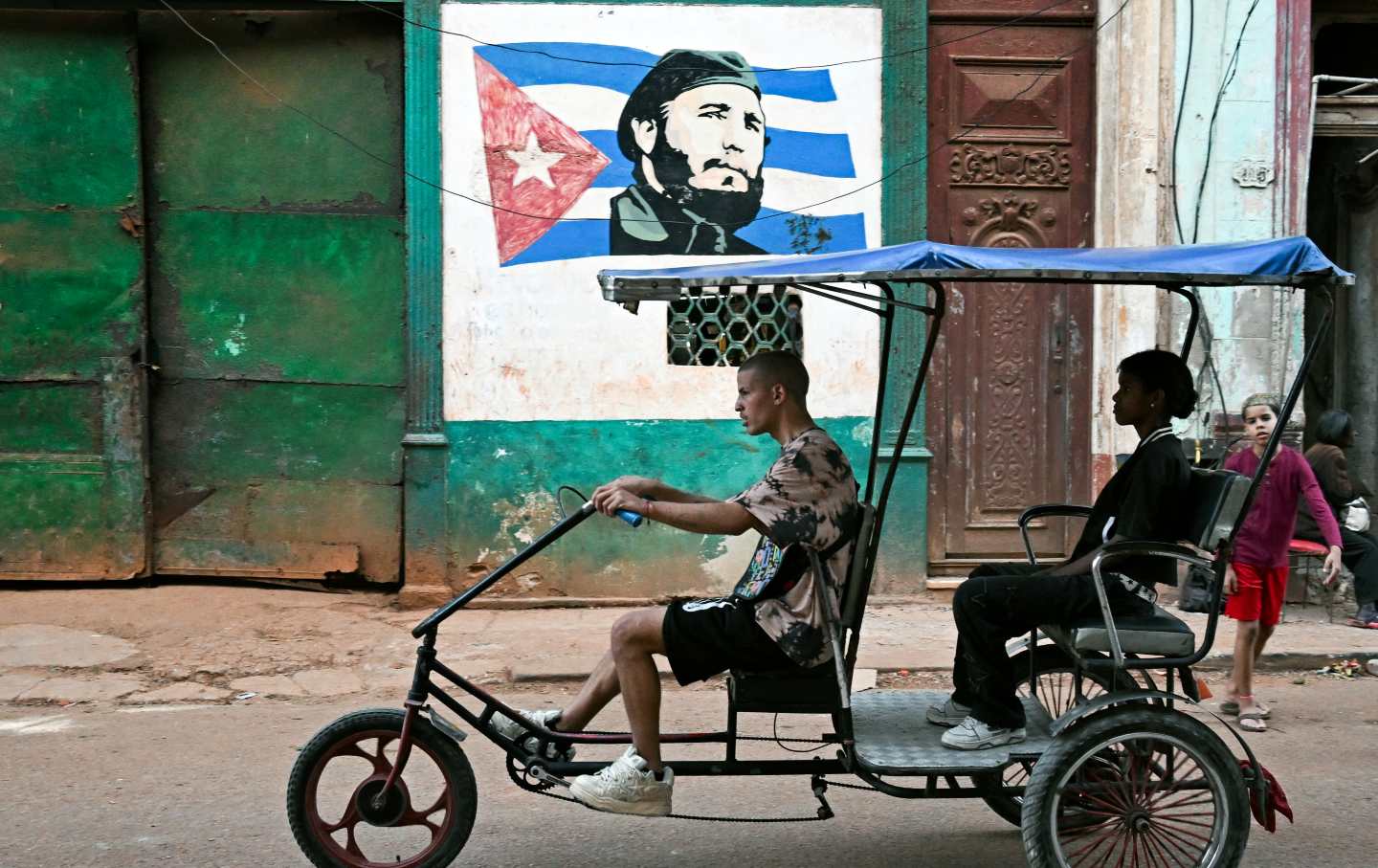
The Cuban government has drastically cut energy and fuel consumption and is downsizing and decentralizing most activity to the local level, where people can walk and use non-fossil-fuel-driven transportation, as the Trump administration blocks oil from reaching the import-dependent country, sparking concerns of a pending humanitarian crisis.
Early last month, the United States cut off all oil and money going to Cuba from Venezuela, the Caribbean island’s most important economic partner, and a few weeks ago threatened to slap tariffs on any country exporting oil to Cuba, a threat aimed mainly at Mexico, its second-most-important oil provider.
Last year, Cuba survived on an estimated 100,000 barrels of oil and derivatives per day, 65 percent of what the country needs to stabilize the economy, which is down 16 percent since 2019. Around 40 percent of the oil and gas equivalent was produced at home, a poor-quality oil used mainly in thermoelectric plants. Venezuela exported 30 percent to the island, 20 percent came from Mexico, and the rest from Russia and the spot market.
Cuban oil cannot be refined, so the country needs to import oil and derivatives for diesel and gasoline or most everything will simply stop.
“There is a lot of fear, and there is a lot of psychological impact on ship owners, shipping companies, and countries that can supply us with fuel,” President Miguel Díaz-Canel said during a press conference earlier this month as he announced almost no fuel had arrived this year and outlined a series of emergency measures.
At an open-air farmers market in Havana, vendor after vendor said they had no idea how business could continue for much longer and food reach the capital of 1.5 million people. They said there were fewer stalls open every day.
“I have worked here for more than 20 years, and this is the worst situation I have faced. It is worse even than the pandemic when we could not open, because then there was fuel,” María Fernández said as the market came to life the other morning and she arranged vegetables and fruit on her stand, one of around 50 also offering some meat and spices.
“Now there is no diesel fuel for the trucks that bring the merchandise from outside the city and other provinces. They are using what they had stored up,” María said as she placed cucumbers, bell peppers, and tomatoes in neat rows.
“The providers, who are mainly from other provinces, will not have fuel, and if it happens to appear it will be very expensive, raising prices. There is produce out there; the problem is how to move it here,” she said, arms now crossed and shaking her head.
UN Secretary General António Guterres and a number of governments and human rights agencies have warned of a humanitarian crisis if oil does not get through.
“The secretary general is extremely concerned about the humanitarian situation in Cuba,” Guterres’s spokesperson, Stéphane Dujarric, told the press.
Fear but No Panic on the Streets
Prices are soaring, power outages are increasing, and gas lines are growing. Public and private transportation are disappearing. Produce at markets is dwindling, and all but emergency surgeries have been canceled. The fear that the quality of life will quickly deteriorate is palpable.
The population was already struggling with the pernicious results of the sanctions put in place in Trump’s first term to gut foreign-currency revenues needed to purchase abroad most of the food, fuel, and inputs for agriculture and manufacture Cuba consumes. That came on top of the consequences of the pandemic and the longest and broadest US sanctions regime in history. Blackouts, deteriorating social services and infrastructure, runaway inflation, and shortages of food, medicine, fuel, and other basic goods and services are nothing new here. But now the Trump administration believes the moment has arrived for a final push to bring the rebellious land back into the imperial fold, no matter the human cost.
“Recent years have been very hard in every way. Everything is scarce and very expensive, and I have no family abroad to help,” Lucía Izquierda, a 40-year-old single mother of two daughters, one 17 and the other 6, said.
Experts estimate that at least 40 percent of the population is in a similar situation, and a much higher percentage receives just a little help from family and friends abroad.
Lucía, a former biology teacher who turned part-time house cleaner, said blackouts were getting longer and disrupting her life “They are still not as bad as in Ciego de Ávila, where my aunt lives,” she said. “They used to have four or five hours of electricity per day, but now it’s like an hour. My aunt’s community has water problems too and relies on tanker trucks sent by the government. They are thinking of using donkeys to bring water in.”
Lucía’s older child’s high school has cut afternoon classes “because there is no more transportation to bring food to the cafeteria.”
Like everyone these days, she fears the future.
“Everything is going to get worse, especially the food and health services. My little girl has asthma. There is no medicine. I had to go to the hospital to get help.”
Díaz-Canel charged that the “energy blockade” was designed to make life unbearable. What does it mean to block and not allow a drop of fuel to reach a country?” he asked.
The Cuban president called for calm, unity, and discipline. “I am not an idealist. I know we are going to face difficult times. We have done it before, but we will overcome them together.”
Emergency Measures
The government has announced that power generation will depend on a number of factors, including local oil and gas production, a Chinese-backed alternative energy program that added nearly 1000 megawatts in solar power last year, and efforts to import oil which the president said is Cuba’s sovereign right. Scarce fuel will go to keep essential services running and to priority economic sectors such as agriculture and exports. Diesel fuel was taken off the market and gasoline went on sale only for dollars through an online reservation platform with a maximum purchase of 20 liters (around five gallons) a turn.
Fuel-saving measures that impact all residents include reducing the work week at thousands of offices, workplaces and education and health facilities and sending employees to jobs near their homes when possible. Already scarce national and provincial rail and bus transportation was cut 50 percent and some factories and hotels temporarily closed. Except for primary schools, family doctor offices, and community clinics, education and public health at the provincial and national levels are being reorganized and downsized toward the municipalities and Internet-based learning and service.
While reforms have led to a less centralized and more diverse economy in the Communist led country, key sectors such as fuel imports and distribution are managed mainly from the top down by the state. Much less fuel is being allocated to the provinces and municipalities which were tasked with coming up with alternatives. Municipalities have reported baking bread and cooking stew outside using coal and firewood and using animal traction for everything from garbage collection to plowing fields and moving people about.
Private taxi driver Alberto Gonzalez said he felt “pretty bad because this has hit me twice.” At 65 he has been waiting 18 months for a hip replacement as his old prothesis is causing pain and could lead to a blood clot that kills him. He has bought the prothesis and other items he needs for the operation in hopes of skipping a waiting list of more than 5,000 people. Alberto said he finally was scheduled to go to the Frank País Orthopedic Hospital on February 10 for the operation.
“The hospital notified me after the cuts were announced that they were no longer operating until further notice,” he said. “The other problem is that I can’t work if there is no gas.”
Alberto went on to say that, while the government had frozen peso sales of gas, the rationing for dollars had yet to begin and besides, it was not nearly enough.
Popular
“swipe left below to view more authors”Swipe →“I registered the first day at my assigned gas station and I am around number 2000 on the waiting list for my 20 liters (five gallons). I drive by every day, and they still are not open. Gas on the black market is scarce and costs the equivalent of four or five dollars a liter compared with around $1.50 last week.”
Alberto ended our conversation with yet another woe. “The fuel situation is a problem not only for work but the family,” he said.
The taxi driver has a cousin who lives in westernmost Pinar de Rio province and who just arrived for cancer treatment at the national cancer institute. “Every day, for four weeks, Monday through Friday, he needs to go to the cancer hospital for treatment. During the pandemic they guaranteed a taxi for people in this situation, but this time they are not,” he said.
More from The Nation
Israel’s Extremist Election Israel’s Extremist Election
The run-up to the vote on Tuesday is exposing the façade of Israeli democracy—and the fealty of the country's so-called opposition when it comes to matters of Jewish supremacy.

“NAZA” and Israel’s History of Automated Warfare “NAZA” and Israel’s History of Automated Warfare
As violent technologies like spyware, predictive targeting algorithms, and 2,000-pound warheads become ordinary instruments of military rule, once-abhorred practices become routin...
Brazil’s Workers’ Party Is Not Stopping Brazil’s Workers’ Party Is Not Stopping
With just a few days remaining before the runoff election, supporters of Lula’s party are doing everything possible to rally support behind the president.

Brazil’s Decision Brazil’s Decision
The moral compass and basic humanity of political leaders really does matter.
Albanian Student Strikes Spur a Political Crisis Albanian Student Strikes Spur a Political Crisis
A new round of protests against the ruling party’s corruption has Prime Minister Edi Rama giving cops bonuses to crack down on dissent.

