
Yale’s President Has Become a Shameful Collaborator With Trump
Maurie McInnis has the power to stand up to the administration. Instead, she’s caving.
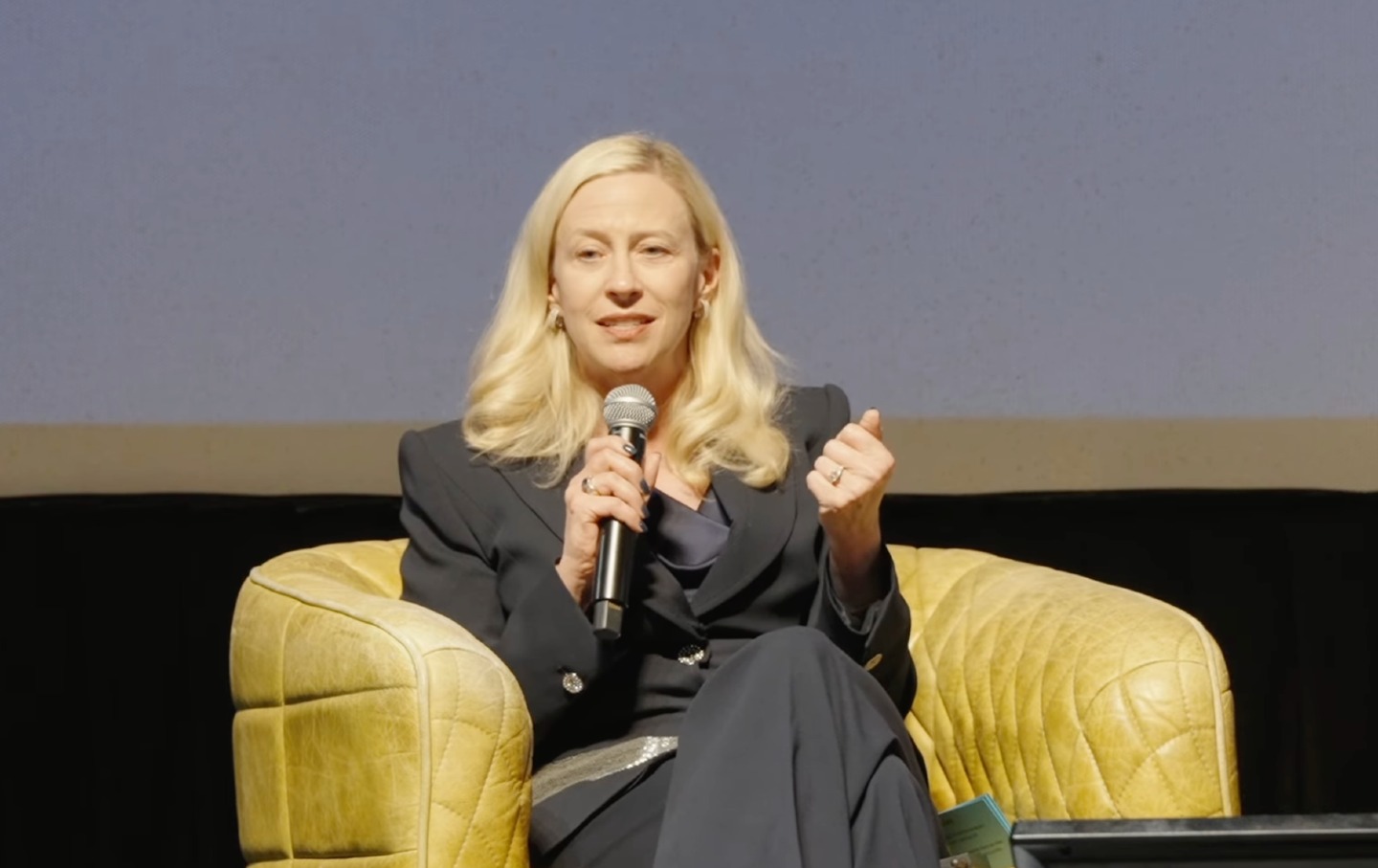
Yale University president Maurie McInnis speaking at the Gibbes Museum of Art in Charleston, South Carolina, on November 10, 2025.
(YouTube)
My grandfather was a renowned scholar. Born in Korea toward the beginning of the 20th century, he studied English literature and was considered one of the premier intellectuals of his generation.
Japan had colonized the Korean Peninsula very early in my grandfather’s life, and the governing Japanese systematically denigrated Koreans. But despite this institutionalized racism, my grandfather became the first Korean hired to teach at his alma mater, the Japanese Imperial University in Seoul.
Japan’s treatment of Koreans worsened during World War II. My grandfather, brilliant as he was, was not spared. His entire career to that point had required constant accommodation to the Japanese, but as the war intensified, the pressures upon my grandfather increased, and he became overtly collaborative with the regime. I think he knew the Japanese Empire was expansionist, violent, and racist. But he also believed it could not be defeated. He concluded that the welfare not only of his family, but of the Korean people, depended upon submission. So he willingly propagandized on behalf of the empire’s war efforts, lending his stature to the whitewashing of their authoritarianism.
After Japan’s defeat and Korea’s liberation, my grandfather was branded a traitor to his nation. That he had behaved, in his view, pragmatically, and collaborated for the sake of his family and his country, did nothing to rehabilitate him in the eyes of the people he had hoped to assist. His reputation was ruined forever; to this day, his name remains stained in Korea.
His eldest son, my father, emigrated to the United States. In 1969, the year I was born, he read in the newspaper that Yale University was admitting women undergraduates for the first time. “My daughter will go there,” he declared, as he later often liked to relate. He envisioned me traveling as far as possible from authoritarianism, and crowning his American dream.
In fact, I did go to Yale, and I did believe, quite sincerely, in its particularly potent manifestation of the American dream. That is, until recently.
Why am I revisiting this ancient family history now? Because over the past 18 months, as the Trump administration has waged war against American higher education, I have come to recognize many present-day collaborators in the same mold as my grandfather. Chief among them, for me, is Yale president Maurie McInnis.
Throughout 2025, as the Trump administration attacked many of Yale’s peer institutions, McInnis did not use her powerful position to stand up for them but kept her head down, perhaps reasoning she could keep Yale out of Trump’s crosshairs. It didn’t work.
Earlier this summer, faced with a highly questionable Department of Justice campaign against Yale itself—which insinuated that the presence of Black and brown students at the Yale School of Medicine must mean that the university has violated the Supreme Court’s ban on affirmative action in college admissions—President McInnis had a chance to proudly defend her institution. Instead, as The New York Times reported, she opened secret settlement negotiations with the Trump administration. These talks are apparently ongoing.
Then, on August 3, Trump Department of Education Secretary Linda McMahon, previously known for her leadership of World Wrestling Entertainment, issued a “Call to Action” to all American university presidents, demanding detailed reform plans to address a slew of flimsy, ideologically charged accusations. It was an obvious act of bad-faith political theater. Yet Yale’s president seemed eager to don her assigned costume and take to the stage.
The day after McMahon’s letter went out, McInnis sent her own letter to the Yale community of students, professors, staff, and alumni, inviting us to help her “describe the work we do on campus,” as if the “Call to Action” were a sincere effort to discover what mysterious activities might be happening at Yale, one of the most prominent universities in the world.
With these responses to the Trump administration, President McInnis has actively normalized what is not normal. She has actively given credence to what is incredible. This is the very essence of collaboration.
Popular
“swipe left below to view more authors”Swipe →As much as McInnis reminds me of my grandfather, she is also strikingly different from him. He was the sole Korean professor at a Japanese university; she is the president of her university. The Japanese Empire under which my grandfather lived dominated its region for decades with brutal efficiency; the federal government under which McInnis and the rest of us live has sown chaos and disorder for a mere 18 months, and sustained repeated rebukes from the courts, notably in cases involving Yale’s peer institutions that have chosen to fight Trump’s overreach rather than settle.
Despite being widely vilified after the fact, my grandfather was not unique. Though he was imprisoned after Korean liberation, he was soon released because there were so many collaborators like him in so many realms of society. President McInnis, on the other hand, is surrounded by powerful peers who are urging her to resist, from the scholars of her own world-renowned law school to the elected officials of her own state of Connecticut. Yet McInnis persists in her collaborative actions. Whether this is out of fear, or misguided pragmatism, or for some other reason, I have no way of knowing. Whatever her motives, her actions are wrong. They are not merely tactically weak and doomed to fail, but deeply destructive.
My grandfather’s collaboration was ruinous to himself and his family. President McInnis’s, if it continues, will be ruinous not merely to her reputation but to the university she leads, to the entire landscape of American higher education, and to our democracy.
This, however, is not the most important difference between President McInnis and my grandfather. The most important difference is that his actions are in the past and can’t be changed. Hers are unfolding now, and could change at any moment. It is not just possible for her to change course. It is critical—not just for Yale or for colleges and universities but for all of us who value the sorts of democratic principles, like freedom of inquiry and freedom of expression, that the Trump administration is rapidly taking away from our schools.
All of us must fight for these freedoms, but some of us are better positioned than others. President McInnis, who leads one of the most respected and resourced educational institutions in the world, is one such well-positioned fighter. Her collaboration is not just needless but incomprehensible and unacceptable. Why not instead be a heroic fighter for democracy? The choice seems clear to me.
Become a Sustaining Donor This September
Between the reemergence of right-wing red-baiting and Donald Trump’s use of the chilling National Security Presidential Memorandum–7 to criminalize left political organizing, we’re seeing McCarthyism reborn before our eyes.
This assault on democracy cannot be ignored or wished away. Resisting it requires bravery in the face of threats and repression, a steadfast commitment to the truth, and the unwavering belief that we can—and will—overcome this darkness.
We must have an independent media that sets the record straight, unearths corruption and abuses of power, and advances a politics of justice and dignity for all if we’re to win this fight.
That’s why I’m writing to you today. This September, The Nation needs to add 100 monthly donors to sustain our progressive journalism. Your contribution makes the next investigative report, the next truth-speaking column, and the next pathbreaking essay all possible.
I hope you’ll support our work with a recurring donation today. If you donate $10 or more a month, we’ll send you a brand new “Hands Off the Free Press!” sticker to recognise your commitment to our cause. Please, donate today.
Onward,
Katrina vanden Heuvel
Editor and Publisher, The Nation
More from The Nation
The Fissures and Fractures Behind the Right’s Pink Facade The Fissures and Fractures Behind the Right’s Pink Facade
After Roe was overturned, some young women are turning more hard-line on abortion—but others are fleeing conservatism altogether.

Notes From Evictionland Notes From Evictionland
Eviction is practically baked into the way Britain manages its tenanted homes. Here’s how it played out—over and over again—for my parents.

How 9/11 Became a Joke How 9/11 Became a Joke
The 25-year journey from national tragedy to national punchline.
We Can’t Let the Kaepernick Era Be Erased From History We Can’t Let the Kaepernick Era Be Erased From History
Critics say the Black Lives Matter movement in sports went too far. In reality, it didn’t go far enough, and the backlash to it has been brutal.

Letters From the October 2026 Issue Letters From the October 2026 Issue
The long shadow of AIPAC… The AI revolution will not be televised… Speaking of taxes… Reporting on abortion… (online only)
We Are Living Under Roy Cohnian Logic We Are Living Under Roy Cohnian Logic
The political fixer created a career for himself as a self-promoting, ubiquitous hustler. Like Trump, he got away with it by having the right friends.

