
Trump Is Laying the Groundwork for the Mass Deportation of Migrant Children
Unaccompanied children have become a new front in Trump’s mass deportation agenda.
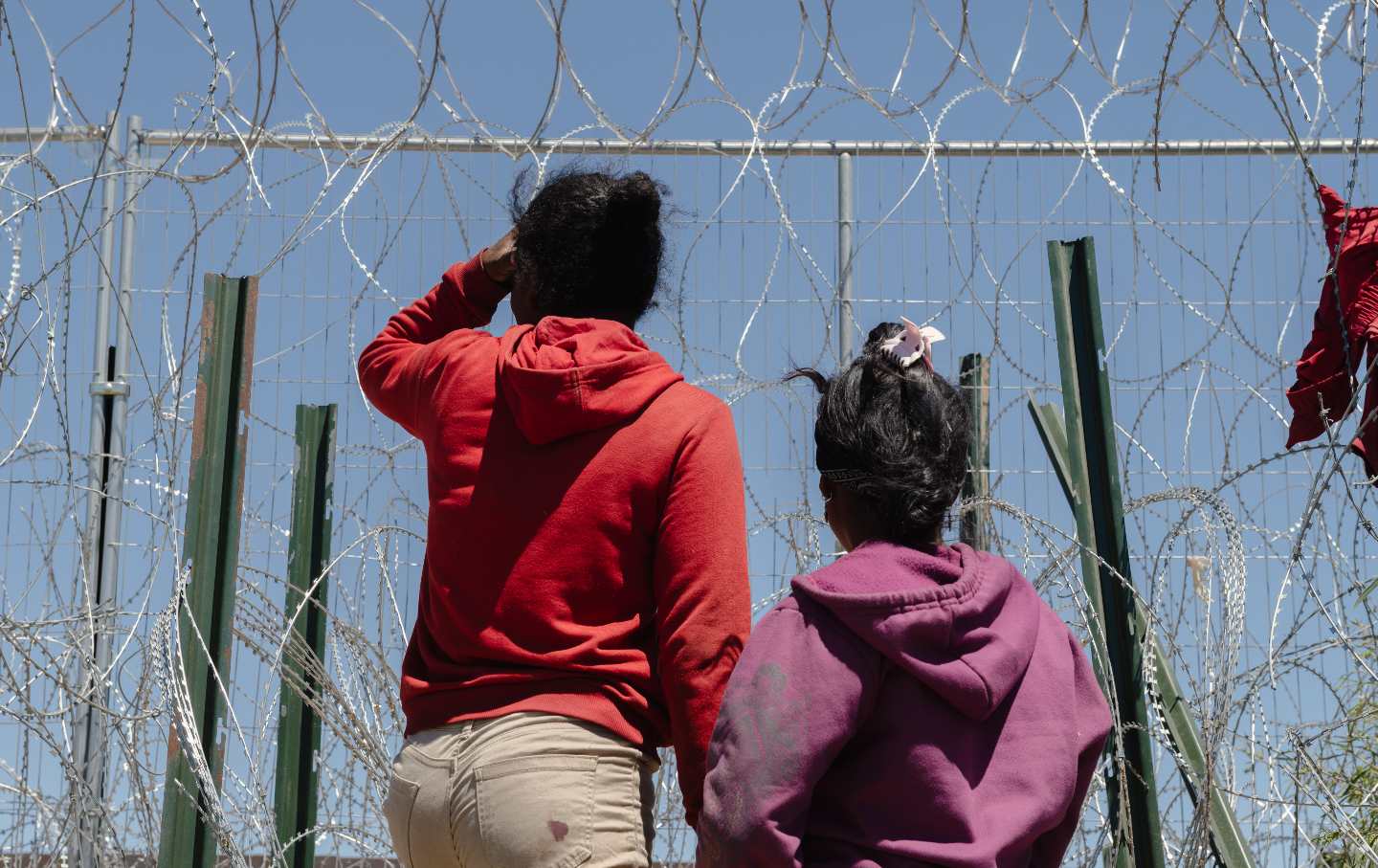
Children look through razor wire after crossing the US-Mexico border.
(Justin Hamel / Getty)This story was published in collaboration with the Investigative Reporting Lab at Yale.
In her decade of experience working with unaccompanied migrant children in Texas, attorney Alexa Sendukas has represented over a hundred children and youth. For years, Sendukas’s work at the Galveston-Houston Immigrant Representation Project (GHIRP) had been supported by federal funding meant to ensure that children do not go defenseless in immigration court. But on July 31, the contract governing that work expired.
GHIRP, which currently represents around 500 young clients, is now staring down a situation Sendukas could never have previously imagined: the possibility of withdrawing from hundreds of cases.
The long-standing contract had funded a network of nearly 100 organizations and hundreds of attorneys providing legal aid to more than 20,000 unaccompanied migrant children across the country. In its place, the Trump administration has struck a $20 million agreement with the nonprofit US Committee for Refugees and Immigrants and a $158 million contract with Our Rescue, an organization founded by an ex-ICE agent accused of sexual exploitation and sex trafficking. On its website, Our Rescue touts its collaboration with law enforcement—but the organization does not appear to have experience providing immigrant legal services.
In the past weeks, some organizations have shut down their legal aid programs for unaccompanied children entirely. Others are preparing to lay off staff and are making difficult decisions about which young clients they can continue representing and which cases they will have to discontinue. Meanwhile, in Central America, one major nonprofit providing social services to returning migrant children told me they are bracing themselves for an influx of deported children they may not have capacity to serve.
This gutting of expert legal assistance for migrant children comes as immigration enforcement increasingly targets children and families, and the federal government fast-tracks court hearings for children across the country.
“It’s very clear that this is a comprehensive targeting of children to accelerate their deportation,” Sendukas said.
The result is a deluge of legal proceedings for migrant children with fewer lawyers than ever to represent them. GHIRP has some 70 asylum interviews scheduled for the next six weeks; last Monday, Sendukas was scheduled for five simultaneous interviews. Some young clients have been working with Sendukas for years. GHIRP’s youngest client is 4 years old.
Texas is a national epicenter for immigration enforcement, and in Houston, local law enforcement collaborates extensively with ICE. Nearly every day, new children continue to arrive to shelters for unaccompanied children within the state, Sendukas says.
Sendukas’s work representing these young people is no longer funded, but if she doesn’t show up for her clients, she asks, who will?
The administration has been trying to make it harder for unaccompanied migrant children to access legal representation since February of last year, when it issued and then quickly rescinded a stop work order for legal services funded through the unaccompanied children contract. The Trump administration’s attempt to prematurely terminate the contract a month later was blocked in federal court.
Yet, while the contract had continued until July 31, the Trump administration stopped paying around December 2025, putting organizations like GHIRP under financial pressure. Earlier this month, a federal court ordered Trump to release those unpaid funds—an amount advocates say totaled $65 million.
Acacia Center for Justice, the prime contract holder on the original agreement that funded organizations like GHIRP, has said that negotiations over a new contract failed because the Trump administration demanded that it share confidential client information that could be used to accelerate deportations.
In a statement to The Nation, the press secretary for the Department of Health and Human Services wrote that the Office of Refugee Resettlement (ORR), the agency responsible for unaccompanied children, “remains fully compliant with its legal and regulatory obligations.”
The US’s celebrated right to counsel does not exist in immigration court. According to the Vera Institute of Justice, of the more than 630,000 people ordered removed in immigration courts over the past year, more than two-thirds had no lawyer representing them.
However, a 2008 federal anti-trafficking law requires the federal government to provide legal counsel to unaccompanied migrant children “to the greatest extent practicable.”
The Trump administration is now dismantling a network of expert legal organizations across the country, built up over the past two decades, that provides know-your-rights presentations to unaccompanied children in government custody, helps children file asylum claims, and represents young clients in immigration court.
In a Thursday court filing, a group of non-profits funded under the previous contract, including GHIRP, called for an evidentiary hearing to examine the Department of Health and Human Services’s failure to provide legal services. The filing detailed examples of children–including a seven-year-old in Los Angeles, a child in Texas, and a one-year-old baby in Arizona–who appeared in court without an attorney, and in some cases waived their rights to seek relief from removal.
In the days after the contract expired, Ana Devereaux, a staff attorney at the Michigan Immigrant Rights Center, sorted through the organization’s 950 ongoing cases to determine which unaccompanied children they could continue to represent. MIRC is currently expecting to withdraw from 520 of those cases.
Without federal funding, MIRC is planning to lay off the entire 70-person team working on unaccompanied children’s cases by October. MIRC is in a better financial situation than many peer legal providers across the country: It has managed to source funding from the state of Michigan, private foundations, and individual donors to keep representing children in as many cases as possible. But this supplementary funding won’t be nearly enough to cover the full range of services previously funded by the federal government.
Alexandra Manrique Alfonso, the director of the Children’s Legal Program at the Miami-based legal nonprofit Americans for Immigrant Justice (AI Justice), said the organization was similarly evaluating its 300-some cases to determine whom they could continue to represent. Attorneys may look at a child’s age, the status of their case, and their risk of removal when making these evaluations—but such decisions are very difficult, Manrique Alfonso said.
“Every minor deserves representation,” Manrique Alfonso said. “We are trying to see who is the most vulnerable out of the most vulnerable set.”
GHIRP, MIRC, and AI Justice have also been facing a slew of asylum hearings, suddenly scheduled just as the organizations are attempting to downsize operations. MIRC has received around 21 asylum interview notices in the last four weeks—more than they had received in the entire previous year. This uptick in caseload aligns with Trump’s attempts to accelerate the deportation process. For instance, in late July, the administration instituted a new that allows asylum officers to determine an applicant’s asylum eligibility without interviewing them.
The term “unaccompanied alien children” has traditionally referred to children who cross the US-Mexico border alone. But over the past year, new arrivals in ORR custody are increasingly children and teens living in the US who are apprehended by internal immigration enforcement, advocates say. Such children may not really be “unaccompanied” at all. A child or teen who is living with their family in the US may be stopped by immigration enforcement while alone and thus processed as unaccompanied.
According to Devereaux, immigration enforcement in Michigan has appeared to target parents who come forward to reunite with children in ORR-run shelters. In one case Devereaux described, a father was detained during a fingerprint appointment to be reunited with his teenage son. The father was deported, and his son is now in long-term foster care.
Similar tactics have been reported in Texas, where attorneys say children are being used as “bait” to arrest and detain family members. In July, Reuters reported that over 12,000 people had been arrested by immigration enforcement using leads that ORR had shared with ICE about unaccompanied children and sponsors.
Such stories reveal how unaccompanied children have become a central target in the Trump administration’s mass deportation campaign. Deportations of unaccompanied minors have tripled compared to Trump’s first term, ProPublica has reported.
“The mass deportation agenda is driving an unprecedented level of family separation, and not just because parents are deported,” said Becky Wolozin, a senior attorney at the National Center for Youth Law. “Children are being taken into custody without their families; parents and caregivers are threatened with deportation if they attempt to reunite with their children.”
Popular
“swipe left below to view more authors”Swipe →While such separation tactics are less visible than the infamous family separation policy of Trump’s first term, they are “incredibly harmful,” Wolozin said.
Over the past year, the number of days unaccompanied children spend in ORR custody has skyrocketed (in July, the average stay in ORR custody was 187 days). Because the government has defunded attorneys who visit shelters for legal rights presentations, children will lose key advocates who can monitor the conditions in these shelters, which have sometimes been sites of sexual harassment and abuse.
For the some 1,800 unaccompanied children currently in government custody, suddenly losing a trusted attorney may be traumatic, advocates warn. “Especially for kids in custody, they may trust their attorneys more than any of the other adults in their life,” Devereaux said. “Sometimes we have clients who are having mental health crises and the first person they call is their attorney.”
Amy Schaltegger Escoto is the director of reintegration programs at Kids in Need of Defense (KIND), which provides services to children returning to Guatemala and Honduras. According to Schaltegger Escoto, the number of children served by the program has doubled over the past year, even as funding remains flat.
Children returning from the US can be traumatized by their journeys, Schaltegger Escoto says. Restarting life in a new country—sometimes after living all or most of their lives in the US—can be immensely complex. In many cases, the children have lost some Spanish-speaking ability; children may also feel shame, failure, and stigma after they return to their country of origin.
In yet another move to lay the groundwork for possible mass deportations, Trump administration is ramping up construction for immigration facilities flagged specifically for unaccompanied children. A request for proposal posted by the Department of Health and Human Services in July invites contractors to bid on the construction of an “Emergency Intake Facility” to hold up to 3,000 unaccompanied children.
Advocates have raised alarm over this planned construction, pointing out that shelters for unaccompanied children are currently at around only 27 percent occupancy. According to Sendukas, who has visited similar large-scale emergency shelters to provide know-your-rights presentations, children in emergency intake facilities often face poor conditions and inadequate access to legal services.
In Alexandria, Louisiana, ICE plans to open a 528-bed facility for families, unaccompanied children, and women, next to an airport that has become the largest deportation hub in the nation. The facility will be built on a defunct Air Force base that has been found to have some of the highest levels of forever chemical contamination in the country.
ICE has described the facility as a 72-hour “staging area.” Yet investigations into a similar short-term facility operating in the same town shows that people are held well over the three-day limit, in unsafe conditions. The LaSalle Family Foundation, the nonprofit arm of a private prison corporation, is slated to run the new facility for family and children. In the past year, two people have died at a LaSalle-run ICE institution in a nearby town.
Tania Wolf, Southeast advocacy manager for the National Immigration Project, rejects the idea that the Alexandria ICE facility could serve as a humane and short-term holding spot for unaccompanied children. The goal, Wolf says, is to expand detention and deportation.
“Once you build it, they will fill it,” Wolf said. “And they are moving at break-neck speeds to open up these facilities.”
Become a Sustaining Donor This September
Between the reemergence of right-wing red-baiting and Donald Trump’s use of the chilling National Security Presidential Memorandum–7 to criminalize left political organizing, we’re seeing McCarthyism reborn before our eyes.
This assault on democracy cannot be ignored or wished away. Resisting it requires bravery in the face of threats and repression, a steadfast commitment to the truth, and the unwavering belief that we can—and will—overcome this darkness.
We must have an independent media that sets the record straight, unearths corruption and abuses of power, and advances a politics of justice and dignity for all if we’re to win this fight.
That’s why I’m writing to you today. This September, The Nation needs to add 100 monthly donors to sustain our progressive journalism. Your contribution makes the next investigative report, the next truth-speaking column, and the next pathbreaking essay all possible.
I hope you’ll support our work with a recurring donation today. If you donate $10 or more a month, we’ll send you a brand new “Hands Off the Free Press!” sticker to recognise your commitment to our cause. Please, donate today.
Onward,
Katrina vanden Heuvel
Editor and Publisher, The Nation
More from The Nation

How 9/11 Became a Joke How 9/11 Became a Joke
The 25-year journey from national tragedy to national punchline.

We Can’t Let the Kaepernick Era Be Erased From History We Can’t Let the Kaepernick Era Be Erased From History
Critics say the Black Lives Matter movement in sports went too far. In reality, it didn’t go far enough, and the backlash to it has been brutal.

The Bund and the Radical History of Jewish Anti-Zionism The Bund and the Radical History of Jewish Anti-Zionism
Molly Crabapple’s Here Where We Live Is Our Country revisits the past of the Jewish Labor Bund and considers what it might mean for our future.

The Making of the Millennial Working Class The Making of the Millennial Working Class
A new book follows a rising generation of labor organizers as they attempt to unionize their workplaces.

Can We Save Democracy? Can We Save Democracy?
Hélène Landemore’s case for an alternative system of popular government.

The Fissures and Fractures Behind the Right’s Pink Facade The Fissures and Fractures Behind the Right’s Pink Facade
After Roe was overturned, some young women are turning more hard-line on abortion—but others are fleeing conservatism altogether.

