
Can We Save Democracy?
Hélène Landemore’s case for an alternative system of popular government.
Can We Save Democracy?
Hélène Landemore’s case for an alternative system of popular government.
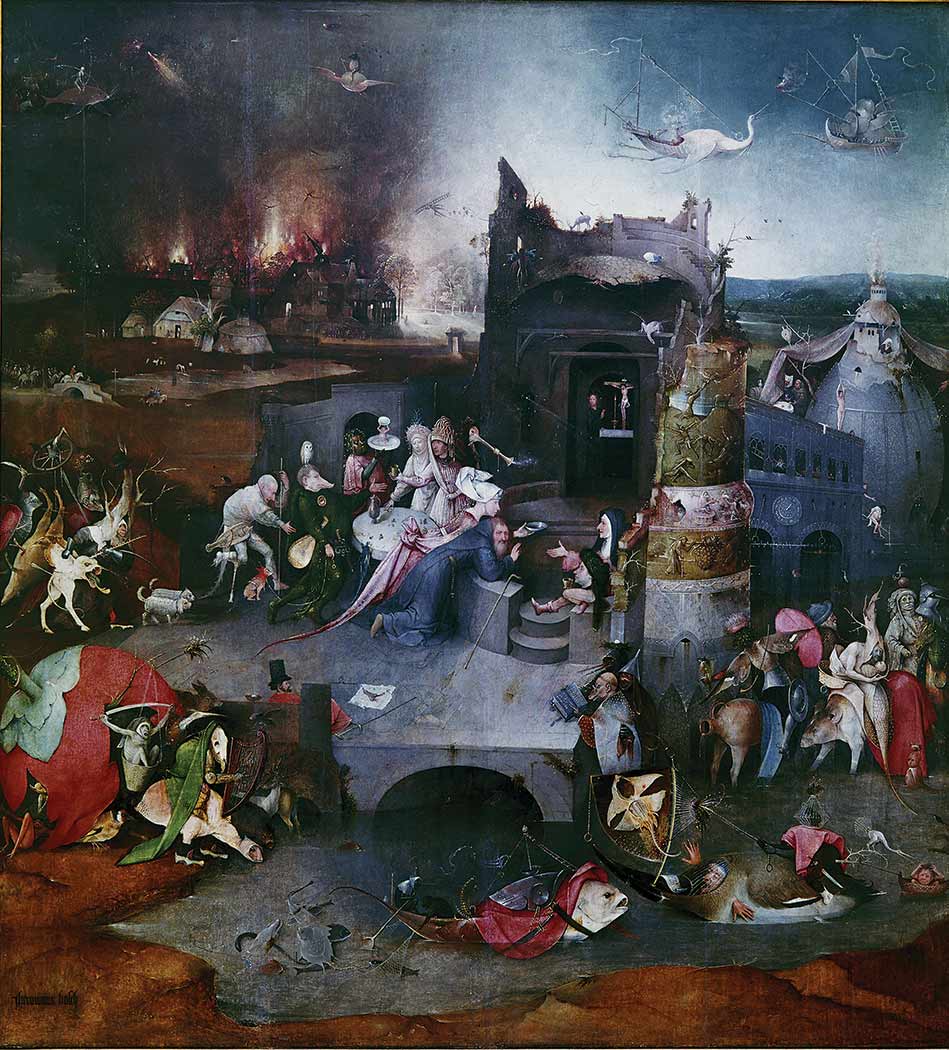
In 1965, The American Scholar published an essay on morality by Joan Didion. As a matter of substance, what she turned in was not compelling—at least not to those of us who believe, contra Didion, that it is possible to discern good and evil in the world with reference to principles that lie beyond “the social code” of the societies we happen to live in. But as a matter of craft, it proved to be a fine and memorable piece of writing. “At least some of the time,” Didion wrote, “the world appears to me as a painting by Hieronymus Bosch,” and in those instances, the dictates of her conscience directed her to a vantage point somewhere near Los Alamos, New Mexico, looking out at the mushroom clouds of atom-bomb tests, “praying,” as Norman Mailer’s character Marion Faye does in The Deer Park, “as if for rain… ‘let it come and clear the rot and the stench and the stink.’”
We cannot know for certain what Didion would have made of the current state of American politics. But the spirit of that passage is present in the kinds of cynical remarks one hears all the time now—for instance, the line that, with this administration’s having established that a long-suffering people may be unilaterally liberated by a well-targeted airstrike, we should hope that the United States is next in line for regime change. Because morality is real, we’re better off not indulging this kind of thinking. But what if we really could—peaceably—start afresh? What kinds of democratic institutions would we build, and what would we expect of them? Whether one believes that working our way to a full national reset is plausible or not, revisiting our democratic intuitions and aspirations—and what “democracy” is to begin with—can help us understand the present sources of our political dysfunction and inform the development of practical solutions for the future.
Over the course of the past decade, few people in the world of democratic theory have worked harder to challenge those intuitions than Yale University’s Hélène Landemore. Her latest work, Politics Without Politicians, is a précis of the arguments she has developed in a series of texts for academic presses and a variety of more public engagements, including a 2020 profile in The New Yorker that gives this book its name. “Landemore,” Nathan Heller wrote at the time, “has spent much of her career trying to understand the value and meaning of democracy. In recent years, she has been part of a group of academics, many of them young, trying to solve the problem of elected democratic representation—addressing flaws in a system that is widely believed to be no problem at all.”
The solution to the flaws of electoral representation that Landemore presents in Politics Without Politicians is simple and bold: The bums in Washington should be thrown out of office—not just those from one party, but all of them. And not just in the next election, but forever. “Electoral democracy is beyond repair,” she declares. “A system based on electoral representation is no longer—if it ever was—capable of delivering either democratic or good governance.” Instead, she argues, we the people should finally take it upon ourselves to rule directly.
That message has drawn the praise of luminaries from Lawrence Lessig to Thomas Piketty. “This thought-provoking book,” Nobel laureate Daron Acemoglu has declared, “argues that the solution to dwindling support for our political institutions is more democracy, not less.” It is truly unfortunate that the book does no such thing. Read carefully and within the context of Landemore’s other work, Politics Without Politicians instead makes the case that we must rescue the democratic idea by wringing the democracy out of it. Landemore’s proposals really would disempower the politicians. But they would also, just as surely, disempower you.
Few who pick up Landemore’s book will disagree with its opening premise: that liberal democracy, by the lights of perhaps most in the West, isn’t going very well at the moment. “Consider,” she writes, “that in three of the world’s so-called most advanced democracies—the United States, the United Kingdom, and France—over two thirds of the population think their governing elites are corrupt…. In both the United States and France, large majorities think their political system needs drastic changes. Sixty-three percent of Americans express little confidence in the future of the political system, and 56 percent of the French want a Sixth Republic.” Their frustrations are legitimate, Landemore adds: “When political scientists crunch the numbers, they find that the preferences of rich people shape policy outcomes and law substantially more than those of the majority do.” And that reality is largely overshadowed by the rubbish and refuse heaped upon us by the political media, which is given to covering “the horse race, the scandals, the strategizing, the posturing, and rarely—at best superficially—the substance of issues.”
These criticisms aren’t novel, and most books on the state of democracy tend to offer an equally familiar set of diagnoses and prescriptions to address them. But Landemore names and dismisses them immediately. “We could blame these problems on external factors and forces, such as globalization, capitalism, the fast-paced changes brought by new technologies, foreign threats, or immigration—all of which undeniably make the job of governing at the scale of a nation-state quite difficult,” she writes. “But excuses can only go so far. Chronic underperformance and widespread dissatisfaction with the system—along with a growing retreat from it—should make one thing clear: There’s a fundamental problem with the system itself.”
As she tells it, that’s a conclusion that she reached only fitfully and painfully. “Like many people, I initially blamed empirical, external factors for the increasingly glaring inefficiencies and injustices of the system. My thinking was remedial: How can we improve the system without fundamentally changing it?” So she cycled her way through the standard remedies of most democratic-reform agendas—fixing campaign financing, elevating women and minorities, improving civic education, and all the rest—before landing on an idea that many voters have arrived at without the benefit of advanced degrees in political science. It was the damned politicians, Landemore realized, who were actually the problem. The clowns in Congress—indeed, in any elected office anywhere—really are wealthier and worse than the rest of us. And they govern us poorly in the service of their own interests rather than the interests of their voters or the common good. “Not only do politicians not generate optimal laws and policies,” Landemore writes, “they often do not even give us what we want, which—whether good or bad—one might expect in a democracy.”
Research also suggests that politicians are most likely to give voters what they want when their desires happen to align with those of the wealthy. Even in countries to the economic left of the United States, such as Germany, Denmark, the Netherlands, Norway, and Sweden, Landemore observes, “policies and laws are more responsive to the preferences of rich voters and economic groups.” Electoral politics, she concludes, is oligarchic by design—not just because inequality is rising, and not just because the wealthy have more resources to throw into politics, but also because elections select for the kind of people likeliest to be rich. “Elections thrive on the ability of individuals to stand out and compete,” Landemore writes. “They oversample and empower the extroverted, the confident, and the downright arrogant and entitled.” In fact, she says, extrapolating from the work of the political scientist Brian Klaas, they oversample psychopaths, who “are characterized, among other things, by an overconfidence in their own judgment, which, if anything, seems a job requirement in electoral politics.”
As persuasive as all this might sound to readers fed up with the noise and nonsense of our politics, many will come to Politics Without Politicians with a fair question in mind: What democratic alternatives to politicians and elections do we realistically have? For Landemore, our best option remains a form of governance used most famously in the ancient world—sortition. Like the city-state of Athens well over 2,000 years ago, which had a legislative assembly open to all adult male citizens and appointed them to public office by lottery, we should be represented and governed by ordinary people, chosen at random:
Imagine hundreds of everyday people from all around the country, from every age and walk of life, all selected by a national lottery. They come together for extended periods of time in a parliament-like institution to deliberate and decide ways to address the housing crisis or the opioid crisis, or how to do something about gun regulation. They are paid for their time and all their expenses are covered. Their deliberations are enriched by input from the larger population and by the support of experts and civil servants. Their recommendations either feed into the legislative process, are sent to a referendum, or become law.
Landemore goes to great lengths to prove that this idea isn’t as quixotic as it might seem at first. For starters, assemblies very similar to what she describes are already being tried out around the world: As of 2023, more than 700 “deliberative minipublics” of ordinary people have been convened in over 50 countries. “These randomly selected bodies are used to generate ideas, policy recommendations, and, in some cases, legislative proposals,” she explains. “They consistently demonstrate that, under the right conditions, ordinary citizens are capable of informed deliberation, reasoned judgment, and even competent lawmaking. In fact, evidence shows they perform as well as, or better than, professional politicians in many respects.”
Political and social scientists have lent this supposition some empirical support in recent decades, and Landemore has drawn substantially from the research of the University of Michigan’s Scott E. Page. “In his book The Difference,” she explains,
he shows how, under certain conditions, it is more useful for a group trying to solve a difficult problem to include people who think very differently from one another relative to the problem at hand, rather than to include only the smartest people, who are likely to think similarly (because, say, they went to the same elite school). To crack a code, for example, it could be more useful to have a mathematician, a poet, and a linguist working together, rather than three top mathematicians.
Even Aristotle, a critic of democracy, seemed to acknowledge this dynamic as one of democracy’s main advantages, Landemore adds: “The importance of the cognitive diversity found in larger numbers of deliberators is arguably why Aristotle claimed in the Politics that democracy had the superiority of a potluck dinner, which can never disappoint, compared to feasts organized by one person only, which can go awry if the host’s tastes are too specific, however refined.”
More than anything else, that metaphor implies that Landemore—like Aristotle, evidently—has been remarkably lucky with potlucks. But the allusion she makes to the film 12 Angry Men is perhaps more convincing. In it, 11 jurors voting to convict a man on trial for murder are carefully prodded and challenged by a lone holdout and gradually draw enough insights from their own diverse experiences and perspectives to conclude that they ought to acquit the defendant instead. “It’s not one man against all,” Landemore writes. “It’s all of these men, flawed and complex as they are, helping one another figure out the truth of the matter.” This kind of deep discussion and intimate persuasion, she adds, is easiest in small groups—a democratic electorate of many thousands or millions can’t talk things out in the same way. This is where sortition, or selection by lot, comes in. Randomly choosing members of the public for representative bodies, Landemore argues, would allow small groups that mirror the public and its diversity to debate and deliberate on issues in ways that the public at large cannot. Imagine, basically, the respondents to a political poll gathering in person to actually talk things out, with some help from facilitators guiding the discussions and experts brought in to inform them.
Again, this idea has already been put to the test, including, Landemore notes, in her native France, where “minipublics” have been thrust to the center of national politics in the past decade as part of the Great National Debate project that President Emmanuel Macron launched in 2019 in response to the yellow-vest movement then roiling the country. That initial foray was followed by the Citizens’ Convention for Climate, also in 2019, and the Citizens’ Convention on the End of Life in 2022 and 2023. Such assemblies “make room for one emotion that is vanishingly rare in politics as we know it: love—specifically civic love,” Landemore writes. That love is “instrumental” to the very nature of these experiments, “allowing everyone, including the shy, to contribute their views.”
To its credit, Politics Without Politicians assembles quite a lot of evidence, empirical and anecdotal, that minipublics are useful and even inspiring bodies that prove ordinary people can play a meaningful role in the crafting of public policy. But Landemore is making a larger, more audacious argument: Electoral representation is so fatally flawed that government by minipublic should replace politicians and elections altogether. The ideal democratic government, she explains, would consist of “a central agenda-setting and legislative chamber based on lot,” while also allowing the public to vote on “relatively frequent referenda” of ambiguous authority. “My favored system thus does away with politicians entirely,” she writes, “by centering a large parliament-like assembly of randomly selected citizens as the primary site of legislative power.”
Problematically, though, it’s politicians who would have to bring such a system about: “Reforms and changes will have to happen through them and with their help,” Landemore acknowledges. That’s an awkward conclusion to land on, given how unequivocally the book begins: Politicians, she insists at the outset, constitute a “political class that is homogeneous along too many dimensions to govern well and justly,” and are exceedingly unlikely to act for the common good. If that’s the case, how plausible is it that we can elect politicians who are selfless and noble enough to disempower themselves and transform democratic governance as Landemore recommends? And if it really is plausible, doesn’t that suggest we can simply elect politicians decent enough to govern well in the first place?
Landemore’s certainty that we can’t drives the book. And many of her readers, understandably, will come to share her pessimism—enough so that they might fail to notice that Landemore’s project is the obliteration of democratic rights. In the ideal system she hopes to see, the ability to vote for one’s representatives or to seek public office would be eliminated. And the “possibility of doing the governing yourself ” through sortition, in her words, would clearly be very remote in a country like the United States, for instance—with an adult population of roughly 270 million people, it would be extremely unlikely that any given person would be randomly selected for a national assembly small enough to allow for deep deliberations. Landemore points out that we might have better luck being chosen for a state or local assembly, but representation clearly isn’t fungible in the ways that she implies—the chance to have a say on a local bike lane isn’t a substitute for the chance to have a say on whether we go to war or reform the American healthcare system.
In the end, Landemore’s hope is that democratic government by consent, as conventionally understood—the distribution of some formal political power to all citizens in a given society on the basis of “one person, one vote”—might be replaced someday with a system that “distributes power…on the basis of ‘one person, one lottery ticket,’” given the fact that all citizens would have at least a nominal chance of being chosen for her assemblies. But a losing lottery ticket, of course, is just a piece of paper—arguing that assemblies distribute power even to those who aren’t selected for them is akin to saying that Mega Millions makes everyone who buys a ticket richer.
Conceptually, the fact that most people wouldn’t end up in one of Landemore’s assemblies is also supposed to be offset by the representativeness of the chosen few. With some careful statistical work and algorithms, she argues, each assembly could reflect the demographic characteristics of the wider population as closely as possible. You might not be in the assembly or able to choose who is, the bulk of the public will be told, but someone close to your demographic profile will be there saying and doing things similar to what you probably would have said and done.
While this is the principle at work when survey researchers attempt to take snapshots of raw public opinion through samples in polls, the implication that people who share the same race, gender, or class are functionally interchangeable for the purposes of democratic representation discounts the role that individual personalities, judgments, and experiences would be sure to play in actual political debates within these assemblies. Two people of the same overall demographic profile might behave quite differently in a debate, and might have vastly different experiences, hold different worldviews, or respond to arguments and information in different ways. What’s more, one cohort of assembly members might contain more individuals with direct knowledge of a given subject than another that could have been drawn. One side of an argument might be better represented by more charismatic, eloquent people in one potential cohort than in another. Because of all this, two different randomly chosen assemblies, told to discuss and debate the same subject or policy, might reach two different conclusions. Which one would truly represent the public at large?
Given the magnitude of these and other dilemmas that sortition poses—the privileges that deliberative spaces afford those with the time, resources, and physical ability to deliberate at length; the power that biased moderators or administrators might wield over the assemblies—the strength of the case that Landemore initially made against politicians and elections is worth revisiting. To begin with, the book’s assessment of electoral politics is built largely on stereotypes. “Close your eyes and picture in your head ‘a politician,’” she instructs early on. “What comes to mind? Chances are it’s someone in business dress (in the West, a power suit), speaking from a lectern, posing for pictures, cutting a ribbon, shaking hands, or kissing babies in a crowd.” That may well be the image that first comes to mind for most readers. But even in the United States, politically benighted as we may be, many if not most of our politicians aren’t really the handshaking, baby-kissing kind. There are more than 90,000 elective bodies in this country across all levels of government, comprising (by one 2012 count) more than 500,000 elected officials, from the tiny but well-known coterie of politicians in Washington all the way down to the many thousands of school-board members, county administrators, and other far less prominent officials serving, largely anonymously, in our mind-numbing jumble of municipal districts and jurisdictions.
It is true, as Landemore suggests, that wealthier Americans tend to dominate politics at all levels. But the actual electoral landscape in America does complicate Landemore’s account. “While an ‘ordinary’ person might eventually make it in electoral politics, a shy person never will,” she claims. “They hate posing for pictures, shaking hands with strangers, asking for money, pretending to have levels of knowledge they do not possess, and vying for attention amid a shouting match. You will not catch a shy person shamelessly self-promoting on camera. Indeed, you will simply never catch a shy person seeking power if that power can only be accessed through public-facing elections.” But does one really need a megawatt smile, debate-team bravado, and a willingness to stop for selfies to win a seat on a local sanitation board?
And as maddening as politicians often are, it’s also not obvious that sortition produces better policy outcomes. For instance, Landemore herself describes the proposals produced by the citizens’ climate convention in France as not “better than” but rather “comparable to what could have come out of a parliament.” Ideally, the ordinary citizens of the climate convention would have outperformed government by elected “psychopaths” significantly. Similarly, readers are told that an effort to have Iceland’s citizens draft a new constitution produced a document that was “not strikingly better,” but “better in ways that are crucial,” to the drafts written by experts, even though it’s not clear what makes the provisions that Landemore cites—a proposal that Iceland’s parliament should decide the status of the national church and a longer list of citizens’ rights—objectively better, beyond the fact that she agrees with them.
Yet the idea that there might be objectively correct answers to most political questions has been central to Landemore’s thought. An “independent standard of correctness,” she writes in her 2012 book Democratic Reason: Politics, Collective Intelligence, and the Rule of the Many, “is the condition of possibility of any normative thinking about politics.” And democracy’s knowledge-producing or “epistemic” qualities, like the cognitive diversity of the public, she believes, should help us discover them—indeed, Democratic Reason, like much of Landemore’s work, implies that democracy would be irrational absent those qualities. “As long as democracy is interpreted as the rule of the dumb many, it seems hardly justifiable (if not legitimate) as a collective decision rule,” she writes. The concept of cognitive diversity, in Landemore’s view, saves democracy from its critics: Given that diversity, democracy can be understood and defended as “a political system capable of turning the input of not-so-smart citizens into relatively intelligent decisions.”
But as useful as cognitive diversity might be for solving certain kinds of problems and answering certain kinds of questions, jurors deciding whether an accused murderer is guilty are engaged in a fundamentally different kind of task than deciding whether a nation should have a death penalty, what immigration policy would be best, or, for that matter, whether there should be a national church and what kind of relationship it should have with the government. While hard facts should inform our political debates, for many or most of the issues we face in politics, deciding what to do isn’t simply a matter of discovering the policies that are neutrally and unambiguously right. Obviously, people often disagree profoundly about how to evaluate which policies are correct in the first place—including well-informed wonks and academics with the same data and research at hand.
This is both the challenge and the point of democratic politics: We have conflicting values that can’t be proven right or wrong by the same means that facts can, and a multitude of competing interests that have to be adjudicated or reconciled. Democracy allows us to work through these tensions and come to collective decisions through a process of fair contestation—without surrendering our agency to some class of elites or betters supposedly possessed of all the right answers and the benevolence to act in our collective interest. While Landemore concedes in Democratic Reason that her model of democracy isn’t suited to some societies—in Lebanon, she muses, “a country deeply divided on religious and cultural fronts[,] the degree of value pluralism is such that it probably makes it impossible for the epistemic properties of democracy to be expressed”—she remains optimistic that the crises of contemporary American politics are, largely, information problems.
A lot of apparent “value pluralism”—for example, the disagreement between Democrats and Republicans over the legitimate size of government—can arguably be explained by a disagreement about facts. This disagreement about the facts of the world leads to a disagreement about political principles that are dependent on these facts. At the bottom, however, both Democrats and Republicans may share a common core of basic normative principles.
But that reading of our politics is contestable at best. The last quarter-century of American life—and the last decade in particular—suggests that it is at least as likely that Democrats and Republicans disagree about how the world actually works, because they disagree about how it should work, as well as about the kind of society that the United States should be. Even to the extent that we do disagree about the facts themselves, both a wealth of political-science research and recent political events tell us that we often do so because the facts are colored, distorted, or obscured by the sources of information we trust and by cultural and ideological presuppositions that shape how we receive information. This is an existential problem not only for democracy in America but for democracy’s prospects in any large and diverse society. And though there are ways we might improve our political debates and information environments, it’s really not a problem that can plausibly be solved. Instead, we should understand it as an ongoing struggle—the price we pay for the ability to collectively choose our own ends rather than having them foisted on us.
It is not clear that Landemore agrees. One of the passages in Politics Without Politicians that is likely to stay with attentive readers appears early in the book, as Landemore details the flaws of electoral representation. “The fact is that any selection mechanism for representatives based on human choice (and in fact any selection mechanism other than random selection) will have inegalitarian consequences,” she writes. “Why is that? Because human choice is inherently discriminatory and homogenizing.”
Beyond the question of whether this is true, the claim is interesting for two reasons. The first is that it undermines Landemore’s case for sortition—if she’s right, would the choices made by the humans managing and participating in Landemore’s system of assemblies and referendums be any less discriminatory and homogenizing? The second is that Landemore has taken a serious interest in AI.
Her 2024 paper “Can AI Bring Deliberative Democracy to the Masses?,” for instance, explores the roles that AI might serve in sortition assemblies, from fact-checking and “providing accurate information in real time” to substantively organizing the ideas and arguments raised. “An AI algorithm,” Landemore offers, could “track the arch of the conversations,” perhaps using the metrics of a “Discourse Quality Index,” and inform the participants when the number of new and worthwhile ideas in their discussions drops. “If quality drops,” she explains, “AI may need to step up its facilitator or fact-checking functions or bring in a human supervisor.”
Unlike Politics Without Politicians, this paper also contains an estimate of what proportion of a given society would ideally participate in the assemblies that Landemore envisions. “The cut-off point would probably be somewhere between the 1.5 percent participation rate of the Great National Debate, which seems too little, and 50 percent of the population, which seems too large to be realistic,” she writes. “I could see a case made for a threshold as low as 10 to 15 percent. In other words, as long as 10 to 15 percent of the population ends up being enrolled in randomly selected assemblies rotated a sufficient number of times, we might have met the legitimacy threshold for mass deliberation.” This, then, is democracy perfected: a system in which most power would be vested in randomly selected, rotating assemblies, comprising perhaps as little as 10 percent of a given population, deliberating under the careful moderation of not discriminatory and homogenizing human beings, but neutrally engineered artificial-intelligence systems programmed to keep their wards on the path toward optimal and correct policy solutions.
Landemore is a democratic theorist in the deliberative tradition, a school that came to prominence in the 1980s and ’90s with the belief—significantly influenced by the work of the recently departed Jürgen Habermas—that democracy could be made both more just and more rational by improving how we communicate. These theorists have devoted an unprecedented amount of attention not only to the nature of the communicative environments where we democratically decide what we believe and what we want, but also to the obligations we might have, to one another and to ourselves, to explain and justify what we believe and what we want as best we can.
Popular
“swipe left below to view more authors”Swipe →Their contributions to our understanding of democracy have been vital, and Landemore, for her part, is surely right that cognitive diversity matters. But democratic politics cannot be reduced to the process of accessing a superior intelligence. While we should all want a more reasoned and intelligent public discourse, paternalistically shrinking that discourse to a size that allows it to be managed by experts and software is a nonsolution—a remedy that wrings all the democracy out of democracy.
Why? Because whatever else it is, democracy is most fundamentally a way to harness collective power over the vicissitudes of our circumstances and the depredations of those in society who hope to dominate us. And as despicable as the politicians who loom largest in the public mind may be, democracy cannot work without the choosing of representatives. The very act of deciding who among us might be the best stewards of our values and interests forces us—as many of us as the ballot can reach, not a fraction of a fraction of the governing public in a particular room or place—to take stock of what our values and interests are and give accounts of them. It is the only means by which most of us—who cannot always be in the streets and cannot spend all of our time poring over budgets and bills—can come together to decide, authoritatively, who we are and what kind of society we’d like to live in.
As rendered in Politics Without Politicians, sortition, as an alternative, reads like a caricature of liberal technocracy devised by the demagogues she urges her readers to reject—those who have convinced much of the public, here in America and elsewhere, that democracy, as conceived and defended by out-of-touch elites, is nothing more than an instrument of control. A few months ago, Palantir cofounder and CEO Alex Karp, who studied under Habermas in the 1990s, penned a pitying remembrance of him in Politico. Habermas, Karp wrote, “believed in the possibility of a purely rational public discourse. I believed, and still believe, such a discourse must be rooted in a more corporeal and traditional—and indeed national and cultural—source.” These two visions are now driving American politics. We are asked to choose daily between the “more corporeal and traditional” delusions and evils of Karp’s and Donald Trump’s fascism and what remains of the dream that, in Habermas’s words, the “unforced force of the better argument” may finally prevail someday. But there is another possibility available to us: an understanding of democracy built from the conviction that we can improve our lives and societies not only by appeals to reason but through political organization and mobilization in the defense of principles that are not reducible to matters of demonstrable fact. There are people who believe in the value of human choice and people who do not. There are people who believe in the dignity and worth of all human beings and those who—out of prejudice or for profit—are working to undermine the idea that there is anything of significance about the human being as such. And those of us who bear existential and not merely instrumental commitments to democracy and the continued development of human agency will only prevail if we present democracy as an ideal that can genuinely empower us anew—ideally, on a sounder and surer basis than “one person, one lottery ticket.” Anything less risks, among other things, driving the masses further into the arms of our worst politicians.
More from The Nation

What Trump and Tucker Carlson Have in Common What Trump and Tucker Carlson Have in Common
Carlson has broken with Trump largely over the war in Iran. But on Ukraine and immigration, the two speak very much the same language.

The Jewish Case Against AI The Jewish Case Against AI
Haredi rabbis and the secular left agree: This technology is a threat to the entire social fabric.

The Fight for Educational Equality Is Also a Fight for a Just Supreme Court The Fight for Educational Equality Is Also a Fight for a Just Supreme Court
The court has severely weakened our ability to make an education system that fulfills the promise of Brown.

The Fall of “Scientific American” The Fall of “Scientific American”
When the beloved science publication got too political, its corporate owners stepped in. Now its future is uncertain.
The Bookstore Revolution in Taiwan’s Conservative Heartlands The Bookstore Revolution in Taiwan’s Conservative Heartlands
After Taiwan legalized same-sex marriage, gender-themed bookstores are working to build the social acceptance that the law alone couldn’t deliver.
Jalen Hurts Deserved Better. We All Do. Jalen Hurts Deserved Better. We All Do.
In a country that treats workers as expendable parts, Hurts’s playing through a blood clot is just the highest-profile example of the price workers pay in an oligarchy.

