
The Politics of Doikayt
The Bund and the history of Jewish anti-Zionism.
The Bund and the Radical History of Jewish Anti-Zionism
Molly Crabapple’s Here Where We Live Is Our Country revisits the past of the Jewish Labor Bund and considers what it might mean for our future.
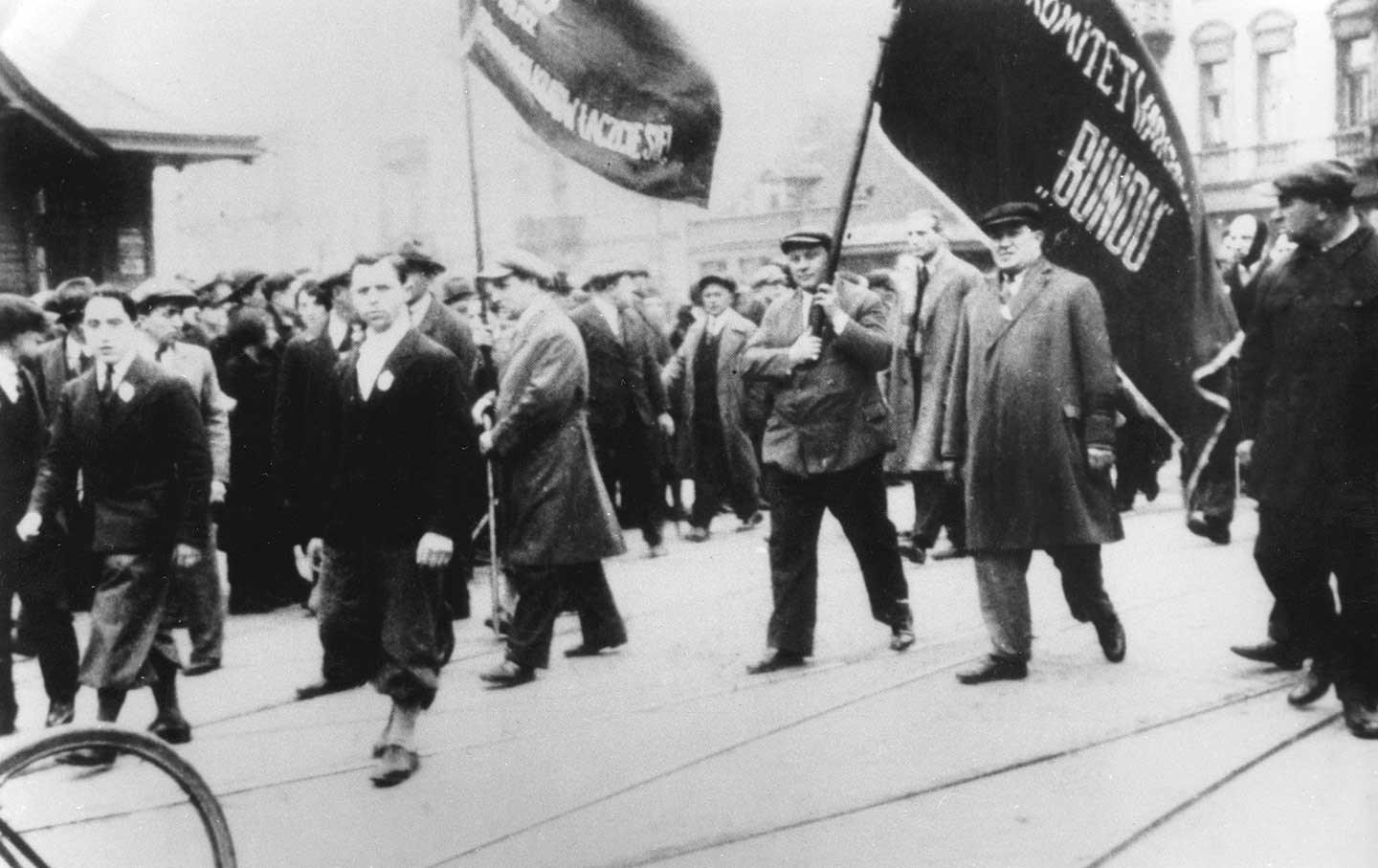
A parade of Jewish Bundists on May Day.
(Getty)
Looking back on a debate with Edward Said in 1978, Irving Howe recalled, among other sharp-elbowed moments, one in particular: When it came time for questions, an old Bundist with a thick Yiddish accent let loose a thundering attack on Israel. Howe said he was “ashamed that a fellow Jew, and a socialist at that, would talk this way.” By the time you get this far into Molly Crabapple’s Here Where We Live Is Our Country, a history of the Jewish Labor Bund (and you probably will, because the book is absolutely spellbinding), you will have become accustomed to such denunciations.
Books in review
Here Where We Live Is Our Country: The Story of the Jewish Bund
Buy this bookBorn in the same year, 1897, Zionism and Bundism were bitter and intimate rivals from the beginning, struggling for the souls of poor Eastern European Jews. The Zionist program—to resolve the Jewish question once and for all by establishing a homeland in Palestine—is well-known, the Bund’s much less so. In Here Where We Live, Crabapple seeks to revive what she can of the Bund’s project. As her title reminds us, the Bund wanted to stay and fight—for Jewish and working-class emancipation through socialism—where its members lived. In the Bund’s eyes, the Zionists wanted exactly what the antisemites around them wanted: for the Jews to self-deport. Staunch opponents of self-deportation, the Bundists were well placed to predict, early and accurately, what the Zionist project of colonizing Palestine would mean for the Palestinians. Crabapple makes it a matter of pride that the Bund was so prescient.
Crabapple routes her history through her great-grandfather, Samuel Rothbort, a Bundist born in czarist Russia who came to the United States in 1904 and became an artist of a vanishing Yiddish-speaking world. Rothbort taught his granddaughter, Crabapple’s mother, to paint. She then taught Crabapple, who has made a name for herself as a visual artist and a writer for left-wing magazines, publishing the words-and-pictures memoir Drawing Blood as well as illustrated accounts of Guantánamo, the Syrian rebels, and the Greek financial crisis. If the evidence had permitted, one would have wanted more of Samuel, who makes only walk-on appearances. While her great-grandfather’s example intrigues and inspires her, Crabapple’s retrieval of her family history is really there only to help her tell the story of the Bund, especially its anti-Zionism.
There are many ways of telling this story. The Bundists were Jews, but they were also secularists who rejected their parents’ religion. They were labor organizers who sought to defend poor Jewish workers, who were the victims of antisemitism as well as exploitation. And, first and foremost, they were revolutionary socialists. They led strikes by Jewish workers against Jewish factory owners; in New York City, they led the fight of Jewish tenants against Jewish landlords. David Dubinsky, the leader of the International Ladies Garment Workers’ Union, was a former Bundist. In those years, organizing involved the near-certainty of street fighting. The memoirs of tough-guy enforcer Bernard Goldstein have enough material to fill a Hollywood action flick. If that movie gets made, it will give a well-merited boost to the moral status of antifa.
Crabapple enjoys telling these stories, and they are good ones. A mass movement of working-class Jews is a thing of the past, but Zionism is very much an antagonist of the present, and she wards off nostalgia by putting the Bund’s anti-Zionism front and center. Her own political commitments aside, she has good historical reasons to do so. Crabapple quotes Chaim Weizmann, the Zionist leader who became the first president of Israel, in 1903: “Our hardest struggle everywhere is conducted against [the Bund].” At the same time, the Bund was describing Zionism as “the most evil enemy of the organized Jewish proletariat.”
For the Bund, Zionism was not just a distraction; it gave local antisemites a convenient means of eliminating the Jewish population. Instead of building power for working-class Jews, Zionists encouraged the Jews of Eastern Europe to give up the fight (to the Zionists, a losing fight) and move elsewhere. The Bundists, on the other hand, advocated doikayt, or “hereness”: Here where we live is our country. Here where we live is the place where freedom has to be won, freedom for everyone. During the 1905 uprisings against the czar, the American socialist Meyer London, who in later years would come to voice his own criticisms of the Zionist project in Palestine, gave this motto an allegorical spin straight out of the Passover Seder. He told his New York audience that in Poland, the young people “pray to God, not to lead them again out of Egypt, but to help them to free Egypt.”
This program of hereness ultimately depended, of course, on the reciprocal solidarity of the Egyptian (or Polish) working classes, which is to say those who were not Jews. Muslims and Christians had to want to join in a common struggle. In the United States, where London was based, this appeared more likely than in the old country, especially in the first decades of the 20th century, when his Socialist Party appeared to be on the rise. But given the steady drumbeat of antisemitic violence in Eastern Europe that Crabapple faithfully records, it is something of an understatement to say that working-class solidarity in Poland and Russia—or, for that matter, in Europe as a whole—could not be taken for granted. “Only a fool would try to free Egypt, many Jews reckoned,” Crabapple writes. “It was, after all, filled with drunken, violent Egyptians.”
Along with the issue of whether solidarity was possible between Jews and non-Jews, the largest question hanging over the Bund’s program was who or what the Jews were supposed to be once they no longer defined themselves by religion. What was the substance of the Bund’s Jewishness once it had broken with Judaism, once even the exodus from Egypt had been lopped off the traditional Jewish narrative of liberation? Is it enough to assume, as the Bundists did and as many of us continue to assume today, a paradoxical but real relationship between a former attachment to Judaism and a present assertion of universal values? Inside the walls of the Warsaw Ghetto, while trying desperately to tell the world about the extermination of the Polish Jews, the Bund also put out a statement demanding the release of Mahatma Gandhi, who had just begun a hunger fast in prison.
For Irving Howe, discussing the movement’s transplantation to North America, the Bund’s secular universalism was a self-betrayal and a political mistake. The Bundists’ denial of religious parochialism became “a parochialism of their own.” “To show any sensitivity, let alone fellow feeling, for the religious or cultural sentiments that immigrant workers had brought from Europe, was to open oneself to ridicule for still being under the sway of Jehovah.” How, he asked, would the rejection of their religious heritage stop short of assimilation?
Then as now, it is not an easy question to answer. Fellow socialist Jews like Leon Trotsky and Rosa Luxemburg were undaunted by the prospect of assimilation. They held that there was no excuse for the existence of a Jewish political organization that would remain separate from the social-democratic left, and after 1917 from the Communist Party. For Luxemburg, as Crabapple puts it, “Jews were not a nation but a caste…. Once legal oppression ended and medieval prejudice stopped, Jews would cease to exist as a separate group.” Trotsky applauded the Bund’s “fruitful work in developing the consciousness of the Jewish proletariat” but wanted it incorporated as “a section within a unified party.”
One might imagine that the Bund’s strongest argument for its autonomy would be the prevalence of Yiddish. It is true that after the movement’s failure or defeat (Crabapple calls it the latter, pointing to implacable structural forces), the now-displaced language would become a “portable homeland” for Bundists, a language and culture doing its best to survive on its own, most often without the Bund’s socialist politics. But at the outset, speaking Yiddish did not determine the Bundists’ identity, even if it became a practical aid in organizing. The dominant language of its founders, in fact, was Russian.
Wanting to be too Russian was arguably one of the Bund’s fatal errors in 1917. While Lenin and the Bolsheviks were proposing an immediate end to Russia’s participation in World War I—a proposal that would soon help put them in power—the Bund supported the position of Kerensky and the provisional government, which wanted to keep pursuing victory now on behalf of the new revolutionary Russia. By July 1917, Kerensky’s failed spring offensive and the hundreds of thousands of Russian lives lost to the war had led millions to turn against the provisional government. It seems possible, though Crabapple doesn’t make this argument, that it was not the Bund’s Jewish particularism but, on the contrary, a misguided desire to be good Russian patriots—a desire to be more Egyptian than the Egyptians, so to speak—that led it astray at what turned out to be a decisive moment. Some of the antisemitic violence that Crabapple chronicles appears to have targeted Jews as loyal representatives of Russia. For some Poles and Ukrainians, it didn’t matter that the country had had a revolution; Russia was still Russia.
Popular
“swipe left below to view more authors”Swipe →The Bolsheviks themselves tended to see the Bund, in Howe’s words, as “a disguised version of Jewish nationalism.” As Crabapple notes, “Georgi Plekhanov, the Russian Marxist theoretician, had made a famous joke dismissing the Bundists as Zionists with seasickness.” The joke puts Bundists and Zionists in the same boat. It’s not far from Howe’s own contemptuous view of the Bund’s anti-Zionism.
What, after all, was the Jewish identity that the Bund wanted so much to preserve? Why not do as Trotsky and Luxemburg advised, dissolving the Jewish socialist movement into the existing organizations of socialist allies? Why not pursue a “race-blind” politics, as many have championed since then? The best answer the Bund had to offer was the experience of antisemitic persecution: Jews had suffered antisemitism not as workers but as Jews. Both experiences were essential to their identity; how else could they understand themselves fully and intimately? Unfortunately for the Bund, that explanation of Jewish distinctness was less a solution than another problem. The more evidence that Crabapple collects of antisemitic violence—and she collects a lot—the less plausible is the plan of uniting with the Egyptians to liberate Egypt. European antisemitism was the Zionists’ ace in the hole: Every pogrom scored points against “Here where we live is our country.” As Crabapple notes, “the darker things got for Jews in Poland, the more seductive Palestine seemed.”
Inevitably, the reader’s foreknowledge of Hitler’s Final Solution weighs heavily on the entire book. But the Nazis were not alone in bolstering the Zionists’ argument for emigration. What do you think when you hear, for example, that more than 100,000 Jews were murdered much earlier, in pogroms between 1918 and 1921? Or that “in the first weeks of World War II the Soviets rounded up hundreds of Bundist activists”? Or that Jewish survivors of the Warsaw Ghetto uprising, who were already very few, were sometimes caught and murdered not by the Germans but by Polish nationalists, who in the 1930s had made antisemitism into state policy? The Bund’s internationalism is burdened by relentless instances of antisemitism in the world they insisted on winning; eventually, even in this book, that world stops looking winnable. Hence the Zionists come to seem almost right after all—not right about Palestine, but right that there was no hope for Jews in Eastern Europe. They had to get out. While Crabapple takes the Bund’s side, her book is also bold enough to stage an argument with itself.
As Here Where We Live recognizes, another country to which the Jews of Eastern Europe could escape was, of course, the United States, where Crabapple’s great-grandfather found refuge and achieved some recognition as an artist. Going to America may not have been a self-consciously political option, but it managed to save a lot of Jewish lives. Should that alternative denouement also shape our judgment of the Bund? Getting out, rather than staying to fight, did not necessarily mean colonizing Palestine; it might also mean learning to fight somewhere else, for example in the United States, as it did for many immigrant Jews.
Crabapple does not sing the praises of America as a place of prosperity and security. She includes it in “Exileland,” along with the European capitals that Jews fled to from the Pale of Settlement, not from Israel. By character, she sounds like what the Bund called a tuer—a doer, an activist. At any rate, she is eager to celebrate the lives of the Bund’s rank-and-file activists, whose names are unlikely to show up in the archives. And because she talks like a tuer herself (and, for that matter, also like an artist; artists have to be tuers), she is always noticing the named and nameless injustices here in America that call out for action. Chief among them—this gives her story a pleasing roundness—is America’s unconditional support for Israel. She interrupts her history repeatedly to make that and other connections with recent politics. This intense presentness stops the book from getting stuck in a familiar paradox: a commemoration of past activism that has few if any consequences in the present—activism as a venerated museum piece rather than a practice in the here and now.
For Howe, the Bundists were “opposed to Zionism” primarily on the grounds that it was a “utopian fantasy.” The objection that colonizing Palestine was impractical did come up and was one reason for their opposition. But the primary reason was the Bund’s internationalism. In 1929, after riots in Palestine in which many Jews and Palestinians were killed, the Bund refused to participate in ceremonies mourning the Jewish victims. A leader in Warsaw, addressing 3,000 workers, said that what was needed was “the renunciation of the Zionist plan to rule the land against the will of the majority…. The Arab hatred of the Jewish population is a direct result of Zionist politics. Zionism has poisoned the atmosphere and put the Jewish population of Palestine in danger.” Even in 1937, with Hitler in power and the Palestinians again in revolt, the Bundist line was unwavering. The Zionist movement, the Bund declared, “has taken it upon itself to settle people in a home that is for the most part occupied by others, in order to take control of all of it.” The issue for the Bund then, as it is for Jewish anti-Zionists today, was justice for the Palestinians.
On the subject of antisemitism, one can also glean wisdom from the Bund. The upsurge of antisemitism in recent years has certainly lowered the temptation to draw any absolute contrast with Eastern Europe. No matter how much better it might appear than the Pale, the United States today looks less like a haven. Still, it helps to remember that Donald Trump’s dog-whistle presidency and the rise of the even crazier antisemitism to his right—the Hitler-admiring Nick Fuentes and his fans, for example—have coincided with Israel’s destruction of Gaza. The genocide has been a generous gift to antisemites here and everywhere. History takes and also gives. However different in quantity and quality, antisemitism in Eastern Europe a century ago was also a historical product, though not one for which any Jews bore as much responsibility as Benjamin Netanyahu and Trump do for the rise of antisemitism today. It was “a kind of counterreaction,” Mark Mazower writes, summarizing what many scholars have concluded, “to the accelerated rhythms of modern times”—a response to the new capitalist modernity of which Jews appeared to be the bearers, however untrue that might have been in reality. Blaming the Jews for disturbing older and familiar ways of life had many disadvantages, and not just for the Jews, but it “had the advantage of giving a physical embodiment to the otherwise abstract forces behind social upheaval.”
Zionists have always liked to pretend that antisemitism is eternal and inexplicable. It’s a conveniently self-justifying way of portraying your antagonist. What the evidence shows, however, is that antisemitism is a product of historical forces and thus neither eternal, however disquieting its resurgences, nor inexplicable. What the evidence shows, in other words, is that the Bundists, though defeated, were not wrong. The antisemitism that stood between the Bundists and the liberation of Egypt was as open to change as the emergent capitalist order was—not something that would ever be easy to change, but not unalterable either.
The Bund’s spirit survives in the unprecedented proportion of Jews, especially young people, who have refused to allow antisemitism to be weaponized. It survives in the fact that a present-day Irving Howe, however surprised at a Yiddish accent, could no longer be shocked at hearing a Jewish denunciation of Israel. In the last 50 years, Howe’s outrage at Jewish critiques of Israel has become less intellectually respectable. The groundswell of praise that has greeted Crabapple’s book is a testament to its many virtues, but also to the change that has overtaken moral common sense, especially since Gaza.
More from The Nation

What Trump and Tucker Carlson Have in Common What Trump and Tucker Carlson Have in Common
Carlson has broken with Trump largely over the war in Iran. But on Ukraine and immigration, the two speak very much the same language.

The Jewish Case Against AI The Jewish Case Against AI
Haredi rabbis and the secular left agree: This technology is a threat to the entire social fabric.

The Fight for Educational Equality Is Also a Fight for a Just Supreme Court The Fight for Educational Equality Is Also a Fight for a Just Supreme Court
The court has severely weakened our ability to make an education system that fulfills the promise of Brown.

The Fall of “Scientific American” The Fall of “Scientific American”
When the beloved science publication got too political, its corporate owners stepped in. Now its future is uncertain.
The Bookstore Revolution in Taiwan’s Conservative Heartlands The Bookstore Revolution in Taiwan’s Conservative Heartlands
After Taiwan legalized same-sex marriage, gender-themed bookstores are working to build the social acceptance that the law alone couldn’t deliver.

Jalen Hurts Deserved Better. We All Do. Jalen Hurts Deserved Better. We All Do.
In a country that treats workers as expendable parts, Hurts’s playing through a blood clot is just the highest-profile example of the price workers pay in an oligarchy.

