
The Fall of Scientific American
The Fall of “Scientific American”
When the beloved science publication got too political, its corporate owners stepped in. Now its future is uncertain.
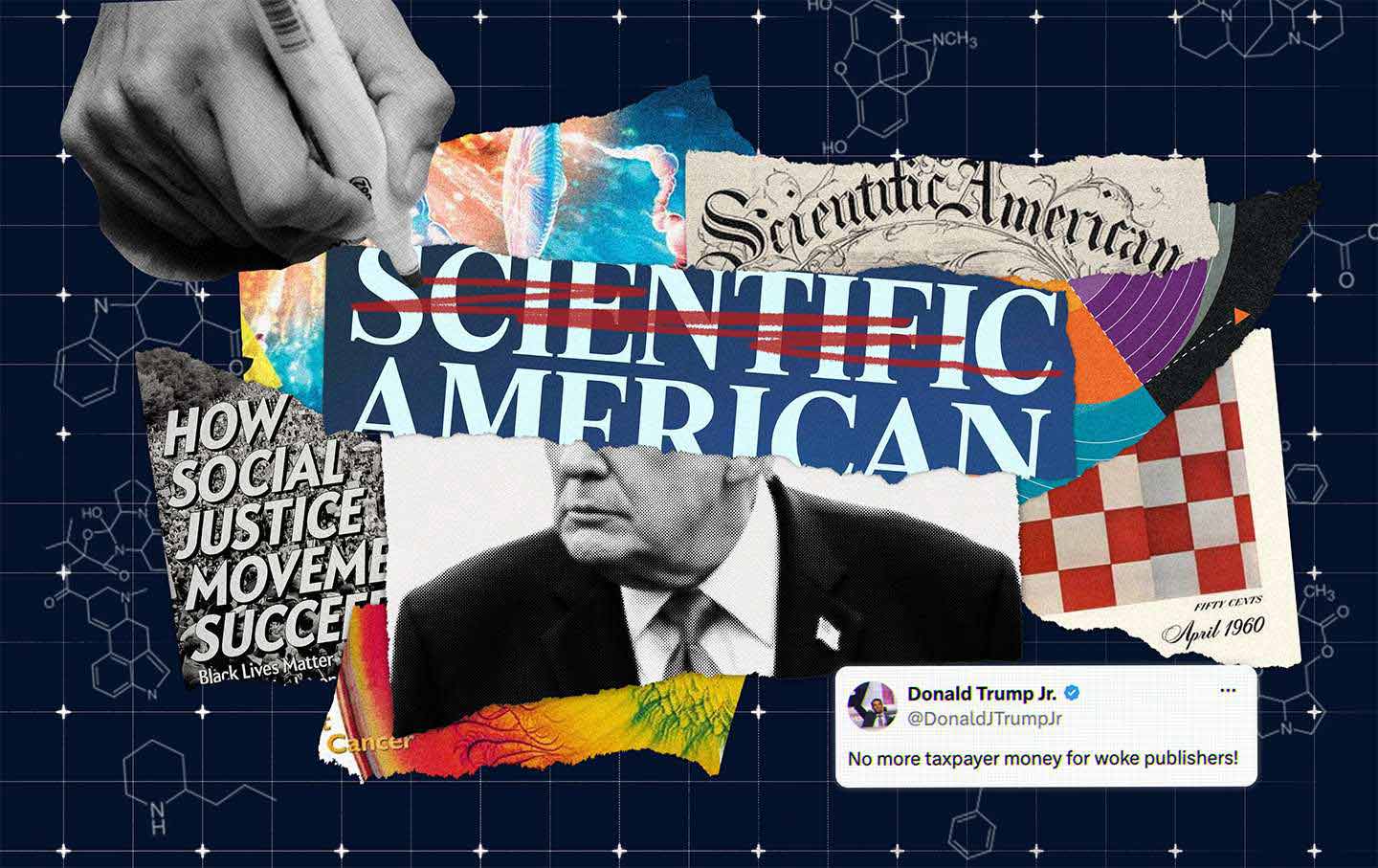
In March of 20doz26, in a nondescript, 46th-floor office overlooking lower Manhattan, about two dozen members of Scientific American’s editorial staff had gathered in person and online to talk openly about their approach to political coverage.
David Ewalt, the editor in chief, wanted them all to understand something: The magazine was not “kowtowing” to the Trump administration. In fact, according to a recording of the meeting obtained by The Nation, he asked staff present to “raise your hand if you’ve ever heard me say not to cover a political story.”
Two people raised their hands.
For well over a year, rumors had been circulating among the staff about top-level editors’ rejecting pitches they saw as too political, controversial articles triggering angry phone calls from Scientific American’s corporate owner, and even, on at least one occasion, ownership forcing editors to blunt language critical of the Trump administration.
Then there was what happened to the opinion department. In the first months of the new administration, it had been publishing about 15 pieces a month, many of which criticized Trump’s attacks on scientific research. But after the department published a particularly provocative column in May 2025—“Science Tells Us the U.S. Is Heading toward a Dictatorship”—management, in what one staffer would later call an “unprecedented” move, had told the department to “pause” publishing new articles until the new editor in chief started.
The opinion department’s hiatus had worried some people more than others—there were legitimate journalistic reasons to want to emphasize breaking news, even if not everyone agreed with them. But by March 2026, nine months into Ewalt’s tenure, the opinion section seemed to be gone for good—and other departments were feeling political pressure, too. That, along with a round of layoffs, a restructuring of the newsroom, and veiled threats about the future of the magazine, had left the staff frustrated and looking for answers. Now that the new editor in chief was finally coming to the full editorial staff “to listen as well as to speak,” as one staffer put it, they began asking questions.
What about that rumor, someone asked him: Had editors really been told to not put the word “Trump” in headlines?
That was true, Ewalt said. Last year, a Breitbart article had criticized Springer Nature, Scientific American’s German owner, for attacking those “skeptical of the coronavirus vaccine” and spreading “gender insanity.” “No more taxpayer money for woke publishers!” declared Donald Trump Jr., retweeting the article. In June 2025, Axios reported that all federal subscriptions to Springer Nature publications had been canceled. Although Trump officials later walked back the bulk of the cuts, they had shocked the scientific community: Without access to Springer Nature’s thousands of journals, including the prestigious Nature publications, researchers at federal agencies—from the NIH to NASA—would struggle to stay abreast of scientific developments. The company itself, meanwhile, risked losing as much as $25 million in federal contracts.
So if Ewalt had asked people to keep Trump out of the headlines last summer, it was because corporate higher-ups were visiting the site all the time. “And if they saw the word ‘Trump,’” he said, according to the recording, “they were wetting their fucking lederhosen.” People had no idea how “lily-livered and weak-kneed and cowardly” Springer Nature was, he said. “They are so fucking afraid of the Trump administration.”
The opinion editors had long since been reassigned to other roles, but now, almost a year later, Ewalt was telling his staff that even news stories sometimes had too much of a slant to them. “I am not ever telling anybody here ‘Don’t go after the Trump administration,’” he told them. “I’m saying I don’t want to hear your opinion.” He just didn’t think it was their “strongest weapon.” If everyone stuck to objective, hard-hitting reporting, Ewalt believed that they would be able to stay out of trouble with Springer Nature.
Mentioning Trump in headlines was now allowed. “But let’s be realistic about the world we live in,” he told his staff. Last August, Ewalt warned, Springer Nature could have easily decided that the magazine’s “$4 million in losses” wasn’t worth risking millions more that the company earned from federally funded subscriptions to its scientific journals. He had been “trying to keep Springer Nature from freaking out and shutting us down,” he said.
As the meeting came to an end, Ewalt seemed optimistic. “This is useful,” he said. “We’ll do this more.”
But staffers still felt uncertain. Could people really trust their editor in chief to stand by their reporting, like he promised? Or would he retract articles if readers sent too many angry emails, or if Springer Nature’s billionaire CEO called? Those concerns, one staffer said, weren’t “quelled in that meeting at all.” Rather, it had transformed accumulated gossip and implication into something far more concrete—and “set everybody’s teeth on edge,” said another staffer, who, like a number of sources for this story, chose to speak anonymously because they feared retaliation from current or prospective employers. “He was trying to be honest with us,” the staffer said. But, also, it “alarmed the shit out of everybody.”
Another meeting never took place.
In April, the staff of Scientific American took the first formal step to form a union with the Writers Guild of America East, citing a number of concerns, including editorial independence. And on June 23—three days before the National Labor Relations Board was scheduled to count the unionization votes—Springer Nature announced that it was selling the magazine to a little-known company called LabX.
Scientific American is the oldest magazine in the United States and, among science publications, one of the most familiar and beloved. Like other publications of its caliber, it also has a tradition of editorial independence. In the 1980s, after a tumultuous split between its co-owners, it was absorbed by the German publishing empire Holtzbrinck, which currently controls both Springer Nature and the Big Five publisher Macmillan. A 1998 Vanity Fair feature called the company the “shark of choice” for struggling publishers: It promised to allow them to continue their work with minimal interference.
In recent years, however, Springer Nature’s hands-off reputation has begun to falter. Interviews conducted this summer and fall with a over a dozen current and former Scientific American employees depict a magazine that, especially over the past two years, has struggled to protect its editorial independence in the face of sometimes overwhelming pressure from its corporate ownership—a picture corroborated by audio recordings and documents obtained by The Nation.
Back in 2017, Springer Nature had made headlines when it admitted that it had censored hundreds of academic articles in mainland China at the behest of the Chinese government. But for most staffers, the first sign of a more hands-on approach came in 2021, when an opinion article about the medical situation in Gaza was pulled from Scientific American’s site after right-wing backlash.
At the time, the article’s authors received no explanation. But current and former Scientific American staffers familiar with the situation told The Nation that the reason was simple: Stefan von Holtzbrinck himself—known for his enthusiasm for Israel—had called then–editor in chief Laura Helmuth and ordered that it be taken down.
It wouldn’t be the last conflict between Helmuth and Springer Nature. Helmuth, who joined the magazine in 2020, had pushed it to cover more politics, arguing that science cannot be disentangled from its social context. Scientific American had issued presidential endorsements for the first time under her leadership. In 2024, after Helmuth called Trump supporters “bigots” and “fascists” on social media on election night, the magazine again became the target of right-wing backlash. This time, facing pressure from Springer Nature, she resigned.
The magazine had been struggling financially for years, but the pressure to be profitable only increased as Springer Nature repeatedly tried and failed to go public; in 2024, it finally succeeded. After Helmuth’s departure, “it felt like a pendulum swing back to ‘let’s stick to the science,’” said Kelso Harper, who was then the magazine’s senior multimedia editor. “Let’s not get involved in too much messy political stuff.”
In the first months of Trump’s second administration, though, messy politics was almost unavoidable. Trump brought disaster after disaster for science writ large—thousands of grants suspended or canceled, tens of thousands of workers fired or pressured to resign, billions of dollars of funding slashed or frozen. Scientific American’s opinion department critiqued Republican attacks on everything from trans health care and measles vaccines to fluoride and the National Weather Service.
Then, in April 2025, as the administration’s war on DEI in science continued to accelerate, psychiatrist and anthropologist Eric Reinhart posted a letter to X that the Trump-appointed US attorney for Washington, DC, Ed Martin, had originally sent to the Illinois-based medical journal CHEST. The letter, dated April 14, asked: Was CHEST protecting the public from misinformation? Was it disclosing when viewpoints were influenced by funders? Did it publish articles from competing viewpoints? “It has been brought to my attention that more and more journals like CHEST Journal are conceding that they are partisans in various scientific debates,” the letter read. “The public has certain expectations, and you have certain responsibilities.”
CHEST is not well-known outside its field, but the letter made national headlines as an example of the administration’s unprecedented efforts to undermine what the right called “woke” science. Reinhart submitted an op-ed to Scientific American senior editor Dan Vergano arguing that the letter represented “an authoritarian threat to science.” As the story moved toward publication, news broke of similar letters to other journals, including the prestigious New England Journal of Medicine and JAMA. Reinhart’s op-ed quickly progressed through an initial edit, a “top” edit, and a copy edit; according to e-mails and documents obtained by The Nation, a legal reviewer made only one, minor change.
But when the draft returned from another round of edits, this time from acting editor in chief Jeanna Bryner, the word “fascist” had disappeared, along with a reference to the genocide in Gaza. A paragraph in which Reinhart argued that fascists benefit from “self-interest, automatic obedience, and ethical cowardice” had been cut entirely. In a comment in the document, he protested: “Shying away from publicness and directness on these issues will only make them worse.”
The draft next went to Springer Nature’s US head of legal for review. He left a comment declaring, with no explanation, that the cuts were “necessary.” “Got it,” Bryner responded.
A tranche of recently released documents show that Springer Nature had good reason to fear retaliation: On April 14, 2025, Ed Martin had sent Scientific American a threatening letter nearly identical to that received by CHEST. He sent similar letters to Nature Medicine—also owned by Springer Nature—along with at least 10 other publications. (Martin is currently facing disciplinary proceedings from the DC bar for sending a different threatening letter to Georgetown University.)
At the time, Scientific American president Kim Lau responded to Martin privately, asserting that its content was “fully protected by the First Amendment.” Behind the scenes, however, Springer Nature leadership was insisting on substantial changes to Reinhart’s op-ed, against Lau’s objections.
Those objections were why they were “ultimately allowed to print it” at all, Lau told Jeanna Bryner and the two opinion editors in a May 2025 meeting, according to audio obtained by The Nation. The only reason things didn’t “blow up in a bigger way,” she said, was that Reinhart eventually agreed to the changes. But when the piece was eventually published, on May 1, it received little attention—probably, she said in the meeting, because they had “watered it down so much.”
And when Dan Vergano published his column “Science Tells Us the U.S. Is Heading toward a Dictatorship” two weeks later, it was the final straw. Shortly after, Lau called Bryner, Vergano, and the chief opinion editor, Megha Satyanarayana, into the May 2025 meeting.
“There’s no way to sugarcoat this,” Lau told them. Springer Nature felt that Scientific American’s criticism of Trump was threatening their broader business—selling subscriptions to their scientific journals. The federal government was a major client.
“I have reiterated repeatedly that we have a history of editorial independence, and that these things are crossing that line,” said Lau, referring to Springer Nature’s repeated editorial interference. “It’s very clear that they understand that. But given where our business is, and the threats to the larger business, they don’t care.”
The department’s work, she said, was being placed on “pause” until the new editor in chief, David Ewalt, arrived.
Lau was explicit about the pressure they were all under. “We’re upsetting the company on a daily basis,” she said. Germany was six hours ahead of New York, and she and Bryner would wake up to early-morning calls from the German board. “If I thought me quitting would help the situation, I would have done it,” Lau said. “They are terrified about the things that are happening in the US.”
Although Lau gave the editors reason to hope that Ewalt might manage to resurrect the opinion department—“I think he sees value in it,” she said—he would turn out to be on the same page as the Springer Nature executives in at least one regard: It was time to reduce opinion output significantly. During his interviews, Ewalt had pitched them his new vision of the magazine: less editorializing, more facts.
In May 2025, though, the opinion editors—like the rest of the magazine—still didn’t know much about their new boss. Lau assured them they could all talk things over with Ewalt and see how he wanted to approach the issue. “We just need to be clear that what we’re fighting for is worth it. And I’ll be honest with you,” she said, “I don’t think this is the thing I want to die on the hill for.”
“We are in a fight right now for the future of SciAm in general,” she said. “There is nothing that’s a given in our future. We are losing a lot of money, and we do not necessarily have a clear path to closing that gap.”
Over the course of the next year and a half, at least 53 of the approximately 84 people employed at the magazine would either be laid off, resign, or retire.
Ewalt took over the magazine on June 2 with a mandate to increase traffic and subscriptions. But there were other changes, too. Helmuth’s departure had triggered a new attention to employees’ political expression, and Ewalt’s arrival reinstated objectivity as the journalistic North Star. Things that had produced no objections in the past became contentious: People were discouraged from following only left-leaning social-media accounts, for example, to avoid the appearance of bias. Although he initially promised that his restructuring efforts would not include layoffs, in October 2025 10 employees lost their jobs, replaced by a slate of hires to new positions, including three breaking news reporters. In December, Kim Lau threatened further changes if revenue didn’t start picking up—more layoffs, workers guessed, or maybe a sale.
Though October’s layoffs galvanized the then-incipient union campaign, staffers had additional concerns. Vergano, who had been reassigned to report on Washington, remembers hoping that the union could serve as a counterweight to the “clear, corrosive corporate interference and influence” he’d witnessed at the magazine. That emphasis on editorial independence, said WGAE organizer Andy Greenberg, was one of the things that set the campaign apart from others he’d worked on. “We have to look out for us,” one staffer realized, “because Springer Nature is not.”
After Scientific American announced its new union in April, Springer Nature hired Littler Mendelson, the largest “union avoidance” firm in the US. A consultant with the off-putting habit of calling senior employees “young lady” was brought in to run anti-union meetings. Still, by election day, spirits were high. Union pins were everywhere. Someone brought in mitochondria cookies. “We knew it was a slam dunk,” Vergano said.
But it was becoming difficult to enjoy the moment. In the weeks after the vote, rumors began to circulate that Springer Nature executives were “basically measuring everybody’s desk to sell it,” Vergano said. “It was not subtle.” The bad news hit on June 23: sale to LabX, salary cuts, mass layoffs.
“The amount of panic, the amount of tears, the amount of ‘I don’t know the next time that I will see you, goodbye forever maybe’ conversations that were happening in the newsroom—I mean, traumatic puts it lightly,” said books and culture editor Brianne Kane. Even those who had received job offers from the new owners were told to clear their desks and that their laptops would be shut off by midnight.
The next week, a few dozen workers, freelancers, and allies gathered at the 1 New York Plaza office. Despite the previous week’s events, the mood on the picket line was jaunty. A small but energetic brass band accompanied chants of “New York is a union town,” and the signage was heavy on puns (“I Do Not Cosine These Layoffs”).
Behind the scenes, Springer Nature was still doing its best to nullify the election, including by trying to withdraw the petition for an election by pointing out that it had laid off everyone at the magazine. “This was a case where a corporate parent restructured and sold its subsidiary in a transparent attempt to defeat an election,” the WGAE wrote in a legal filing. “The Board should not reward such conduct.” When the NLRB counted the votes, the tally was 31 to 1 to unionize.
In the immediate aftermath of the sale, staffers were left scrambling to learn more about Scientific American’s new owner. Previously, LabX’s best-known publication had been Discover, a onetime dentist’s office stalwart that was hollowed out by private equity buyers in the aughts; according to multiple staffers, the ownership transition seemed rushed, chaotic, and disorganized. When one worker reached out to a former employee of one of LabX’s other publications, the stories they heard—including ones related to editorial independence—were part of why they turned down their job offer, they said. (LabX did not respond to multiple requests for comment.)
The NLRB case with Springer Nature remains open, but the union also filed for a new election. LabX hasn’t hired any outside union-busters, but it has held three meetings asking for more time to prove that a union isn’t needed. “It’s comical,” said one staffer, given that the company’s first action as the new owner was to lay off “many very talented, very successful staff members.” The bargaining unit is much smaller this time around—from 35 to less than 20, with a few positions still in dispute—but workers remain as committed to organizing as ever. The result, counted this week, was 12 to one.
When Dan Vergano reached out to the Society of Professional Journalists’s ethics committee for advice in May 2025—shortly after the department’s work was put on pause—he was told to start by working through official channels: Going public could come at a high personal cost. Besides, as a journalist, “you don’t want to be part of the story,” Vergano said. “It’s literally stomach-churning.”
Popular
“swipe left below to view more authors”Swipe →He declined to speak to particular incidents, citing legal concerns. Still, he said, when a company is willing to interfere in critical journalism, how could reporters not end up pulling their punches? “We are trying to deliver you the raw stuff of democracy,” he said. “If a company allows their own greedy interests to shape that, then that’s a problem for democracy.”
It was clear that the “pall” Vergano described extended beyond the opinion section. “When you hear about people’s pieces getting cut to pieces, when you hear about pitches getting turned down,” said another editorial staffer, “these things ripple out to other departments.” That March meeting with Ewalt was the first time the newsroom had discussed editorial interference so openly, but by that point the problem was far from new: It was often unclear whether decisions were motivated by corporate interference or editorial judgment; stories of infamous incidents circulated for years.
“Reporters like to think that there should be a 60-foot brick wall between the business side of a news outlet and the editorial side,” Dan Axelrod, the chair of the Society for Professional Journalists’s ethics committee, told The Nation. “The reality is there isn’t, and there never has been.”
For most staffers, it’s still unclear exactly what motivated the sale—the money Scientific American was already losing, or the far vaster sums that Trump had threatened to take away, or both. Journalists at Nature News, also under the Springer Nature umbrella, were enduring “the same scrutiny” of their reporting on the Trump administration; Lau had told the opinion editors as much last year. But, Lau said at the time, Nature was “not a brand that’s losing money.” Scientific American, meanwhile, was a public-facing magazine owned by a company with little interest or expertise in public-facing journalism.
“The decision to divest reflected a strategic focus on our area of greatest expertise, academic research and scientific publishing,” Springer Nature’s North American president said in a statement to The Nation. David Ewalt had put it more clearly, perhaps, during the March meeting: “We are journalists working for a weird multinational corporation,” he told his staff. “We are the appendix of this organization. They don’t need us. They don’t even, frankly, want us anymore.” (Both Ewalt and Lau declined to comment on this story, and both have left Scientific American.)
Though it’s not ideal for democracy or free speech, Axelrod said, the journalism code of conduct does not bar a publication’s owners from steering it away from public service in search of profit. But “it’s sad and surprising to think that they would potentially do that on the fly, in a way that breaks readers’ trust.”
It was tragic, he added, “that the journalists who are supposed to be reporting on undue influence by the government on the creation and dissemination of scientific findings appear to be subject to that same undue influence.”
For one staffer, who started working in journalism after the recession, the field had been in bad shape for as long as they could remember—but Scientific American, they said, was always held up as “one of the icons, if not the icon, of meaningful, impressive journalism about science.” It was their dream job. On its own, they said, Scientific American wasn’t going to solve all the challenges at the intersection of science and society—attacks on public health, a lack of climate action, widespread disinformation. Still, they worried about “losing the spirit of it,” and that it would become just another website publishing less-meaningful “cool stories about science.”
In a letter to readers in Scientific American’s September issue, the new editor in chief—Jeanna Bryner, promoted once again—announced that the magazine was moving out of its Battery Park office. “I can’t promise that the next chapter will be free of mistakes or tumult,” Bryner wrote. But the change in ownership was “an opportunity for SciAm to be even better”—and, she added, “have some fun.” (Bryner did not respond to multiple requests for comment.)
At least one freelancer has already written publicly about their negative experience with the new Scientific American, and two more editorial staffers were laid off at the end of September, including Megha Satyanarayana, Vergano’s former colleague in the opinion department—who declined to comment for this piece—and a data reporter. Vergano remains worried that LabX seems more interested in “gee-whiz stuff” than critical, substantive reporting. From what he’s seen of their publications, he said, “they produce things that are schlockfests. And we were doing good work at Scientific American.”
In the May 2025 meeting that shut down the opinion department, Vergano and Satyanarayana had grappled with the unintended consequences of that work, work that leadership had once championed. “We thought that by being more provocative and by becoming more of a voice ourselves that we would hopefully make a difference,” Satyanarayana said to Lau. The experiment, she said, was “costing us more than I ever thought it would.”
Satyanarayana was talking about their columns, but she could as easily have been referring to a broader project: Scientific American’s efforts, dating back to Laura Helmuth’s tenure, to advocate for science at a time when science was under attack more than ever before.
“This is something that many outlets are struggling with right now,” Lau said. “That doesn’t excuse it, or make it better. Probably it makes it worse.”
More from The Nation
The Bookstore Revolution in Taiwan’s Conservative Heartlands The Bookstore Revolution in Taiwan’s Conservative Heartlands
After Taiwan legalized same-sex marriage, gender-themed bookstores are working to build the social acceptance that the law alone couldn’t deliver.
Jalen Hurts Deserved Better. We All Do. Jalen Hurts Deserved Better. We All Do.
In a country that treats workers as expendable parts, Hurts’s playing through a blood clot is just the highest-profile example of the price workers pay in an oligarchy.
The Terrifying Future of States’ Criminalizing Pregnant People Is Already Here The Terrifying Future of States’ Criminalizing Pregnant People Is Already Here
The idea of charging people who have abortions with murder is gaining traction on the right. But a report finds that people are already being prosecuted for their pregnancy outcom...
The Supreme Court Is Coming for Affirmative Action—Again The Supreme Court Is Coming for Affirmative Action—Again
The high court has just accepted a case that takes aim at efforts to increase diversity at high-performing public schools.
My Family’s Dark, Hidden History With Institutionalization My Family’s Dark, Hidden History With Institutionalization
My great-great-grandfather was the namesake of an infamous institution for the disabled. From long-neglected records of the property, the lives of forgotten people were uncovered....
Smoke and Mirrors: The Right's Latest Attacks Against Trans People Smoke and Mirrors: The Right's Latest Attacks Against Trans People
The MAGA movement is redoubling its attacks on trans healthcare in an attempt to win votes this November.

