Should Parents Be Convicted for Mass Shootings Committed by Their Children?
Given that our politicians are refusing to deal with the reality of gun violence, it’s tempting to say yes. But the ultimate responsibility for such violence lies elsewhere.
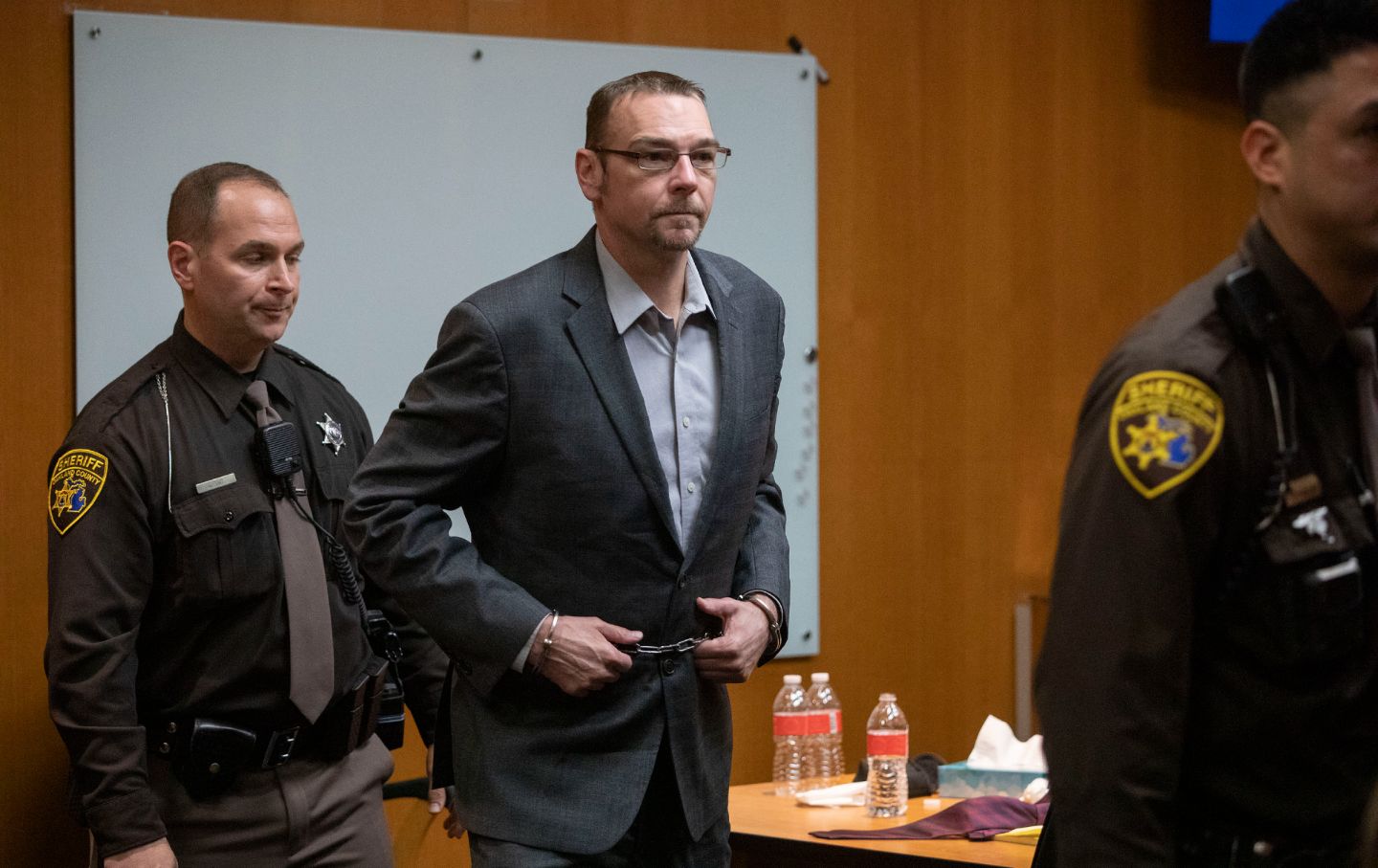
In March, a Georgia jury took less than two hours to convict Colin Gray—the father of a teen who shot 13 people, killing four, at his Georgia high school in 2024—on all 27 of the charges he faced, including second-degree murder and manslaughter. Gray’s son Colt was sentenced to life in prison for committing the murders; the elder Gray is the third parent a court has decided should also go to prison for a mass killing committed by their minor-age child. The first two were James and Jennifer Crumbley, sentenced to 10 to 15 years after their son Ethan killed four classmates in a 2021 Michigan school shooting.
It’s tempting to cheer these outcomes. Law enforcement visited Gray’s home twice with warnings about his son—once in 2021 after Colt searched “how to kill your dad” on school computers, and again in 2023 for online threats he’d made to shoot up a school. Gray still gave the teen—who had a “shrine” in his bedroom dedicated to the 2018 Parkland, Florida, school shooter—an AR-15-style rifle the following Christmas. James Crumbley also gave his son Ethan the pistol he used in the massacre and told him to “suck it up” when he asked to see a doctor about his mental health. On the morning of the shooting, James and Jennifer were shown their son’s violent drawings at an emergency school meeting but refused the administrators’ request to take him home and get him help. If there are parents who “deserve” to share the blame for the killings their kids committed, Colin Gray and the Crumbleys fit the bill. Sam Levy, a former prosecutor who now works in gun-violence prevention at Everytown for Gun Safety, argues that holding parents criminally liable is necessary. “We have to operate in the reality in which we live, which is a world in which there are more guns than people,” he told me. “Accountability is a very important deterrent for any bad actor, whether it’s a parent or the shooters themselves.”
But are these convictions about Gray and the Crumbleys, or are they about the rest of us, and the anger and exhaustion we’ve built up over decades of knowing that what might actually prevent the next mass shooting is precisely the thing that our political class is unwilling to make happen? Punishing parents who ignore the red flags their children wave in their faces may be a sort of stand-in for a policy on gun violence. But it’s not a solution for our national gun problem. As the legal scholar Leslie Joan Harris noted some 20 years ago, “lawmakers seem to ‘discover’ the idea of using parental responsibility laws to prevent teenage crime every couple of decades or so,” beginning with the start of the 20th century, despite a lack of evidence supporting their use. As recently as 2024, a criminology study noted that we still have “no comprehensive empirical studies evaluating whether parental legal culpability reduces juvenile delinquency.”
The Gray and Crumbley convictions “make me worried about how far this could go,” says Eve Brank, a psychology professor at the University of Nebraska-Lincoln who studies parental-liability legislation. “Do we start punishing [the shooters’] friends? How about siblings? Once you start going down the path of what I call ‘vicarious responsibility,’ the bubble can get pretty big.” Parents often lack the resources and support to respond when their kids’ behavior is troubling, Brank says. A parent’s “calculus might become, ‘I don’t want to end up in prison for something my kid does, so I am going to voluntarily relinquish my parental rights.’ It’s a rational response for a parent who has run out of options in a country with a very limited mental-health safety net.”
Like Brank, Levy calls on schools and communities to “go all the way upstream, creating an ecosystem where you’ve got threat-assessment teams who can identify these problems and think about solutions, get services to kids who need them, and ensure that there are resources brought to bear to help.” Building an architecture to catch threats before they turn into mass shootings makes a lot of sense. But if we’re really trying to prevent shootings before they happen, the intervention farthest up the stream is the one in which politicians enact the bare minimum of gun restrictions that ensure there are fewer guns in circulation. Every country has shitty parents. No other industrialized nation has anything close to our 45,000 gun deaths each year.
We know that increased criminalization tends to target those who already live under constant suspicion. “Communities of color [have] really learned that…when we pass more criminal statutes the people who are in the crosshairs are politically vulnerable,” Ekow Yankah, a law professor at the University of Michigan, told McGraw Hill in 2025. Black and brown parents are “more likely to be held responsible for children’s misbehavior than White parents,” according to a 2024 study, “given that Black and Latino students are more likely to face punishment in school compared to their White counterparts.” Black students are up to 3.6 times more likely to be suspended or expelled and/or referred to law enforcement for the same actions as white kids. Consequently, “secondary discipline”—mandatory school meetings, parenting classes, and administrative scrutiny that parents are subject to alongside their kids—“was not neutrally applied” to all parents but overwhelmingly fell on “low-income, Black and Latina mothers.”
You know what we have proved with a slew of research studies? That tightening gun policies would put a real dent in the number of mass shootings. Colin Gray, the Crumbleys, and their kids who pulled the trigger will all be in jail for a long time, but the stores where the guns were bought will be open again tomorrow. “The gun owner that fails to secure their gun, or hands it to a child they know is in crisis, is culpable,” Levy says. “An industry that fails to innovate towards safety and markets weapons in a way that glorifies militarism and violence is culpable. So are lawmakers who, tragedy after tragedy, walk away and refuse to face the problem head-on, though there are countless options at their disposal.”