
Marc Andreessen’s Dangerously Unexamined Life
The tech mogul has declared himself an enemy of introspection, and that conveniently erases considerations of conscience from his amoral investment empire.
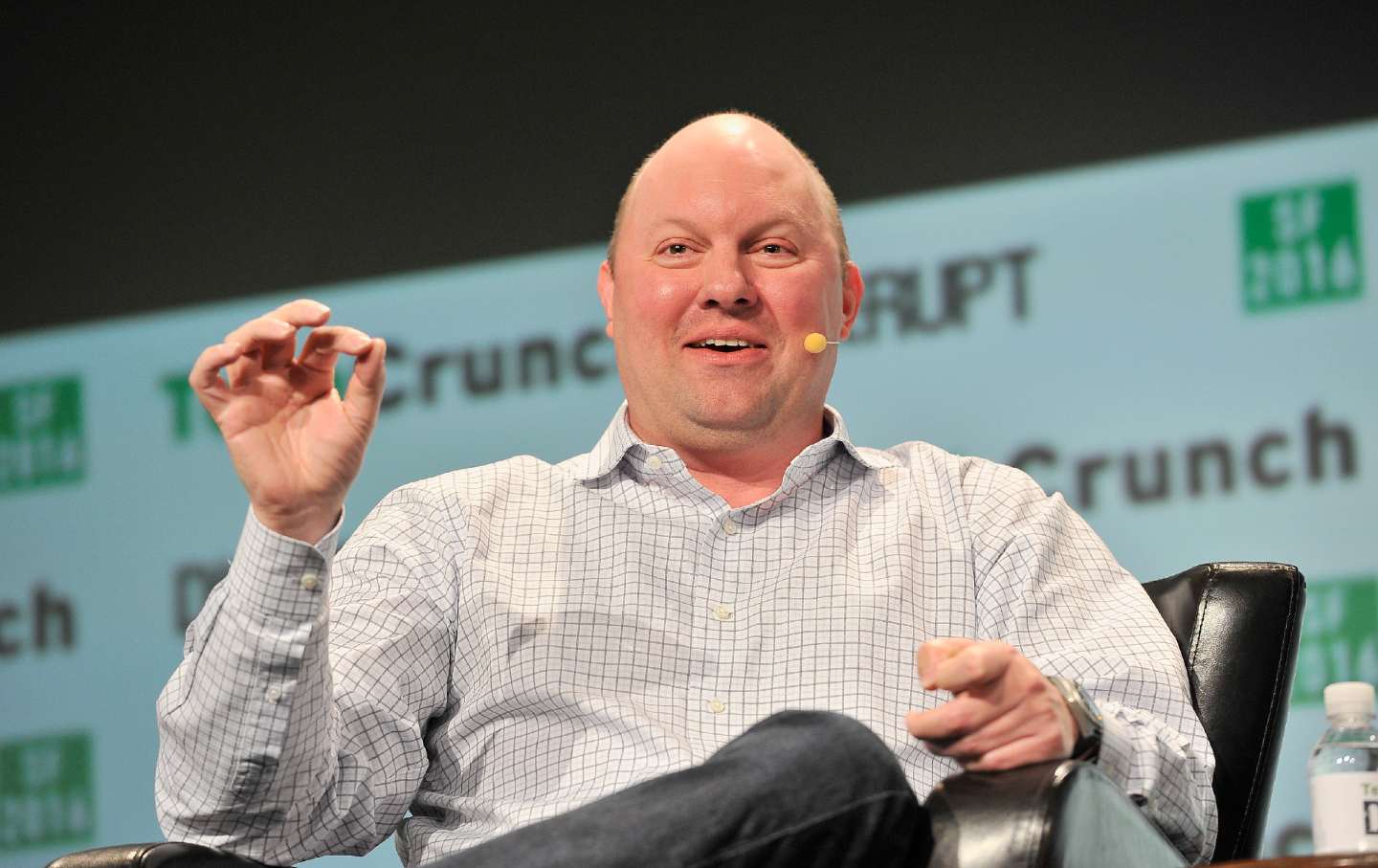
Marc Andreessen holding forth at TechCrunch Disrupt 2016 in San Francisco.
(Steve Jennings / Getty Images for TechCrunch)Marc Andreessen, cofounder of the venture capital behemoth Andreessen Horowitz, the chief polemicist of the tech right, and a man with an impossibly large head, has a confession to make: He engages in “zero” introspection, or at least “as little as possible,” as he proudly announced on a recent podcast. The whole idea of self-examination, he explained, is basically a Freudian fad— an invention dating from around 1910 that serious people have no business indulging. “If you go back, like, 400 years ago, it never would have occurred to anybody to be introspective,” he explained cheerfully. The podcast host congratulated him for his bold stance.
The psychology of this is certainly interesting. The politics of it are alarming.
But let’s start with the history, since Andreessen brought it up. The idea that introspection is a Viennese invention of the early 20th century is the kind of claim that can only be made by someone who didn’t do the reading. After all, the injunction “Know thyself” was carved into the stone of the Temple of Apollo at Delphi around 600 BCE, give or take. Socrates, a century later, told anyone who would listen that the unexamined life was not worth living (not long before the authorities decided that his life was not worth living). Marcus Aurelius, who ran an empire rather larger and more complicated than Andreessen Horowitz (or a16z, as the firm likes to style itself) kept a private journal of relentless self-examination that became one of the most-read books in the history of the world. Meanwhile, a bit further east, and some 2,400 years before Freud, Sun Tzu wrote: “Know your enemy and know yourself and you can fight a thousand battles without disaster.” Andreessen has almost certainly read The Art of War, or at least its Wikipedia entry—every Silicon Valley dipshit has—but he appears to have absorbed only the “know your enemy” part of the quote and quietly skipped the other half.
In saying all this, I’m not saying anything that a dozen other critics of Andreessen haven’t said already. But missing from the discourse is the fact that “knowing thyself” almost certainly goes back a great deal further than the Delphic oracle, like millions of years further. Consider: A variety of animal species, from great apes to birds to at least one species of fish, demonstrate the rudimentary form of self-awareness measured by the mirror test, in which scientists watch an animal to see if it recognizes its reflection as itself.
And in an even more select number of species, we see behavior that seems like clear proof not only of basic self-awareness but also of some degree of real introspection. Elephants return to the bones of dead relatives and stand over them in what is very difficult to describe as anything other than grief, which requires a certain understanding that something has been taken from you specifically. Chimpanzees, who diverged evolutionarily from humans some 6 or 7 million years ago, manage their own emotional states in social situations—suppressing fear displays when it’s dangerous to show fear, visibly calming themselves before a confrontation, and so forth—which means they have some degree of awareness of their internal life.
Evolution invented introspection for reasons that were ruthlessly practical: You make better decisions if you can examine your own past mistakes; you can function better at work if you can remind yourself that despite the maelstrom of emotions your boss stirs up in you, she is not in fact your mother. The animal that has developed the most advanced ability to introspect, and benefited the most from it is, of course, homo sapiens, and not only because it improves our personal survival skills and cuts back on the amount of time we spend crying in the bathroom at work, but because it helps us understand others.
Unless, of course, you deliberately turn that part of your brain off. When you examine your own motivations, desires, and inner life, neuroscientists have discovered, you are using the same parts of the brain that allow you to understand the motivations, desires, and inner lives of others. This means in turn that when you wall off access to your own inner life you also impair your capacity to imaginatively inhabit the experience of other people. Zero introspection is not just a personal quirk or a supposed productivity hack. It’s a permission slip for zero accountability. And Andreessen, it turns out, has good reasons for wanting to avoid accountability.
His firm has bet big on war and the companies that provide the technology behind it, one of them being the notorious Anduril Industries, founded by Palmer Luckey—a man who was famously fired from Facebook not long after it was discovered that he was secretly funding a pro-Trump trolling operation called “Nimble America.” Anduril’s Lattice AI platform—a command-and-control system that integrates drones, surveillance, and targeting into a single architecture—is part of the operational infrastructure of the current war against Iran; the Army signed a $20 billion contract to use Lattice during active combat operations, describing it as providing AI-driven targeting “where it is needed most.” The company has also formed a joint venture with the state defense conglomerate of the United Arab Emirates, a country accused by the United Nations of widespread human rights abuses and war crimes, to manufacture autonomous drones for export across the Middle East. Nice work if you can get it.
Then there’s Shield AI, another company benefiting from a16z’s largesse, whose Nova autonomous drone has been used by the Israeli Defense Forces in Gaza to navigate inside buildings to locate and engage targets; as a result, the American Friends Service Committee formally lists Shield AI as a corporation profiting from the Gaza genocide. Shield AI has shamelessly pitched the drone’s operations in Gaza to investors as evidence of its capabilities, and happily sells its V-BAT surveillance drones to the Egyptian military government, which has used drone and surveillance technology against its own population. “We literally spend no time talking about the politics of particular missions,” CEO Gary Steele insisted in an interview with Fortune in December. Instead, he explained, he was focused on how to “deliver the customer outcomes.” Hannah Arendt might have had something to say about this.
These are some of the crown jewels of the defense-contractor-heavy portfolio that a16z’s Katherine Boyle manages under the banner of something called American Dynamism, which she has built into a $1.2 billion fund within the firm. Boyle is religious, Republican, and a long-standing personal friend of JD Vance; she’s become, in The New York Times’ words, “the tech right’s own Phyllis Schlafly.” Accordingly, much of her professional life is devoted to wrapping the defense industry in the language of patriotism and national purpose. The American Dynamism website describes its mission as embodying “the spirit of innovation, progress, and resilience that drives the United States forward” and defending “the values upon which this country was founded.” Apparently, the American Dynamists see no conflict between professing allegiance to these values and selling war-making tech to authoritarian regimes committing genocide and various other war criminals.
Andreessen’s now-notorious “Techno-Optimist Manifesto” from 2023 provides additional cover: Anyone who raises concerns about the foreordained course of tech innovation, he argued, has “blood on their hands” because slowing alleged progress kills people. This sweeping indictment clearly doesn’t apply to the non-hypothetical human beings killed by the tech his firm bathes in money—that would require a measure of introspection, after all.
We should note that Marc Andreessen does in fact have an inner life, because we all do. As a result, his declaration of zero introspection is either a weird and extreme failure of self-knowledge or (more likely) a performance, a brand identity so thoroughly constructed and maintained that it functions like an authentic account of the brander’s experience. Either way, the practical effect is identical: a man with enormous influence over the technologies of war and surveillance, over the political direction of the country, over the infrastructure of violence that his firm has spent a decade funding, has, in effect, announced that he has no interest in examining his conscience.
Andreessen has built the perfect ideology for Silicon Valley in the Trump age: Move fast, break people, and don’t devote even a moment to self-examination. To paraphrase Pascal—another apostle of the inner life born well before 1910—all of humanity’s problems stem from Marc Andreessen’s inability to sit quietly in a room alone.
Become a Sustaining Donor This September
Between the reemergence of right-wing red-baiting and Donald Trump’s use of the chilling National Security Presidential Memorandum–7 to criminalize left political organizing, we’re seeing McCarthyism reborn before our eyes.
This assault on democracy cannot be ignored or wished away. Resisting it requires bravery in the face of threats and repression, a steadfast commitment to the truth, and the unwavering belief that we can—and will—overcome this darkness.
We must have an independent media that sets the record straight, unearths corruption and abuses of power, and advances a politics of justice and dignity for all if we’re to win this fight.
That’s why I’m writing to you today. This September, The Nation needs to add 100 monthly donors to sustain our progressive journalism. Your contribution makes the next investigative report, the next truth-speaking column, and the next pathbreaking essay all possible.
I hope you’ll support our work with a recurring donation today. If you donate $10 or more a month, we’ll send you a brand new “Hands Off the Free Press!” sticker to recognise your commitment to our cause. Please, donate today.
Onward,
Katrina vanden Heuvel
Editor and Publisher, The Nation
More from The Nation

As Morale Sags, More Military Service Members Are Having a Crisis of Conscience As Morale Sags, More Military Service Members Are Having a Crisis of Conscience
According to multiple GI rights organizations, service members are inquiring in unprecedented numbers about seeking conscientious objector status.

What Remains of Riis? What Remains of Riis?
A new members’ club has revived Riis Park’s long-vacant bathhouse, reopening old questions about whom the People’s Beach is really for.

When Texas Sex Ed Falls Short, Gen Z Women Turn to Social Media When Texas Sex Ed Falls Short, Gen Z Women Turn to Social Media
A 2025 study found that 70 percent of adolescents sought reproductive health information through social media platforms.

Justice for Macklemore Justice for Macklemore
The rapper has been dumped from Ed Sheeran’s tour for saying “free Palestine.” That’s a disgrace.

We Are Living Under Roy Cohnian Logic We Are Living Under Roy Cohnian Logic
The political fixer created a career for himself as a self-promoting, ubiquitous hustler. Like Trump, he got away with it by having the right friends.
Time Has Run Out for AI Risk Deniers Time Has Run Out for AI Risk Deniers
The recent spate of reports about the technology’s destructive power underline two prime directives: Be afraid, and regulate aggressively.

