
Will Academia Survive the Criminalization of Dissent?
Professors are experiencing an overwhelming sense of fear and disillusionment amid the crackdown of pro-Palestine protests. “I don’t know anybody who’s not scared right now.”
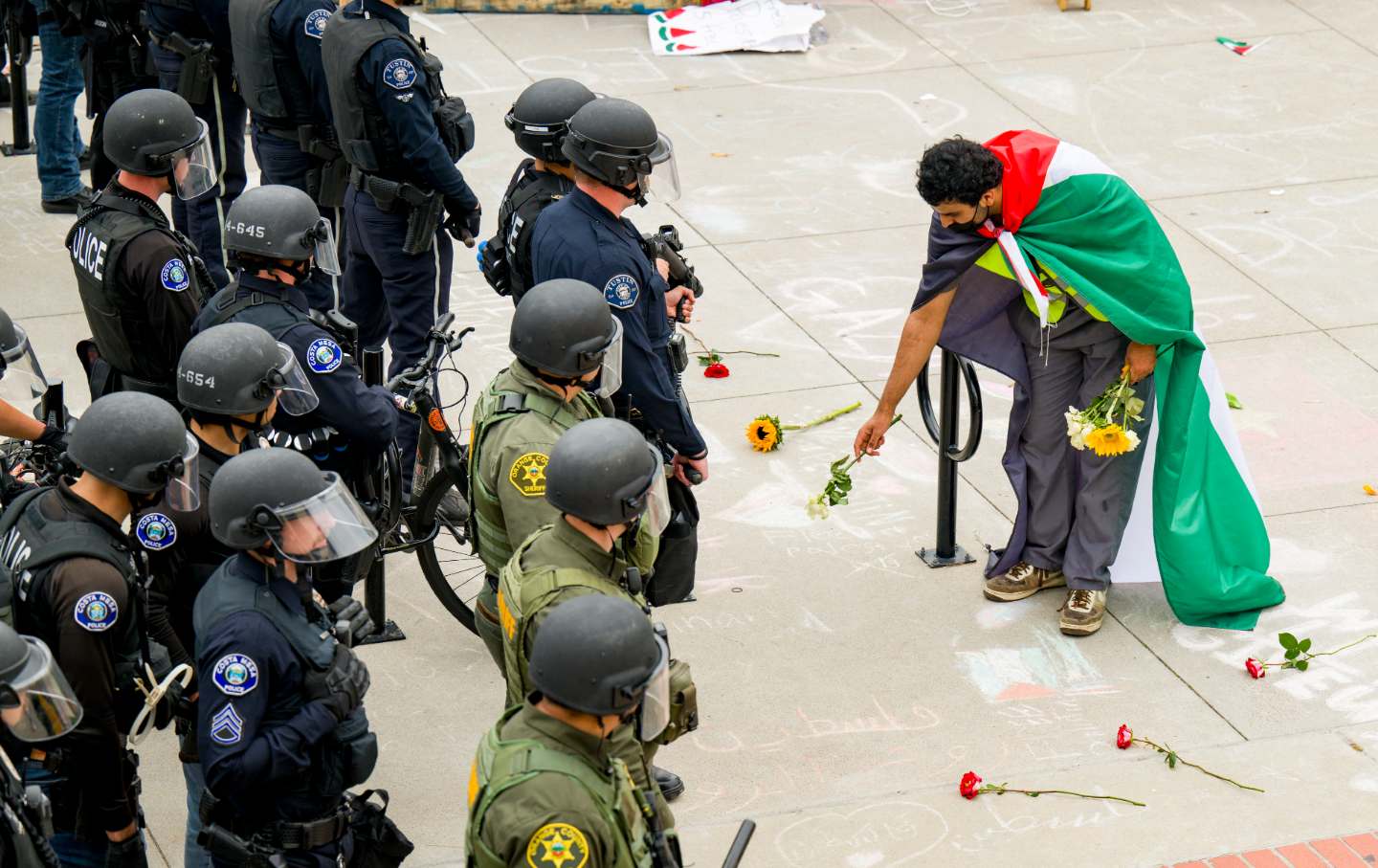
A supporter of the pro-Palestinian encampment at UC Irvine in May 2024.
(Leonard Ortiz / Getty)Academic tenure is one of American higher education’s few guarantees. It protects scholarship and teaching from political constraints and censorship, earned after years of research and training. It’s a promise. Until, for Maura Finkelstein, it wasn’t.
In September, Finkelstein was fired from Muhlenberg College after nine years of teaching for sharing an Instagram post in support of Palestine. An administrative investigation deemed her tenure insufficient to protect her job; a rare situation formerly reserved for cases of severe neglect of duty.
She says she was naïve to be surprised. “There are things that we cannot say or talk about,” Finkelstein said. “If we say or talk about these things or support our students in their investment in speaking and talking about these things, then we may be suspended. We may be fired. We may be locked out of campus, as just happened at NYU. I think people are really, really, really concerned about the future of the university in the United States.”
Before 2024, Finkelstein would have said the positive aspects of academia outweighed her fears. Now, she’s not so sure.
“This past year, I have spent most of my time wondering what on earth our jobs are and what college professors are and aren’t allowed to do, both in terms of research and in the classroom. And I’m feeling pretty pessimistic about it,” she said. “I don’t know anybody who’s not scared right now.”
Across America, professors are experiencing an overwhelming sense of disillusionment. Interviews of nearly 60 faculty by The Chronicle of Higher Education found dropping trust and increasing anger at policies and administrators after the pandemic. They’re seeing larger, more bureaucratic administrations—the president, provost, deans, associate deans, and governing board—more likely to punish students and faculty for protest activity. Even before the pro-Palestine protests and subsequent crackdown, attempts to sanction faculty surged between 2004 and 2022—from four to 145, according to the Foundation for Individual Rights and Expression.
It’s a trend in academia that Annelise Orleck, professor of history at Dartmouth College, has called the “criminalization of dissent.” Orleck has studied social protest movements as a historian nearly her entire 34-year career at Dartmouth. Last spring, she was pushed to the ground by police—called into Dartmouth by the president of the university and the board of trustees—and arrested while supporting the rights of her students to protest.
“I looked out there and I said, ‘Oh my God, this is fascism.’ And one of my colleagues said, ‘Don’t say that so loud, they’ll arrest you’ and I said, ‘They’re not gonna arrest me.’ But of course they did,” Orleck said.
The police arrested 89 campus members—including more than 60 students—who were charged for trespassing on their own campus. “[There’s] a student organization that runs hikes and goes camping in the New Hampshire wilderness. The vans that they used to take students on these trips had the logos papered over, and Dartmouth had them at the ready for police to use for mass arrests that night.”
In the months following, the Dartmouth faculty were divided on a no-confidence vote against the president. They did vote for a censure; the first presidential censure in Dartmouth’s more than 250-year history.
The school’s chapter of American Association of University Professors is fighting back against restrictions on academic speech, including a policy put in effect on December 10 forbidding departments from making public statements—even on their own websites.
Orleck has heard her colleagues say they should not have protests on campus. She’s always believed protests are part of a college education. “I would like to believe that in my long years here, there was not a time before this where colleagues would be supporting bringing in men with guns and truncheons onto our campus who assaulted students and faculty. I think this is a moment of extreme division, and I think the climate right now and this [university] president have exacerbated that.”
Timothy Burke, a history professor at Swarthmore for over 30 years, says the shift toward more corporate administrative roles and less faculty governance began decades ago. Before that, faculty performed many of the roles administrators currently manage in conversation with students—such as admissions or creating regulations. Starting in the 1980s, professional administrators started to creating regulations, acting alone as faculty felt shut out.
“There’s a thing called the ‘Red Book’ that was about a big two-day meeting between faculty and the student body from the 1960s at the height of student protest, where they canceled classes—seems unthinkable in the context of contemporary Swarthmore,” said Burke. “They had a conversation about the things that were changing in the world that a lot of students felt the faculty needed to change,” he said. “They wanted the faculty to abandon a number of the so-called parietal rules that govern student conduct, among them, specifying that premarital sex was cause for expulsion.”
Many within academia are aware of these tensions and working to change them. Robert Goldberg, Swarthmore’s vice president for finance and administration, says establishing open communication between faculty, students, and administrators is a critical component of the liberal arts experience. He cited Swarthmore initiatives including Community Conversations, to foster dialogue, and “Lunch and Learn” to help community members learn about inclusive environments.
Goldberg says college endowments and finances are often misunderstood. Many college protests over the past year have pushed for BDS divestment from Israel, which he said is complicated by the college’s diversification of assets overseen by external fund managers. “We also have to ensure that the endowment is a perpetual asset, meaning it needs to provide financial support to the college today and in the future so that the next generation of students can reap the same benefits as today’s students,” Goldberg said. “Our spending from the endowment is governed by specific rules to ensure that we maintain its buying power.… We do not invest in individual companies or stocks. Rather, we have a diversified portfolio across a number of asset classes. Those investments are overseen by about 100 different fund managers.”
At Swarthmore, the endowment’s earnings provide for about half of the annual operating budget, with the majority going toward loan-free financial aid. Additionally, Goldberg says the cost of a student’s annual education to the college is $143,000, about $60,000 more than total tuition paid; the endowment subsidizes this gap, which is why its strength is so crucial. However, Burke believes this protection of the endowment is overemphasized at educational institutions, at the cost of other values.
“It is corporate thinking, the idea that decision-making has to be fast, the decision-making has to be responsive to market conditions, in particular, the decision-making needs to put first and foremost revenue, budgetary health, etc., as the primal value. What you do is make as much money as you can, even if you’re a nonprofit,” said Burke. “Get on the firmest financial standing that you can reduce all risks, protect the endowment at all costs. But regardless, never do anything that might put the growth of the endowment at risk.”
Finkelstein believes colleges’ finances have relied more on private donations, and so have their values and decisions. Colleges share of revenue coming from donations, rather than tuition, differs across the country depending on financial and endowment standing. Swarthmore, for example, has retained a more constant ratio of donations to tuition, where gifts account for about 2 percent of revenue.
“My job is to interrogate and reveal how power operates, and that is what I have been doing for my entire career. There’s no reality in which I stopped doing that because my employer doesn’t want to alienate their donors,” Finkelstein said. “I don’t believe that I can be a trusted educator if I am not teaching my students the things that they need to know.”
Popular
“swipe left below to view more authors”Swipe →Todd Wolfson, who was elected president of American Association of University Professors (AAUP) national in the summer of 2024, thinks now is the moment to fight back. Wolfson, a professor of anthropology and media studies at Rutgers University, represents just under 10,000 unionized faculty and staff members at Rutgers, and worked on grad student campaigns while at the University of Pennsylvania. “The more I see the crisis that is consuming higher education in this country, the more I realize I want to help fight over the future of higher education.”
Wolfson wants to build additional union chapters and recruit more members. He also wants to win a national commitment to fully fund public higher education, end student debt, ensure safe and secure jobs for workers, and fight for people to understand why higher education is valuable for America’s future. He has heard from AAUP’s members about self-censoring out of fear around protest restrictions. “I think right now only right-wing provocateurs are really talking about higher education, and they’re painting a very incorrect picture of the sector,” Wolfson said. “So we need to speak on our own behalf and transform the narrative about why higher education is so important to the future of this country.”
But Burke says trust between administrators and faculty has been hard to restore as people retire and are hired frequently, and would require more than top-down policies to rebuild. “Trust is a culture problem. And culture problems are wicked problems…When you don’t have [trust] anymore, you can’t just recreate it by policy, because cultures that work well are built on complicated human relationships. They’re built on small, subtle things that you didn’t know were important until you don’t have them.”
For Burke, a start to rebuilding culture and trust is by sharing more information on administrative decision-making with faculty. Finkelstein believes transparent faculty governance is crucial; As administrators have replaced faculty in governance roles and given faculty recommendations less weight, she says the outcomes and policy have resulted in a narrowing of academic freedom.
Outside of administration, Orleck said she felt profoundly supported by her departments and, most importantly, students during her arrest. “Many people ask me that question. ‘How could you continue to work for a place that subjected you to physical violence?’” Orleck said. “I’m really committed to my students. I think we have shared a lot of very profound moments of change and community over the years, and I feel very supported by colleagues, past and present.”
Finkelstein says the only hope she’s had recently has come from the student protests. Although colleges can be elite spaces, she says they can also be the crucible for social change and political revolution. “Whenever I want to hold on to possibility, I look at what our students are doing, and I look at how they’re showing us about the world and how they’re showing us a different model,” Finkelstein said. “These encampments were the best of what higher education can be. And so, of course, college and university administrators who are invested in keeping these institutions otherwise are going to destroy them.”
Orleck thinks the situation represents a new wave of McCarthyism. The nature of student protests have not changed, she says. What has changed, as police in riot gear are called in, is the increase in violence and repression in response to protests. “I have suggested this unthinkable thing, which is that they just let students have their protest. They walk onto campus, they carry their signs, they chant, they have speeches, they go home and they study and nothing happens. It’s all peaceful…. That’s not viewed at this point as a credible suggestion, which says to me that things have changed, perhaps for a long time, and that’s chilling.”
Orleck remembers younger faculty running from rural jail to rural jail the night of May 1 during the arrests, bailing out students. Afterwards, they held teach-ins, providing what Orleck called “tremendous amounts of intellectual, academic, and emotional labor.”
“There’s no question I get depressed sometimes. I think both in terms of the neoliberal academy and the authoritarian academy, sometimes I feel like we’ve lost,” Orleck said. “But then I have conversations with students. I had an amazing term both before and after I was beaten up by the police, and the students were incredible. I think we will all remember our time together, so I’m not willing to walk away from that yet.”
Become a Sustaining Donor This September
Between the reemergence of right-wing red-baiting and Donald Trump’s use of the chilling National Security Presidential Memorandum–7 to criminalize left political organizing, we’re seeing McCarthyism reborn before our eyes.
This assault on democracy cannot be ignored or wished away. Resisting it requires bravery in the face of threats and repression, a steadfast commitment to the truth, and the unwavering belief that we can—and will—overcome this darkness.
We must have an independent media that sets the record straight, unearths corruption and abuses of power, and advances a politics of justice and dignity for all if we’re to win this fight.
That’s why I’m writing to you today. This September, The Nation needs to add 100 monthly donors to sustain our progressive journalism. Your contribution makes the next investigative report, the next truth-speaking column, and the next pathbreaking essay all possible.
I hope you’ll support our work with a recurring donation today. If you donate $10 or more a month, we’ll send you a brand new “Hands Off the Free Press!” sticker to recognise your commitment to our cause. Please, donate today.
Onward,
Katrina vanden Heuvel
Editor and Publisher, The Nation
More from The Nation
As Morale Sags, More Military Service Members Are Having a Crisis of Conscience As Morale Sags, More Military Service Members Are Having a Crisis of Conscience
According to multiple GI rights organizations, service members are inquiring in unprecedented numbers about seeking conscientious objector status.
What Remains of Riis? What Remains of Riis?
A new members’ club has revived Riis Park’s long-vacant bathhouse, reopening old questions about whom the People’s Beach is really for.

When Texas Sex Ed Falls Short, Gen Z Women Turn to Social Media When Texas Sex Ed Falls Short, Gen Z Women Turn to Social Media
A 2025 study found that 70 percent of adolescents sought reproductive health information through social media platforms.

Justice for Macklemore Justice for Macklemore
The rapper has been dumped from Ed Sheeran’s tour for saying “free Palestine.” That’s a disgrace.
We Are Living Under Roy Cohnian Logic We Are Living Under Roy Cohnian Logic
The political fixer created a career for himself as a self-promoting, ubiquitous hustler. Like Trump, he got away with it by having the right friends.

Time Has Run Out for AI Risk Deniers Time Has Run Out for AI Risk Deniers
The recent spate of reports about the technology’s destructive power underline two prime directives: Be afraid, and regulate aggressively.

