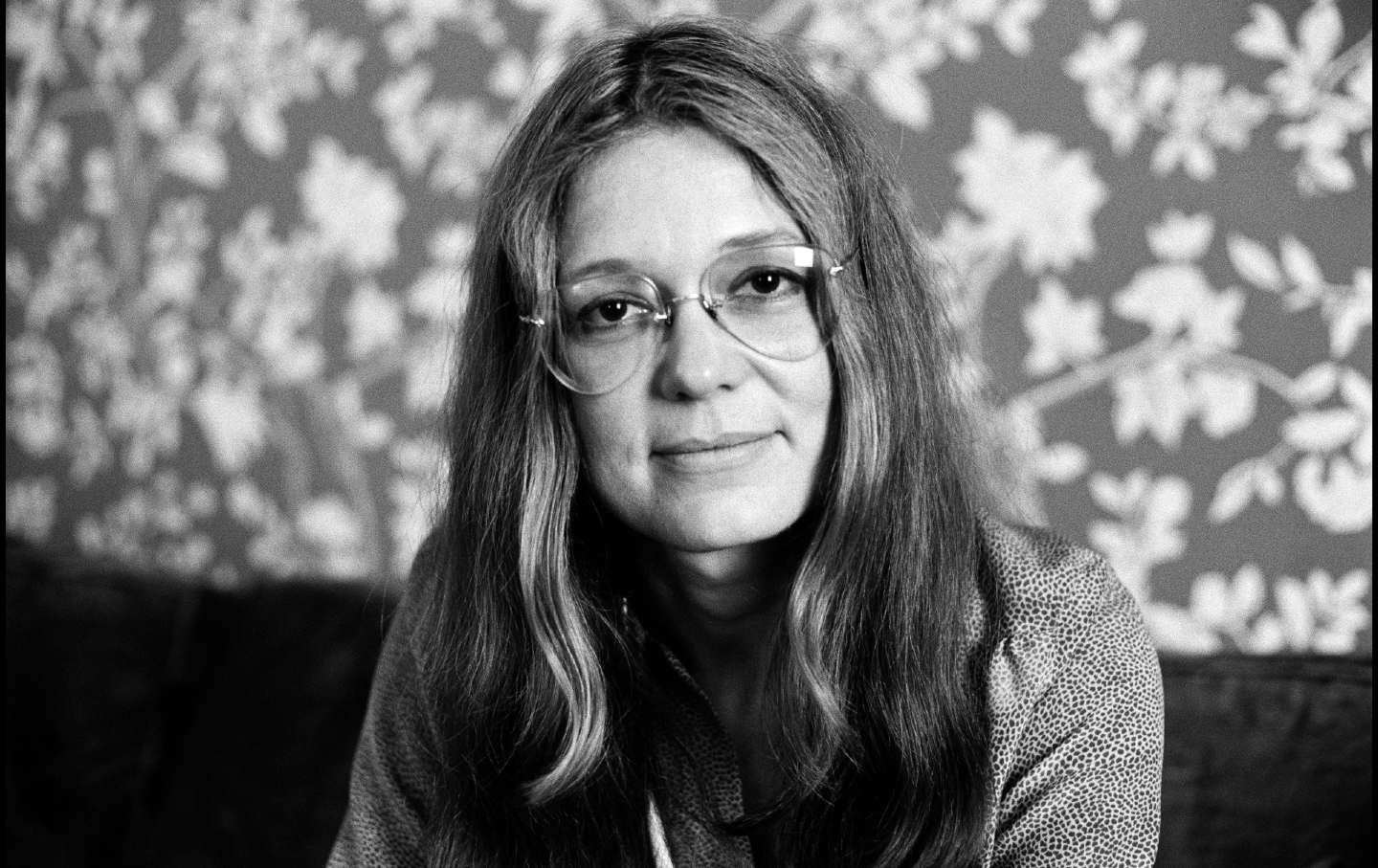
Gloria Steinem in San Francisco in November 1977.
(Janet Fries / Getty Images)It is hard to imagine the world without Gloria Steinem, who died on September 2 at the age of 92. For over half a century, she defined American feminism, much as many feminists, including herself, wished the media didn’t make one woman with long hair and aviator glasses the public face of a movement of millions. She was adored, attacked, and also envied, most famously by Betty Friedan, who accused her of diluting the movement’s focus and seeking celebrity. (Seeking celebrity? As we would say now, you say that like it’s a bad thing.) As Rebecca Traister says, she was the great popularizer. And lord knows, feminism needs to be popular.
The second wave gets a bad rap these days—dour, puritanical, essentialist, man-hating, racist—much of it undeserved. Gloria was the antidote: She was witty, fun-loving, free-spirited, warm, sexy, glamorous, and, of course, beautiful. She lived a big life—she wrote 11 books and spent years on the road as an “itinerant organizer”—and she lived it on her own terms.
Did she say some foolish things, things that haven’t aged well? Of course. Anyone who lives as much in the public eye as Gloria did is bound to misspeak unless they are a robot or a Trappist monk. The day her obituary went up at The New York Times I got a call from a reporter who was writing about Gloria’s famous gaffe on Real Time with Bill Maher in 2016. Young women, said this strong Hillary supporter, were for Bernie Sanders because “that’s where the boys are.” (Trust the media to seize on a rare sexist remark from a feminist while passing over the many much worse comments from sexist men like, for example, Bill Maher.) Here’s what she wrote to me when I e-mailed her at the time:
What I was thinking sitting there was that both young women and young men gravitate toward each other, and here, for a shared reason—Bernie makes an economic message like that of Occupy—but Bill cut me off to make a joke, with a line from the song, “Where the boys are”—I said no twice, that wasn’t what I meant, I even said, “how well do you know me?” Also I had just said that young women are very activist, mad as hell about what’s happening to them, graduating in debt but averaging a million dollars less over their life time to pay it back.
Altogether, it’s clear to me that this generation of young women are far more activist and feminist than mine was.
Don’t go on Bill Maher is the moral of that story.
Sisterhood, the idea that women, qua women, have anything in common, is out of fashion, to put it mildly. The movement sometimes seems to be devouring itself in ideological battles that are sometimes mostly covert bids for power within organizations. Yet sisterhood was Gloria’s guiding principle and the premise of her politics. She really believed that women, despite their differences of race, class, age, and so on, could work together and learn from each other to make a better fairer life for all women, and for men as well. She organized by welcoming people into the movement—feminists from all over the world, young women, activists, and writers of every age. She connected people: Back in the ’80s, when a bunch of us were sitting in the airport waiting for our flight to Dubrovnik for a conference of the newly founded Network of East-West Women (shoutout to Ann Snitow, its cofounder, tireless organizer, and guiding spirit), who should show up at the last minute but a young woman pushing a dolly holding a gift from Gloria—several boxes of books by her friend Alice Walker.
It must have been hard for Gloria to watch the Trump administration trample on women’s hard-won gains—most obviously the undoing of the constitutional right to abortion, but also the dismantling of the architecture of legal protection for women’s rights, and the general license given sexist speech and behavior over the two Trump administrations. Yet she remained hopeful. One advantage older women have right now is that they remember what life used to be like when women needed their father’s or husband’s signature to get credit, marital rape was legal, and divorce was hard to get, lesbians and unfaithful wives lost custody of their children, whole categories of work were effectively barred to women—including Steinem’s own field of journalism—and basically the whole world told women to shut up, get married, and have babies.
In her last essay, published by The New Yorker, Gloria wrote: “As I write this, the world seems in a tailspin. Many feel that all the progress we’ve made is being reversed. When you’re lucky enough to have lived a long life, as I have done, your role as an older person is to remind us how far we have come.”
Gloria never forgot what life was like before, and what the women’s movement accomplished in, historically speaking, a shockingly short period of time. We did it before, so why not again? Perhaps in the answer is the secret of her hopefulness.