From Mission Impossible to Mister Mayor
If Zohran Mamdani governs as he campaigned, he will prove that the people have the power to shape their own future.
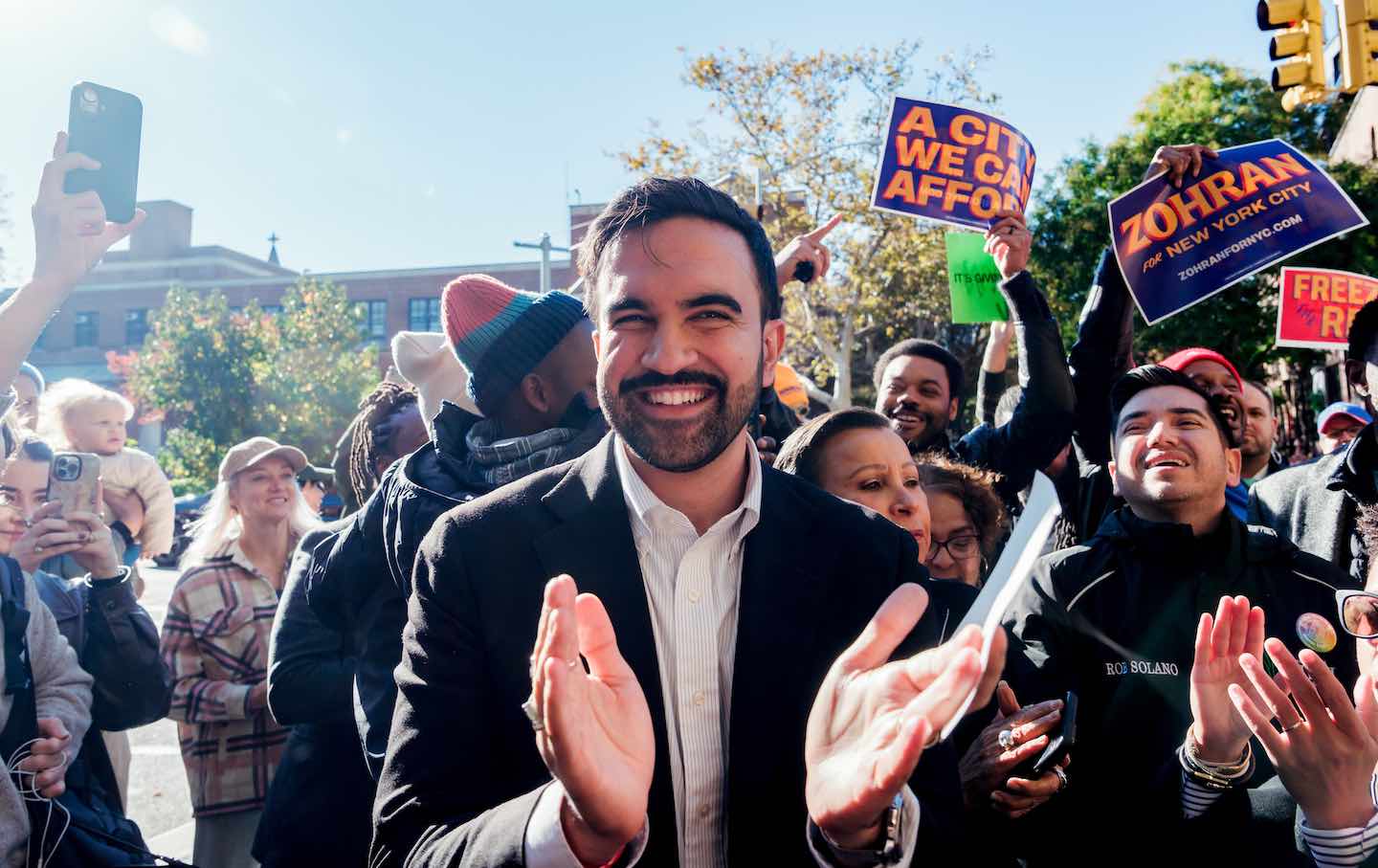
Zohran Mamdani has no higher responsibility than to be a great mayor of New York City. It is, after all, his job, now that more than one million New Yorkers have overwhelmingly elected him to the highest office of America’s largest and most dynamic municipality. Yet, as he succeeds, Mamdani has the potential to transform not just a city but the politics of a nation that desperately needs a robust antidote to Donald Trump’s oppressions. As Mamdani told The Nation after his Democratic primary win in June, “You cannot defeat this attack on democracy unless you also prove its worth.”
What took Mamdani’s candidacy from impossible to inevitable was his fundamental understanding that to prove the worth of democracy, leaders must make the lives of the people who elect them measurably better. Trump has failed miserably in this regard. But so, too, have many Democrats. One of the primary reasons the Democratic Party lost in 2024 was that its technocratic response to the affordability crisis struck Americans as lacking in both urgency and ambition. So Mamdani, a democratic socialist who takes his inspiration from Franklin Delano Roosevelt, Fiorello La Guardia, and Bernie Sanders, set a higher bar. “A life of dignity should not be reserved for a fortunate few,” he declared. “It should be one that city government guarantees for each and every New Yorker.” He coupled this vision with practical proposals for a rent freeze, fast and free buses, universal childcare, and city-owned grocery stores in food deserts. And he pledged to fund his plan by taxing the very billionaires that Trump has enriched and establishment Democrats have coddled.
Prominent pundits refused to accept the prospect that New Yorkers would elect a democratic socialist as mayor (hello, cable news commentators), as did newspaper editorial writers (hello, New York Times) and top Democrats (hello, Senate minority leader Chuck Schumer, who refused to endorse his party’s nominee for mayor of his hometown). The elites were slow to catch on to the fact that this 34-year-old Muslim immigrant from Uganda, after serving three terms in the relative obscurity of the New York State Assembly, had captured the imagination of the city’s multiracial, multiethnic electorate. Of course, Mamdani’s mastery of social media helped. He presented himself with a confidence that belied his age, a calm that countered the hysterics of his critics, and a clarity that both inspired and reassured voters. Tens of thousands of young volunteers rallied around a candidate who was comfortable speaking truth to power. When he called out the genocide in Gaza, Mamdani was attacked by the New York Post and a billionaire-funded smear campaign. Yet he won a mandate from New Yorkers who demanded moral clarity amid Republican cruelty.
Mamdani framed his year-long campaign against the failed politics of the past—as exemplified by the increasingly desperate former governor Andrew Cuomo—and around an understanding that, while democracy is surely under attack from authoritarians in Washington, “it is also under attack from the inside, [because of] the withering of the belief in its ability to deliver on any of the needs of working people.”
Mamdani’s determination to renew faith in democracy by delivering economic justice is not new: FDR made the connection with his “Economic Bill of Rights.” Sanders and Alexandria Ocasio-Cortez are doing the same with their “Fighting Oligarchy” rallies. But Mamdani’s relentless focus on putting government in the service of the working class captures the zeitgeist of 2025. So powerful is his vision that Trump pulled out every stop to derail Mamdani’s campaign: threatening to impound funding for the city, to send in federal troops, and to arrest the Democrat if he kept his promise to protect immigrants. While Mamdani relied on public funding and volunteers to carry his message, billionaire-funded political action committees directed $19 million into a bitterly divisive campaign against him.
With Mamdani’s election, the attacks from his avowed enemies in Washington and on Wall Street will only intensify. To counter them, he must surround himself with tough, experienced managers. In the face of hostile media and corporate lobbying, Mamdani’s determination to maintain his viral social media campaign will be essential to mobilizing his base, unifying New Yorkers, and keeping the pressure on cautious Democrats in Albany.
State and national Democrats have an interest in Mamdani’s success. The party ran well November 4 in races nationwide. But to win big in 2026, its leaders must abandon their feckless resistance to the big ideas that inspire voters who seek alternatives to the false promises and dark machinations of Trumpism. That doesn’t mean every Democratic nominee in 2026 must mirror every position of Mamdani’s, but they need to channel his energy and boldness.
Mamdani will take office in daunting times for his city and his country—much as La Guardia did after his election in 1933 as the radical mayor of a city of immigrants and working-class families impoverished by the Great Depression. La Guardia captured the imagination of New York and the nation, becoming a beacon of hope at a time of chaotic economics and looming fascism. Mamdani’s campaign celebrated La Guardia’s legacy. He recalled when we interviewed him that his predecessor “took on these twin crises of anti-immigrant animus and the denial of dignity to working people, and did so with an understanding of what the fruition of democracy looked like—and even what the fulfillment of life, liberty, and the pursuit of happiness looked like—understanding it in the language of the urban sphere: of more parks, more beauty, more light.”
Mamdani’s sweeping victory proves the political promise of democracy. And if he governs as he campaigned—as a courageous and deeply principled, yet always results-oriented, champion of economic justice and social uplift—he will prove, as La Guardia did before him, that the people have the power to shape their own future. This is what Trump and the billionaires truly fear, because Zohran Mamdani is right when he says, “They are the authoritarians who seek to keep us pressed beneath their thumbs, because they know that once we shake ourselves loose, we will never be held down again.”