
From Foreign Correspondent to Uber Driver
I once documented human displacement and desperation. Now, due to a crumbling media ecosystem, I am living it.
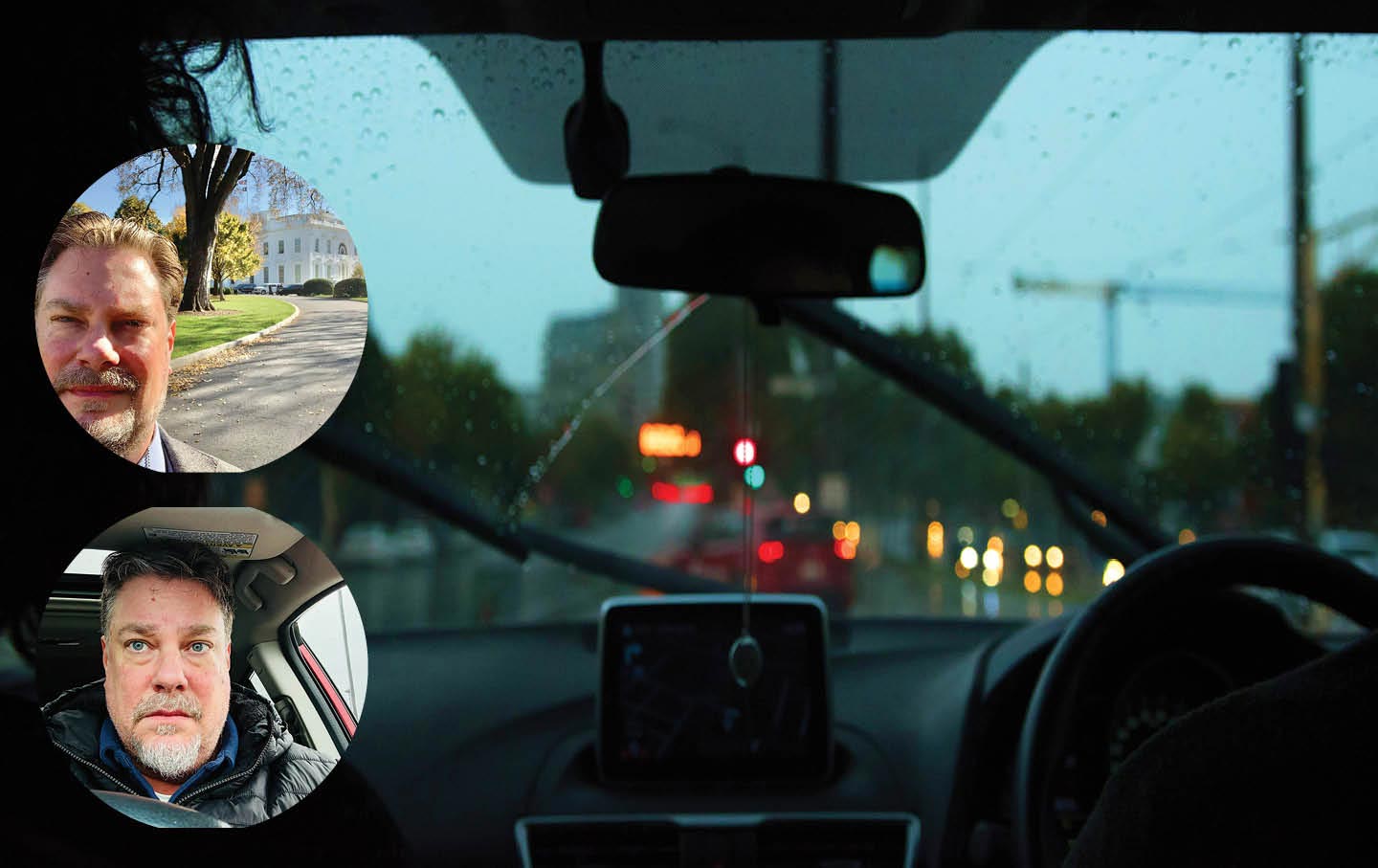
My phone beeped, alerting me to a ride. I clicked to accept, and a few minutes later I pulled up beside an older lady in a parking lot in Fairfax, Virginia, about half an hour outside Washington, DC. She exchanged a few words in Spanish with the man who was waiting with her in the early-morning darkness and then slid into the back seat of my Subaru Outback. The fare was going to earn me less than $7.
“Buenos días,” I said. She said the same to me and was chatty, unlike the people I had picked up earlier. She was born in Peru, she said, and her husband had died two years ago. He used to take her everywhere and now he was gone, so she used Uber to get to work. I dropped her at the front door of a hotel.
It was my first morning as an Uber driver, and everyone I picked up was Latino or South Asian and heading to work. My first three customers were schoolteachers. Then I dropped a young woman at a hospital and her mother at a grocery store that had yet to open. I brought a young man to a large auto mechanic’s garage, another to a Panera Bread chain restaurant, and a woman to the open back door of a strip-mall diner.
I made $130 in a little less than five hours. Since I’m 55 and have the bladder of a 3-year-old, I had to find a place to pee three times. “Welcome to Donald Trump’s America,” I muttered to myself as I whipped into a city park to take a leak behind a tree.
I didn’t know the immigration status of any of my clients. But I wondered: How is the misguided and aggressive targeting of the very people who serve us breakfast, teach our children, fix our cars, clean our hotel rooms, and comfort our sick “making America great”?
I have had a lot of questions since I returned to the United States to live and work on July 4, after having been away for 28 years. After serving as Reuters’s Ottawa bureau chief for five years, my job was eliminated in a cost-cutting drive. I wanted to stay in Canada, where I owned a home and my kids attended the local schools, but I was unable to find a new job that would allow me to. Crossing the border didn’t feel like a homecoming. America is as foreign to me today as Italy had been in 1998, when I started working there as a foreign correspondent.
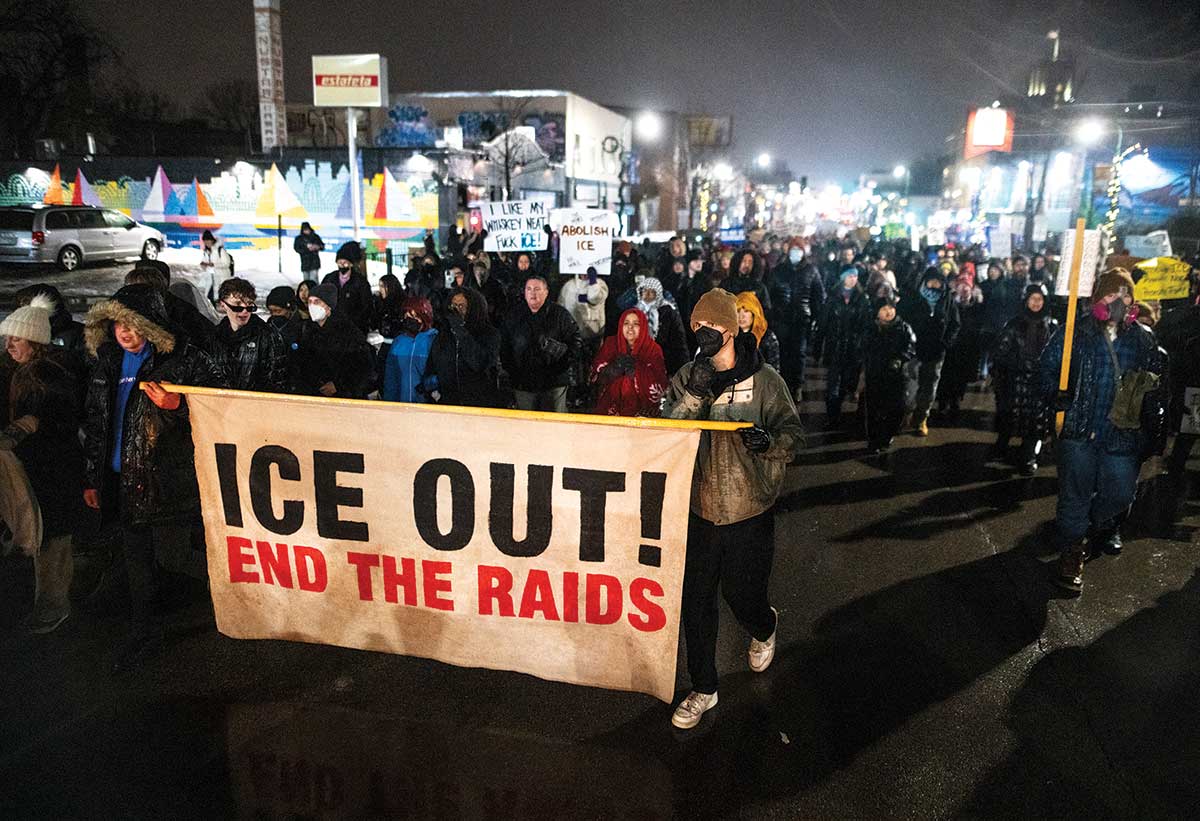
It is a darker place now. In January, a mother of three and an intensive-care nurse were shot and killed on the streets of Minneapolis as they observed the federal agents seeking to deport hardworking people who dream of making a better life for their children. Instead of bringing murder charges against the shooters, the Department of Justice brought charges against two prominent Black journalists who were covering the protests.
As a correspondent who covered politics on two continents, I have seen politicians in other countries use immigrants as scapegoats. It’s always a deadly approach, especially for the immigrants. But Trump needs scapegoats to distract from the gaping wound that is the relentless shrinking of America’s once-great middle class. That social grouping once included me. But not anymore.
In Canada, I made about $130,000 a year. In America, driving for Uber, I’m unlikely to exceed the $38,680 a year that is the federal poverty guideline for a family of five, and it takes twice that much to live comfortably in Northern Virginia.
In my previous jobs, I interviewed prime ministers and CEOs and documented humanitarian disasters for media organizations with a global reach. Now I provide a basic service, and I wait for my phone to beep.
For most of my life, my movement has given me both agency and freedom. Now, other people’s movement is a means for my survival.
I see my own fragility reflected in the people climbing into my back seat: widows, migrants, parents—workers stitching together lives on the margins. We are all improvising, all one broken transmission or missed paycheck away from something even worse. For the first time in my life, I am not observing this precarious world from the outside, notebook in hand. I am inside it, dependent on an algorithm to find me passengers and map my destinations, measuring my worth in $5 increments.
As a journalist, I depended on taxi drivers to help me do my job. When Canadian Prime Minister Justin Trudeau visited the White House in November 2021, I took an Uber to Pennsylvania Avenue. When Italian Prime Minister Silvio Berlusconi testified during his corruption trial in May 2003, I took a cab to the Milan courthouse. When I interviewed Romano Prodi ahead of Italy’s 2006 national election, in which he narrowly defeated Berlusconi, I took a cab to party headquarters.
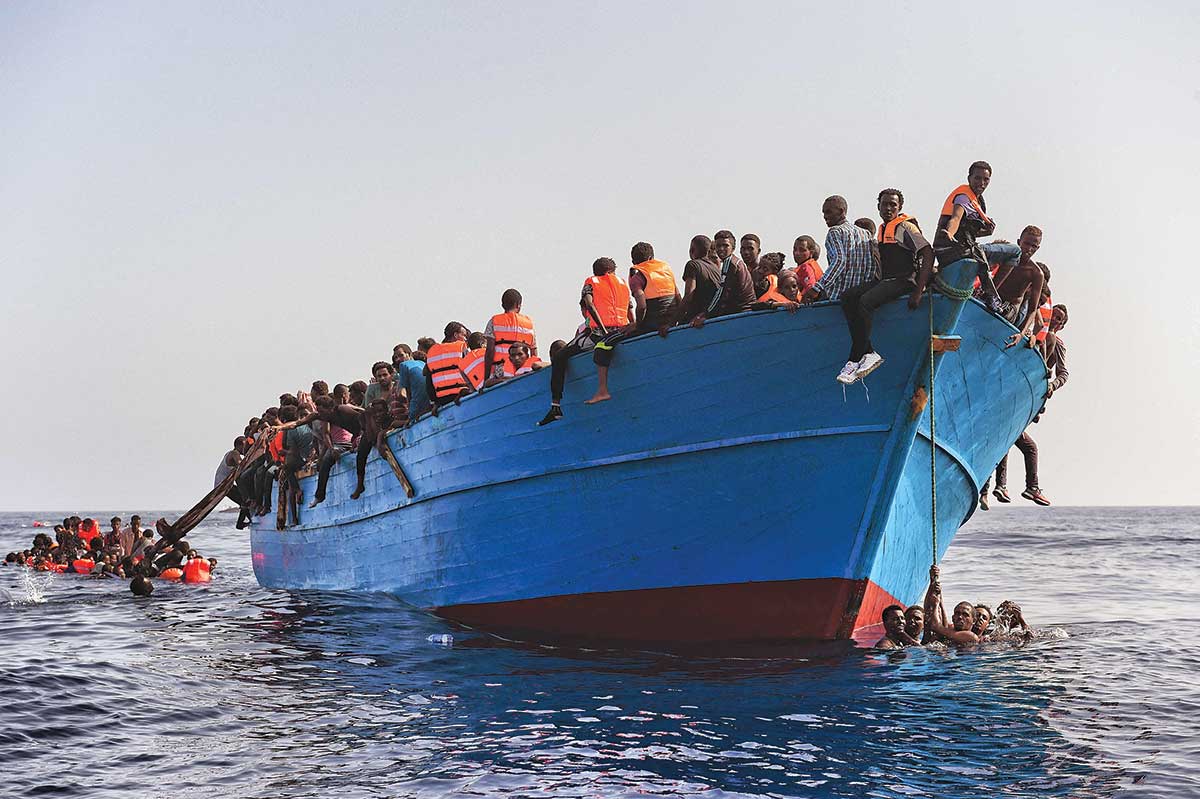
For several years, I covered the deadliest migration route in the world, across the Mediterranean Sea to Italy or Malta from the northern coast of Africa. An estimated 26,000 people have died attempting this passage since 2014—roughly half the number of Americans who died in the Vietnam War. It is also where there have been the most disappearances. Only Neptune, the Roman god of the sea, knows how many.
During the time I was documenting the contours of human displacement, I didn’t really understand what would drive a person to attempt such a dangerous journey, especially with children in tow. Now I am closer to understanding that kind of desperation.
In 2014, I sailed on the San Giorgio, a 436-foot Italian Navy vessel. The San Giorgio was part of an Italian rescue mission with the Latin name Mare Nostrum (Our Sea), which began after a shipwreck near the Italian island of Lampedusa killed more than 360 men, women, and children. The operation saved 150,000 people, but it was suspended after a year under pressure from countries including France, Germany, Britain, and the Netherlands—where most of the migrants settled after being rescued. Right-leaning, anti-immigrant parties were gaining ground.
Nongovernmental organizations took over maritime rescues after that. In 2017, I boarded the Aquarius, which was run by two NGOs. It was a busy time for sea crossings. In one morning, within sight of the Libyan coast, the Aquarius picked up 560 people in six massive rubber boats reinforced with a plywood floor. They hailed from at least a dozen countries, including Nigeria, Sudan, Morocco, and Bangladesh.
After everyone was safely out of the dinghies, the crew announced in various languages, “Libya is over.” The migrants cheered because for most of them, Libya had been hell on earth. Libya descended into chaos after Muammar Gaddafi’s ouster in 2011, allowing people smuggling to take root among the rival factions and making it a popular transit point to Europe. Migrants were often detained there for months, crowded into warehouses and given little food and water. Men were forced to work without pay. Sometimes gangs of smugglers sold migrants to other smugglers like slaves. The men were beaten and sometimes shot to death if they tried to escape. Women were raped and arrived on board the rescue ships pregnant. I know all this because I talked to them and they told me their stories, which I published.
They literally had nothing but the clothes on their backs—not even shoes. Among the children rescued was a 5-year-old girl, the age of my oldest daughter at the time. She was terrified and crying when she was lifted from the rubber boat, but she quickly relaxed on board the Aquarius, and her eyes lit up when the crew gave her fruit, snacks, and a stuffed animal to cuddle.
After the migrants had got some rest, and after they’d had time to understand that the most dangerous part of their trip was over, the lights twinkling on the Sicilian coast came into view. Pointing and shouting, they erupted into cheers and then song. Beating on drums furnished by the ship’s crew, the migrants sang and danced well into the night. As I watched the celebration, I couldn’t wipe the smile off my face.
We docked in Calabria, and I caught a flight back to Rome. As the taxi sped through the city, I couldn’t wait to see my 3-year-old twins—a boy and a girl—and my slightly older daughter. When I walked through the front door, they rushed to me. “Papa!” they shouted. I hugged them tight. I’d never felt so lucky in my life.
After Reuters transferred me to Canada in 2019, I realized a professional dream. I had become a bureau chief in a country in the G7, which is the bloc of wealthy nations that seeks a common stance on the main economic and political challenges facing the world; Italy and the United States are also members. A couple years later, I convinced my Italian wife that we should apply for permanent residency, which would give us both the right to work in Canada indefinitely. All I had was a work permit allowing me to work for my news agency.
I hired an immigration lawyer to put everything together and I waited for an invitation to apply. Canada’s immigration process is governed by a point system and is by invitation only.
A few months later, I was fired amid budget cuts in the struggling news industry. I was not alone. For the better part of a decade, as newsrooms were downsized, I received farewell e-mails from dozens of colleagues. I drafted my own such message in March of 2024. With a note of bitterness, I urged my coworkers to “take care of yourselves so that you can take care of your loved ones.… In the blink of an eye, my children grew into teenagers, and I realized I’d been ‘on call’ their entire lives.”
South of the border, in the United States, more than 10,000 journalists lost their jobs between 2022 and 2024, according to Nieman Reports. Last year, the trend continued with 2,254 cuts, according to Challenger, Gray & Christmas. Google, Facebook, YouTube, and TikTok have gobbled up the advertising dollars, and campy 30-second videos by influencers now deliver what passes for news on social media.
Trump and members of his administration regularly attack credible journalists for spreading “fake news,” undermining society’s trust in journalists and in facts—both of which are vital in a functioning democracy. Jeff Bezos, a billionaire who cut nearly half of the newsroom of The Washington Post, one of America’s most important newspapers, has put money and currying favor with Trump ahead of democracy.
At the time, losing my job slammed the door on my wishes to stay in Canada. It weakened my immigration status, and I would never be asked to apply for permanent residency. The great and kind Canada, the country where I thought I would live at least until my children were adults, had chewed me up and spit me out. I couldn’t even drive for Uber.
When I lost my job, my entire family lost access to Canada’s publicly funded healthcare coverage, and there is virtually no private health insurance there. We had no family doctor, and, God forbid, if any of us had to go to the hospital, it would have to be paid for out of pocket. Despite having good local contacts, I couldn’t find an employer willing to sponsor me. The clock was ticking on our legal right to reside in Canada. We were no longer welcome.
In June 2025, I sold my house, the first I had ever owned. Not knowing how long it would take me to find a job in Washington, I put my family on a plane in Montreal. They flew to Italy, where they could live rent-free in a family member’s home, where they’d be covered by state healthcare, and where the kids could go to high school. After I said goodbye to them, I wept uncontrollably in the airport parking lot, not knowing when I would see them again.
After a life spent both crossing borders and freely reporting on those who struggled to overcome them, I didn’t expect one to rise up beneath my feet.
Ihad left the States to teach English and work as a freelance journalist in Romania in the summer of 1997, when Bill Clinton was in the White House. Seinfeld, Friends, and ER were the most-watched TV shows. Men in Black was a summer blockbuster. The Internet barely existed and was used mainly for e-mail. Business executives had car phones, but no one I knew had a cell phone. Back then, I shared an apartment in Colorado Springs with my best friend from college, and we each paid about $300 in rent.
This past July, I moved into an Airbnb apartment in Virginia, in the basement of a town house I shared with an elderly Latina woman who spoke little English. It cost me $2,000 a month. My three decades in Romania, Italy, and Canada have so far failed to impress recruiters.
When I lost my job, I told myself, “If all else fails, I’ll drive for Uber.” Well, here I am, and it’s not as comforting as I thought it would be. I used to think I was different from the migrants I wrote about—protected by a passport, a salary, a press badge. But the past two years have stripped away that illusion.
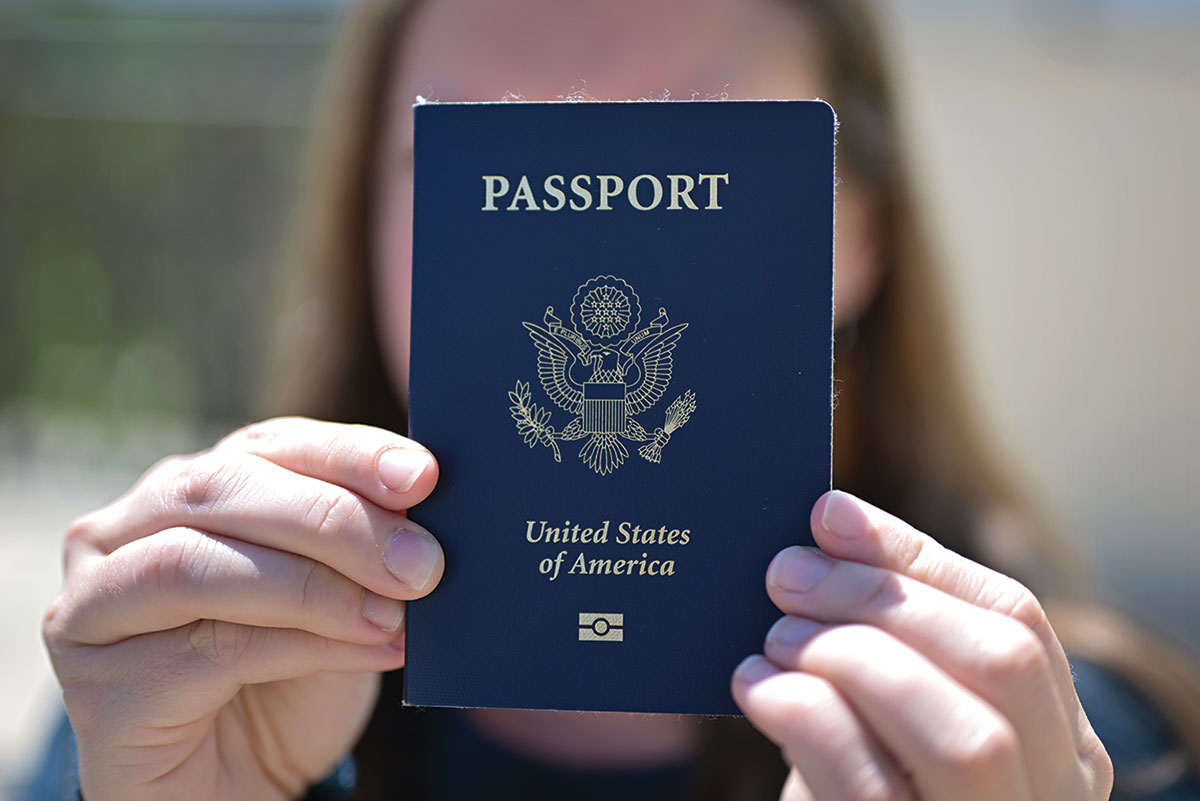
That said, I am still relatively lucky. I’m a middle-aged white guy with a US passport, so I’m not likely to be snatched off the street by ICE. I have some savings and people to lean on.
Eager to get my family back late last year, I looked for a larger rental. After two rejections, because the landlords were understandably worried that I wouldn’t be able to pay the rent, my octogenarian father cosigned a lease with me for a place in Fairfax—$3,000 a month.
My middle-class habits die hard. I still want my three teenage children to have what they desire for Christmas, even if it’s an expensive computer. I still want each of them to have their own room. I still want them to get the kind of education that in America is found mainly in middle- or high-income communities, and I’m willing to pay extra rent for it.
My wife remains in Italy, where she has healthcare and feels more secure after our disorienting departure from Canada. She also fears being deported if she were to join us in the US, something that has happened to other foreign spouses of Americans. Fortunately, my children are now here with me, attending an American high school for the first time. I feel like I’m building something in my newest city. I’m optimistic for the first time in a long time, but I also realize that optimism isn’t the same thing as security.
In the 1980s and ’90s, my teachers and mentors in high school and college in Indiana and Illinois encouraged me to be open to new cultures and languages. My favorite books then, including but certainly not limited to Jack Kerouac’s On the Road and Hermann Hesse’s Siddhartha, hinted at the knowledge and understanding that can be unlocked only by exploring the unknown.
At 15, I applied to be an exchange student and ended up spending my junior year in high school in Italy. Fully immersed in the home of a warm family, I learned the language and adapted to the culture. The self-confidence I gained from that experience was a springboard to my success as an adult. My Italian host family remains close to me. The mother has been a third grandmother to my children. Being open and not afraid of “the other” has enriched my life. But it seems to have done the opposite of making me rich.
Today in America, my international experience seems to have little value. Worse, it feels anathema to the values promoted by the ruling class, which is now empowering armed agents to prowl the streets of our cities in search of “the other” and encouraging voters to fear them.
I do not fear different cultures or languages. I’m fascinated by them. The truth is that we all have a lot in common. Most people, no matter their nationality, fall into two categories: parents who want to help their children succeed in life, and youth chasing their dreams.
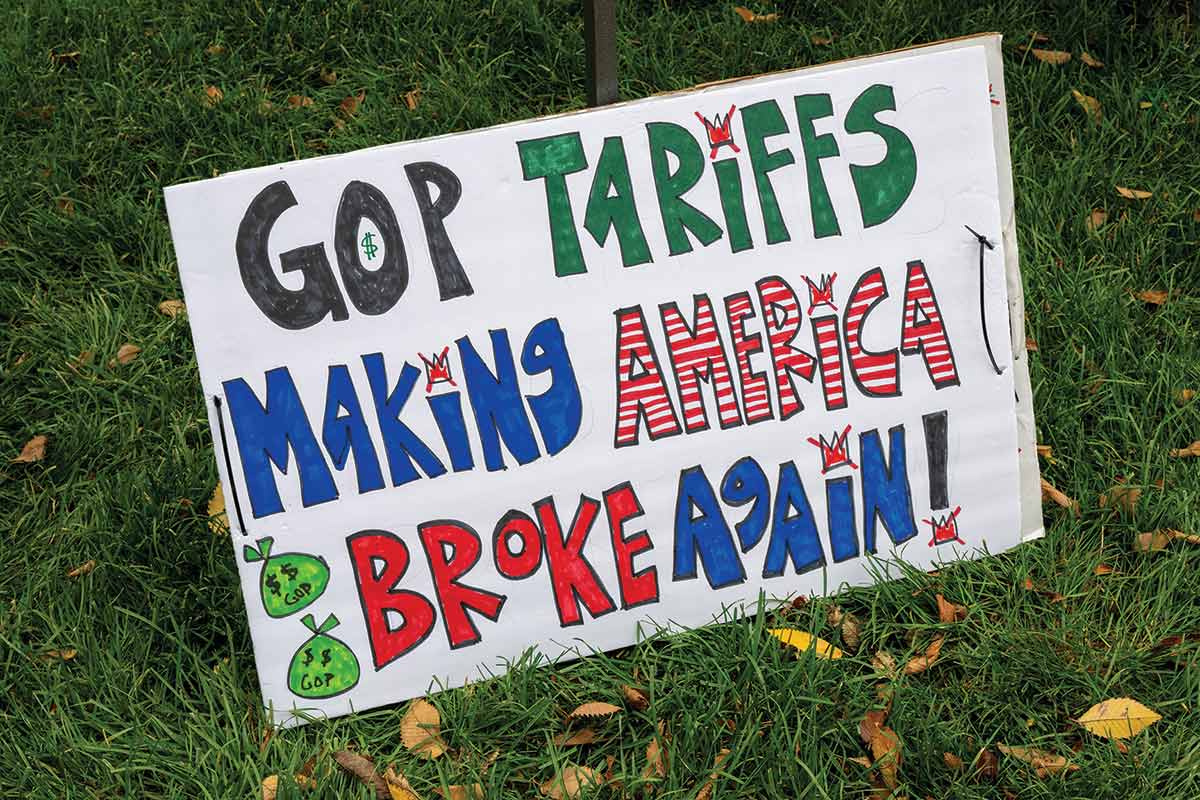
What I do fear is the economic squeeze that is coming. The job market is already a war zone. Trump’s tariffs will inevitably continue to force up prices and slow growth. Setting monetary policy from the White House will lead to disaster. The shrinking middle class is going to shrink faster. It won’t be a sudden collapse, but a drift toward it.
The people I am driving around are, like me, trying to navigate that drift. They are people who get up before dawn to feed their families. They trust me to get them to work on time. I trust an app to buy me another day. None of us has any real leverage. Like the migrants who braved the deadliest border crossing on the planet, we are all at the mercy of the sea.
Support independent journalism that does not fall in line
Even before February 28, the reasons for Donald Trump’s imploding approval rating were abundantly clear: untrammeled corruption and personal enrichment to the tune of billions of dollars during an affordability crisis, a foreign policy guided only by his own derelict sense of morality, and the deployment of a murderous campaign of occupation, detention, and deportation on American streets.
Now an undeclared, unauthorized, unpopular, and unconstitutional war of aggression against Iran has spread like wildfire through the region and into Europe. A new “forever war”—with an ever-increasing likelihood of American troops on the ground—may very well be upon us.
As we’ve seen over and over, this administration uses lies, misdirection, and attempts to flood the zone to justify its abuses of power at home and abroad. Just as Trump, Marco Rubio, and Pete Hegseth offer erratic and contradictory rationales for the attacks on Iran, the administration is also spreading the lie that the upcoming midterm elections are under threat from noncitizens on voter rolls. When these lies go unchecked, they become the basis for further authoritarian encroachment and war.
In these dark times, independent journalism is uniquely able to uncover the falsehoods that threaten our republic—and civilians around the world—and shine a bright light on the truth.
The Nation’s experienced team of writers, editors, and fact-checkers understands the scale of what we’re up against and the urgency with which we have to act. That’s why we’re publishing critical reporting and analysis of the war on Iran, ICE violence at home, new forms of voter suppression emerging in the courts, and much more.
But this journalism is possible only with your support.
This March, The Nation needs to raise $50,000 to ensure that we have the resources for reporting and analysis that sets the record straight and empowers people of conscience to organize. Will you donate today?
More from The Nation
The Underground Movement to Spark Union Organizing From the Inside The Underground Movement to Spark Union Organizing From the Inside
The labor movement is reviving the practice of “salting” to bring unions to huge new industries.

Taking Aim at Overpaid CEOs Taking Aim at Overpaid CEOs
Landmark San Francisco and Los Angeles ballot initiatives aim to hike taxes on corporations with huge gaps between CEO and worker pay.
Why Meatpacking Workers, Some Facing Deportation, Voted to Strike Why Meatpacking Workers, Some Facing Deportation, Voted to Strike
The workers at the JBS plant in Greeley, Colorado, voted overwhelmingly for a strike last month.
Why Does the Supreme Court Treat Trump Like a “Regular” President? Why Does the Supreme Court Treat Trump Like a “Regular” President?
The emperor is stark naked, but thanks to a misguided legal doctrine, the Republican justices keep insisting he’s fully clothed.

Mary K. Simkhovitch and the Dream of an Affordable New York Mary K. Simkhovitch and the Dream of an Affordable New York
A new book revisits the public housing programs of the 1930s.

The DOJ's Shameful Abuse of Power Must Be Reined In The DOJ's Shameful Abuse of Power Must Be Reined In
The weaponizing of the department to do Trump’s bidding has dangerously undermined its credibility.

